Alcohol content is more than a number on a label—it shapes how a spirit behaves in a cocktail, how it’s metabolized by the body, how it’s regulated by law, and even how it’s perceived culturally. Yet confusion persists between infused vodka and liqueur, especially among home mixologists, small-batch producers, and curious consumers. Many assume that because both are flavored and often sweetened, they occupy the same category—and therefore carry similar alcohol strength. That assumption is misleading, and sometimes legally perilous. The distinction isn’t just semantic; it hinges on precise definitions set by global alcohol authorities, production methodology, ingredient thresholds, and measurable ABV (alcohol by volume) ranges. Understanding these differences empowers better choices behind the bar, smarter purchasing decisions, and more informed conversations about responsible drinking.
What Legally Defines Each Category?
Regulatory frameworks—like those from the U.S. Alcohol and Tobacco Tax and Trade Bureau (TTB), the European Union’s Spirit Drinks Regulation (EU No 110/2008), and Canada’s Food and Drug Regulations—draw sharp lines between categories based on composition, not just flavor. These definitions directly govern labeling, taxation, distribution, and even retail classification.
Infused vodka is, first and foremost, vodka. Under TTB standards, vodka must be “neutral spirits” distilled to at least 95% ABV (190 proof), then diluted to no less than 40% ABV (80 proof) before bottling. Flavoring—whether through botanicals, fruits, herbs, or spices—must occur after distillation, and crucially, without adding sugar or other non-distillate sweeteners. If sugar is added—even in trace amounts—the product forfeits its “vodka” designation and becomes a different class entirely.
Liqueur, by contrast, is defined by its sweetness and lower base alcohol strength. The TTB defines liqueurs as “distilled spirits with added flavoring materials and/or fruit juice, and containing not less than 2.5% sugar by weight.” EU regulation is stricter: liqueurs must contain a minimum of 100 g/L of total sugars (equivalent to 10% w/w) and typically fall between 15% and 30% ABV—though some reach up to 40%. Critically, liqueurs are not required to begin as neutral spirits; many start as brandy, rum, or whiskey bases, which retain character before sweetening and flavoring.
Tip: If a bottle labeled “vanilla vodka” contains corn syrup or glycerin, it’s not legally vodka—it’s a flavored spirit or liqueur. Always check the ingredient list, not just the front label.Alcohol Content: A Comparative Breakdown
The most consequential practical difference lies in typical ABV ranges—and why those ranges exist. Below is a comparative summary of industry-standard norms across commercial and craft production:
| Category | Typical ABV Range | Legal Minimum (U.S.) | Legal Maximum (U.S.) | Why This Range Exists |
|---|---|---|---|---|
| Unflavored Vodka | 40%–50% | 40% | No federal cap (but >57.5% requires special handling) | Mandatory dilution post-distillation ensures neutrality and safety for broad consumption. |
| Infused Vodka | 35%–40% | 40% (if labeled “vodka”) | 40% (standard), up to 50% if labeled “high-proof infused spirit” | Minor ABV drop may occur during infusion (e.g., fruit water content), but must be corrected to meet 40% minimum before bottling to retain “vodka” status. |
| Liqueur | 15%–30% | No fixed minimum, but ≥2.5% sugar required | Typically capped at 35%–40% for stability and palatability | Sugar depresses alcohol volatility and increases viscosity; higher ABV destabilizes emulsions and accelerates spoilage in sugared products. |
| Herbal Bitters (e.g., Angostura) | 40%–45% | Not classified as liqueur due to low sugar & high bitterness | 45% | Technically “aromatic bitters,” not liqueurs—exempt from sugar requirements but taxed as spirits. |
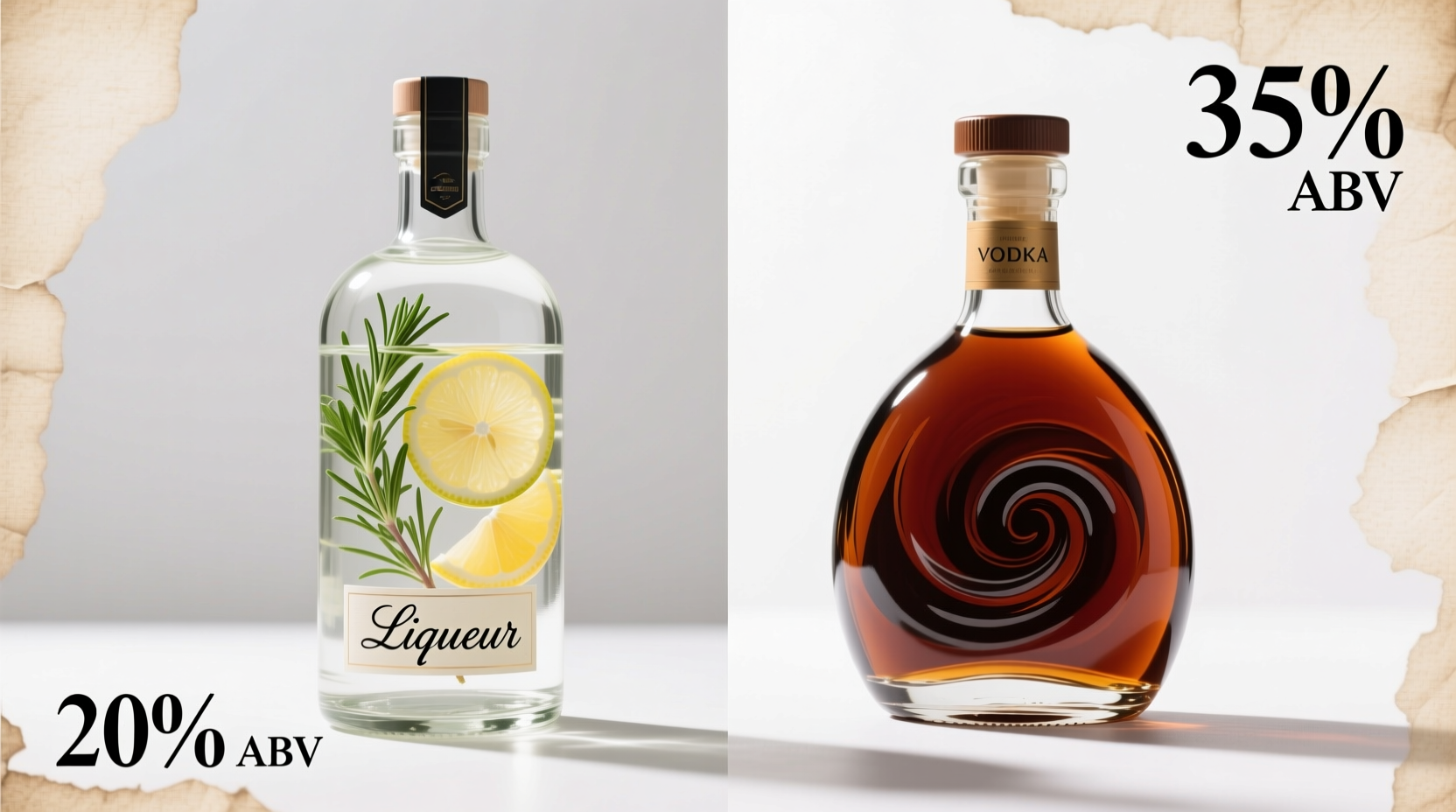
This table reveals a critical truth: infused vodkas rarely dip below 37.5% ABV in practice—not because they’re inherently stronger, but because producers adjust post-infusion to comply with the 40% legal floor. Liqueurs, however, are *designed* to sit comfortably in the 20%–25% range. That 15–20 percentage point gap isn’t incidental. It reflects divergent purposes: infused vodka delivers clean, spirited flavor with full alcoholic impact; liqueur delivers sweetness, texture, and approachability, using alcohol as a solvent and preservative—not the primary sensory driver.
How Production Method Drives Alcohol Differences
You cannot separate alcohol content from process. The way flavor enters the liquid dictates its final strength, stability, and regulatory identity.
Infused vodka production follows a strict sequence: start with high-proof neutral spirit (≥95% ABV), dilute to ~45–50% ABV, then steep botanicals or fruit for days or weeks. After filtration, the liquid is tested. If ABV has fallen below 40% (e.g., due to water leaching from fresh raspberries), the producer must either re-distill—a rare, costly step—or add neutral spirit to bring it back up. Sugar is never added at this stage; any perceived sweetness comes from natural fruit esters or aromatic compounds, not sucrose.
Liqueur production begins differently. Most start with a base spirit already at drinkable strength (e.g., 40% ABV brandy or 35% ABV rum), then add concentrated flavor extracts, citrus oils, or macerated botanicals—and crucially, substantial quantities of sugar syrup (often 20–30% by volume). This syrup dramatically lowers overall ABV. For example, blending 700 mL of 40% ABV brandy with 300 mL of 70% sugar syrup (which contains ~0% alcohol) yields 1 L of liquid at approximately 28% ABV—well within liqueur norms. The sugar also binds water molecules, slowing evaporation and oxidation, allowing longer shelf life despite lower alcohol.
“The moment you dissolve sugar into a spirit, you change its physical chemistry—not just its taste. You reduce vapor pressure, alter mouthfeel, and create an environment where certain microbes can’t thrive. That’s why a 22% ABV amaretto lasts years unrefrigerated, while a 38% ABV chili-infused vodka needs careful storage and shorter timelines.” — Dr. Lena Ruiz, Food Chemist & Beverage Stability Consultant, UC Davis Department of Viticulture and Enology
A Real-World Example: The Limoncello Misstep
In 2021, a Brooklyn-based home distiller launched “Sunset Lemon Vodka,” marketing it as a craft infused vodka made with Sorrento lemons and organic cane alcohol. Initial batches tested at 39.2% ABV—just shy of the 40% legal threshold. When customers reported cloudiness and rapid flavor degradation after four weeks, the producer investigated. Lab analysis revealed two issues: first, the lemon zest had introduced pectin and natural sugars (0.8% w/w); second, the infusion water content had diluted the spirit beyond correction without re-distillation. Rather than relabel, they reformulated—removing zest, using only cold-pressed lemon oil, and adjusting post-filter ABV to 40.5%. The new product passed TTB approval as “Lemon-Infused Vodka.” Meanwhile, their original cloudy batch—now legally classified as a liqueur—was rebranded “Limoncello-Style Spirit” and taxed at a 30% higher rate. The difference in ABV was just 0.8 percentage points. The difference in compliance, cost, and market positioning was transformative.
Practical Implications for Drinkers and Mixologists
Understanding ABV distinctions changes how you build drinks, store bottles, and assess value. Here’s what matters most in daily use:
✅ Mixing Stability & Dilution Control
- Infused vodka behaves like standard vodka in cocktails: it integrates cleanly, doesn’t curdle dairy, and resists separation. Its higher ABV means less dilution from ice melt—ideal for stirred martinis or spirit-forward sours.
- Liqueur introduces viscosity and sugar load. Shake vigorously to emulsify. Avoid pairing high-sugar liqueurs (e.g., triple sec, crème de cacao) with acidic ingredients unless balanced with sufficient spirit—otherwise, drinks become cloying or unbalanced.
✅ Shelf Life & Storage
- Unopened infused vodka: 3+ years at room temperature, away from light.
- Unopened liqueur: 2–4 years, depending on sugar and preservative content. Higher-sugar liqueurs (e.g., Galliano, 23% ABV, 35% sugar) last longest; lower-sugar herbal liqueurs (e.g., Chartreuse, 55% ABV, ~15% sugar) oxidize faster.
- Opened bottles: Infused vodka remains stable for 12–18 months. Liqueurs degrade noticeably after 6–12 months—especially cream-based or citrus-forward ones.
✅ Serving Temperature & Glassware
- Infused vodka shines chilled (0–4°C)—enhancing aromatic lift without numbing the palate.
- Liqueurs are best served slightly cooler than room temperature (12–16°C) to preserve viscosity and layered flavor release. Over-chilling thickens them excessively.
FAQ: Clarifying Common Confusions
Can infused vodka ever be lower than 40% ABV and still be called vodka?
No—not in regulated markets. The TTB, EU, and UK HMRC all require a minimum of 40% ABV for any product labeled “vodka,” regardless of infusion. If ABV falls below that during production, it must be corrected before bottling or relabeled (e.g., as “flavored spirit” or “liqueur”). Some countries allow “37.5% ABV vodka” (e.g., UK pre-Brexit), but that exception no longer applies under current GB regulations.
Why do some liqueurs taste stronger than some vodkas?
Perceived strength isn’t just about ABV. Glycerin (common in cordials), high acidity (e.g., Campari), intense bitterness (e.g., Fernet-Branca), or volatile esters (e.g., peach schnapps) trigger trigeminal nerve responses—creating a “hot” or “sharp” sensation independent of ethanol concentration. A 22% ABV Jägermeister feels more aggressive than a smooth 40% ABV citrus vodka because of its herbal complexity and glycerin content—not its alcohol level.
Is homemade fruit-infused vodka always safe to drink?
Safety depends on ABV and sanitation—not just infusion time. At ≥40% ABV, ethanol inhibits bacterial growth, including Clostridium botulinum. However, if fresh fruit introduces significant water and the final ABV drops below 30%, risk increases. Always use high-proof base spirit (≥45%), discard solids after 7 days, and refrigerate if ABV is uncertain. Never infuse low-ABV spirits (e.g., wine or beer) with fruit and expect safety.
Conclusion: Choose With Precision, Not Assumption
Calling something “infused vodka” or “liqueur” isn’t stylistic—it’s chemical, legal, and functional. That 15–20 percentage point ABV gap between typical examples isn’t trivia; it determines whether a bottle belongs behind the bar or on the dessert cart, how long it stays vibrant on your shelf, how it interacts with other ingredients, and even how your body processes it sip by sip. Whether you’re selecting a bottle for your home bar, developing a small-batch product, or simply decoding a cocktail menu, treating these categories as interchangeable risks imbalance, instability, and misalignment with your intent. Respect the numbers. Read the fine print. Taste critically—not just for flavor, but for body, warmth, and finish. And remember: precision in definition enables creativity in execution. Now that you know the real difference in alcohol content, you’re equipped not just to identify—but to innovate, educate, and elevate.
💬 Have you encountered an ABV-related mix-up in your own bar or kitchen? Share your story—including what happened, how you resolved it, and what you learned—in the comments below. Your experience could help others avoid costly confusion.








