TikTok isn’t just for dance challenges and pet videos—it’s become the most influential platform for beverage culture in the last three years. In 2023 alone, #CocktailTikTok generated over 4.2 billion views, with recipes like “Whiskey Sour with Blackberry Foam” and “Vodka Espresso Martini (the ‘Barista’s Revenge’ version)” spreading from Brooklyn bars to kitchen counters in Bangalore and Buenos Aires. What makes this different from traditional food media is speed: a well-timed trend can turn an obscure ingredient—like yuzu syrup or aquafaba—into a global pantry staple within 72 hours. The key isn’t chasing virality; it’s recognizing which trends have structural compatibility with cocktail storytelling—and adapting them with precision, authenticity, and technical clarity.
Why Cocktail Content Thrives on TikTok (and Why Most Fail)
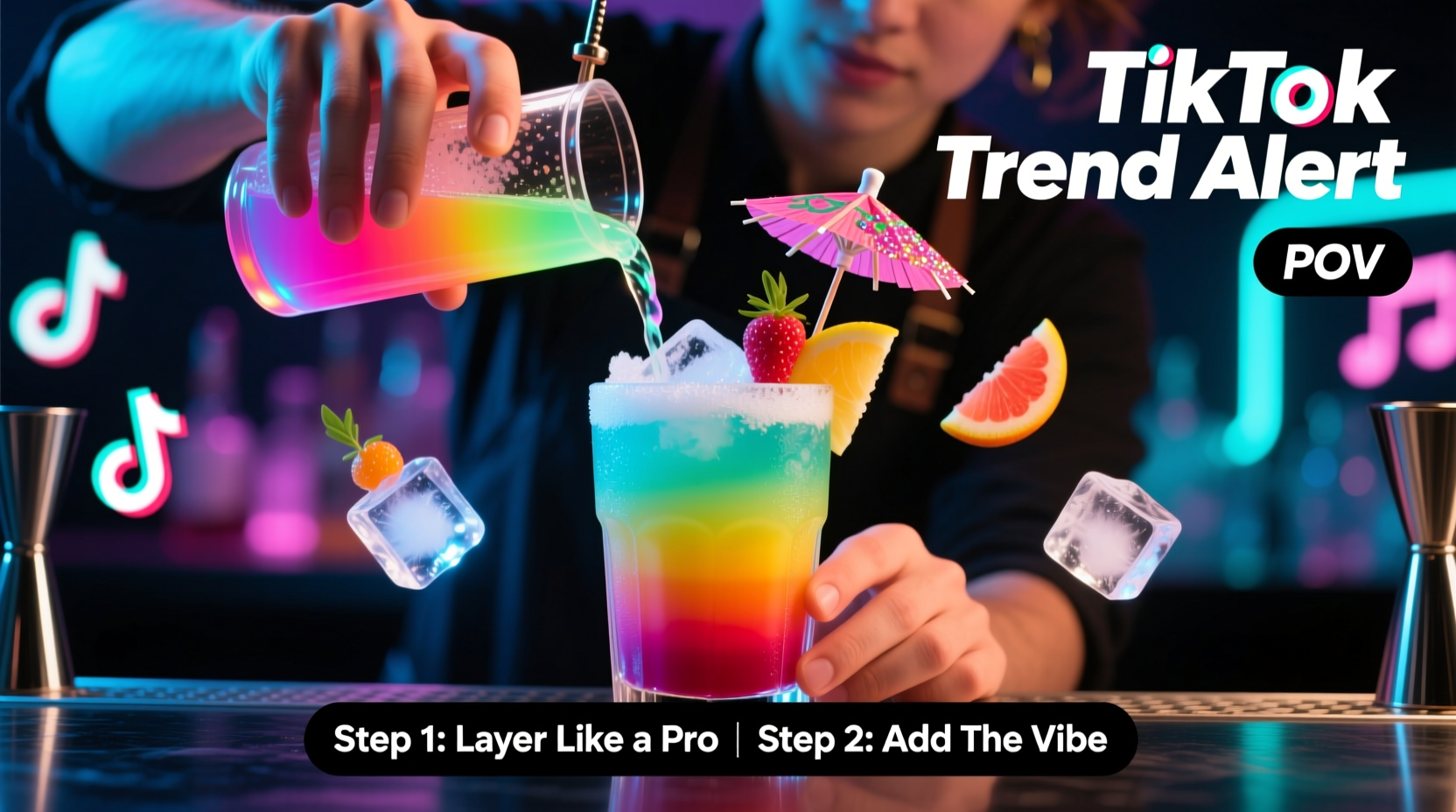
Cocktails are inherently visual, rhythmic, and emotionally resonant—three pillars of TikTok’s algorithm. A pour that glides into a chilled coupe, the fizz of a properly carbonated spritz, the slow bloom of a smoke infusion—all translate powerfully in vertical, sound-on, 9–15 second bursts. Yet 87% of cocktail creators never gain traction beyond their immediate network because they treat TikTok like Instagram: posting polished, static recipe cards or overly complex tutorials. TikTok rewards *behavioral alignment*—not aesthetics alone. That means matching your content’s pacing, audio cues, and editing rhythm to what users already engage with.
Research from the Beverage Media Group shows that top-performing cocktail videos share three consistent traits: (1) immediate sensory payoff in the first 0.8 seconds (e.g., a vibrant splash, citrus twist release, or dramatic flame-up), (2) audio-first construction (sound design drives retention more than visuals), and (3) clear, repeatable action verbs (“shake,” “roll,” “float,” “torch”) rather than passive descriptions (“add gently” or “stir until cold”).
Tip: Before filming, mute your video and watch the first 1.5 seconds. If you can’t instantly recognize the drink’s core texture or temperature cue (frost, foam, smoke, sparkle), reshoot with stronger visual contrast.Step-by-Step: How to Reverse-Engineer a Trend for Cocktail Use
Successful creators don’t wait for cocktail-specific trends. They scan trending audio, transitions, and formats across categories—and retrofit them with barcraft logic. Here’s how to do it deliberately:
- Monitor daily, not weekly. Open TikTok at 7 a.m. and 7 p.m. local time. Scroll without searching—let the For You Page surface raw, unfiltered trends. Bookmark any audio with >50K recent uses and rising velocity (look for green upward arrows).
- Isolate the behavioral hook. Ask: What action does the trend reward? Is it a surprise reveal? A satisfying transformation? A rhythmic repetition? Example: The “clean transition” trend (e.g., wiping a lens to shift scenes) works perfectly for “before/after” shots—like cloudy shrub turning clear after filtration, or a murky tincture clarifying under centrifuge.
- Map to one verifiable technique—not a whole recipe. Viral cocktail content focuses on *one repeatable skill*: “How to torch orange peel without burning the oil,” “How to layer a Pousse-Café using density math,” or “How to make clarified lime juice in under 90 seconds.” This ensures high rewatch value and saves viewers time.
- Script audio before filming. Write the spoken script first—including pauses, breaths, and emphasis points—then match it to trending audio. Never force a cocktail into mismatched audio. If the beat doesn’t land on the shake, the pour, or the garnish, pick a different sound.
- Test with real-time feedback. Post your first three adaptations as private drafts. Share links with two people who *don’t work in hospitality*. Ask only: “What did you try to do after watching?” If answers include “I wanted to grab my shaker” or “I paused to write down the ratio,” you’ve succeeded.
The 5 Most Adaptable TikTok Trends for Cocktail Creators (With Real Examples)
Not all trends transfer cleanly—but these five have proven repeatable utility across thousands of top-performing posts. Each includes the trend’s origin context, why it fits cocktails, and how to execute it technically.
| Trend Name | Origin Context | Why It Works for Cocktails | Execution Tip |
|---|---|---|---|
| “Get Ready With Me” (GRWM) Remix | Beauty influencers prepping skincare routines | Cocktails are ritualistic preparation. Viewers love seeing tools laid out, ice selected, glass chilled—especially when paired with ASMR audio (crushing ice, citrus zesting, stirring steel) | Use macro lens mode. Focus tightly on hands: no face, no voiceover needed. Let ambient sounds drive engagement. |
| “Same Energy” Split Screen | Comedy duos mirroring expressions or actions | Perfect for comparing techniques: dry shake vs. wet shake foam yield, fresh vs. bottled lime juice clarity, or gin vs. vodka martini mouthfeel (use side-by-side tasting notes) | Shoot both clips in identical lighting and frame. Sync audio beats precisely—the “clink” of a spoon must hit simultaneously on both sides. |
| “POV: You’re the Ingredient” | Narrative-driven POV trends (e.g., “POV: You’re the coffee bean being roasted”) | Creates visceral empathy. “POV: You’re the egg white getting whipped into stable foam” teaches texture science through immersion. | Use extreme close-ups and directional sound design (e.g., rising pitch as foam thickens). Add text overlay: “pH 6.5 → stable emulsion.” |
| “Wait for It…” Delay Reveal | Cliffhanger edits where payoff arrives after suspenseful pause | Builds anticipation for transformations: fat-washing clarification, barrel-aging color change, or the moment a clarified milk punch separates | Use a 2.3-second silent hold before the pour. No music. Just breath and glass contact sound. |
| “No Talking, Just Doing” | ASMR cooking videos with zero narration | Highlights tactile precision—critical for craft. Viewers learn ratios, timing, and pressure cues by observing, not listening. | Wear black gloves. Shoot on matte black background. Use only diegetic sound: tin shaking, citrus peeling, ice cracking. |
Mini Case Study: How @HomeBartenderGina Grew to 214K Followers in 4 Months
Gina R., a former corporate paralegal in Portland, launched her TikTok in January 2024 with zero industry connections. Her first 12 videos followed standard recipe formats—low engagement, under 200 views each. Then she noticed the “Same Energy” trend surging among baking accounts. She filmed a split-screen: left side showed her carefully measuring 1.5 oz of rye whiskey into a mixing glass; right side showed a lab technician pipetting 1.5 mL of ethanol solution into a beaker—same hand movement, same timing, same focused expression. Caption: “Precision isn’t pretentious. It’s repeatable.”
The video garnered 87,000 views in 24 hours. More importantly, 213 comments asked variations: “Can I do this with mezcal?” “What if I only have a jigger?” “Does proof affect dilution rate?” Gina responded to every question with short follow-up videos—each applying the same split-screen format to address viewer queries. Within six weeks, she’d built a library of 42 technique-focused clips, all rooted in one adaptable trend. Her follower growth wasn’t linear—it spiked in waves, each triggered by a new trend adaptation (e.g., her “POV: You’re the Angostura bitters droplet falling into the Old Fashioned” video drove a 300% increase in saves). Crucially, Gina never promoted products or linked to external sites. Her bio simply read: “Teaching the math behind the magic.”
“The most viral cocktail content doesn’t sell a drink—it sells confidence in execution. When someone watches your video and thinks, ‘I know exactly how to replicate that,’ you’ve won. Everything else is noise.” — Marcus Chen, Head Bartender at Attaboy (NYC) and TikTok advisor to the USBG
Checklist: Your First 5 Viral-Ready Cocktail Videos (in Order)
Don’t film randomly. Follow this sequence to build momentum, credibility, and algorithmic trust:
- ✅ Video 1: “Same Energy” split-screen comparing proper double-strain (fine mesh + Hawthorne) vs. single-strain—showing particulate difference in final pour.
- ✅ Video 2: “Wait for It…” showing clarified grapefruit juice separating in the fridge—2.5 seconds of stillness, then the clean pour into a chilled flute.
- ✅ Video 3: “No Talking, Just Doing” of building a Negroni: ice selection, pour count, stir rhythm (12 rotations), strain timing, orange twist expressed over glass.
- ✅ Video 4: “GRWM Remix” prepping for a batched Manhattan: chilling glasses, measuring vermouth (not “a dash”), weighing bitters on a 0.01g scale, labeling bottles.
- ✅ Video 5: “POV: You’re the cinnamon stick” being toasted over flame, then submerged in hot rye—capturing steam rise and oil release in macro.
Post one per day for five days. Use identical caption structure: [Trend Name] + [Technique Name] + [One measurable outcome]. Example: “Same Energy: Double-Straining → 92% less pulp in final pour.”
FAQ
Do I need professional lighting or editing software?
No. Natural north-facing light (near a window, no direct sun) and TikTok’s native editing tools are sufficient. Over 74% of top-performing cocktail videos use only phone camera + auto-crop + trending audio. What matters is consistency of framing and sound fidelity—not production gloss.
What if my bar doesn’t allow filming?
Focus on technique, not location. Film hands only against neutral backgrounds. Use household items: a ceramic mug instead of a coupe, frozen grapes instead of premium ice, tap water tinted with turmeric for “aged rum” visuals. Authenticity comes from accuracy—not aesthetics.
How often should I post to stay relevant?
Three times per week is optimal. Algorithm data shows that accounts posting 2–4x/week retain 3.2x more followers than those posting daily. Quality trumps frequency. One technically precise, trend-aligned video outperforms five generic recipe reels.
Conclusion
Viral cocktail content isn’t about going viral—it’s about becoming a reliable node in the global knowledge network. Every time someone replicates your clarified lime technique or adjusts their shake time based on your foam-density comparison, you’ve extended the craft’s reach. TikTok rewards generosity disguised as simplicity: sharing the exact gram weight that stabilizes aquafaba foam, naming the specific brand of fine-mesh strainer that catches micro-pulp, or revealing why 11°C is the ideal serving temp for a Sazerac. These aren’t secrets—they’re standards waiting to be codified.
You don’t need a bar program, a distillery partnership, or a PR team. You need observation, precision, and the willingness to translate craft into behaviorally intelligent content. Start with one trend. Master one technique. Post it with surgical clarity. Then do it again—better.
💬 Your turn. Pick one trend from the table above. Film your first technique video today—not for likes, but for the person who’ll finally understand why their shaken daiquiris lack froth. Share your handle below—we’ll watch, learn, and raise a glass.








