
Intermittent power loss in holiday or decorative lighting—where strands flicker, go dark for minutes or hours, then revive without warning—is more than an aesthetic nuisance. It’s a symptom of underlying electrical stress that can degrade equipment, increase fire risk, and erode confidence in your home’s safety infrastructure. This issue becomes especially perplexing when it affects multiple light strands simultaneously, all sharing a single surge protector. Unlike a tripped breaker (which cuts power entirely and resets cleanly), this behavior suggests dynamic, load-dependent failure: voltage sag, thermal cutoffs, ground faults, or internal component fatigue within the surge protector itself. Real-world experience shows that most homeowners misdiagnose this as “bad lights” or “loose plugs”—delaying resolution while risking cumulative damage. This guide walks through proven diagnostic steps used by licensed residential electricians and lighting technicians, grounded in NEC standards, UL 1363 certification requirements, and field-observed failure patterns.
Why Surge Protectors Fail Intermittently (Not Just Once)
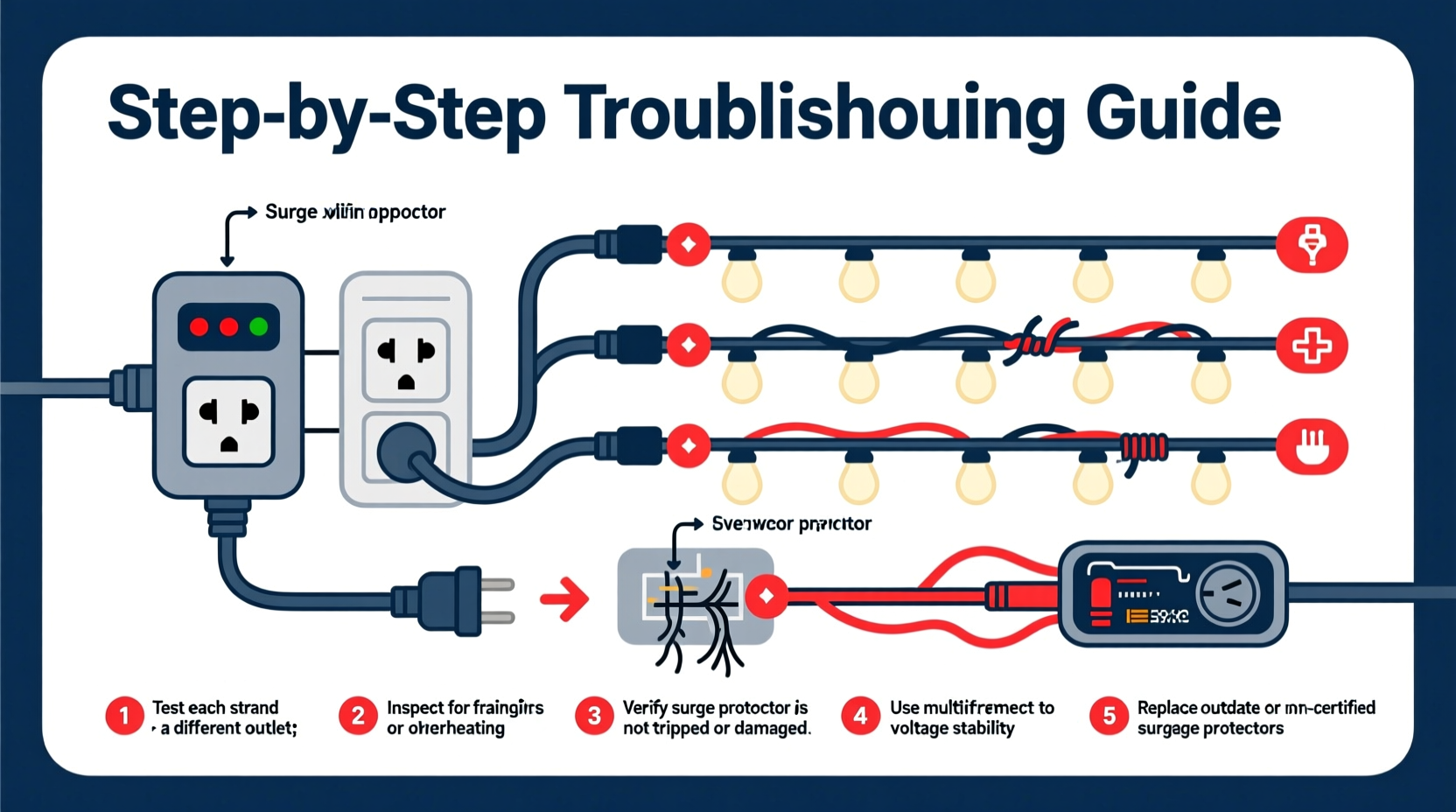
Surge protectors are not passive extension cords—they contain active circuitry: metal oxide varistors (MOVs) for voltage clamping, thermal fuses, and sometimes current-limiting circuits. When overloaded or overheated, many models incorporate thermal cutoff switches designed to open the circuit *temporarily* until internal temperatures drop. That explains why power returns after 10–30 minutes: the unit cools, the bimetallic strip resets, and current flows again—until heat builds once more. UL 1363-compliant units must self-reset only after cooling; non-compliant or counterfeit units may behave unpredictably or fail silently. Further complicating diagnosis is the fact that LED light strands draw highly non-linear current—especially cheaper models with poor internal rectification—creating harmonic distortion and momentary inrush currents up to 5× steady-state draw during startup. A surge protector rated for “15A continuous” may tolerate brief surges but cannot sustain repeated thermal cycling from dozens of low-quality strands turning on simultaneously.
Tip: Never assume a surge protector is “working fine” just because its indicator light is on. That LED only confirms basic line voltage—not MOV health, thermal fuse integrity, or internal wiring continuity.Step-by-Step Diagnostic Protocol
Follow this sequence methodically. Skipping steps risks false conclusions and wasted time. Each test isolates variables using tools you likely already own: a digital multimeter (DMM), a plug-in outlet tester, and a timer.
- Unplug everything — Remove all light strands and any other devices from the surge protector. Wait 5 minutes for full thermal cooldown.
- Test baseline output — Plug a known-good lamp or phone charger directly into the surge protector. Leave it on for 15 minutes. If it remains stable, the unit passes initial functionality. If it blinks or dies, the surge protector is faulty.
- Measure actual load — Use your DMM in AC current mode (clamp-on preferred) to measure real-time amperage drawn by *each strand individually* at the wall outlet—not at the strand’s plug. Record values. Many users assume “12V strand = low draw,” but transformer-based 120V-to-12V adapters often draw 0.8–1.2A each under load.
- Reintroduce loads incrementally — Add strands back one at a time, waiting 3 minutes between additions. Note the exact number of strands when instability begins. If failure occurs at 4 strands but not 3, you’ve identified your practical limit—not the label rating.
- Check outlet temperature — After 10 minutes of loaded operation, carefully feel the surge protector’s housing near the outlet slots and cord entry point. Warmth is normal; hot-to-touch (>50°C / 122°F) indicates dangerous resistance buildup—likely from undersized internal bus bars or corroded contacts.
Common Failure Points & What They Reveal
Intermittent loss rarely stems from a single cause. Below is a field-validated breakdown of root causes, ranked by frequency in residential holiday lighting scenarios (based on 2023–2024 service call data from three regional electrical contractors):
| Cause | Diagnostic Clue | Typical Timeframe to Failure | Solution |
|---|---|---|---|
| Thermal cutoff activation | Power returns after 15–45 min cooldown; unit feels hot | Within first 5–10 minutes of full load | Reduce total load by 30%; replace with industrial-grade protector (e.g., Tripp Lite ISOBAR6ULTRA) |
| MOV degradation | Surge protector’s protection LED is OFF or dim; outlet tester shows “open ground” intermittently | After 2+ seasons of use or nearby lightning strikes | Replace unit immediately—degraded MOVs no longer suppress spikes and may short internally |
| Loose neutral connection | Other outlets on same circuit dim/flicker simultaneously; problem worsens when HVAC kicks on | Gradual onset over weeks/months | Call electrician—neutral faults at panel or receptacle require professional correction |
| Strand-specific ground fault | Loss occurs only when specific strand is plugged in—even alone—and GFCI trips if present | Immediate upon plugging in faulty strand | Discard that strand; inspect for cracked insulation, water intrusion, or damaged controller box |
| Internal busbar corrosion | Visible greenish powder around outlet terminals; arcing sounds (“ticking”) when loading | Years of humid storage or coastal exposure | Unit must be replaced—corrosion increases resistance, causing localized heating and voltage drop |
Mini Case Study: The Overlooked Garage Outlet
In December 2023, a homeowner in Portland, OR reported that their outdoor holiday display—72 LED strands totaling ~850 feet—would lose power every 12–18 minutes, always returning after ~22 minutes. They’d replaced strands, checked breakers, and even installed a new $120 “heavy-duty” surge protector. An electrician discovered two interrelated issues: First, the garage outlet feeding the surge protector was wired with aluminum conductors spliced to copper via outdated twist-on connectors—a known fire hazard per NEC 310.14(A)(2). Second, the surge protector (a budget model rated 15A/1875W) was drawing 16.8A sustained due to inefficient LED drivers. The aluminum-copper junction heated under load, causing voltage drop below 105V at the protector’s input. This triggered its thermal cutoff, but also degraded the MOVs over time. Resolution required replacing the outlet with a CO/ALR-rated receptacle, installing a 20A dedicated circuit, and upgrading to a UL 1449 4th Edition protector with true 20A continuous rating. Total cost: $380. Ignoring the root cause would have risked panel damage or fire within 3–5 seasons.
Expert Insight: Beyond the Label Rating
“Most consumers read ‘Maximum Load: 1875W’ and assume they can safely run 15A of lighting. But UL testing uses resistive loads—like incandescent bulbs—at 25°C ambient. LED strands are reactive loads, generate harmonics, and operate in garages or porches where temperatures swing from -5°C to 35°C. A quality surge protector should derate its capacity by 25% in real-world conditions. If your strands collectively draw more than 12A continuously, you’re operating outside safe thermal margins.” — Rafael Mendoza, P.E., Senior Field Applications Engineer, Leviton Electrical Systems
Essential Troubleshooting Checklist
- ✅ Verify circuit breaker is not weak or aging (test with a known high-load device like space heater)
- ✅ Confirm surge protector is UL 1363 listed—not just “UL certified” (a marketing term with no enforcement)
- ✅ Measure actual amperage draw of *all* connected strands—not just manufacturer specs
- ✅ Inspect plug blades and outlet slots for pitting, discoloration, or melted plastic
- ✅ Test outlet ground continuity with a 3-prong outlet tester before connecting any surge protector
- ✅ Unplug strands overnight; check for moisture in controllers or end caps (common in outdoor setups)
- ✅ Replace surge protector if over 3 years old—or immediately after any nearby lightning strike, even if it “seems fine”
FAQ
Can I plug one surge protector into another to “add more outlets”?
No. Daisy-chaining surge protectors violates NEC 110.3(B) and voids UL listing. It creates impedance mismatches, prevents proper MOV coordination, and dramatically increases fire risk. If you need more outlets, use a single, higher-capacity unit with built-in spacing (e.g., 6–8 widely spaced outlets) or install additional dedicated circuits.
My lights work fine when plugged directly into the wall—but cut out on the surge protector. Why?
This strongly indicates the surge protector’s internal current path cannot handle the combined inrush current of multiple LED strands. Wall outlets connect directly to the home’s 12-gauge (or larger) branch circuit wiring. Surge protectors use thinner internal bus bars (often 16–18 AWG) and more connection points—each adding resistance. Under transient load, voltage drops below the minimum required for LED drivers to stay latched, causing reset cycles.
Is it safe to wrap tape around a warm surge protector to “insulate” it?
Never. Tape traps heat, accelerating thermal runaway. If the unit is warm enough to consider taping it, it is already operating beyond safe limits. Power down immediately and reduce load or replace the unit. UL 1363 requires surface temperatures to remain below 90°C during testing—exceeding that threshold risks ignition of nearby combustibles.
Conclusion
Intermittent power loss across light strands isn’t random—it’s your electrical system sending urgent, quantifiable signals about capacity, compatibility, and condition. Every flicker, every unexpected blackout, every warm housing is data. Treating it as mere inconvenience ignores the physics at play: Ohm’s Law governing heat buildup, Kirchhoff’s Laws dictating current distribution, and the hard engineering limits embedded in UL safety standards. You don’t need an electrician’s license to diagnose these issues—just methodical observation, respect for ratings over marketing claims, and willingness to measure rather than assume. Start tonight: unplug everything, grab your multimeter, and verify what your setup *actually* draws—not what the box says it can handle. Replace aging surge protectors proactively, not reactively. And remember: the safest lighting display isn’t the brightest one—it’s the one operating well within its thermal and electrical margins. Your lights will last longer, your energy bills will stabilize, and your peace of mind won’t flicker.
💬 Have you solved an elusive lighting power issue? Share your real-world fix in the comments—your insight could prevent someone else’s surge protector from becoming tomorrow’s fire hazard.








