
It’s a scene repeated in homes across the country: you turn your back for 90 seconds, and there your cat is—perched precariously on the top shelf of your liquor cabinet, tail flicking beside an open bottle of bourbon, paws inches from a row of glass decanters. The risk isn’t just breakage or spilled spirits—it’s ethanol toxicity, glass shards, falling objects, and the unsettling reality that cats don’t understand “off-limits” the way dogs do. Unlike obedience-based training, preventing access to the liquor shelf requires understanding feline motivation, environmental design, and consistent behavioral reinforcement—not punishment. This isn’t about breaking your cat’s spirit; it’s about redirecting instinct with empathy, precision, and patience.
Why Cats Target the Liquor Shelf (and Why It’s Dangerous)
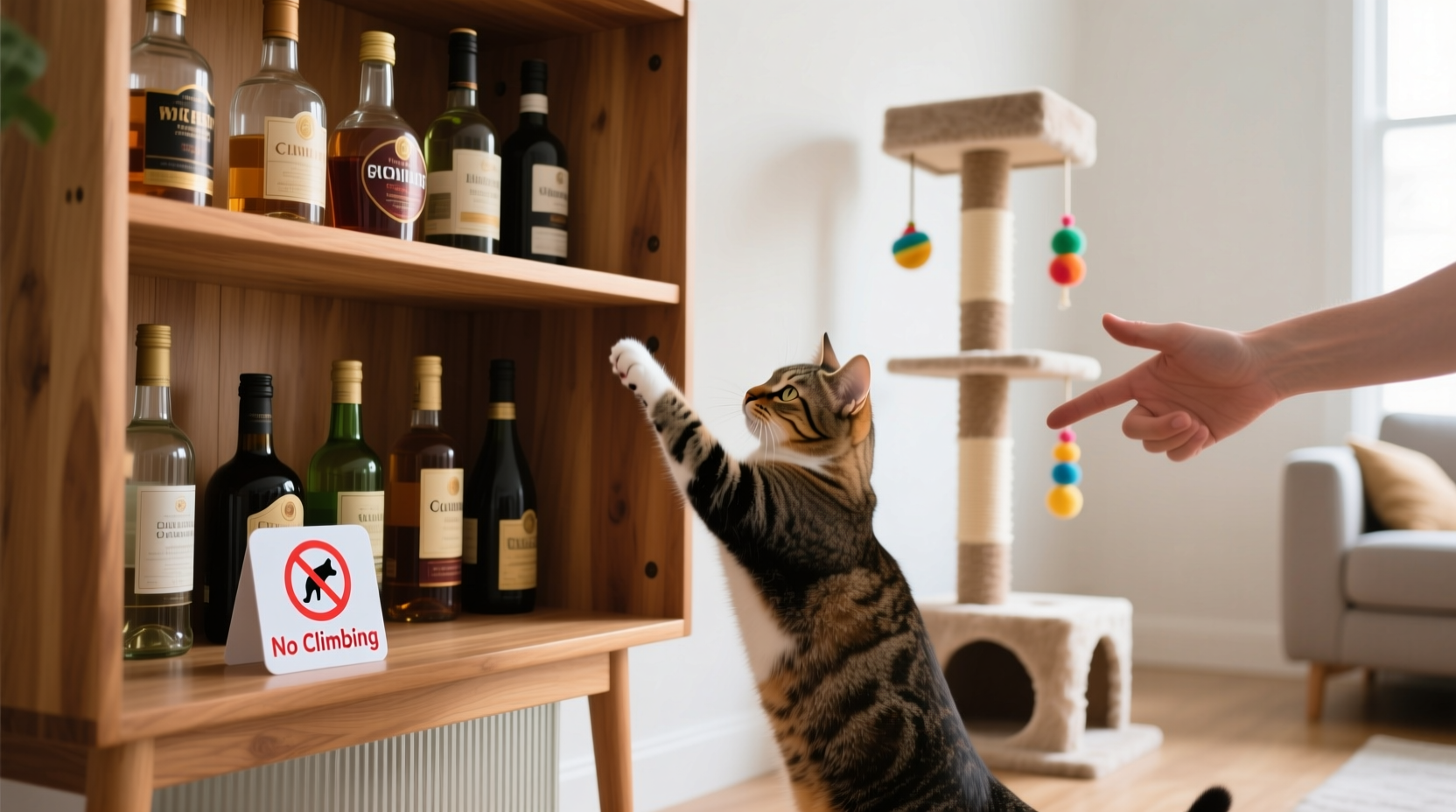
Cats climb for three core reasons: surveillance, thermoregulation, and territorial security. The liquor shelf often satisfies all three. Its height offers an unobstructed vantage point over household activity. Its surface—often wood, stone, or cool laminate—retains ambient temperature longer than carpeted floors, making it ideal for napping. And because it’s rarely used as a functional space by humans, it becomes a quiet, scent-neutral zone cats interpret as “theirs.”
But this seemingly benign behavior carries serious risks:
- Ethanol exposure: Even small amounts of spilled alcohol can cause vomiting, disorientation, respiratory depression, and coma in cats. Their livers metabolize ethanol far less efficiently than humans’.
- Glass hazards: Knocked-over bottles, shattered decanters, or broken stoppers create sharp debris that can lacerate paws or be ingested.
- Fall injuries: A misstep from a 5–6 foot shelf can result in fractures, especially in older or overweight cats.
- Chemical ingestion: Many liqueurs contain xylitol, caffeine, or essential oils—all toxic to cats. Even trace residue on a bottle rim poses danger during grooming.
Dr. Sarah Lin, DVM and feline behavior consultant at the Feline Wellness Institute, confirms:
“We see two to three ethanol toxicity cases per month linked to cats accessing open or poorly sealed alcohol containers. Prevention isn’t optional—it’s veterinary standard of care.”
Step-by-Step Environmental Management Plan
Training begins not with commands—but with architecture. Cats respond more reliably to physical boundaries than verbal correction. Follow this five-phase sequence over 10–14 days:
- Phase 1 — Audit & Secure (Day 1): Remove all bottles from the shelf. Install childproof cabinet locks on any doors or drawers below. Use double-sided tape or aluminum foil along the front edge of the shelf surface—cats dislike the texture and sound.
- Phase 2 — Block Access (Days 2–3): Place a lightweight, freestanding barrier (e.g., a 24-inch tall acrylic panel or tension-mounted shelf guard) directly in front of the shelf. Ensure it’s stable and cannot tip if nudged.
- Phase 3 — Redirect Energy (Days 4–7): Introduce a new vertical perch *within 3 feet* of the liquor shelf—such as a wall-mounted cat shelf or sturdy cat tree with a hammock. Place treats, catnip, or a favorite blanket there daily.
- Phase 4 — Reinforce Alternatives (Days 8–12): When your cat uses the new perch, offer immediate low-value praise (“good spot”) and a single freeze-dried treat. Never reward near the liquor shelf—even accidentally.
- Phase 5 — Gradual Reintroduction (Days 13–14): Once your cat consistently chooses the alternative perch for 3+ days, remove the barrier. Monitor closely for 48 hours. If climbing resumes, reinstate Phase 2 for another 3 days before retrying.
Do’s and Don’ts: A Safety-Centered Behavior Chart
| Action | Do | Don’t |
|---|---|---|
| Storage | Store all bottles in closed, latched cabinets. Keep open containers in the refrigerator or behind sealed glass doors. | Leave bottles uncapped, even briefly—even “just while pouring.” |
| Training Tools | Use clicker training paired with high-value treats (e.g., tuna flakes) to reinforce staying on approved surfaces. | Use spray bottles, loud noises, or physical shooing—it increases anxiety and may shift climbing to hidden, unsupervised locations. |
| Environmental Cues | Place motion-activated air canisters (e.g., Ssscat) *above* the liquor shelf—not on it—to deter approach without startling your cat. | Rely solely on verbal “no” or clapping—their hearing is acute, but context is lost; they’ll associate the sound with your presence, not the shelf. |
| Enrichment Strategy | Rotate puzzle feeders and interactive toys every 48 hours to reduce boredom-driven exploration. | Assume “my cat isn’t interested in alcohol”—curiosity, not thirst, drives the behavior. A cat may lick condensation off a cold bottle or bat at a swinging stopper. |
Real-World Success: The Case of Luna and the Rye Cabinet
Luna, a 4-year-old domestic shorthair in Portland, OR, had climbed onto her owner’s open-back rye cabinet weekly for 11 months. Her routine was precise: wait until her human entered the kitchen, then leap from the dining chair to the cabinet’s lower shelf, then scale upward using decorative brackets as footholds. Two near-misses occurred—one involving a cracked crystal tumbler, another where she knocked over a half-full bottle of ginger liqueur, soaking the wooden shelf.
Her owner, Maya, implemented the environmental management plan but added one critical adaptation: she installed a narrow, angled shelf (10 inches deep) directly above the liquor cabinet, anchored to wall studs. She covered it with faux-sheepskin and placed a heated cat pad underneath. Within 3 days, Luna began napping there instead. By Day 7, she’d stopped approaching the liquor cabinet entirely—even when Maya left bottles out intentionally as a test. Maya attributes success not to discipline, but to “giving her a better job to do.” Luna now spends 6–8 hours daily on her elevated perch, observing birds through the window and napping in dappled sunlight—exactly what her instincts demanded, just in a safer location.
Behavioral Reinforcement Techniques That Work (and Why Others Fail)
Cats learn through operant conditioning—specifically, positive reinforcement and negative punishment (removing something desirable to decrease behavior). Punishment—yelling, spraying water, or tapping the nose—is ineffective and counterproductive. It damages trust, increases stress-related behaviors (like inappropriate urination), and rarely connects consequence to location.
Instead, focus on these evidence-based methods:
- Clicker + Treat Pairing: Click the moment all four paws are on the approved perch, then deliver a treat within 1 second. Repeat 5x/day for 10 days. Studies show cats retain learned associations faster with auditory markers than voice alone.
- Target Training: Use a chopstick or wand toy to guide your cat’s nose toward the new perch. Reward each successful touch. This builds voluntary engagement, not fear-based avoidance.
- Passive Deterrence: Place a shallow baking sheet filled with crumpled aluminum foil on the liquor shelf. The noise and unstable surface discourage landing—but never leave it unattended for more than 4 hours, as prolonged exposure causes stress.
- Scent Substitution: Rub a cotton ball with diluted lavender oil (0.1% concentration) on the *frame* of the liquor cabinet—not the shelf itself. Cats dislike strong botanical scents, and lavender has mild calming properties that reduce exploratory drive.
Crucially, avoid “redirection frustration”: don’t lure your cat away from the shelf with treats *only after* she’s already up there. That teaches her the shelf is a reliable place to get attention—even negative attention. Instead, catch her *before* the leap: call her name calmly while holding a treat at floor level near the new perch. Reward movement toward it—not arrival.
FAQ: Addressing Common Concerns
My cat only climbs the liquor shelf when I’m cooking. Is this attention-seeking?
Not necessarily. Cooking triggers multiple feline motivators: rising heat creates thermal currents your cat follows upward; sizzling sounds mimic prey movement; and your focused attention makes the area temporarily “high-value.” Rather than assume intention, install a perch near your stove (e.g., a wall-mounted shelf beside the island) and reward calm observation from there. This satisfies curiosity without risk.
Can I use double-sided tape permanently on the shelf?
No. While effective short-term, adhesive residue builds up, attracts dust, and degrades wood finishes over time. Replace tape every 48 hours—and never use industrial-strength varieties. Safer long-term options include removable vinyl shelf liners with textured surfaces or Velcro-backed rubber mats designed for pet stairs.
What if my cat is elderly or has arthritis? Won’t climbing restrictions increase stress?
Yes—so adapt accordingly. For senior cats, prioritize ground-level enrichment: low-entry beds near windows, food puzzles placed on rugs, and gentle brushing sessions near the liquor cabinet’s base. Their motivation to climb diminishes with age, but their need for sensory input remains. Redirect energy into tactile play (feather wands dragged slowly) rather than vertical challenges.
Conclusion: Safety Is a Daily Practice, Not a One-Time Fix
Preventing your cat from climbing the liquor shelf isn’t about winning a battle of wills—it’s about honoring their nature while safeguarding their well-being. Every cat who scales that shelf is doing exactly what evolution prepared them to do: seek height, explore novelty, and claim secure territory. Your role isn’t to suppress that drive, but to channel it. With thoughtful environmental design, consistent positive reinforcement, and unwavering attention to toxicological risks, you transform a potential hazard into an opportunity for deeper connection. You’ll notice subtle shifts: fewer startled jumps when you enter the room, more relaxed naps in daylight zones, and a calmer household rhythm. Start today—not with a spray bottle, but with a measuring tape and a plan. Measure the distance between your liquor shelf and the nearest wall stud. Sketch where a new perch could go. Then take that first step: lock the cabinet, place the foil, and wait. You’ll likely find your cat already watching you from the floor—tail curled, eyes bright, ready for the next chapter of trust.
💬 Your experience matters. Have you successfully redirected your cat from a hazardous perch? Share your strategy, timeline, and what surprised you most—we’ll feature community insights in our monthly feline safety roundup.








