
Calisthenics is one of the most accessible, effective, and sustainable forms of physical training available. It uses bodyweight movements to build strength, endurance, coordination, and flexibility—without requiring any gym membership or equipment. Whether you're new to fitness or returning after a break, starting calisthenics at home is a smart, low-barrier way to transform your physique and boost overall health.
The beauty of calisthenics lies in its simplicity. You don’t need dumbbells, resistance bands, or pull-up bars to begin. All you need is your body, consistency, and a structured approach. This guide walks you through everything from foundational exercises to weekly progression, injury prevention, and motivation strategies—all without spending a dollar on gear.
Why Calisthenics Works Without Equipment
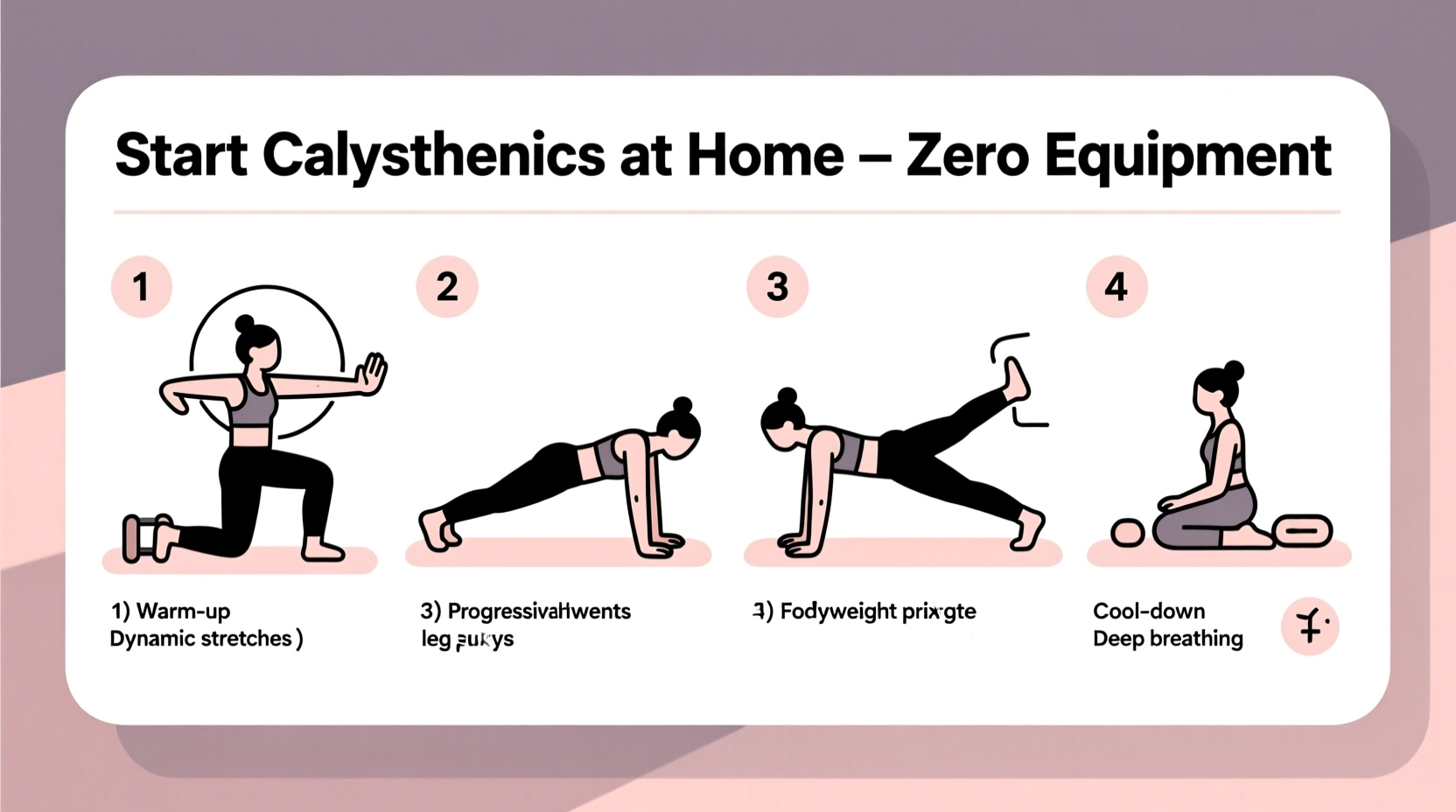
Bodyweight training has been used for centuries by athletes, soldiers, and martial artists to develop functional strength and agility. Unlike machine-based workouts that isolate muscles, calisthenics emphasizes compound movements—engaging multiple muscle groups simultaneously. This leads to better coordination, improved joint stability, and real-world strength.
Research shows that progressive bodyweight training can yield strength gains comparable to weightlifting when intensity and volume are properly managed. The key is progression: as an exercise becomes easier, you modify it to increase difficulty—through leverage, tempo, range of motion, or added reps and sets.
“Bodyweight training teaches you to control your own mass before adding external load. That’s the foundation of true strength.” — Coach Paul Wade, author of *Convict Conditioning*
Essential Bodyweight Exercises for Beginners
Starting with the right movements ensures steady progress and minimizes injury risk. These six foundational exercises target all major muscle groups and form the core of any beginner calisthenics routine.
- Wall Push-Ups – A beginner-friendly entry into upper body pushing motions. Builds chest, shoulders, and triceps strength gradually.
- Knee Push-Ups – Progression from wall push-ups. Maintains proper spine alignment while reducing load.
- Incline Rows (Under Table Rows) – Use a sturdy table or desk to perform horizontal pulls. Targets back and biceps—critical for posture balance.
- Assisted Squats – Stand in front of a chair, lower slowly until you lightly touch it, then stand up. Builds leg strength safely.
- Glute Bridges – Lie on your back, knees bent, lift hips toward the ceiling. Activates posterior chain and improves pelvic stability.
- Plank (on Knees if Needed) – Hold a straight-line position from head to knees. Develops core endurance and shoulder stability.
Your First 4-Week Calisthenics Plan
Jumping into intense workouts too soon leads to burnout or strain. This phased plan builds strength, joint resilience, and neuromuscular coordination progressively.
Week 1–2: Technique & Activation
- Frequency: 3 days per week (e.g., Monday, Wednesday, Friday)
- Sets/Reps: 2 sets of 8–10 reps per exercise
- Rest: 60 seconds between sets
- Focus: Master movement patterns, engage correct muscles, avoid rushing
Week 3–4: Build Volume & Stability
- Frequency: 3–4 days per week
- Sets/Reps: 3 sets of 10–12 reps; add 1 set of planks (20–30 seconds)
- Rest: 45–60 seconds between sets
- Focus: Increase time under tension, improve breathing control
| Exercise | Week 1–2 | Week 3–4 |
|---|---|---|
| Wall Push-Ups | 2x10 | 3x12 |
| Knee Push-Ups | 2x8 | 3x10 |
| Incline Rows | 2x10 | 3x12 |
| Assisted Squats | 2x10 | 3x15 |
| Glute Bridges | 2x12 | 3x15 |
| Plank | 2x15 sec | 3x30 sec |
After Week 4, reassess. Can you do 15 clean knee push-ups? 20 squats with full depth? If yes, you’re ready to advance.
Progressive Overload Without Weights
Progressive overload—the gradual increase of stress on the body—is essential for growth. In calisthenics, this doesn’t mean lifting heavier weights but manipulating variables like leverage, tempo, volume, and range of motion.
- Leverage: Shift your center of gravity to make moves harder. Example: Elevate feet during knee push-ups to increase upper-body load.
- Tempo: Slow down the eccentric (lowering) phase. Try 3 seconds down, 1 second up in squats to deepen muscle engagement.
- Range of Motion: Go deeper in movements. Full-depth squats activate more glutes than partial ones.
- Volume: Add sets or reps. Going from 3x10 to 4x12 increases total workload.
- Frequency: Train a movement pattern 4–5 times per week with lighter loads to build skill and endurance.
Example progression path for push-ups:
- Wall Push-Ups → 2x10
- Knee Push-Ups → 3x12
- Elevated Feet Knee Push-Ups → 3x10
- Full Push-Ups (on toes) → 3x8
- Slow Eccentric Push-Ups (3 sec down) → 3x6
Common Mistakes to Avoid
Even with no equipment, poor technique can lead to strain or stalled progress. Watch out for these common pitfalls:
| Mistake | Why It’s Bad | How to Fix |
|---|---|---|
| Rushing through reps | Reduces muscle activation, increases injury risk | Use a metronome or count: “Two-one, two-one” per rep |
| Holding breath | Increases blood pressure, limits endurance | Exhale on exertion (pushing up), inhale on lowering |
| Skipping warm-up | Stiff joints, higher chance of strains | Do 5 minutes of dynamic movement: arm circles, leg swings, torso twists |
| Training daily without rest | Muscles grow during recovery, not workout | Take at least 1 full rest day between sessions |
| Comparing to advanced routines | Leads to frustration and improper scaling | Respect your level. Mastery beats mimicry. |
Real Progress: A Mini Case Study
Jamal, 34, had never exercised regularly. Working long hours in IT, he struggled with low energy and back pain. With no budget for a gym and no space for equipment, he started calisthenics at home using this exact beginner protocol.
First two weeks: Focused on form. Wall push-ups felt hard. Plank lasted only 12 seconds. But he showed up three times a week.
By Week 5: Transitioned to full knee push-ups, 3 sets of 12. Squats became deeper and smoother. His morning stiffness decreased significantly.
At 12 weeks: Achieved his first unassisted push-up. Added single-leg glute bridges and longer planks. Lost 7 pounds of fat, gained visible muscle definition, and reported better sleep and focus.
His secret? Consistency, not intensity. He never missed two sessions in a row, even when doing just half the workout on tired days.
“You don’t need perfect conditions to get results. You need commitment to show up and move, even when motivation fades.” — Dr. Lena Torres, Sports Physiologist
Checklist: Starting Calisthenics at Home (Zero Equipment)
- ✅ Choose a consistent time and space (even 10 sq ft works)
- ✅ Wear comfortable clothing and non-slip socks or bare feet
- ✅ Warm up for 5 minutes before every session
- ✅ Start with wall push-ups, incline rows, assisted squats, glute bridges, and plank
- ✅ Train 3 times per week with at least one rest day in between
- ✅ Track your reps and sets weekly
- ✅ Prioritize slow, controlled movements over speed
- ✅ Reassess progress every 4 weeks and adjust difficulty
Frequently Asked Questions
Can I build muscle with calisthenics at home?
Yes, provided you apply progressive overload. Muscle growth depends on mechanical tension, metabolic stress, and muscle damage—all achievable through increased difficulty, volume, and time under tension in bodyweight exercises.
What if I can’t do a single push-up yet?
Start with wall push-ups. They use the same mechanics but reduce bodyweight load significantly. Most beginners transition to knee push-ups within 2–3 weeks with consistent practice.
How long until I see results?
Noticeable improvements in strength and posture often appear within 4–6 weeks. Visible muscle tone and fat loss typically take 8–12 weeks, depending on diet, sleep, and consistency. Focus on performance gains—like holding a longer plank or doing more reps—as early indicators of progress.
Conclusion: Your Journey Begins Now
You already have everything you need to start calisthenics at home. No equipment. No excuses. Just your body and the willingness to move with purpose. The first few sessions might feel awkward or tiring, but that’s part of the process. Each rep builds not just muscle, but discipline, confidence, and resilience.
Forget about perfection. Focus on showing up, moving well, and progressing steadily. In three months, you could go from struggling with wall push-ups to performing full push-ups, deep squats, and minute-long planks—all in the comfort of your living space.
🚀 Start today. Do five wall push-ups, ten glute bridges, and hold a 15-second plank. That’s your first workout. Come back tomorrow and do it again. Small actions, repeated consistently, create lasting change.








