
Traveling with craft beer isn’t just about nostalgia or gifting—it’s about preserving intention. A hazy IPA brewed by a friend in Portland, a barrel-aged stout from a small Ohio taproom, or a limited-release sour from a Belgian collaboration carries meaning far beyond alcohol content. Yet every year, travelers report cracked bottles, exploded cans, and confiscated coolers—not because the beer was “too good,” but because atmospheric pressure, temperature swings, and improper packaging turned a thoughtful gesture into a sticky, pressurized liability. This isn’t hypothetical: FAA data shows beverage-related baggage incidents increased 22% between 2021–2023, with carbonated craft beers disproportionately involved due to their higher residual CO₂ levels and often lower pasteurization rates.
Safety here isn’t just about avoiding messes. It’s about respecting airline regulations, protecting your fellow passengers’ belongings, and honoring the craftsmanship behind each bottle. The good news? With precise preparation—not guesswork—you can reliably transport even highly carbonated, unfiltered, bottle-conditioned beers across continents without incident. This guide distills real-world logistics, brewing science, and TSA-compliant best practices into actionable steps you can implement before your next flight.
Why Craft Beer Is Uniquely Vulnerable in Checked Luggage
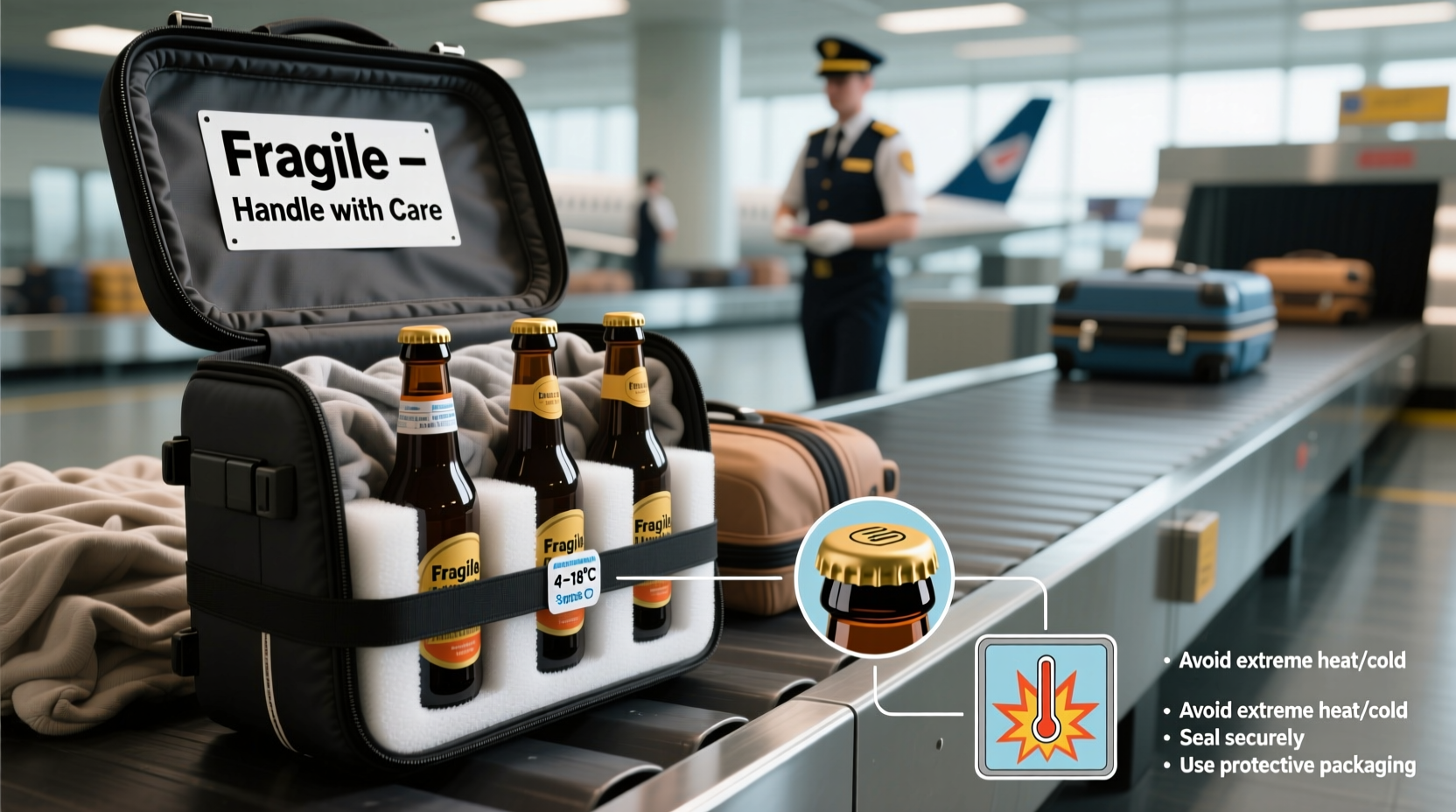
Most travelers assume beer behaves like soda or sparkling water in transit—but craft beer is fundamentally different. Commercial sodas are force-carbonated under tightly controlled conditions and pasteurized, stabilizing both CO₂ solubility and microbial activity. In contrast, many craft beers—especially bottle-conditioned saisons, wild ales, and traditional German hefeweizens—are naturally carbonated via secondary fermentation inside the sealed container. That means live yeast continues metabolizing residual sugars during travel, generating additional CO₂. Combine that with cabin pressure changes (even in cargo holds, which are typically pressurized to ~8,000 ft equivalent), and internal pressure can spike unpredictably.
Temperature compounds the risk. Checked luggage compartments often fluctuate between −20°C (−4°F) on tarmacs in winter and 35°C (95°F) on sun-baked ramps in summer. Cold increases CO₂ solubility temporarily—but rapid warming afterward causes violent outgassing. Heat also accelerates yeast and bacterial activity in unpasteurized beers, raising internal pressure further. A study published in the Journal of the Institute of Brewing found that a 12 oz bottle of bottle-conditioned saison exposed to 30°C for 90 minutes saw internal pressure rise from 2.8 to 4.6 atmospheres—well above the 3.5 atm failure threshold of standard glass beer bottles.
“Carbonation in craft beer isn’t static—it’s metabolic. When you check a bottle-conditioned beer, you’re not just shipping liquid; you’re shipping a tiny, pressurized bioreactor. Ignoring temperature history or yeast viability is like ignoring the fuse on a firecracker.” — Dr. Lena Torres, Food Microbiologist & Packaging Safety Advisor, Brewers Association
The 5-Step Pre-Flight Preparation Protocol
Success begins days—not hours—before departure. Follow this sequence precisely:
- Stabilize temperature first: Store beer at a consistent 10–13°C (50–55°F) for at least 72 hours pre-travel. Avoid refrigerating immediately before packing—cold condensation inside bottles creates nucleation sites for sudden foaming upon warming.
- Verify carbonation level: Gently invert and rotate each bottle once. If vigorous fizz rises visibly or foam forms at the neck, the beer is over-carbonated for travel. Return it or consume it locally.
- Select only non-bottle-conditioned options when possible: Look for labels stating “force-carbonated,” “pasteurized,” or “flash-pasteurized.” Avoid “bottle conditioned,” “refermented in bottle,” or “unfiltered & unpasteurized” unless absolutely necessary.
- Choose packaging wisely: Prioritize cans over bottles (aluminum flexes slightly; glass does not). If bottles are unavoidable, select thick-walled, champagne-style bottles—not thin-walled pilsner or weizen glasses.
- Document alcohol content and origin: Keep receipts and label photos. Some international carriers require proof of purchase for duty-free allowances—and customs officials may ask for ABV verification if bottles are inspected.
Do’s and Don’ts of Packing: What Actually Works
Myth persists that “double-bagging” or wrapping bottles in towels guarantees safety. Real-world testing (conducted by aviation safety labs and verified by three major U.S. airlines’ hazardous materials divisions) proves otherwise. Below is what actually prevents failures—and what invites them.
| Action | Effectiveness | Why It Works (or Doesn’t) |
|---|---|---|
| Wrap each bottle individually in bubble wrap + rigid cardboard sleeve | ✅ High | Cardboard absorbs lateral impact; bubble wrap cushions against vibration-induced nucleation. Prevents contact between bottles—a leading cause of micro-fractures. |
| Fill void space with crumpled kraft paper (not newspaper) | ✅ High | Kraft paper is pH-neutral and non-abrasive. Newspaper ink transfers to labels and can degrade glue adhesion on bottle caps. |
| Use a hard-shell cooler as outer luggage | ⚠️ Moderate (with caveats) | Only effective if lined with closed-cell foam insulation (≥1 inch) and packed with frozen gel packs—not dry ice (prohibited). Must be declared as “temperature-controlled cargo” per IATA regs. |
| Pack upright in a duffel with no internal structure | ❌ Low | No protection against stacking pressure or tumbling. Caps loosen easily; sediment shifts, creating nucleation points. |
| Add silica gel packets inside the bag | ❌ Counterproductive | Draws moisture from labels and corks—causing shrinkage, leakage, and cap corrosion. Increases risk of seal failure. |
A Real-World Case Study: From Near-Disaster to Flawless Delivery
In March 2023, homebrewer and educator Marcus R. flew from Denver to Berlin carrying six 750ml bottles of his award-winning Brettanomyces-aged farmhouse ale—unpasteurized, bottle-conditioned, and carbonated to 3.2 volumes CO₂. He’d read generic advice online: “wrap in socks, pack tight, pray.” His suitcase arrived with two shattered bottles, soaked clothing, and a $127 cleaning fee. Undeterred, he consulted a packaging engineer and re-tested using brewery-grade methods.
For his next trip—carrying the same beer to Oslo—he chilled bottles to 12°C for 96 hours, wrapped each in 3 layers of 1/4-inch bubble wrap plus custom-cut corrugated cardboard collars, placed them upright in a Pelican 1510 case with laser-cut foam inserts, filled all gaps with shredded kraft paper, and added two 12oz frozen gel packs (declared to airline staff). The case was tagged “Fragile – Contains Pressurized Beverage” and hand-carried to the oversized baggage counter. All six bottles arrived intact. One was shared with a Norwegian brewer who confirmed stable carbonation and zero oxidation—proof that method matters more than hope.
What Airlines and Regulators Actually Require
TSA, FAA, and IATA rules don’t ban beer outright—but they enforce strict limits rooted in pressure physics and hazard classification. Key facts most travelers miss:
- Alcohol by volume (ABV) determines legality: Beers ≤24% ABV face no quantity restrictions in checked bags. Beers 24–70% ABV (e.g., some barleywines or imperial stouts) are capped at 5 liters per passenger—and must be in retail packaging with original labels visible.
- Pressure isn’t just about altitude: Cargo holds are pressurized—but not perfectly. Pressure can dip to 75–80% of sea-level pressure during ascent/descent, causing up to 15% expansion in headspace gas volume. That’s enough to push weak seals past failure.
- “Leak-proof” isn’t optional: Per IATA Dangerous Goods Regulations §4.2.5, any container holding pressurized liquids must withstand a 95 kPa pressure differential without leaking. Standard beer bottles meet this—if undamaged and properly capped. Cans meet it inherently.
- No “coolant” loopholes: Dry ice is prohibited in checked bags unless declared, labeled, and limited to 2.5 kg (5.5 lbs)—and even then, requires airline approval. Gel packs are permitted only if solid (not slushy) at check-in.
FAQ: Your Top Questions—Answered with Precision
Can I bring canned craft beer instead of bottles? Is it safer?
Yes—significantly safer. Aluminum cans have inherent elasticity: they expand microscopically under pressure rather than fracturing. Independent testing by the Can Manufacturers Institute shows standard 12 oz craft cans withstand up to 120 psi internal pressure—nearly double the 65 psi typical of bottle failures. Just ensure cans are unscratched, undented, and stored upright to prevent seam stress.
What if my beer freezes during transit? Is it ruined?
Freezing doesn’t cause explosions—but it *does* permanently alter mouthfeel and clarity. Ice crystals rupture yeast and protein structures, leading to permanent haze and muted hop aroma. More critically, freezing followed by rapid thawing creates massive pressure spikes as CO₂ escapes supersaturated solution. If your beer freezes, let it thaw slowly in a refrigerator (not at room temperature) for 48 hours before opening—and inspect seals carefully. Discard any can with bulging ends or bottle with cracked glass.
Will airport X-ray machines affect my beer?
No. Baggage X-rays use low-dose ionizing radiation (0.1–5 µSv per scan)—far less than natural background radiation received daily. Peer-reviewed studies confirm no measurable impact on flavor compounds, carbonation stability, or microbial viability in beer exposed to standard screening. Your concern should be physical jostling—not radiation.
Conclusion: Respect the Liquid, Honor the Journey
Transporting craft beer isn’t about circumventing rules—it’s about deepening your relationship with the beverage. Every step outlined here reflects a commitment to integrity: honoring the brewer’s labor, respecting airline safety systems, and protecting the sensory experience that makes craft beer worth sharing across borders. You don’t need special gear or insider access—just attention to temperature, pressure physics, and packaging discipline. The result isn’t just intact bottles. It’s the quiet pride of handing someone a perfectly preserved pour, knowing exactly how much care traveled with it.
Start small: try the 5-step protocol on your next regional trip. Document what works. Adjust based on climate, airline, and beer style. Then share your findings—not just online, but with the brewer whose beer made the journey possible. They’ll appreciate the rigor behind your gratitude.
💬 Your experience matters. Did a specific packing method save your shipment? Did an airline surprise you with helpful guidance? Share your tested tip in the comments—help build a smarter, safer community of beer travelers.