
Every year, millions of households set up a Christmas tree with care—only to have it transformed into a feline jungle gym within hours. While cats are naturally curious and agile, their enthusiasm for scaling evergreens can lead to toppled trees, broken ornaments, scattered tinsel, and even injury. Preventing this behavior isn’t about punishing your cat; it’s about understanding their instincts and redirecting them with smart, humane strategies. The good news: with the right combination of environmental adjustments, physical barriers, and behavioral training, you can enjoy a cat-safe holiday season without compromising on tradition.
Understanding Why Cats Climb Christmas Trees
Cats aren’t misbehaving when they scale a Christmas tree—they’re acting on deeply ingrained instincts. In the wild, elevated spaces offer safety, surveillance, and warmth. A Christmas tree, with its swaying branches and dangling decorations, mimics a vertical playground that’s nearly impossible for a curious cat to resist. Add in unfamiliar scents (pine, lights, new ornaments), movement (from fans or people walking by), and the thrill of novelty, and the tree becomes an irresistible attraction.
Moreover, some cats see the tree as part of their territory. If it appears suddenly and smells foreign, they may investigate or even mark it through light scratching or rubbing. Others are drawn purely by motion—shiny balls reflect light, ribbons flutter, and blinking lights flicker like prey. These stimuli trigger hunting behaviors, turning ornament retrieval into a game.
Effective prevention starts not with frustration, but with empathy. Rather than asking “Why won’t my cat leave the tree alone?” ask instead: “What need is my cat trying to fulfill?” Once you identify the motivation—exploration, play, security—you can address it constructively.
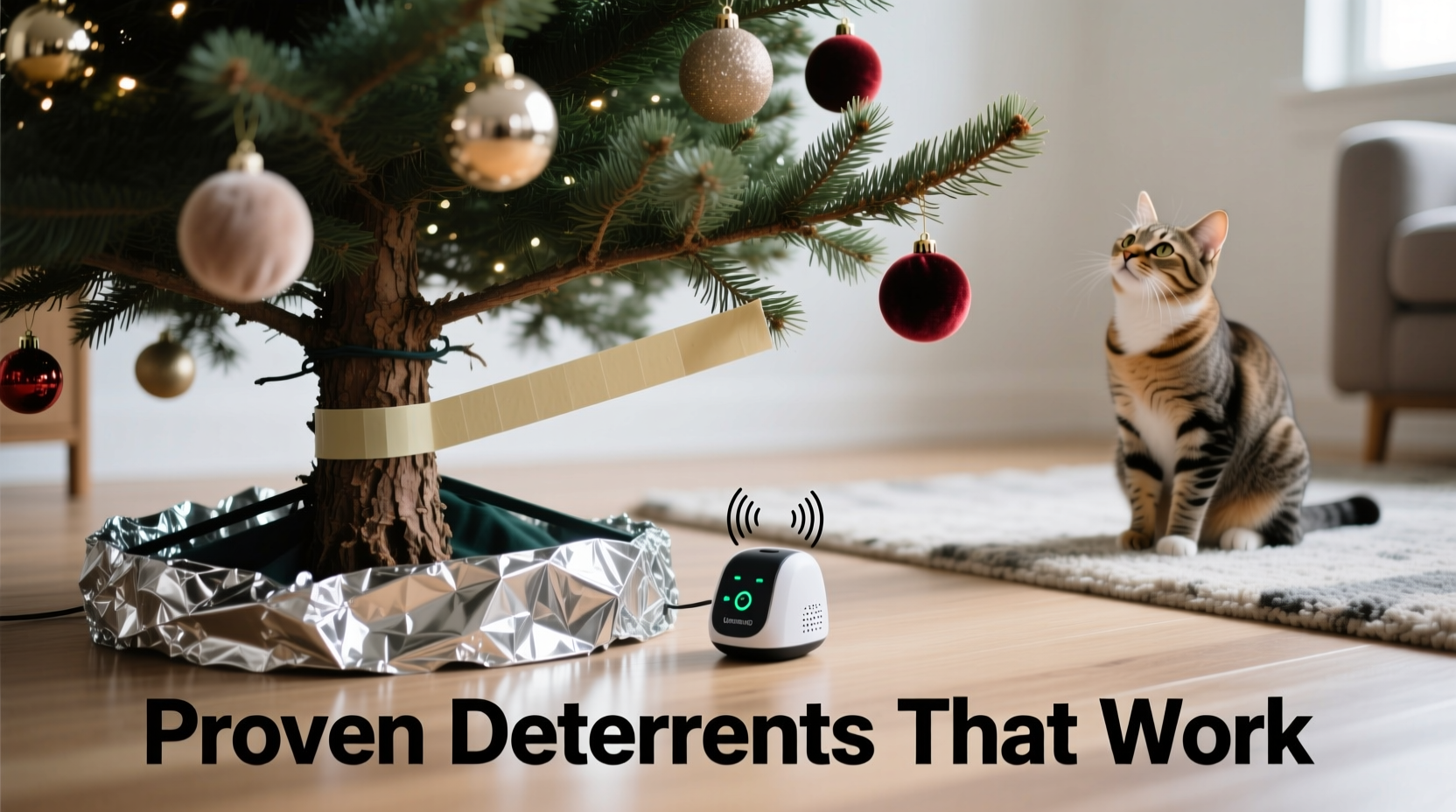
Tip: Never punish your cat for climbing the tree. This increases anxiety and damages trust. Instead, focus on redirection and environmental management.Proven Physical Deterrents That Work
The most reliable way to prevent tree climbing is to make the base unappealing while securing the structure itself. These methods are backed by veterinarians and animal behaviorists as safe and effective.
- Secure the Tree to a Wall or Ceiling: Use fishing line, sturdy straps, or a tree tether kit to anchor the trunk. Even if your cat climbs a few feet, a secured tree won’t tip over, preventing injury and mess.
- Use a Tree Skirt or Barrier: Wrap the base with aluminum foil, plastic carpet protector (nubby side up), or a citrus-scented spray. Most cats dislike the texture or smell and will avoid stepping near it.
- Elevate the Tree Base: Place the tree on a high stand or platform that’s difficult to jump onto. Ensure stability so the cat can’t destabilize it once climbing begins.
- Apply Double-Sided Tape: Cats dislike sticky paws. Apply non-toxic double-sided tape around the lower trunk or nearby floor surfaces to discourage approach.
- Install Motion-Activated Air Sprayers: Devices like Ssscat emit a harmless burst of air when movement is detected. Positioned near the tree, they startle cats without causing harm and teach avoidance over time.
These deterrents work best when combined. For example, anchoring the tree prevents accidents, while texture and scent barriers reduce initial interest.
Environmental Management: Redirecting Natural Behavior
Instead of fighting your cat’s instincts, channel them productively. Cats don’t climb just to annoy—they seek stimulation. By offering better alternatives, you reduce the tree’s appeal.
- Create a multi-level cat tree near the living area, ideally decorated with safe holiday-themed toys or wrapped boxes underneath.
- Install window perches or shelves at different heights so your cat can observe from above without needing the Christmas tree.
- Introduce interactive toys during tree setup to associate the space with play—but not on the tree itself.
- Rotate toys weekly to maintain novelty and prevent boredom-driven exploration.
Dr. Lindsey Smith, certified feline behavior consultant, explains:
“Cats don’t climb Christmas trees because they hate holidays—they climb because the environment offers no better option. Give them a superior alternative, and they’ll choose it nine times out of ten.” — Dr. Lindsey Smith, Feline Behavior Specialist
Step-by-Step Guide: Preparing Your Home Before Tree Setup
Prevention begins before the first branch is unpacked. Follow this timeline to create a cat-friendly yet tree-safe environment:
- Week 1: Assess Risk Factors
Identify your cat’s jumping ability, favorite routes, and past behavior around new objects. Note any previous incidents with furniture or plants. - Week 2: Install Alternatives
Set up cat trees, perches, or tunnels in the same room where the tree will go. Let your cat explore and claim these spaces first. - Day of Setup: Control Access
Keep your cat in another room while assembling the tree. Minimize lingering scents of pine sap or packaging that might attract investigation. - Immediately After Setup: Apply Deterrents
Anchor the tree, apply tape or foil at the base, and position air sprayers. Avoid placing toys or food nearby, which could draw attention. - First 72 Hours: Supervise Closely
Monitor interactions. If your cat approaches, gently redirect to their own perch or toy. Reward calm behavior with treats.
This proactive approach conditions your cat to view the tree as off-limits while reinforcing acceptable behaviors.
Safe Decoration Practices for Cat-Friendly Homes
What you hang on the tree matters as much as how you secure it. Many traditional decorations pose risks beyond climbing—they can be ingested, cause entanglement, or break dangerously.
| Decoration Type | Safe Alternative | Risk Level |
|---|---|---|
| Tinsel & Ribbons | Felt garlands, paper chains | High – causes intestinal blockage if swallowed |
| Small Ornaments | Large, lightweight wooden or fabric balls | Medium – choking hazard, glass shards |
| Hanging Bells | Sturdy bottom-layer ornaments only | Medium – noise stress, swallowing small parts |
| Edible Decorations | None (or use pet-safe dough shapes) | High – toxic ingredients (e.g., chocolate, nuts) |
| Light Strings | LED mini-lights, secured tightly | Medium – chewing risk, electrical hazard |
Always place fragile or tempting items toward the top third of the tree, beyond typical reach. Consider using a fake tree if your cat tends to chew real pine needles, which can irritate the digestive tract.
Tip: Test low-light LED strands for warmth—overheating bulbs may attract cats seeking cozy spots.Real-Life Example: The Thompson Family’s Solution
The Thompsons in Portland, Oregon, struggled for years with their two playful tabbies, Milo and Luna, who treated their Fraser fir like a personal climbing wall. One year, the tree fell during the night, breaking a heirloom ornament and scattering water across the hardwood floor.
Determined to find a lasting fix, they consulted a local vet behaviorist. Following the advice, they anchored the tree to a wall stud using nylon straps. They covered the stand with crinkly plastic carpet protector and placed double-sided tape around the perimeter. They also built a tall cat tree beside the fireplace, wrapping it with red-and-green scratchers and hanging feather toys.
Within days, both cats preferred their new perch. Motion-activated air sprayers discouraged early试探 (tentative) approaches. By Christmas morning, the tree stood intact—and the cats were curled atop their own tower, watching quietly from above.
“We stopped seeing it as a battle,” said Sarah Thompson. “Once we gave them their own spotlight, they didn’t want ours.”
Essential Checklist: Cat-Proofing Your Christmas Tree
Use this checklist in the days leading up to setup to ensure a smooth, safe holiday:
- ✅ Choose a stable tree stand or secure it to the wall/ceiling
- ✅ Cover the base with aluminum foil, plastic matting, or citrus spray
- ✅ Apply double-sided tape around the trunk and nearby floor areas
- ✅ Install motion-activated deterrents (e.g., compressed air devices)
- ✅ Set up alternative climbing structures in the same room
- ✅ Use only pet-safe decorations (no tinsel, small parts, or edibles)
- ✅ Keep lower branches free of ornaments and lights
- ✅ Supervise initial interactions and redirect with toys if needed
- ✅ Remove tree promptly after holidays to reduce prolonged exposure
Frequently Asked Questions
Can I use essential oils to keep my cat away from the tree?
No. While citrus scents may deter cats, many essential oils (especially tea tree, pine, and citrus) are toxic when inhaled or ingested. Cats groom themselves frequently, increasing the risk of poisoning. Stick to safer deterrents like textured barriers or motion sensors.
Will keeping the tree behind a baby gate help?
Yes, if your home layout allows it. A freestanding gate can restrict access while still allowing visibility. However, ensure your cat has enriching activities elsewhere. Confinement without stimulation may increase stress and unwanted behaviors.
My cat only climbs at night. What should I do?
Night climbing often occurs when supervision ends. Consider relocating the tree to a room that can be closed off after bedtime. Alternatively, drape a soft net or mesh loosely over the lower half each evening—just enough to block access without trapping your cat.
Final Thoughts: Harmony Over Holiday Hazards
Preventing cats from climbing Christmas trees isn’t about eliminating joy—it’s about sharing it safely. With thoughtful preparation, you can protect your decor, your pet, and your peace of mind. The key lies not in restriction alone, but in enrichment: giving your cat compelling reasons to stay grounded while safeguarding the traditions you love.
Start early, combine multiple deterrents, and never underestimate the power of a well-placed cat tree. When your feline feels secure, stimulated, and included—even from a distance—the holiday spirit shines brighter for everyone.
💬 Have a clever cat-proofing trick or story? Share your experience in the comments and help fellow pet owners enjoy a safer, happier holiday season!








