When the holiday season arrives, few things evoke warmth and nostalgia like the soft glow of Christmas lights. But what happens when there's a blackout—or you're miles from the nearest outlet on a winter camping trip? The answer lies in portable energy: power banks. Once reserved for charging phones, modern power banks now have the capacity and output to illuminate entire strands of festive lights. With the right setup, you can maintain holiday cheer regardless of grid availability.
This guide walks through the technical and practical aspects of powering Christmas lights from a power bank. From selecting compatible lights and calculating battery life to ensuring safety and maximizing efficiency, this article equips you with everything needed to keep your decorations shining—off-grid and stress-free.
Understanding Your Power Bank’s Capabilities
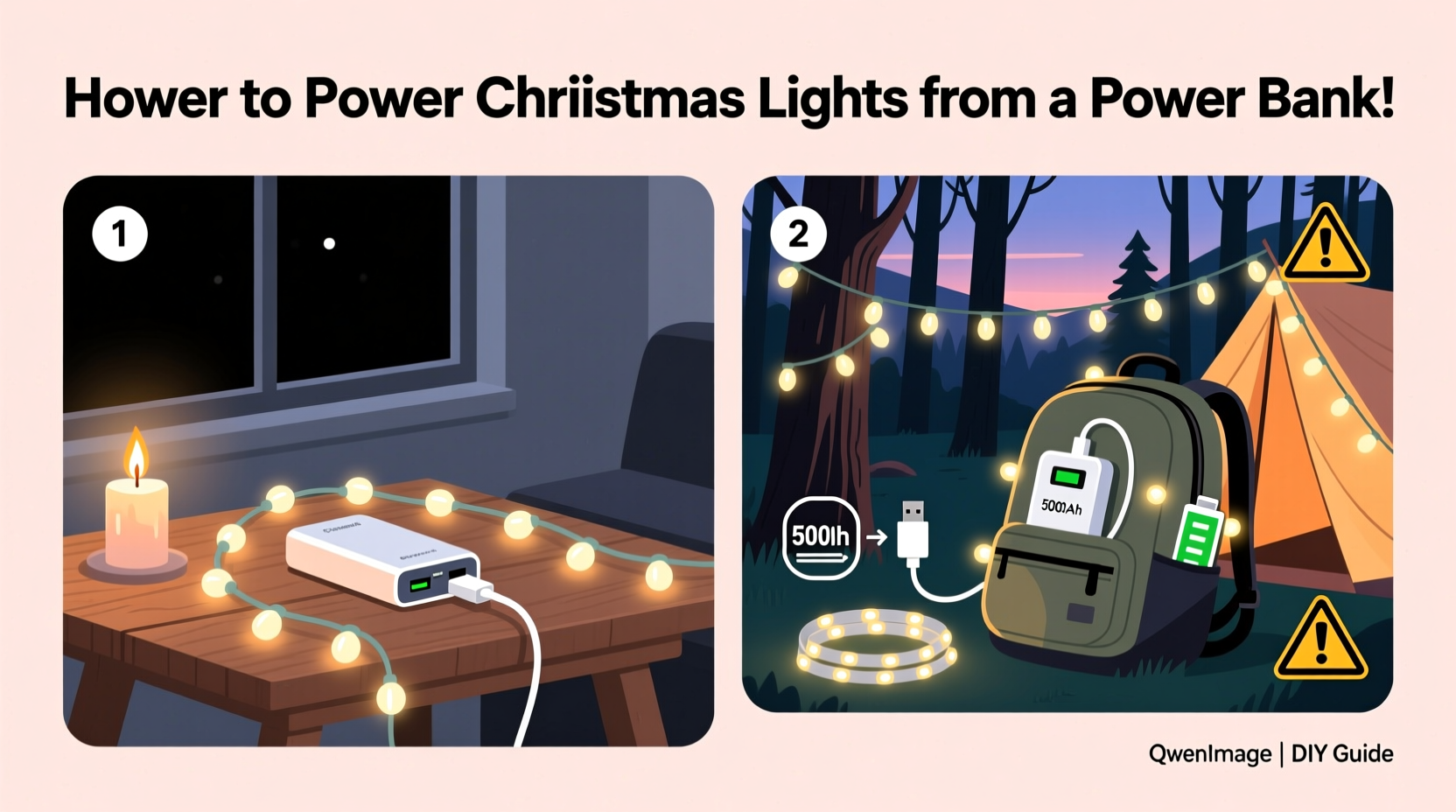
Not all power banks are created equal. While some are designed solely for smartphones, others can deliver sustained power suitable for small electronics like LED Christmas lights. The key is understanding three core specifications: capacity (measured in milliampere-hours, mAh), output voltage (typically 5V via USB-A or USB-C), and total energy delivery (in watt-hours).
A standard power bank ranges from 5,000 mAh to 30,000 mAh. To determine whether it can run your lights, convert its capacity into usable energy. For example:
- A 10,000 mAh power bank at 3.7V stores about 37 watt-hours (Wh) of energy (calculated as: 10,000 × 3.7 ÷ 1,000 = 37 Wh).
- Accounting for conversion losses (typically 10–20%), only around 30–34 Wh are actually available.
Most mini LED Christmas light strings consume between 1 and 5 watts. A 3-watt strand running for 10 hours requires 30 watt-hours—well within the range of a high-capacity power bank.
Tip: Look for power banks labeled \"high-output\" or those supporting USB-PD (Power Delivery) if you plan to power multiple strands or longer runs.Selecting Compatible Christmas Lights
The success of your off-grid lighting depends heavily on choosing the right type of Christmas lights. Not all decorative lights operate efficiently on low-voltage DC power from USB sources. Here’s what to look for:
- LED over incandescent: LED lights use up to 90% less energy than traditional bulbs and generate minimal heat, making them ideal for battery operation.
- USB-powered models: Some Christmas lights are explicitly designed to plug into USB ports. These typically run on 5V and draw current between 0.2A and 1A (1–5 watts).
- Low wattage per string: Aim for lights rated under 5 watts. Check packaging or product specs; many list power consumption directly.
- Shorter lengths: Longer strands may require more voltage than a single power bank can sustain. Stick to 10–50-light sets unless using a high-capacity source.
“Efficiency starts with the bulb. Modern micro-LEDs can shine brightly for hours on minimal power—perfect for emergency or outdoor setups.” — Dr. Alan Reeves, Electrical Engineer & Sustainable Lighting Consultant
Step-by-Step Guide to Connecting Lights to a Power Bank
Setting up your lights with a power bank is straightforward if done correctly. Follow these steps to ensure a reliable and safe connection:
- Verify compatibility: Confirm that your Christmas lights are USB-powered or can be adapted to run on 5V DC. Avoid modifying AC-only lights unless using an inverter (which reduces efficiency).
- Charge your power bank fully: Plug it into a wall outlet or solar charger ahead of time. A full charge ensures maximum runtime.
- Inspect cables and connectors: Use a high-quality USB cable without fraying or loose ends. Poor connections cause flickering or failure.
- Connect the lights: Plug the light string’s USB end directly into the power bank’s output port. If using an adapter (e.g., USB to barrel plug), ensure polarity matches.
- Test the setup: Turn on the lights and observe brightness. Dimming may indicate insufficient power or weak battery charge.
- Monitor temperature: After 15 minutes, touch the power bank and lights. Excessive heat suggests overload or poor ventilation—disconnect immediately.
Estimating Runtime: How Long Will the Lights Stay On?
One of the most common concerns is how long the lights will last on a single charge. The formula is simple:
Runtime (hours) = (Power Bank Watt-Hours × Efficiency Factor) ÷ Light Wattage
Using a 20,000 mAh power bank (74 Wh theoretical, ~60 Wh real-world after losses) powering a 3-watt LED string:
60 Wh ÷ 3 W = 20 hours of runtime
However, actual performance varies based on:
- Age of the power bank (older units lose capacity)
- Number of cycles (recharge history)
- Temperature (cold environments reduce lithium-ion performance)
- Additional loads (charging other devices simultaneously)
| Power Bank Capacity | Estimated Usable Energy (Wh) | Runtime with 3W Lights | Runtime with 5W Lights |
|---|---|---|---|
| 5,000 mAh | ~15 Wh | ~5 hours | ~3 hours |
| 10,000 mAh | ~30 Wh | ~10 hours | ~6 hours |
| 20,000 mAh | ~60 Wh | ~20 hours | ~12 hours |
| 30,000 mAh | ~90 Wh | ~30 hours | ~18 hours |
Note: These estimates assume 80% efficiency. Real results may vary slightly.
Expanding the Setup: Multiple Strings and Solar Charging
If one power bank isn’t enough, consider scaling up. You can connect multiple light strings—but not all configurations work safely.
Some USB-powered light sets support daisy-chaining, allowing two or more to run from a single port. However, exceeding the power bank’s output limit (usually 2.4A or 12W max per port) can trigger auto-shutdown or damage circuits.
To power multiple independent strings:
- Use a powered USB hub connected to the power bank.
- Distribute load across multiple output ports if available.
- Never exceed the total output rating of the power bank (check manual for combined max output).
For extended off-grid use—such as multi-day camping trips—pair your system with a solar charger. A 20W–50W solar panel can replenish a large power bank during daylight, enabling near-continuous lighting.
“We powered our entire campsite decor during a week-long winter festival using two 25,000 mAh power banks and a foldable solar panel. It stayed lit every night without grid access.” — Lena Torres, Outdoor Enthusiast & Festival Organizer
Safety and Best Practices
While convenient, running electrical devices from portable batteries requires caution. Lithium-ion power banks are generally safe but can pose risks if misused.
Do:
- Use UL-certified or reputable-brand power banks and lights.
- Keep devices dry and away from snow or rain (even brief exposure can short-circuit electronics).
- Store power banks at room temperature when possible—avoid freezing conditions.
- Turn off lights when not in use to conserve battery.
Don’t:
- Leave systems unattended overnight unless designed for continuous use.
- Modify cables or attempt to step up voltage without proper knowledge.
- Use damaged or swollen power banks—dispose of them properly.
- Overload USB ports beyond their rated output.
Checklist: Powering Christmas Lights Off-Grid
Before heading out or preparing for storm season, go through this checklist:
- ✅ Choose low-wattage, USB-compatible LED Christmas lights
- ✅ Select a power bank with at least 10,000 mAh capacity
- ✅ Fully charge the power bank before deployment
- ✅ Test the connection indoors first
- ✅ Pack spare cables and a waterproof enclosure (if outdoors)
- ✅ Calculate expected runtime based on wattage
- ✅ Bring a solar charger for multi-day use
- ✅ Monitor heat and performance during initial operation
Frequently Asked Questions
Can I use any power bank to run Christmas lights?
No—not all power banks can sustain the required output. Only use models with stable 5V USB output and sufficient capacity. Very small power banks (under 3,000 mAh) may not provide enough current for even a single string.
What if my Christmas lights don’t have a USB plug?
You’ll need either an adapter (e.g., USB to DC barrel plug) matching the correct voltage and polarity, or a small inverter to convert DC to AC. However, inverters reduce efficiency by 15–30%, so direct USB compatibility is preferred.
Will cold weather affect performance?
Yes. Lithium-ion batteries lose capacity in cold temperatures. A power bank that delivers 20 hours at 20°C (68°F) might only last 10–12 hours at 0°C (32°F). Keep the bank insulated (e.g., inside a tent or wrapped in cloth) when possible.
Conclusion: Light Up Anywhere, Anytime
Powering Christmas lights from a power bank transforms how we experience holidays during disruptions or adventures. Whether enduring a winter blackout or bringing festive charm to a remote campsite, portable energy offers independence and continuity. With careful planning, the right gear, and attention to detail, you can enjoy twinkling lights without relying on the grid.
The tools are already in your home or backpack—a few cables, a charged power bank, and efficient LEDs are all it takes. As renewable and portable power technology advances, these solutions will only become more accessible and effective.
💬 Have you powered holiday lights off-grid? Share your setup, challenges, and favorite tips in the comments below—your experience could inspire someone else’s bright idea!








