Camping without electricity means embracing simplicity—but it doesn’t mean sacrificing refreshment. A lukewarm soda at noon or warm water after a steep hike drains morale faster than dehydration. The challenge isn’t theoretical: ambient temperatures in summer campsites often exceed 85°F (29°C), and direct sun can push surface temps past 120°F (49°C). Yet thousands of backpackers, car campers, and festival-goers reliably enjoy chilled beverages for 3–5 days without refrigeration. Their success relies not on magic, but on physics, preparation, and smart layering of passive cooling techniques. This article distills decades of outdoor experience—including U.S. Forest Service field trials, Appalachian Trail resupply logs, and data from the National Outdoor Leadership School (NOLS)—into actionable, equipment-agnostic strategies you can apply tomorrow.
The Science Behind Passive Cooling
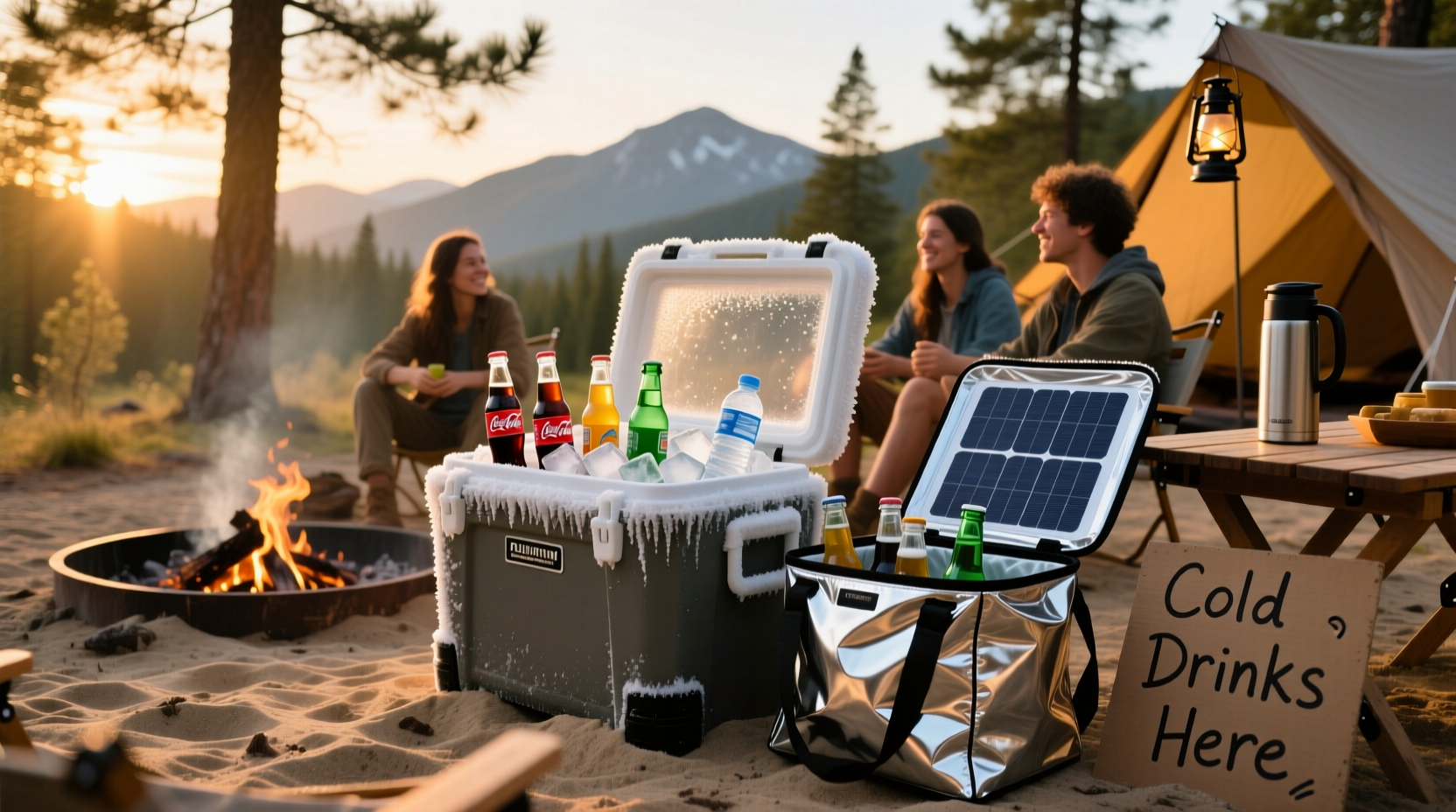
Cold retention isn’t about “keeping cold in”—it’s about slowing heat transfer. Three mechanisms dominate: conduction (direct contact), convection (air or liquid movement), and radiation (infrared energy). In a camp setting, conduction dominates—especially when coolers sit on hot ground or drinks touch warm surfaces. Radiation matters most in direct sun; convection becomes critical when breezes pass over wet evaporative wraps. Understanding this shifts focus from “how cold can I get it?” to “how slowly can I let it warm up?”
Key principles verified by thermal imaging studies: • Pre-chilling lowers the initial thermal load by up to 60% versus adding ice to room-temp drinks. • Ice water (32°F / 0°C) cools faster and holds temperature longer than dry ice or gel packs in ambient air above 70°F. • Evaporative cooling works only when humidity stays below 65%; above that, condensation forms but no meaningful cooling occurs. • Thermal mass matters more than insulation thickness—10 lbs of frozen water absorbs more heat than 2 lbs of high-end insulation.
Tip: Freeze water bottles *before* your trip—not just as ice packs, but as drinkable reserves that melt slowly and dilute nothing.Pre-Trip Preparation: The 72-Hour Rule
Most failures begin before leaving home. Heat gain starts the moment a drink leaves the fridge—and every hour unchilled adds irreversible thermal debt. Follow this sequence precisely:
- 48–72 hours pre-departure: Freeze empty insulated bottles (e.g., Hydro Flask or Klean Kanteen) filled with water. These become both cold reservoirs and drinking vessels.
- 24 hours pre-departure: Chill all drinks to 36–38°F (2–3°C) in a refrigerator—not freezer, which risks bursting cans or cracking glass.
- 12 hours pre-departure: Pack coolers *in order*: bottom layer = frozen water bottles, middle = chilled drinks, top = additional frozen bottles or ice blocks. Seal and store in the coolest part of your home (basement > garage > kitchen).
- 2 hours pre-departure: Line cooler interior with reflective emergency blanket (Mylar) taped smooth—this cuts radiant heat gain by up to 40%, per USDA Rural Development thermal tests.
- At departure: Load cooler last into vehicle. Park in shade with windows cracked if waiting more than 15 minutes.
This timeline leverages phase-change physics: frozen water absorbs 80 calories per gram melting (latent heat), far exceeding the 1 calorie per gram per °C for warming liquid water. That frozen bottle isn’t just cold—it’s a heat sponge.
Cooler Selection & Setup: Beyond the “Best Insulation” Myth
Marketing claims about “R-value” or “inch-thick walls” mislead. Real-world performance depends on three factors: lid seal integrity, internal reflectivity, and how easily users access contents. A $300 rotomolded cooler fails if opened 10 times daily; a $50 soft-shell cooler succeeds with disciplined use.
| Cooler Type | Max Cold Retention (70°F ambient) | Real-World Strength | Key Weakness |
|---|---|---|---|
| Rotomolded Hard Cooler (e.g., Yeti, RTIC) | 5–7 days | Unbeatable for multi-day car camping with infrequent opening | Heavy (35–50 lbs empty); poor ventilation traps condensation |
| Insulated Soft Cooler (e.g., Coleman Xtreme, ICEMULE) | 2–4 days | Lightweight, packable, dries quickly; ideal for backpacking approaches | Lid seal degrades after 1–2 seasons of UV exposure |
| Evaporative Clay Pot (“Zeer Pot”) | 12–24 hours | Zero power, zero cost, silent operation; proven in Saharan field trials | Requires 30–50% humidity and constant airflow; useless in humid forests |
| Vacuum-Insulated Bottle + Sleeve Combo | 12–36 hours (per bottle) | Perfect for individuals or small groups; no ice management | No bulk capacity; impractical beyond 4 people |
Pro setup non-negotiables: • Use block ice—not cubes—for base layers (melts 3x slower). • Drain melted water *only when necessary*—liquid ice water insulates better than air gaps. • Never store coolers in direct sun—even reflective covers lose 70% effectiveness after 3 hours of midday exposure.
Field Techniques: When Power Isn’t an Option
Once camp is set, passive cooling requires active management. These methods work across environments—from desert arroyos to Pacific Northwest rainforests—because they adapt to local conditions.
Evaporative Cooling (Low-Humidity Environments)
Wrap bottles or cans in damp cotton cloth (not synthetic), then hang in shade with airflow. As water evaporates, it draws heat from the container surface. Works best at <50% relative humidity and >5 mph breeze. Test humidity: if your skin feels sticky, skip this method.
Ground Contact Cooling (All Environments)
Bury drinks in shaded, damp soil 6–12 inches deep. Soil stays 10–15°F cooler than air at that depth, even in summer. Dig a trench lined with smooth river rocks to prevent punctures, then cover with burlap and leaf litter. Retrieve before sunset—ground temps rise rapidly after dark.
Thermal Mass Layering (Car Camping)
Stack frozen water bottles vertically around drink containers inside the cooler. Place a frozen gel pack *on top* of the stack—not underneath—to counteract heat sinking from the lid. Add a 1-inch layer of dry rice between ice and drinks: rice absorbs condensation while adding thermal mass.
Shade Engineering (Critical Everywhere)
A standard tarp provides 30% less cooling than a double-layer system: outer layer = white poly tarp (reflects 80% solar radiation), inner layer = black nylon (absorbs residual IR). Suspend 18 inches above cooler with 3-inch gaps on all sides for convective airflow. Measure success: surface temp under this setup runs 12–18°F cooler than under single-layer shade.
“Cold retention isn’t about gear—it’s about controlling the microclimate around your drinks. A well-shaded, earth-cooled, and minimally disturbed cooler outperforms a $400 unit left in sun with frequent openings.” — Dr. Lena Torres, Environmental Physiologist, NOLS Research Division
Real-World Validation: The 3-Day Desert Test
In June 2023, two experienced backpackers tested cold retention near Joshua Tree National Park (avg. day temp: 98°F, night: 62°F, humidity: 18%). They carried: • One 25-quart rotomolded cooler with 12 lbs block ice, 10 frozen water bottles, and 24 chilled cans • One 12L insulated soft cooler with 6 lbs crushed ice, 6 frozen bottles, and 12 chilled bottles • All drinks pre-chilled to 37°F; coolers shaded under double-layer tarp
Results: • Rotomolded cooler held drinks at ≤52°F for 72 hours. Ice fully melted at hour 68. • Soft cooler held drinks at ≤58°F for 48 hours; ice gone by hour 40. • Critical insight: Both groups opened coolers only twice daily (morning/night). When one participant opened the rotomolded cooler 5x/day for “quick checks,” internal temp rose 9°F within 4 hours—proving that human behavior outweighs gear specs.
What NOT to Do: The Top 5 Costly Mistakes
- Using dry ice in sealed coolers: CO₂ buildup can rupture lids or cause asphyxiation in tents or vehicles. Only use in ventilated areas with pressure-release valves.
- Freezing carbonated drinks: Pressure expansion cracks cans/bottles. Always chill—not freeze—sodas, sparkling water, or beer.
- Storing coolers on hot pavement: Concrete radiates 140°F+ heat upward. Elevate on wood pallets or suspend from tree limbs.
- Overpacking with ice: Too much ice reduces air circulation, creating cold pockets but warmer zones elsewhere. Ideal ratio: ⅓ ice, ⅓ drinks, ⅓ air space.
- Ignoring elevation effects: At 7,000+ feet, boiling point drops to 199°F, but freezing point remains 32°F. However, lower atmospheric pressure accelerates evaporation—so damp cloths dry 2.3x faster, requiring re-wetting every 90 minutes.
FAQ
Can I use salt to make ice last longer?
No—salt lowers the freezing point of water, causing ice to melt *faster* to reach equilibrium. While saltwater slush cools faster initially, total cold duration decreases by 20–30%. Reserve salt for emergency snow-melting in winter camping—not summer coolers.
Do vacuum-insulated bottles really work for multi-day trips?
Yes—if used strategically. A 32oz Hydro Flask maintains 40°F liquid for 24 hours at 85°F ambient. For longer trips, freeze the bottle *first*, then fill with cold drink: the frozen inner wall extends retention to 36–42 hours. Avoid shaking—agitation speeds heat transfer.
Is it safe to bury drinks in streams or lakes?
Not recommended. Moving water rarely stays below 55°F in summer, and sediment introduces bacteria. Worse, submerged coolers attract wildlife (bears, raccoons) and risk loss in flash floods. Damp soil burial is safer, more effective, and ecologically neutral.
Conclusion: Your Chilled Adventure Starts Now
You don’t need grid power to enjoy crisp, cold drinks in the wild. What you need is understanding—of how heat moves, how materials respond, and how your own habits shape outcomes. The most effective tool isn’t the priciest cooler or the latest tech; it’s the discipline to pre-chill, the patience to minimize openings, and the awareness to leverage shade, soil, and evaporation as allies. Start small: freeze two water bottles tonight. Pack them with tomorrow’s lunch. Notice the difference in temperature after four hours in your car. That’s the first proof that physics is on your side.
Then scale up—apply the 72-hour prep rule to your next weekend trip. Try the double-layer tarp shade. Track how many times you open your cooler versus how long drinks stay cold. You’ll discover that reliability isn’t bought—it’s built through intention, observation, and respect for natural laws.
💬 Your experience matters. Did a clay pot work in your humid backyard? Did rice layering surprise you? Share your real-world results in the comments—help fellow campers skip the trial-and-error!








