Improving aim in Fortnite doesn’t require expensive gear or premium sensitivity presets. While many players believe that high-end mice, custom controllers, or paid coaching are essential, the truth is that consistent, deliberate practice and smart technique adjustments can yield dramatic improvements—completely free of charge. The most effective aim enhancement strategies rely not on what you spend, but on how you train, analyze, and adapt. Whether you're a beginner struggling with flick shots or an intermediate player looking to tighten spray control, this guide delivers actionable methods rooted in real gameplay mechanics and cognitive skill development.
Master the Fundamentals of Sensitivity
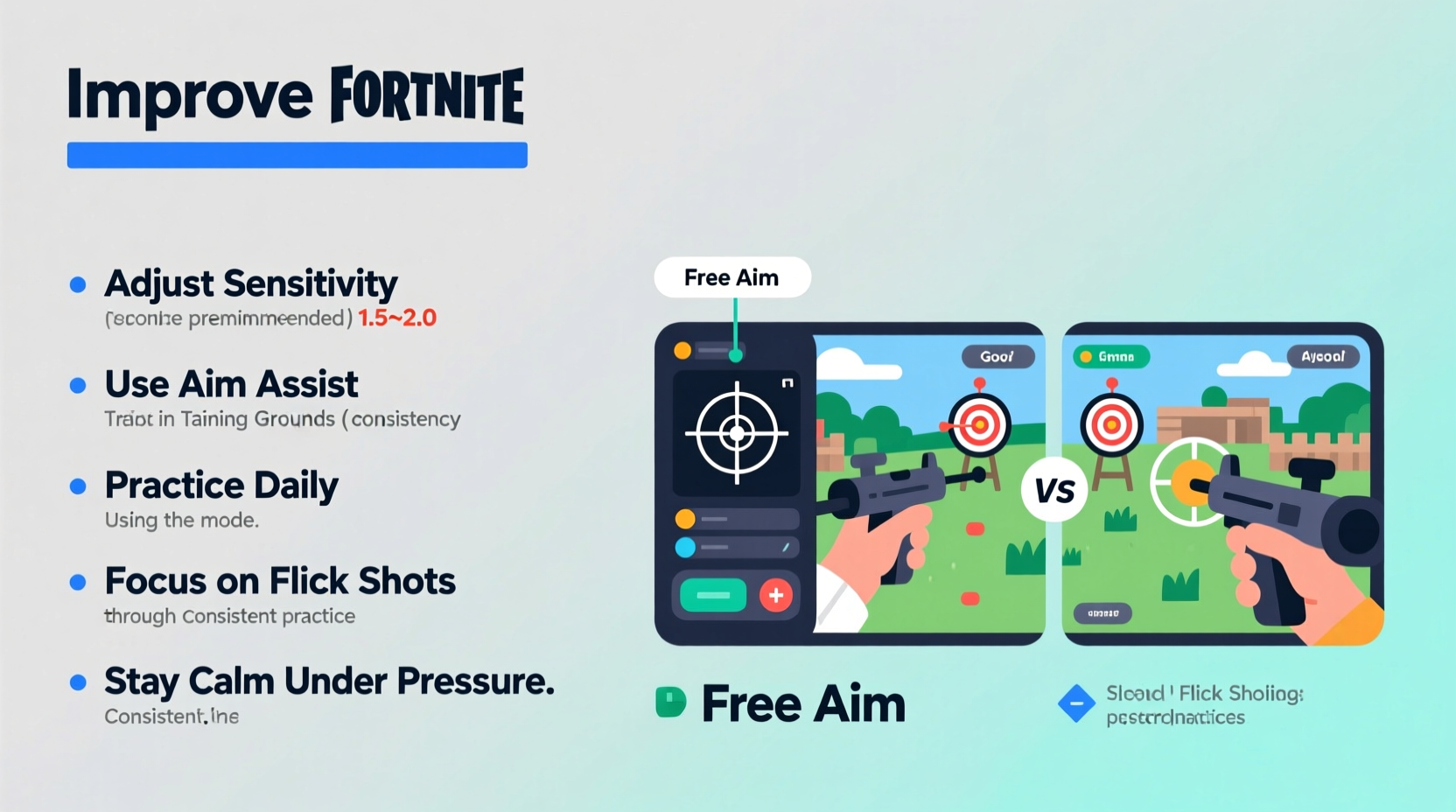
Sensitivity settings are often misunderstood. Many new players crank up their sensitivity to make turning easier, only to sacrifice precision and control. Conversely, overly low sensitivity makes tracking fast-moving enemies difficult. The goal isn't to copy a pro’s exact settings—it's to find a balance that allows both quick turns and accurate micro-adjustments.
Start by testing your current sensitivity in creative mode. Load into a map with static targets and attempt to track moving bots. If you overshoot consistently, your sensitivity may be too high. If you struggle to keep up with lateral movement, it might be too low. Adjust incrementally—no more than 5% at a time—and retest.
Tip: Use a consistent DPI setting (e.g., 800 for mouse users) and adjust only in-game sensitivity to isolate variables.Remember: muscle memory develops around consistency. Once you settle on a sensitivity range that feels responsive but controllable, stick with it for at least two weeks. Frequent changes disrupt long-term improvement.
Optimize Your In-Game Settings for Maximum Clarity
Your aim is only as good as your ability to see and process visual information. Even without premium tools, you can fine-tune default settings to enhance target acquisition and tracking. These adjustments don’t cost anything but significantly impact performance.
| Setting | Recommended Value | Why It Matters |
|---|---|---|
| FOV (Field of View) | 80–90 (Console), 110 (PC) | Wider FOV improves peripheral awareness and target tracking accuracy. |
| Brightness | 100% | Maximizes visibility in dark areas, reducing blind spots during fights. |
| Aim Assist Strength (Controller) | 70–80% | Strong enough to help track, weak enough to maintain manual control. |
| Color Blind Mode | Type 3 or Protan | Increases contrast between players and environments, especially in grassy areas. |
| Targeting Speed | Medium-High | Balances responsiveness with stability during aim transitions. |
These settings create a visual environment where enemies stand out clearly, allowing your brain to process motion faster. Combine them with a clean HUD layout—hide unnecessary elements like the compass or minimap if they distract you during combat.
Train Daily Using Free Creative Mode Maps
The most powerful tool in Fortnite’s arsenal is its Creative Mode—a completely free space where players can access thousands of community-made aim training maps. These maps simulate real combat scenarios and isolate specific skills like flicking, tracking, and spray control.
Popular free maps such as “Aim Lab” (map code: 8927-7845-3210), “The Range,” and “Flick & Tracking Trainer” offer structured drills that challenge different aspects of aim. Spend at least 15–20 minutes per day on one focused drill. For example:
- Flick Training: Jump between platforms while shooting targets that appear briefly. This improves reaction time and crosshair placement.
- Tracking Drills: Follow moving bots with your reticle. Focus on smooth hand-eye coordination, not speed.
- Spray Control: Practice landing headshots during sustained fire. Learn recoil patterns of ARs and SMGs through repetition.
Consistency matters more than duration. Daily 15-minute sessions lead to better retention than sporadic hour-long marathons. Track progress by noting how many targets you hit consecutively over time.
Mini Case Study: From Bronze to Gold in Six Weeks
Jamie, a 16-year-old player from Ohio, was stuck in Bronze III for months. Despite playing daily, her elimination count remained low due to poor aim. She decided to commit to a structured training plan using only free resources. Every day after school, she spent 20 minutes on a flicking trainer map, followed by 10 minutes of tracking practice. She kept her sensitivity fixed at 6.5x and adjusted only brightness and colorblind settings for visibility.
Within three weeks, she noticed she could land more first shots. By week five, she was consistently winning 1v1 encounters. At the end of six weeks, she reached Gold II—without purchasing any gear, coaching, or premium accounts. Her success came not from shortcuts, but from disciplined, targeted practice.
Develop Crosshair Placement and Pre-Aiming Habits
One of the biggest gaps between casual and skilled players is pre-aiming—the act of positioning your crosshair at head level and facing likely enemy directions before engagement. Players who wait to aim after seeing an opponent are already behind by hundreds of milliseconds.
To develop better crosshair placement:
- When rotating across the map, keep your reticle aligned with common angles—windows, doorways, ridge lines.
- After building, immediately adjust your aim to cover potential counter-angles.
- In fights, reset your aim toward the last known position of an enemy even after eliminating them.
This habit reduces the distance your hand must move during a fight, effectively making your aim feel faster. It’s not about raw reflexes—it’s about minimizing input needed when a target appears.
“Top players don’t react—they anticipate. Their crosshair is already near the threat before it emerges.” — Lucas Reed, Competitive FPS Coach
Build Cognitive Skills That Support Aim
Aim isn’t just motor control; it’s perception, prediction, and decision-making under pressure. Improving these underlying cognitive functions enhances aiming indirectly but powerfully.
Reaction Time: Train with simple online tools like humanbenchmark.com (free) to measure and improve response speed. Even small gains translate to quicker target acquisition.
Peripheral Awareness: During matches, consciously note movement outside your direct focus. Are enemies flanking? Is someone editing nearby? Better spatial awareness prevents surprise attacks and reduces panic-induced misclicks.
Stress Management: High-pressure situations degrade fine motor control. Practice breathing techniques before queuing: inhale for four counts, hold for four, exhale for four. This calms the nervous system and stabilizes hand tremors.
Checklist: Daily Aim Improvement Routine (Free Tools Only)
Daily Checklist:- Warm up with 10 minutes on a Creative aim trainer map.
- Adjust brightness and color settings if visibility feels off.
- Focus on pre-aiming during all real matches—prioritize crosshair placement over movement speed.
- After each game, reflect: Did I miss shots due to panic, poor positioning, or mechanical error?
- End with 5 minutes of slow tracking drills to reinforce control.
Avoid Common Pitfalls That Hinder Progress
Many players unknowingly sabotage their own improvement. Recognizing and correcting these mistakes accelerates growth.
| Mistake | Why It Hurts | Fix |
|---|---|---|
| Changing sensitivity too often | Prevents muscle memory formation | Pick one setting and stick with it for 2+ weeks |
| Only playing ranked | No room for experimentation or focused practice | Play Duos or FFA to test new techniques safely |
| Ignoring spray patterns | Missed follow-up shots waste advantage | Practice sprays on walls in empty zones |
| Playing while fatigued | Diminished focus leads to bad habits | Stop after 2 hours or when frustrated |
Progress isn’t linear. Some days will feel worse than others. What matters is consistency over time and the willingness to learn from failure rather than blame mechanics.
FAQ
Can I get good at Fortnite aim without a gaming mouse?
Absolutely. While a high-DPI mouse can help, the majority of aiming skill comes from technique and practice. Many top players started with standard equipment. Focus on control, not hardware.
How long does it take to see real improvement?
With daily focused practice, noticeable gains typically appear within 2–3 weeks. Major improvements—like consistently winning gunfights—take 6–8 weeks of consistent effort.
Should I use aim assist if I play on PC with a controller?
Yes. Aim assist is part of the console/PC controller experience and is balanced accordingly. Disabling it puts you at a disadvantage. Instead, learn to work with it by making smooth inputs and avoiding over-correction.
Conclusion
Improving aim in Fortnite is not a matter of spending money—it’s a commitment to intelligent, consistent training. You don’t need premium settings, elite gear, or paid coaches to become a sharper shooter. What you do need is discipline: to show up daily, refine your settings, master crosshair placement, and train with purpose. The gap between average and excellent aim isn’t filled with cash—it’s built with repetition, reflection, and resilience. Start today, stay patient, and let your progress speak through your K/D ratio.
🚀 Ready to level up your aim? Pick one tip from this guide and apply it in your next session. Share your progress in the comments—your journey could inspire someone else to improve too.








