There’s a quiet revolution happening at music festivals, desert campsites, and mountain trailheads: the rise of the intentional drinker. No longer resigned to lukewarm beer in a koozie or sugary premixed cans, more people are choosing craft, control, and conviviality—even when miles from a bar. But building a portable cocktail kit isn’t about stuffing a duffel with glassware and a mini shaker. It’s about precision, weight calculus, material intelligence, and understanding how flavor behaves under variable conditions—heat, altitude, humidity, and movement.
As a beverage educator who’s led mobile mixology workshops at Burning Man, Coachella, and backcountry sites across the Rockies and Appalachians, I’ve seen what works—and what gets abandoned after Day One. A truly portable kit isn’t defined by how much it holds, but by how reliably it delivers three things: consistency, safety, and joy. This means no leaking spirits, no shattered glass, no wasted ingredients, and no compromise on balance or texture. Below is the distilled result of over 200 field deployments: a complete, modular, and rigorously tested system you can scale up or down depending on your trip’s length, group size, and terrain.
Core Principles: Weight, Stability, and Shelf Life First
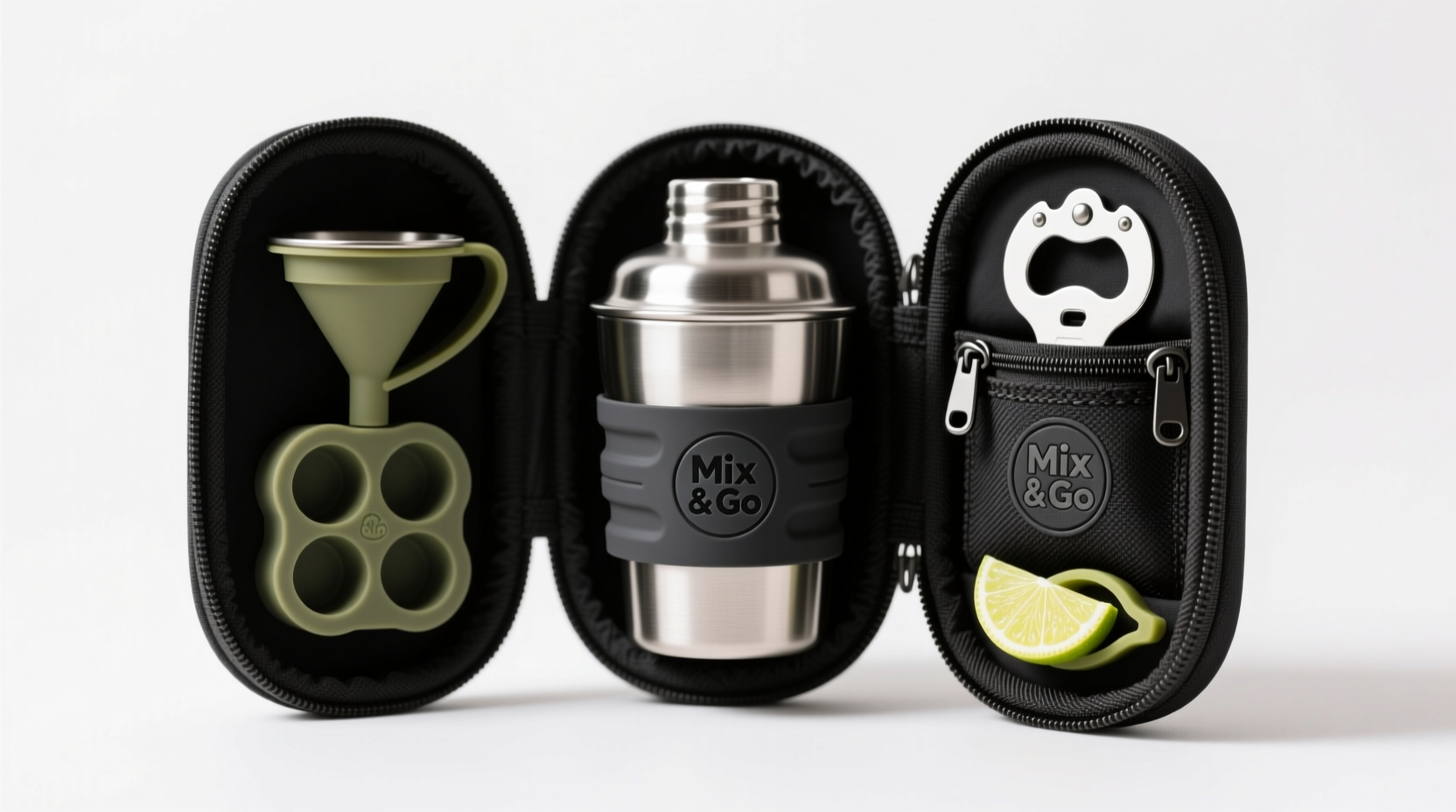
Before selecting gear, internalize three non-negotiables:
- Weight-to-yield ratio: Every gram must serve at least two functions (e.g., a stainless steel tin doubles as a mixing vessel and a sturdy cup).
- Leak-proof integrity: Liquids expand with heat and shift under vibration. If it’s not rated for air travel or bikepacking, it doesn’t belong in your kit.
- No-refrigeration stability: Citrus juice oxidizes in hours. Fresh herbs wilt. Dairy sours. Your kit must rely on shelf-stable alternatives that preserve authenticity—not just convenience.
These aren’t compromises. They’re constraints that sharpen creativity. The best festival cocktails—think a clarified lime margarita or a smoked maple old fashioned—are built around intelligent substitutions, not shortcuts.
Tip: Pre-batch all base spirits and modifiers (like syrups and bitters) into leak-tested silicone dropper bottles or childproof screw-top vials. Label each with ingredient + ABV—for safety and clarity.The Essential Gear List: Curated, Not Compromised
Aim for total kit weight under 1.8 kg (4 lbs) for solo use, or 2.7 kg (6 lbs) for two people sharing. Everything listed below has been stress-tested for backpack carry, tent storage, and repeated temperature swings between 5°C and 40°C.
| Item | Why This Specific Version | Weight (g) | Notes |
|---|---|---|---|
| Double-walled stainless steel Boston shaker (tin + plastic cap) | Plastic cap eliminates glass breakage risk; double wall prevents condensation drip and keeps contents cooler longer | 320 | Cap seals tightly—no leaks even when inverted in a stuff sack |
| Collapsible silicone jigger (0.5–2 oz dual-scale) | Food-grade platinum silicone resists alcohol degradation and folds flat | 28 | Wash with camp soap—no residue buildup |
| Mini muddler (bamboo, 12 cm) | Bamboo is lighter than wood, naturally antimicrobial, and won’t splinter like cheap plastic | 34 | Stores inside shaker tin when collapsed |
| Reusable bamboo straws (2x, with cleaning brush) | Lightweight, durable, and compostable at trip’s end | 16 | Brush fits through straw and cleans interior crevices |
| Collapsible silicone citrus squeezer (with integrated strainer) | Folds to 2 cm thick; built-in micro-strainer catches pulp without clogging | 42 | Use only with fresh limes/lemons—never store juice in it |
Notice the absence of a traditional Hawthorne strainer, bar spoon, or ice tray. That’s deliberate. Ice is rarely reliable off-grid—so we design drinks that don’t require it. And straining? Done via the squeezer’s fine mesh or the shaker’s built-in perforations. A bar spoon adds weight and zero utility when shaking or stirring is done by hand.
The Ingredient Strategy: Shelf-Stable Without Sacrifice
Fresh-squeezed juice is ideal—but impractical beyond 6–8 hours in ambient heat. Instead, adopt the “3-2-1 preservation rule”: 3 days refrigerated, 2 weeks unrefrigerated if clarified or preserved, 1 month if dehydrated or tinctured.
Here’s what actually works in real-world conditions:
- Citrus: Use dehydrated lime or lemon powder (not juice crystals). Reconstitute 1 tsp powder + 15 ml hot water = 15 ml fresh-tasting juice. Adds zero moisture weight and survives desert heat.
- Sweeteners: Avoid simple syrup—it ferments. Use gum arabic–stabilized honey syrup (3:1 honey:water + 2% gum arabic) or maple syrup reduced by 30%. Both resist crystallization and separation.
- Bitters: Standard dropper bottles work—but store them upright in a padded compartment. Heat expands alcohol vapor, increasing pressure. A single burst can ruin your entire kit.
- Herbs & aromatics: Carry freeze-dried mint or basil (rehydrates in 20 seconds), or pre-made rosemary or thyme tinctures (50% ABV base preserves volatile oils).
“Field mixology isn’t about replicating bar drinks—it’s about reimagining them for resilience. The best portable cocktails taste *of place*: smoke from the fire, salt from the wind, citrus sharpness cut with earthy tannins.” — Javier Ruiz, Beverage Director, Wildcraft Distillers & Co.
Step-by-Step: Building Your Kit in Under 15 Minutes
This sequence ensures nothing is forgotten, everything nests efficiently, and your kit stays balanced in your pack:
- Start with the shaker tin. Place the collapsible jigger, muddler, and straws inside it. These form your core nesting stack.
- Add liquid containment. Slot 3–4 silicone dropper bottles (spirit base, modifier, bitters, acid powder) into the remaining space. Use rubber bands to secure them together in pairs.
- Layer dry goods. Place a small muslin bag (10 cm x 12 cm) containing dehydrated citrus powder, gum arabic, and freeze-dried herbs on top. Tie closed with twine.
- Insert the squeezer. Fold it flat and slide it vertically along the inner rim—its curved shape locks it in place without shifting.
- Seal and test. Close the shaker cap firmly. Shake vigorously for 10 seconds upside-down over a sink or towel. If no leakage occurs, you’re sealed for trail use.
That’s it. Total assembly time: 12 minutes. Total packed volume: 12 cm diameter × 18 cm height—fits easily in a side pocket of a 40L backpack or under a camp chair.
Real-World Case Study: The 72-Hour Desert Rally Kit
In May 2023, a group of four friends drove from Tucson to the Sonoran Desert for a self-supported 3-day rally. Temperatures peaked at 42°C daily, with no shade, no power, and minimal water access. Their original plan—a full-size shaker, glass bottles, and fresh limes—was abandoned before leaving the parking lot when their cooler leaked onto the driver’s seat.
They rebuilt using this portable system:
- Base spirits: Mezcal (smoky depth holds up to heat), reposado tequila, and a 100ml bottle of amaro (bitter complexity balances desert dryness)
- Modifiers: Gum-arabic honey syrup, dehydrated lime powder, smoked sea salt tincture (20% ABV)
- Tools: All items listed above, plus one extra bamboo straw and a small ceramic mug (for hot toddies at night)
Over 72 hours, they made 37 drinks—including a mezcal-lime sour with salt foam (made by shaking lime powder + syrup + salt tincture + water), a smoky paloma (using grapefruit powder), and a campfire-spiced old fashioned (cinnamon stick muddled with syrup and amaro). Zero spills. Zero broken items. And critically—no ingredient spoilage. As one participant noted: “We didn’t just have drinks. We had ritual. That tin became our hearth.”
Do’s and Don’ts: Field-Tested Wisdom
| Action | Do | Don’t |
|---|---|---|
| Storing spirits | Keep bottles upright in padded sleeves; wrap caps in beeswax wrap for extra seal security | Store horizontally—alcohol degrades rubber gaskets and increases leak risk |
| Shaking technique | Use the “dry shake” method first (no ice), then add 30 ml cold water to chill and dilute—prevents over-dilution in heat | Shake with ice unless you have insulated, leak-proof ice containers (most don’t exist) |
| Cleaning mid-trip | Rinse shaker and jigger with potable water after each use; air-dry fully before repacking | Let citrus residue sit overnight—it attracts insects and creates sticky buildup |
| Scaling for groups | Add a second shaker tin and double dry goods—never double liquid bottles (weight compounds fast) | Bring a large communal pitcher—it’s heavy, unstable, and impossible to clean properly off-grid |
FAQ
Can I use this kit for hot drinks too?
Absolutely. The stainless steel shaker retains heat well. For hot toddies or spiced cider, warm your spirit and modifier in the tin over low coals (never direct flame), then stir in dried ginger, clove, or cinnamon powder. Add hot water last—just enough to dissolve solids. The double wall keeps hands safe.
What if I forget an ingredient—or run out?
Build redundancy into your base formulas. Example: A “desert sour” uses lime powder + honey syrup + spirit—but if you lose the lime, substitute ½ tsp sumac powder + 1 tsp water. If you lose the syrup, use 1 tsp date paste + 1 tsp hot water. Always carry two acid options (lime + sumac) and two sweeteners (honey + date) to cover gaps.
Is it legal to carry alcohol at festivals or in national parks?
Check venue-specific rules—many major festivals (e.g., Bonnaroo, Outside Lands) allow personal alcohol in designated areas, but ban glass and open containers. National forests often permit it; national parks frequently prohibit it entirely. When in doubt, verify with the managing agency *before* packing. Never assume “everyone does it” is compliance.
Conclusion
A portable cocktail kit is more than gear. It’s a declaration of presence—of choosing to engage deeply with where you are, who you’re with, and how you mark time. It transforms a sweltering afternoon into a shared pause. Turns a dusty campsite into a living room under the stars. Makes the effort of getting there feel earned, not exhausted.
You don’t need a bar, a bartender, or a battery-powered blender. You need intention, a few precisely chosen tools, and the confidence to trust that great drinks aren’t born in perfection—but in adaptation, respect for limits, and quiet attention to detail. Your first kit won’t be flawless. Maybe the lime powder clumps. Maybe the shaker cap loosens once. That’s part of the craft. Refine it. Share what works. Tweak the ratios until the drink tastes like *your* version of arrival.
💬 Build yours this weekend—and tell us what you made. Drop your favorite portable cocktail recipe, a photo of your kit in action, or a tip that saved your trip in the comments below. Let’s raise a tin to thoughtful drinking, wherever the road takes us.








