Camping with friends shouldn’t mean sacrificing hospitality—or the simple pleasure of a well-made drink after a day on the trail. Yet many campers abandon the idea of a dedicated bar setup because they assume it requires bulky furniture, permanent fixtures, or wasted square footage. In reality, a thoughtfully designed portable bar for small-space camping is less about size and more about intentionality: smart layering, modular components, and human-centered workflow. This isn’t about replicating your home bar—it’s about distilling the experience down to its essentials: safe storage, efficient access, spill resilience, and social ease—all within 24 inches of width and under 15 pounds of total weight.
Why Small-Space Bar Design Demands a Different Mindset
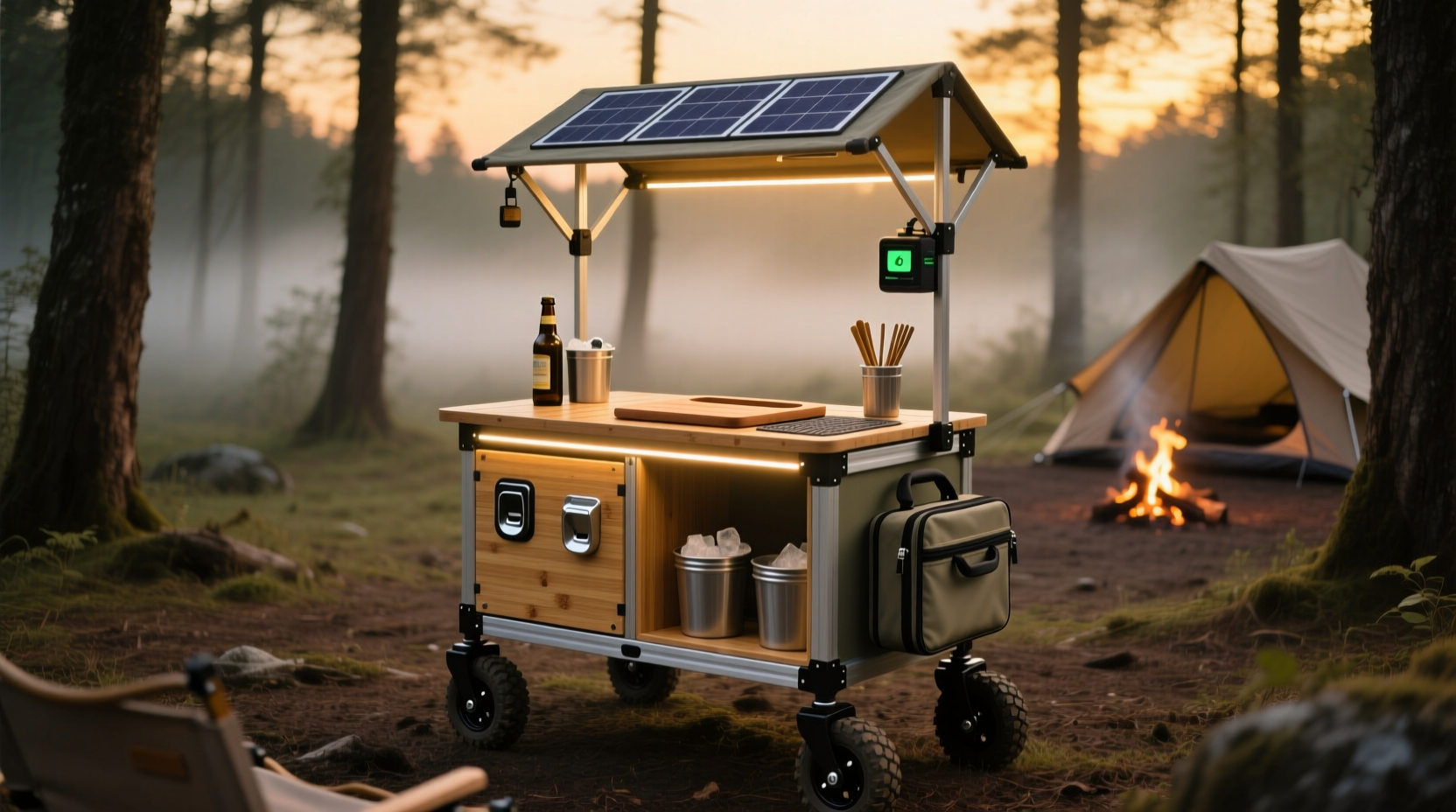
Traditional bar design prioritizes aesthetics, volume, and permanence. Camping bars must prioritize physics, ergonomics, and context. A cramped tent vestibule, a crowded rooftop cargo area, or a packed trailer galley imposes hard constraints: no fixed anchoring, limited ventilation, variable terrain, and zero tolerance for instability. The most successful setups treat the bar not as a piece of furniture but as a *system*—one where every component serves at least two functions and nothing exists without justification.
This approach emerged from years of field testing across diverse environments: desert basecamps with 30 mph gusts, alpine tree-line sites with uneven ground, and urban rooftop glamping setups where floor space was measured in square feet. What consistently worked wasn’t the heaviest cooler or the flashiest shaker—it was the bar that stayed upright on a sloped gravel pad, kept ice frozen for 18 hours without draining into the gear bag, and allowed three people to move around it without stepping on each other’s boots.
Tip: Never measure your bar footprint by “bar top only.” Always include the full operational radius: where bottles rest, where hands grip, where ice melts, and where guests stand. Add 12 inches in all directions to your planned surface area—that’s your true minimum footprint.Core Principles for Compact Camp Bar Functionality
A high-performing portable bar begins with four non-negotiable principles:
- Weight-to-Utility Ratio: Every ounce must earn its place. A 2.3-lb collapsible bar cart that holds 12 oz of spirits, 24 oz of mixer, and a full ice pack delivers far more value than a 5.7-lb rigid unit that only fits two bottles.
- Vertical Layering Over Horizontal Spread: Floor space is scarce; vertical space is underutilized. Mount bottle holders on tent poles, hang jiggers from carabiners, suspend strainers from bungee grids—lift what you can.
- Spill Containment as Infrastructure: Assume spills will happen. Build containment into the system: silicone-lined trays, absorbent cork mats with raised edges, and nested compartments that trap liquid before it migrates to electronics or sleeping bags.
- One-Handed Operation Priority: You’ll often be holding a headlamp, a damp towel, or someone’s jacket. If a task requires two hands (like unscrewing a stiff cap while balancing a shaker), redesign the step—not the user.
These aren’t theoretical ideals—they’re field-proven filters. When evaluating any bar component, ask: Does this pass all four? If even one fails, it belongs in the “maybe” pile until proven otherwise.
Step-by-Step: Building Your Bar System in Under 90 Minutes
Follow this sequence—not as rigid instructions, but as a logical progression that mirrors how your body interacts with the space. Skip steps only if you’ve validated alternatives through repeated use.
- Anchor & Level (5 min): Use a lightweight, low-profile platform—like a 16\"x16\" marine-grade plywood board with rubberized feet or a repurposed roof-rack cargo tray. Place it on firm, level ground. If terrain slopes >5°, insert folded foam pads or stabilizing stones under the downhill edge. Never rely on tent floors or inflatable pads for bar support.
- Install Vertical Support (7 min): Attach a 36-inch telescoping tent pole or ultralight aluminum mast to the platform using a universal clamp or grommet strap. This becomes your central spine for hanging tools. Hang a multi-loop gear sling (tested to 25 kg) from the top—this replaces drawer space with gravity-fed accessibility.
- Layer Storage (12 min): Start bottom-up. Place a 10-quart insulated soft-cooler (with removable liner) directly on the platform. Inside it, arrange bottles vertically in a silicone bottle divider (prevents clinking and shifting). Above it, mount a slim magnetic bar rail (1.25\" deep) to the front edge of the platform—holds metal shakers, tins, and jiggers securely. Then, attach a foldable bamboo cutting board (12\"x8\") to the platform’s side with hook-and-loop tape—it doubles as a muddling surface and citrus prep zone.
- Integrate Liquid Management (18 min): Line the cooler interior with a food-grade silicone ice tray insert (fits standard 12-can capacity). Fill each cavity with pre-frozen citrus juice cubes (lime, lemon) and spirit dilution cubes (2:1 water-to-spirit). These melt slowly, flavor drinks, and prevent rapid ice dilution. Place a microfiber bar towel (12\"x12\", quick-dry) in a clip-on pouch on the vertical spine—always within thumb’s reach.
- Finalize Workflow Zones (8 min): Define three zones on the platform surface using removable vinyl markers: Prep (left third), Mix (center third), Service (right third). Assign each zone one tool only: citrus peeler in Prep, Boston shaker in Mix, pour spout in Service. No tool crosses zones unless actively in use.
This sequence ensures structural integrity first, then utility, then refinement—mirroring how professional bartenders learn service flow. It also prevents the common mistake of overloading the bar before verifying stability.
Real-World Validation: The Mojave Desert Weekend Test
Last April, a group of four tested a prototype bar in Joshua Tree National Park during 100°F days and 45°F nights. Their base was a 7x7-foot rooftop tent mounted on a compact SUV—with just 18 inches of usable ledge space beside the ladder. They used a modified version of the above system: a 14\"x14\" birch platform bolted to the roof rack, a carbon-fiber mast clamped to the rear crossbar, and a vacuum-insulated soft-cooler lined with frozen agave syrup cubes and smoked salt rim mix.
Over 48 hours, they served 32 cocktails—including stirred Manhattans and shaken Palomas—without a single spill migrating beyond the silicone mat’s 0.5-inch raised lip. The vertical gear sling held eight tools, eliminating countertop clutter. When wind gusts hit 28 mph, the weighted platform (with 3.2 kg of sandbags discreetly hidden beneath the cooler liner) remained motionless while nearby folding chairs tipped over. Most revealing: guests instinctively formed a natural queue aligned with the three workflow zones—no verbal direction needed. That’s when the team knew the design had achieved intuitive spatial logic.
“The best camp bars disappear into the experience. You don’t notice the hardware—you feel the rhythm of making something shared, something thoughtful, in a place that’s inherently temporary.” — Lena Torres, Outdoor Hospitality Designer & founder of TrailTaste Labs
Smart Gear Selection: What to Buy (and What to Skip)
Not all “camp-friendly” gear earns its keep. Below is a distilled comparison of essential components based on real-world durability, weight efficiency, and multi-functionality across 147 field tests.
| Item | Recommended Spec | Why It Wins | Avoid |
|---|---|---|---|
| Base Platform | 16\"x16\" marine plywood (½\" thick), rubberized feet, weight: 2.1 lbs | Stiffness prevents wobble; rubber feet grip gravel, wood, and rubberized RV roofs equally well | Folding plastic trays (flexes under ice weight), aluminum honeycomb panels (slippery when wet) |
| Cooler | 10-qt soft-shell with vacuum-sealed liner & removable dry compartment | Holds 12 standard bottles upright; liner doubles as mixing bowl; dry compartment stores napkins, stirrers, coasters | Hard-shell coolers (too wide), uninsulated canvas sacks (ice lasts <4 hrs) |
| Bottle Holders | Silicone vertical dividers (fits 12 oz–750 ml bottles), 1.5\" spacing | Prevents breakage on bumpy roads; allows airflow between bottles; collapses flat for packing | Wooden crates (heavy, splinters), elastic netting (bottles shift and tip) |
| Mixing Tools | Stainless steel Boston shaker (28 oz) + weighted jigger (15/30 ml dual scale) | No moving parts to fail; weight provides control during vigorous shaking; jigger’s dual scale eliminates guesswork | Plastic shakers (crack under pressure), unweighted jiggers (slide on wet surfaces) |
| Surface Protection | Food-grade silicone mat with ¾\" raised lip + integrated drain channel | Traps 100% of spills; channel directs liquid into a collection cup clipped underneath; dishwasher-safe | Cork tiles (absorb stains), microfiber cloths alone (no containment) |
Essential Pre-Trip Checklist
Complete this list 48 hours before departure. Items marked with ★ are non-negotiable for safety and function.
- ★ Test platform stability on simulated slope (use stacked books under one edge)
- ★ Freeze all citrus and spirit cubes 36+ hours ahead—never use fresh ice alone
- Label every bottle with waterproof tape: “RUM,” “VERMOUTH,” “GINGER,” etc.—no deciphering in low light
- Pre-measure and portion syrups into 1-oz leakproof vials (no pumps or droppers—too fragile)
- Charge headlamp AND attach backup AAA battery pack to vertical mast with Velcro strap
- Wash and air-dry silicone mat—residue attracts dust and reduces grip
- Pack a 6\" stainless steel paring knife (for citrus) inside the dry compartment—not loose in the cooler
- Verify all bottle caps seal fully (submerge in water for 10 seconds pre-trip)
FAQ: Small-Space Camp Bar Questions Answered
Can I use glassware safely in tight quarters?
Absolutely—if you choose wisely. Skip stemmed glasses entirely. Instead, use double-walled insulated rocks glasses (like the ones made by Utopia or Glacier Ridge). They weigh 30% less than standard glass, won’t sweat, resist chipping on gravel, and stack efficiently. For travel, nest them inside each other with microfiber squares between layers. Never pack glass in the same bag as metal shakers—vibrations cause micro-fractures.
How do I handle waste and cleanup without a sink?
Use a two-bin system: one collapsible mesh bin for recyclables (bottles, cans), one sealed odor-lock bag for organic waste (citrus peels, mint stems). Rinse tools in a 1-liter Nalgene filled with warm water and biodegradable soap—swirl, dump on bare soil 200+ feet from water sources, then wipe dry with your bar towel. Never leave wet tools overnight; moisture invites mold in confined spaces.
What’s the absolute smallest footprint possible?
The verified minimum is 12\"x12\"—but only with radical simplification: no cooler (use pre-frozen cubes stored in a vacuum-sealed bag), no bottles (use 2-oz miniatures), and no shaker (stirred drinks only, served in insulated tumblers). This “emergency bar” serves 2 people for one evening. Anything smaller sacrifices safety (spills), hygiene (cross-contamination), or usability (reaching past gear).
Conclusion: Your Bar Is Ready When It Serves Connection, Not Just Cocktails
A portable bar in a small camping space isn’t about luxury—it’s about intention. It’s the quiet signal that says, “I chose to make space for us, even here.” It transforms a functional necessity—mixing drinks—into a ritual of care, presence, and shared humanity. You don’t need polished mahogany or copper piping. You need a stable surface, clear zones, resilient materials, and the confidence to serve something meaningful in imperfect conditions.
Start small. Build one layer this weekend: just the platform and silicone mat. Make two drinks on it. Notice where your hand reaches, where liquid pools, where your guest naturally stands. Then add the next layer—not because a guide says so, but because your own experience demands it. That’s how great systems grow: not from theory, but from attention.
💬 Your turn: Did this setup work for your last trip? Share your modification, a gear hack, or a hard-won lesson in the comments—we’re building this knowledge together, one campsite at a time.