The line between smartphones and dedicated action cameras has never been thinner. With the iPhone 15 Pro introducing a powerful Action Mode for video stabilization—especially in dynamic shooting scenarios—many content creators are asking: Is it time to retire the GoPro? After all, most people already carry an iPhone everywhere they go. But while Apple’s latest stabilization tech is impressive, it doesn’t automatically make standalone action cameras obsolete. The real answer depends on your workflow, content style, and environmental demands.
This isn’t just about megapixels or frame rates. It’s about reliability under pressure, adaptability across conditions, and long-term usability. Let’s break down where each device excels and whether professionals—and even serious hobbyists—still benefit from owning a GoPro.
Understanding iPhone 15 Pro’s Action Mode
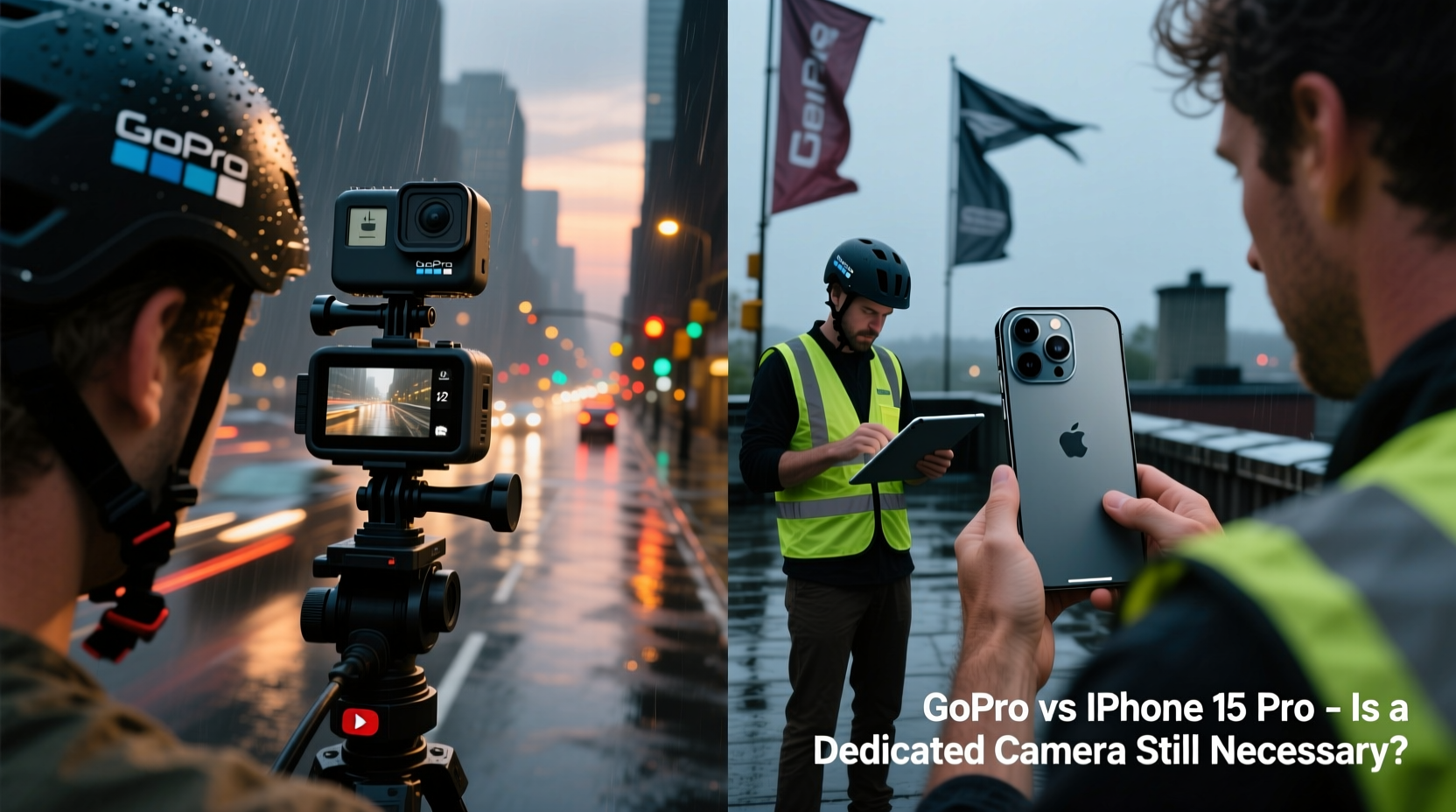
Introduced with iOS 16 and refined in the iPhone 15 Pro, Action Mode uses advanced sensor-shift optical image stabilization (OIS), AI-powered cropping, and gyroscope data to deliver remarkably smooth footage during high-motion activities like biking, hiking, or skateboarding. Unlike standard cinematic mode, which prioritizes shallow depth of field and subtle motion, Action Mode aggressively stabilizes shaky handheld movement by sacrificing some field of view.
Apple achieves this through a combination of hardware and software:
- Sensor-shift OIS: The entire sensor moves to counteract motion, offering better correction than lens-based systems.
- Fusion algorithms: Combines data from multiple sensors to predict and correct movement before it affects the image.
- Smart cropping: Uses pixel oversampling from the 48MP main sensor to maintain resolution despite digital zoom-in for stabilization.
In practice, this means you can run with your iPhone in hand and capture watchable, professional-looking clips without gimbals or mounts. For casual vloggers and social media creators, that’s a game-changer.
Tip: Enable “Lock Camera” in Settings > Camera > Record Video to prevent accidental mode switching when rotating your phone mid-recording.GoPro HERO12: Built for Extremes
While the iPhone 15 Pro impresses in everyday scenarios, GoPro remains purpose-built for extreme environments. The HERO12 Black, released in 2023, features HyperSmooth 6.0 stabilization, 5.3K60 and 4K120 video recording, waterproofing up to 33 feet (10 meters) without a case, and rugged durability tested across deserts, oceans, and mountain trails.
More importantly, GoPro offers modular accessories—chest harnesses, helmet mounts, suction cups, dive housings—that integrate seamlessly into adventure workflows. Its small form factor allows for creative mounting options impossible with a bulky smartphone. And unlike the iPhone, GoPro batteries are swappable, enabling continuous filming during long shoots.
One often-overlooked advantage is thermal management. iPhones throttle performance quickly during extended 4K recording, especially in hot climates. GoPros, designed for sustained operation, manage heat more efficiently thanks to passive cooling and optimized firmware.
“Stabilization isn’t just about smoothing shakes—it’s about maintaining usable framing after aggressive cropping. GoPro’s larger stabilization buffer gives us more room to edit.” — Derek Lin, Adventure Cinematographer & Vimeo Staff Pick Creator
Direct Comparison: Key Performance Metrics
| Feature | iPhone 15 Pro | GoPro HERO12 |
|---|---|---|
| Max Video Resolution | 4K at 60fps (extended to 240fps slo-mo) | 5.3K at 60fps, 4K at 120fps |
| Stabilization Tech | Action Mode + Sensor-Shift OIS | HyperSmooth 6.0 + RockSteady+ |
| Water Resistance | IP68 (up to 6m for 30 mins) | 10m without housing; 60m with Super Suit |
| Battery Life (Video) | ~1.5–2 hours (varies with temp and settings) | ~2–3 hours (swappable battery) |
| Audio Quality | Dolby Atmos, spatial audio support | Wind Suppression+, 3-mic array, external mic via adapter |
| Mounting Flexibility | Limited (requires third-party cases/clips) | Extensive ecosystem (mods, poles, floats) |
| Low-Light Performance | Strong due to computational photography | Moderate; improves with Night Lapse and HDR modes |
The table reveals clear trade-offs. The iPhone wins in low-light clarity and audio richness, leveraging Apple’s ecosystem intelligence. But GoPro dominates in durability, expandability, and consistent high-bitrate output regardless of ambient temperature.
Real-World Use Case: Mountain Biking Vlog
Consider Alex Rivera, a full-time outdoor content creator who films weekly mountain biking adventures in Colorado. Last season, he switched from using a GoPro mounted on his helmet to relying solely on his iPhone 15 Pro clipped to his backpack strap.
Initially, results were promising. Action Mode kept footage stable enough for Instagram Reels and YouTube Shorts. However, during a downhill descent with frequent jumps and rough terrain, the iPhone overheated after 18 minutes of continuous 4K recording. The video cut out twice, and upon review, noticeable rolling shutter distortion appeared during rapid panning.
Worse, when crossing a creek bed, water seeped into the third-party waterproof case, fogging the lens. He lost critical footage. The next weekend, he reverted to his GoPro—with its native waterproof design and shock resistance—and captured uninterrupted 45-minute runs without issue.
“I love how my iPhone looks in daylight,” Alex said. “But when I’m pushing limits, I need gear that won’t quit. That’s still the GoPro.”
When iPhone 15 Pro Is Enough
Not every creator needs a GoPro. For urban vloggers, travel bloggers filming scenic walks, or educators capturing classroom demos, the iPhone 15 Pro’s Action Mode delivers excellent value. If your priorities include:
- Seamless integration with iCloud and editing apps like Final Cut Pro for iPad
- Natural color grading and portrait-like depth from computational imaging
- Minimal setup time and no extra gear to carry
- Audio recording with built-in mics or AirPods integration
…then the iPhone may be sufficient. Many TikTok influencers and micro-vloggers have fully transitioned to smartphone-only production, using gimbals only when necessary. The convenience factor is undeniable.
Tip: Use a rugged case like the Catalyst Waterproof Case to add drop protection and true waterproofing to your iPhone during outdoor shoots.When You Still Need a GoPro
Dedicated action cameras shine in niche but vital situations:
- Underwater Filming: Whether snorkeling or diving, GoPro’s Super Suit and flat lens ports eliminate distortion better than any phone housing.
- Extended Battery Demands: Wildlife documentarians or race-day motorsport videographers benefit from carrying spare GoPro batteries.
- Hands-Free Mounting: Chest cams, head straps, or handlebar mounts provide unique POVs that holding an iPhone cannot replicate safely.
- Harsh Environments: Dust, sand, saltwater, and extreme temperatures degrade phones faster—even with protection.
- Consistent Workflow: GoPro’s Quik app allows batch processing, tagging, and cloud backup tailored for high-volume shooters.
Moreover, GoPro’s Max Lens Mod and TimeWarp 5.0 offer features absent from iPhones, such as horizon-leveling up to 45 degrees and automatic highlight tagging during recording.
Checklist: Should You Keep Your GoPro?
Answer these questions to decide if a dedicated camera still fits your needs:
- Do you frequently shoot in rain, snow, or underwater?
- Are you filming for longer than 90 minutes continuously?
- Do you rely on first-person perspectives (helmet, chest, bike-mounted)?
- Is your phone your primary communication tool during shoots?
- Do you edit professionally and require consistent codec support (like ProTune or LOG profiles)?
- Have you experienced iPhone overheating during past recordings?
If three or more apply, a GoPro—or similar action cam—remains a worthwhile investment.
FAQ: Common Questions About iPhone vs GoPro
Can iPhone Action Mode replace a gimbal?
In many cases, yes—for walking shots, light movement, or short-form content. However, for cinematic pans, car rigging, or professional-grade smoothness, a gimbal still provides superior control and longer stability without cropping.
Does GoPro have better audio than iPhone?
Natively, no—the iPhone records richer ambient sound with less compression. But GoPro supports external microphones via USB-C adapters, allowing pro audio upgrades. In windy conditions, GoPro’s Wind Suppression+ often outperforms the iPhone’s software filtering.
Is it worth buying a GoPro if I already own an iPhone 15 Pro?
Only if your content involves extreme sports, prolonged recording, or environmental risks. For general lifestyle vlogging, the iPhone suffices. But for creators building a brand around adventure, durability, and versatility, the GoPro complements—not competes with—the iPhone.
Conclusion: Tools for Different Missions
The iPhone 15 Pro’s Action Mode marks a turning point in mobile videography. It proves that smartphones can now handle many tasks once reserved for specialized gear. Yet, just because a tool *can* do something doesn’t mean it should—or will perform reliably when it matters most.
Content creators don’t face an either/or choice. Instead, think in terms of tool stacking. Use your iPhone for quick cuts, interviews, and polished edits. Deploy your GoPro when conditions demand resilience, longevity, and creative freedom. Together, they form a flexible, future-proof kit.
Technology evolves fast, but so do audience expectations. Viewers today demand both authenticity and polish. Whether you’re scaling a cliff or touring a city, the best camera is the one that captures the moment—without failing you halfway through.
🚀 Ready to test your setup? Try filming the same activity with both devices side-by-side. Compare stabilization, audio, and post-edit flexibility—you might be surprised what each reveals.








