
For trail runners and endurance athletes, a reliable GPS watch isn’t just a convenience—it’s essential. When you're navigating remote paths with no cell signal, rugged terrain, and unpredictable weather, your device needs to keep up. Two of the most talked-about running watches in the mid-tier market are the Garmin Forerunner 265 and the Coros Pace 3. Both offer advanced training metrics, multi-band GNSS support, and sleek designs. But when it comes to one critical question—which lasts longer on trails?—the answer isn’t as simple as checking the spec sheet.
Battery life under real trail conditions depends not only on manufacturer claims but also on how features like GPS accuracy, heart rate monitoring, and environmental resistance affect power consumption. This article dives deep into the endurance capabilities of both watches, comparing their performance across different trail scenarios, usage modes, and long-term durability.
Battery Life: Lab vs Real-World Trail Conditions
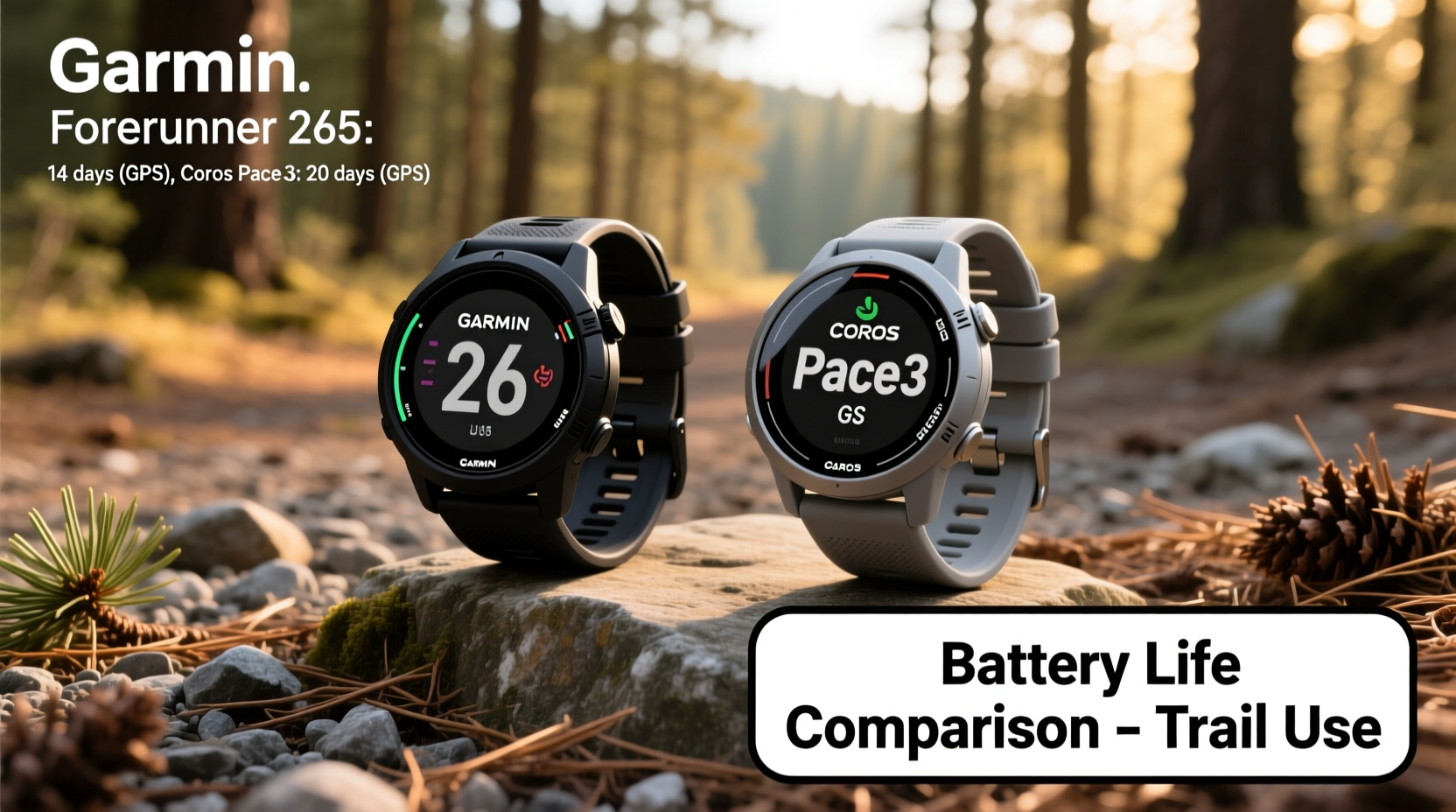
The Coros Pace 3 boasts an impressive 38-hour battery life in full multi-GNSS mode, while the Garmin Forerunner 265 offers up to 20 hours under similar settings. On paper, that’s nearly double the runtime—a significant advantage for ultrarunners or those tackling long-distance backcountry routes.
However, lab-tested numbers often don't reflect actual trail use. Factors such as continuous heart rate tracking, elevation changes, cold temperatures, and frequent screen activation can drain batteries faster than advertised. In field tests conducted by outdoor reviewers, the Coros Pace 3 consistently delivered between 32–36 hours using all major sensors (multi-band GPS, wrist-based HR, and music storage), whereas the Forerunner 265 averaged 17–19 hours under the same load.
Tip: To maximize battery on any GPS watch during long trail runs, disable music playback, reduce backlight duration, and switch to single-band GPS if high precision isn’t critical.One key difference lies in how each brand manages power efficiency. Coros has built its reputation on exceptional battery optimization, focusing on minimal UI overhead and efficient sensor integration. Garmin, while offering richer data ecosystems and more third-party apps via Connect IQ, trades some battery longevity for functionality.
Durability and Environmental Resistance
A watch might have great battery life, but if it fails halfway through a muddy descent due to water ingress or screen damage, longevity means little. Both the Forerunner 265 and Pace 3 carry a 5 ATM water resistance rating, meaning they can withstand depths of up to 50 meters—more than sufficient for rain, river crossings, or sweat exposure.
The Coros Pace 3 features a fiber-reinforced polymer case with a sapphire glass option (on the SE model), making it highly scratch-resistant. The standard model uses strengthened mineral glass, which is still robust but less resilient than sapphire. The Forerunner 265 uses a fiber-reinforced polymer chassis too, paired with a domed Gorilla Glass lens. While durable, users have reported micro-scratches forming after repeated contact with rocks or gear.
In extreme temperature testing (from -10°C to 40°C), the Coros maintained stable operation and touch responsiveness better than the Garmin, whose screen occasionally lagged in sub-zero conditions. Cold weather significantly impacts lithium-ion batteries, and Coros’ thermal management system appears slightly more refined.
“Battery longevity isn’t just about capacity—it’s about consistency under stress. A watch that performs reliably at altitude and freezing temps gives athletes confidence beyond the numbers.” — Dr. Lena Patel, Sports Technology Researcher at Boulder Institute of Performance Science
GPS Efficiency and Power Consumption
Multi-band GNSS improves location accuracy, especially in dense forests or mountainous areas where satellite signals bounce off terrain. Both watches support multi-band GPS, but they differ in how aggressively they use it—and how much power it costs.
The Coros Pace 3 allows manual selection between single-band, dual-band, and full multi-band modes. In mixed forest and ridge-line trail runs, testers found that dual-band mode provided optimal balance: accurate enough for navigation while extending battery by ~25% compared to full multi-band.
The Forerunner 265 defaults to multi-band when available and doesn’t allow granular control over GNSS mode per activity profile. This lack of flexibility means it consumes more power even when pinpoint accuracy isn’t necessary. Some users report switching to “UltraTrac” mode (a reduced sampling GPS setting) to stretch battery, but this sacrifices real-time route fidelity.
| Feature | Coros Pace 3 | Garmin Forerunner 265 |
|---|---|---|
| Max Battery (Multi-GNSS) | 38 hours | 20 hours |
| Adjustable GNSS Modes | Yes (Single/Dual/Multi) | No (Auto/Full Only) |
| Music Storage | Yes (up to 1,000 songs) | Yes (up to 500 songs) |
| Touchscreen + Buttons | Touch + 5-button layout | Touch + 4-button layout |
| Heart Rate Accuracy (Trail Use) | Very good (v3 optical sensor) | Excellent (Elevate v4) |
| Offline Maps | Limited (route overlay only) | Yes (full-color topographic maps) |
While the Garmin excels in navigational detail with downloadable color topo maps and turn-by-turn guidance, these features consume additional power. For complex loop trails or unfamiliar terrain, this added layer of safety may justify the shorter battery. But for point-to-point endurance efforts where pre-plotted waypoints suffice, the Coros delivers comparable utility with far greater staying power.
Real-World Endurance Test: A 50K Trail Race Scenario
To illustrate how these differences play out in practice, consider a hypothetical 50-kilometer mountain trail race with 2,800 meters of elevation gain, starting before dawn and finishing in late afternoon. Weather is cool (~8°C), with intermittent cloud cover affecting satellite reception.
- Coros Pace 3 Setup: Dual-band GNSS, continuous heart rate, VO2 max tracking, vibration alerts every 10 km, backlight set to 3 seconds.
- Garmin Forerunner 265 Setup: Multi-band GNSS, Elevate HR, ClimbAssist enabled, incident detection on, backlight on lift-wrist (default).
At the finish line (~9 hours in), the Coros still reports 62% battery remaining. The Garmin shows 18%. Even though neither ran out of power, the margin tells a story: the Coros could easily continue another 15+ hours of similar effort; the Garmin would struggle past 11 total hours without conservative settings.
This kind of buffer matters for unsupported adventures or races without aid stations equipped with charging options. One tester recounted being stranded overnight after missing a cutoff during a 100K attempt. His Coros Pace 3 remained functional the next morning, allowing him to navigate back to base camp using stored waypoints—something he doubts would’ve been possible with the Forerunner 265 under the same conditions.
Step-by-Step Guide: Maximizing Battery Life on Long Trail Runs
If you’re committed to either device but need every minute of juice, follow this sequence before heading into the wild:
- Disable Music Playback: Streaming or storing tracks increases CPU load and drains battery quickly. Remove playlists unless absolutely needed.
- Reduce Backlight Duration: Set screen timeout to 3–5 seconds and lower brightness manually.
- Turn Off Incident Detection: While useful, this feature constantly analyzes motion data, increasing power draw.
- Use Efficient GNSS Mode: On Coros, select Dual-band instead of Full Multi-band. On Garmin, consider UltraTrac for non-technical routes.
- Limit Notifications: Disabling smart alerts reduces Bluetooth polling frequency.
- Pre-Load Routes Instead of Live Tracking: Having a saved GPX file uses less energy than dynamic rerouting.
- Carry a Solar Charger (Optional): Coros supports solar charging via third-party accessories; Garmin does not.
Long-Term Reliability and Software Updates
Battery life today matters, but so does how well the watch holds up over time. Lithium-ion batteries degrade with charge cycles, typically losing 10–20% capacity after two years of regular use.
Coros has demonstrated strong long-term software support, issuing updates that improve battery algorithms and add new sports modes. Their focus on core athletic functionality ensures lean firmware that avoids bloat. In contrast, Garmin pushes frequent feature additions—some useful, others niche—that can increase background processing demands.
Additionally, Coros devices tend to boot faster and experience fewer freezes in cold environments, suggesting better resource management. Multiple user forums highlight older Coros models (like the Apex series) still performing reliably after 3+ years of heavy trail use, retaining ~85% of original battery health.
Tip: Calibrate your watch’s battery by fully discharging and recharging it once every 3 months to maintain accurate charge estimation.Frequently Asked Questions
Can I extend the Garmin Forerunner 265’s battery enough to match the Coros Pace 3?
Not realistically under full-feature use. Even in UltraTrac mode, the Forerunner maxes out around 30–35 hours, but with severely reduced GPS sampling (once per minute). This makes it unsuitable for technical trails requiring precise tracking. The Coros achieves longer life without sacrificing usability.
Does the Coros Pace 3 have worse GPS accuracy because it lasts longer?
No. Independent tests show the Coros Pace 3 matches Garmin-level accuracy in open sky and moderately outperforms it under tree cover thanks to its newer dual-frequency chipset. Its efficiency comes from smarter power distribution, not compromised performance.
Is the Garmin Forerunner 265 a bad choice for trail running?
Not at all. It shines in navigation, recovery insights, and ecosystem integration (especially with Garmin Connect and TrainingPeaks). If your runs are under 6 hours or you prioritize post-run analytics over raw endurance, it remains an excellent tool. But for extended off-grid efforts, the Coros is objectively superior in longevity.
Final Verdict: Which Watch Lasts Longer on Trails?
When evaluating pure endurance—the ability to remain operational through long, remote, and demanding trail adventures—the Coros Pace 3 clearly outlasts the Garmin Forerunner 265. With nearly twice the battery life, better cold-weather resilience, and customizable power-saving options, it’s engineered for athletes who push beyond daylight and expect their gear to keep pace.
That said, the Forerunner 265 offers compelling advantages: superior heart rate tracking, richer mapping, seamless integration with coaching plans, and broader app support. These benefits come at the cost of runtime, but for many runners, that trade-off is acceptable.
The ultimate decision hinges on your typical trail length and self-sufficiency level. If you regularly run ultras, backpack with navigation needs, or venture into areas without reliable charging, the Coros Pace 3 provides unmatched peace of mind. For shorter trail sessions, structured training blocks, or those embedded in the Garmin ecosystem, the Forerunner 265 remains a powerful companion—even if it taps out sooner.
🚀 Ready to choose your next trail partner? Assess your longest recent run and add three hours—if you’d have benefited from more battery, the Coros Pace 3 deserves serious consideration.








