Trail running demands precision, endurance, and reliability from both athlete and equipment. When choosing a smartwatch to accompany you through rugged terrain, unpredictable weather, and long distances, the decision between the Garmin Fenix 8 and the Apple Watch Ultra 2 isn’t just about brand loyalty—it’s about matching functionality to your specific needs. Both devices are flagship-grade, built for extreme conditions, but they serve different philosophies in design, ecosystem, and performance.
The Garmin Fenix 8 represents the pinnacle of purpose-built outdoor sports technology. Engineered with multisport athletes in mind, it emphasizes navigation, battery longevity, and ruggedness. The Apple Watch Ultra 2, on the other hand, blends premium fitness tracking with seamless integration into the iOS ecosystem, offering advanced health metrics and communication features that appeal to tech-savvy runners. So, which one truly excels when the pavement ends and the trails begin?
Battery Life: Endurance That Matches Your Longest Runs
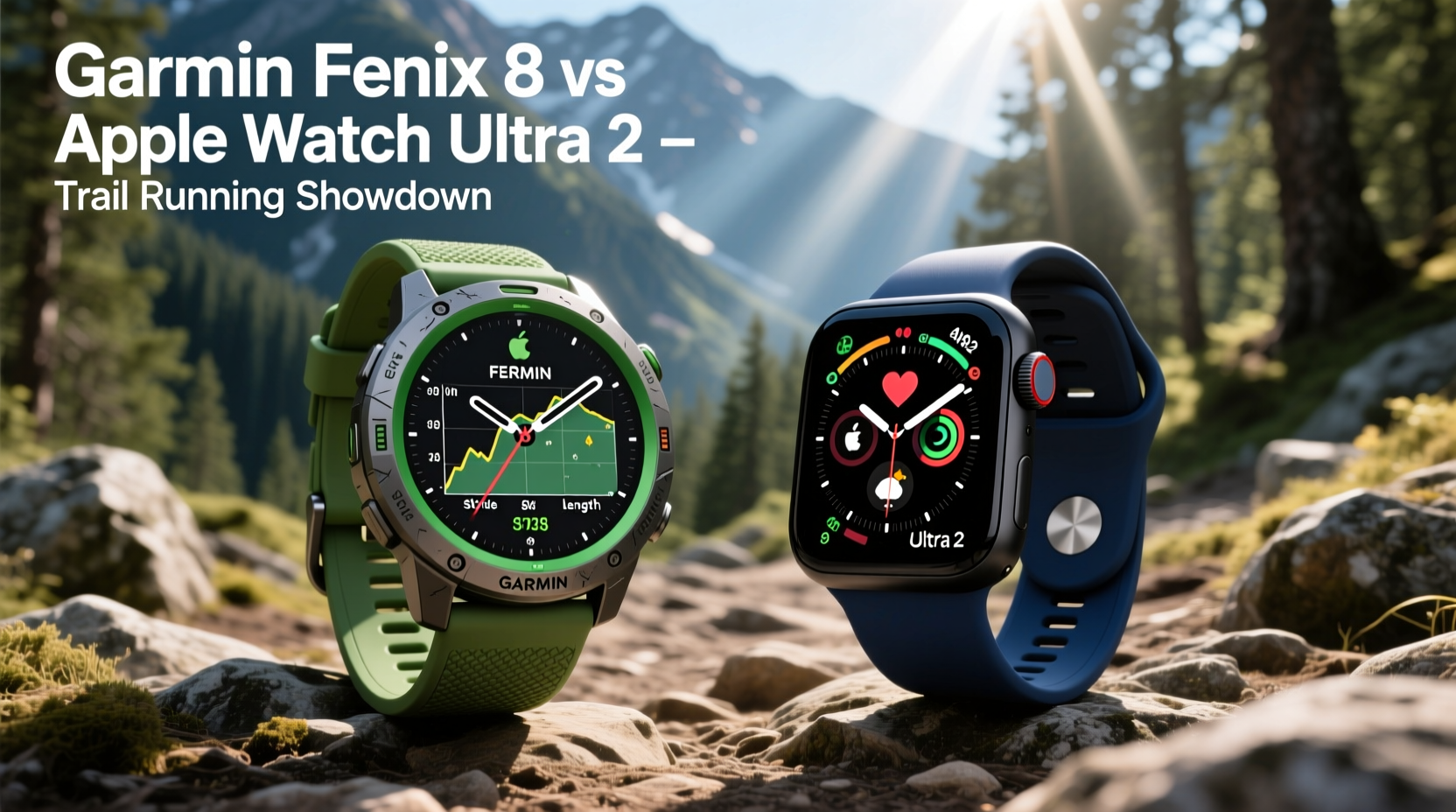
For trail runners, especially those tackling ultras or multi-day backcountry routes, battery life isn't a convenience—it's a necessity. A dead watch mid-run means losing access to critical navigation, safety alerts, and pace data.
The Garmin Fenix 8 leads decisively in this category. In typical GPS mode, it delivers up to 46 hours of continuous use. With solar charging enabled under optimal conditions, that extends to over 70 hours—more than enough for most weekend adventures or even 100-mile races without needing a recharge. In expedition mode, where only essential tracking functions remain active, battery life stretches beyond two weeks.
In contrast, the Apple Watch Ultra 2 offers approximately 36 hours in standard GPS mode. While this is impressive for an Apple device and sufficient for weekend trips, it falls short for extended off-grid missions. Even with Low Power Mode activated, which disables non-essential notifications and background refresh, the Ultra 2 maxes out around 60 hours—still less than the Fenix 8’s base performance.
Tip: For runs exceeding 20 miles, always start with a fully charged watch—and consider carrying a portable solar charger if relying on the Ultra 2.GPS Accuracy and Navigation Features
Precise location tracking is non-negotiable when navigating remote trails. Both watches support multiple satellite systems (GPS, GLONASS, Galileo, and QZSS), ensuring strong signal acquisition even under dense tree cover or deep canyons.
However, the Fenix 8 goes further by integrating topographic mapping directly onto its interface. Preloaded with global TOPO maps, it allows users to view contour lines, elevation profiles, and trail markers without relying on phone connectivity. You can create or download routes via Garmin Connect, transfer them to the watch, and follow turn-by-turn directions using the breadcrumb trail or compass overlay.
The Apple Watch Ultra 2 lacks native offline topographic maps. While it records GPS data accurately and syncs with third-party apps like AllTrails or Gaia GPS on your iPhone, you lose full navigational capability once your phone is out of range. This limitation becomes significant during solo runs where real-time orientation is crucial.
“On technical single-track routes, having a detailed map display saved my team twice during alpine traverses.” — Daniel Reyes, IFMGA-certified mountain guide
Additionally, the Fenix 8 includes incident detection, storm alerts, and ABC sensors (altimeter, barometer, compass) calibrated specifically for altitude changes common in trail environments. These tools help anticipate weather shifts and monitor elevation gain/loss with high precision.
Durability and Environmental Resistance
Trail running exposes gear to mud, water, rocks, and sudden temperature swings. Both watches are built to military-grade standards (MIL-STD-810H), meaning they withstand shock, thermal extremes, and humidity.
The Fenix 8 uses a sapphire crystal lens across most models, providing near-scratch-proof protection. Its fiber-reinforced polymer chassis and stainless steel bezel make it resilient against drops on rocky terrain. It’s rated to 100 meters of water resistance, suitable for swimming, snorkeling, and accidental submersion.
The Apple Watch Ultra 2 features a custom titanium case and a deeper dive-rated depth of 40 meters (ISO 22810 compliant). Its flat dual-sided sapphire crystal improves screen visibility at angles—a benefit when checking stats mid-stride. However, field reports indicate the flat edges can be more prone to gouging when brushing against granite or roots compared to the contoured design of the Fenix.
| Feature | Garmin Fenix 8 | Apple Watch Ultra 2 |
|---|---|---|
| Battery (GPS Mode) | Up to 46 hrs (70+ with solar) | Up to 36 hrs (60 with LPM) |
| Satellite Systems | GPS, GLONASS, Galileo, QZSS, BeiDou | GPS, GLONASS, Galileo, QZSS, BeiDou |
| Topo Maps | Preloaded & offline capable | No native support; requires iPhone |
| Water Resistance | 100 meters | 40 meters (dive-rated) |
| Display | Power Sapphire Solar (MIP transflective) | Flat dual-sided sapphire OLED |
| Navigation Tools | TracBack, route planning, altimeter, storm alert | Compass Waypoints, limited offline nav |
| Ecosystem | Garmin Connect, multi-brand compatibility | iOS-only, tight Apple integration |
Fitness Tracking and Recovery Insights
Both watches deliver robust training analytics, but their approaches differ significantly. The Fenix 8 focuses on performance readiness and load management. Using Firstbeat Analytics, it calculates metrics such as Training Load, Recovery Time, and Performance Condition—data points proven useful for periodized training blocks.
It also provides Trail Running Dynamics when paired with compatible foot pods, measuring vertical oscillation, ground contact time, and stride length. These insights help refine form and prevent injury over repetitive off-road mileage.
The Apple Watch Ultra 2 leverages Apple’s latest S9 chip and second-generation optical heart rate sensor for highly accurate HR monitoring. It introduces advanced metrics like Core Temperature sensing (during sleep and post-workout recovery), which may offer early warnings for overtraining or illness. Additionally, ECG and blood oxygen monitoring provide broader health context, though these are less directly tied to trail running performance.
Where Apple shines is in real-time feedback. With Siri voice commands, you can log splits, pause timers, or send emergency messages hands-free. Notifications from Messages, WhatsApp, or Strava keep you connected—even deep in forested areas with cellular coverage.
Tip: Enable \"Pulse Ox\" sampling during night sleep on either device to track respiratory trends over time—useful for detecting altitude adaptation issues.Real-World Use Case: A 50K Mountain Race Test
To evaluate real-world performance, consider the experience of Sarah Lin, an ultrarunner preparing for the Cascade Crest 50K in Washington State. Her route included 10,000 feet of elevation gain, river crossings, and sections with no cell service.
Sarah used the Fenix 8 throughout her race. She preloaded the official course GPX file, set waypoints at aid stations, and relied on the barometric altimeter to confirm her position when fog obscured landmarks. The watch lasted the entire 14-hour effort with 30% battery remaining. Post-race analysis showed consistent cadence and heart rate zones, and the watch correctly flagged “Poor Recovery” the next day, prompting her to skip a planned tempo run.
Her teammate Mark used the Apple Watch Ultra 2. He appreciated the crisp display and ability to receive motivational texts from family mid-race via LTE. However, he couldn’t view his current location on a topographic map without pulling out his phone—once, this caused a five-minute detour off-trail. His watch died at hour 12, cutting off final segment data. Despite excellent health tracking, the lack of self-contained navigation and shorter battery proved limiting.
This example underscores a key takeaway: while the Ultra 2 enhances connectivity and wellness awareness, the Fenix 8 offers greater autonomy and resilience in isolated, demanding environments.
Step-by-Step Guide: Choosing the Right Watch for Your Trail Style
- Assess your typical run duration. If most runs exceed 4 hours or include overnight segments, prioritize the Fenix 8’s battery advantage.
- Determine your navigation dependency. Solo runners on unmapped trails will benefit more from Fenix’s onboard maps and TracBack feature.
- Evaluate smartphone reliance. If you always carry your iPhone, the Ultra 2’s partial offline function may suffice. If you leave your phone behind, the Fenix is superior.
- Consider ecosystem preference. iPhone users who value seamless integration with Health app, Fitness+, and iMessage may prefer staying within Apple’s ecosystem.
- Test wearability. The Fenix 8 is slightly heavier (~85g vs ~61g), which some find cumbersome over long durations. Try both on a wrist simulator or in-store demo.
- Review training goals. Coached athletes focused on structured progression should lean toward Fenix’s detailed load balancing. Casual runners enjoying scenic loops might prefer Apple’s intuitive interface.
Frequently Asked Questions
Can the Apple Watch Ultra 2 work with non-iPhone devices?
No. The Apple Watch Ultra 2 requires an iPhone 8 or later running iOS 17 or higher. It does not pair with Android phones, making it inaccessible to non-iOS users.
Does the Garmin Fenix 8 support music streaming?
Yes. The Fenix 8 supports offline music storage (via Bluetooth headphones) and integrates with Spotify, Deezer, and Amazon Music. However, you cannot stream directly from the watch without a phone or Wi-Fi connection.
Which watch has better fall detection and emergency response?
Both include fall detection and SOS triggering. The Fenix 8 connects to the Garmin Satellite Network via optional Iridium integration (in newer models), enabling two-way messaging from anywhere globally. The Ultra 2 relies on iPhone proximity or cellular networks, limiting emergency reach in remote zones unless you have LTE service.
Final Verdict: Purpose-Built vs. Connected Performance
The Garmin Fenix 8 and Apple Watch Ultra 2 are both exceptional devices—but they excel in different domains. For pure trail running utility, where self-sufficiency, navigation, and endurance matter most, the Fenix 8 is the superior choice. Its combination of long battery life, comprehensive mapping, and rugged design makes it ideal for serious off-road athletes.
The Apple Watch Ultra 2 appeals to those who want a do-it-all wearable: a fitness tracker, communication hub, and lifestyle companion rolled into one. It performs admirably on shorter trail efforts and integrates beautifully with daily digital routines. But when pushed to the limits of remoteness and duration, it shows its constraints.
If your priority is completing a 100-mile race through national parks with zero external support, go with the Fenix 8. If you’re logging weekend trail sessions near civilization and value post-run smoothies shared instantly on Instagram, the Ultra 2 fits seamlessly into that world.
“The best watch isn’t the most advanced one—it’s the one that doesn’t fail when you need it most.” — Lena Torres, Professional Adventure Racer









