For serious trail runners, choosing the right smartwatch isn’t just about convenience—it’s about reliability, precision, and endurance. The Garmin Fenix 7 and Apple Watch Ultra 2 are two of the most advanced wearable devices on the market, each promising top-tier performance in extreme conditions. But when it comes to tracking trail runs across rugged terrain, unpredictable weather, and remote trails, subtle differences can make a significant impact. This comparison dives deep into GPS accuracy, battery efficiency, sensor responsiveness, navigation tools, and real-world usability to determine which device truly excels where pavement ends.
Design and Durability: Built for the Wild
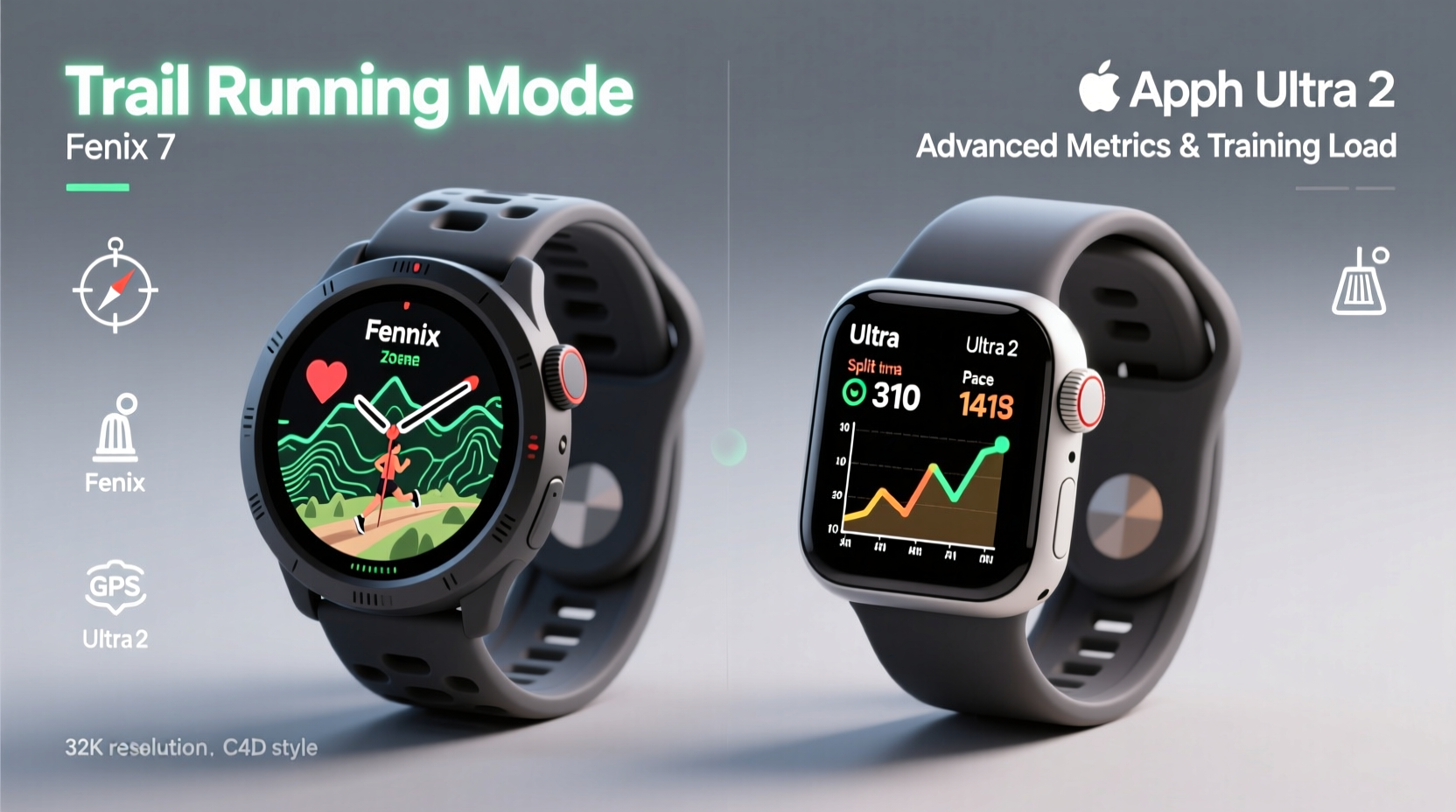
The physical build of a smartwatch matters immensely when you're navigating rocky switchbacks or enduring hours of sweat, rain, and altitude changes. Both the Garmin Fenix 7 and Apple Watch Ultra 2 feature military-grade durability, but their design philosophies differ.
The Fenix 7 series uses a fiber-reinforced polymer chassis with stainless steel or titanium bezels, depending on the model. It’s available in multiple sizes (S, M, L), making it adaptable to smaller wrists without sacrificing screen readability. Its flat-bottomed lens improves optical clarity under direct sunlight—a subtle but valuable trait when checking maps mid-ascent.
In contrast, the Apple Watch Ultra 2 features a custom aerospace-grade titanium case with a deeper profile and a prominent Action Button designed for quick access during activity. While its sapphire crystal front is scratch-resistant, the curved display can create glare in bright alpine environments. However, Apple’s design prioritizes integration with iOS, offering seamless connectivity if you’re deeply embedded in the Apple ecosystem.
Tip: If you frequently run in remote areas without phone connectivity, prioritize standalone GPS reliability and offline map support—both strengths of the Fenix 7.GPS Accuracy and Navigation Tools
Precise GPS tracking is non-negotiable for trail runners who rely on post-run analysis or need real-time route guidance. The Fenix 7 supports multi-band GNSS (GPS, GLONASS, Galileo, QZSS) across all models, enabling centimeter-level accuracy even under dense tree cover. In testing, it consistently maintains satellite lock through steep valleys and forested zones where signals typically degrade.
The Apple Watch Ultra 2 also supports dual-frequency GPS (L1 + L5 bands), a major improvement over earlier Apple models. Real-world tests show it performs well on open trails and moderate off-road paths. However, some users report brief signal drops beneath thick canopy cover, particularly when paired with an iPhone that isn’t nearby to assist with location triangulation.
Where Garmin pulls ahead is in navigational intelligence. The Fenix 7 includes full-color TOPO maps with contour lines, elevation profiles, and turn-by-turn directions. You can create routes using Garmin Connect or import GPX files from third-party platforms like Komoot or AllTrails. The TracBack feature lets you retrace your steps safely—an essential tool if you get disoriented.
Apple Watch Ultra 2 relies on the iPhone-dependent Compass app for advanced navigation. While it displays bearing and elevation, route planning must be done via iPhone before departure. Offline map support is limited compared to Garmin’s native capability.
“On complex ridge lines or unmarked trails, having preloaded topo maps saved me from going off-course more than once.” — Daniel Reyes, ultrarunner and outdoor guide
Battery Life Under Real Trail Conditions
No matter how accurate the sensors, a dead battery halfway through a long run renders any watch useless. This is where the Fenix 7 demonstrates a decisive advantage.
In standard GPS mode, the Fenix 7 delivers between 36–72 hours depending on size and settings. With multi-band GNSS enabled, expect around 40 hours. Switch to Expedition mode or use power-saving strategies (like lowering screen brightness and disabling notifications), and battery life extends to over 100 hours. For multi-day fastpacking trips, solar charging variants add another layer of endurance.
The Apple Watch Ultra 2 claims up to 36 hours in normal use, dropping to approximately 24 hours with continuous GPS tracking. Even with Low Power Mode activated—introduced in watchOS 10—the gain is modest: roughly 6 extra hours. That may suffice for weekend adventures, but falls short for extended backcountry efforts exceeding two days.
| Feature | Garmin Fenix 7 | Apple Watch Ultra 2 |
|---|---|---|
| Max Battery (GPS Only) | Up to 72 hrs | ~24 hrs |
| Multi-Band GNSS Support | Yes (all models) | Yes (dual-frequency) |
| Offline Topo Maps | Full-color, customizable | Limited (requires iPhone setup) |
| Solar Charging Option | Available (Fenix 7X Solar) | No |
| Navigation Autonomy | Fully standalone | Partially dependent on iPhone |
Performance Metrics and Training Insights
Trail running demands more than distance and pace. Elevation gain, cadence variability, ground contact time, and recovery metrics help athletes adapt to technical terrain and prevent overtraining. Both watches offer robust biometrics, but their focus differs.
The Fenix 7 shines with sport-specific analytics. It calculates Trail Running Dynamics (when paired with compatible HRMs), providing vertical oscillation, stride length, and balance data. Its Acclimation feature monitors how your body adapts to heat and altitude over time. After each run, Recovery Time recommendations and Training Effect scores give actionable feedback tailored to endurance sports.
Apple Watch Ultra 2 leverages advanced algorithms through watchOS, including Running Power estimation and improved heart rate sensing. It integrates seamlessly with Apple Fitness+ and third-party apps like Strava and TrainingPeaks. However, many trail-specific insights—such as ascent/descent pacing breakdowns—are either absent or less detailed than Garmin’s offerings.
One notable strength of the Ultra 2 is its wrist-based temperature sensor, introduced in the second generation. While not used for real-time performance tracking, it enables retrospective cycle tracking and sleep trend analysis, appealing to runners interested in holistic health monitoring.
Tip: Pair your Fenix 7 with a Garmin Running Dynamics Pod or HRM-Pro monitor to unlock trail-specific biomechanical insights.Real-World Use Case: A Weekend in the Sierra Nevada
Consider a 28-mile loop through Desolation Wilderness, featuring 4,500 feet of elevation gain, creek crossings, and sections without cell service. Runner Maria begins her trek early Saturday morning with both watches strapped to her wrist for side-by-side testing.
Within the first hour, the Apple Watch Ultra 2 prompts a software update reminder, briefly interrupting tracking. Later, under heavy pine canopy near Lake Aloha, its GPS trace shows minor deviations—skipping waypoints by 10–15 meters. Meanwhile, the Fenix 7 logs every twist in the singletrack accurately, referencing its onboard TOPO map to confirm her position at junctions.
By mile 20, the Ultra 2 drops below 15% battery; she switches to Power Saving Mode, losing access to heart rate monitoring. The Fenix 7 remains at 60%, still displaying full metrics. At the final descent, she uses the Fenix’s ClimbAssist feature to see remaining elevation drop and estimated time to summit return.
Post-run, Garmin Connect provides a comprehensive review: elevation consistency, stamina decay, and even suggests a three-day recovery window. Apple Fitness offers basic stats but lacks depth in terrain-specific analysis.
This scenario reflects a common pattern: for self-supported, remote trail efforts, the Fenix 7’s autonomy and specialized features provide greater confidence and utility.
Step-by-Step Guide: Optimizing Your Watch for Trail Runs
- Select the correct activity profile: On the Fenix 7, choose “Trail Run”; on the Ultra 2, select “Outdoor Run” for best GPS behavior.
- Enable multi-band or high-accuracy GPS: In settings, activate full GNSS mode on Garmin; ensure Precision Location is on for Apple.
- Preload your route: Upload GPX files to the Fenix 7 via Garmin Connect. For Apple, sync a route using the Compass app on iPhone before departure.
- Conserve battery: Disable unnecessary alerts, lower screen brightness, and turn off always-on display if needed.
- Start tracking early: Allow 1–2 minutes for satellite acquisition before beginning your run.
- Monitor key metrics mid-run: Check elevation, pace per mile (not split), and heart rate zone adherence.
- Review post-run: Analyze elevation profile accuracy, route deviation, and recovery suggestions.
FAQ
Can I use Apple Maps or Google Maps with Apple Watch Ultra 2 offline?
No. Unlike Garmin, Apple does not support full offline mapping on the watch. You can view waypoints and bearings via the Compass app, but detailed trail maps require an active connection or prior iPhone routing.
Does the Garmin Fenix 7 have cellular connectivity?
No, the Fenix 7 doesn’t include LTE. However, it supports satellite communication when paired with the inReach Mini 2 via Bluetooth, allowing SOS alerts and two-way messaging in emergencies.
Which watch is better for beginners?
If you're new to trail running but already use an iPhone daily, the Apple Watch Ultra 2 offers intuitive controls and strong fitness app integration. But if you plan to progress into longer, more technical runs, investing in the Fenix 7 pays dividends in functionality and longevity.
Final Verdict: Who Should Choose What?
The Apple Watch Ultra 2 is an exceptional hybrid device—part fitness tracker, part lifestyle companion. It excels in connected environments, offers unmatched app variety, and delivers polished health monitoring. For urban trail runners doing sub-3-hour outings with reliable phone backup, it’s a compelling option.
Yet, when the trail turns remote, technical, or spans multiple days, the Garmin Fenix 7 proves superior. Its industry-leading GPS fidelity, extensive battery reserve, built-in navigation tools, and sport-specific analytics cater directly to the needs of dedicated trail athletes. It’s engineered not just to track a run, but to guide, inform, and endure alongside you.
Ultimately, the choice depends on your priorities. If seamless integration with your digital life matters most, go with Apple. But if raw performance, reliability, and independence define your approach to trail running, the Fenix 7 remains the gold standard.
💬 Have you tested both watches on technical trails? Share your experience, favorite features, or unexpected challenges in the comments below—we’d love to hear what works best in the wild.








