
For urban commuters, choosing between a folding e-bike and a traditional non-electric commuter bike often comes down to convenience, cost, and terrain. Nowhere is this decision more critical than when navigating hilly cities or routes with sustained inclines. While both options offer portability and practicality, their ability to handle elevation varies significantly. Understanding the mechanics, rider effort, and real-world performance on hills can help you make an informed choice—especially if your daily route includes steep climbs.
Mechanical Differences That Impact Hill Performance
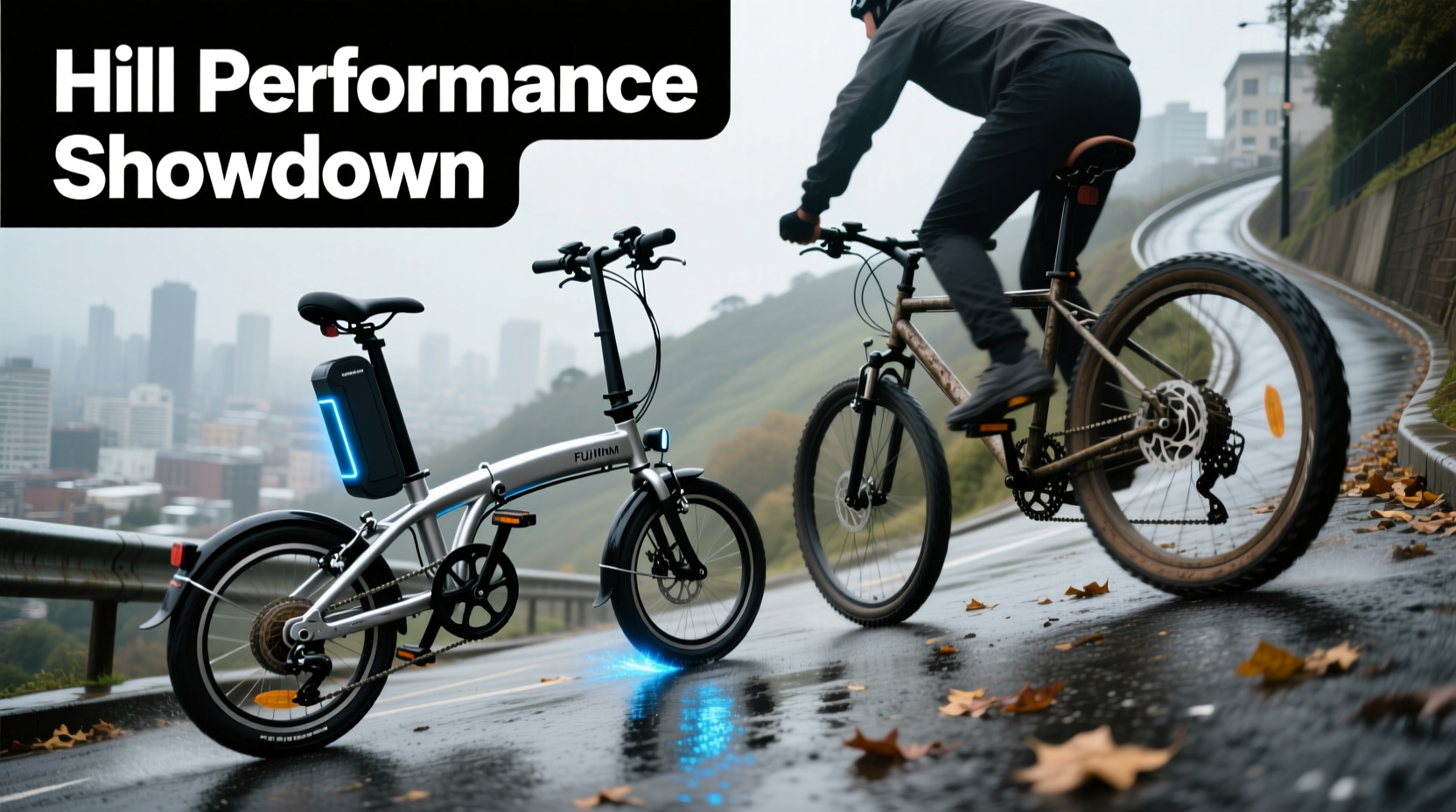
The fundamental difference between a folding e-bike and a traditional commuter bike lies in power delivery. Traditional bikes rely solely on human pedaling. Folding e-bikes, despite their compact size, are equipped with electric motors and batteries that assist the rider. This assistance is crucial on hills, where resistance increases dramatically due to gravity and gradient.
Folding e-bikes typically use either hub-drive or mid-drive motors. Mid-drive systems, though less common in compact models, provide superior torque and weight distribution, making them especially effective on inclines. Hub-drive motors (rear or front) are simpler and more affordable but may struggle on steeper gradients, particularly if the rider is carrying extra weight or riding into headwinds.
Traditional commuter bikes, even high-end ones with multiple gears, depend entirely on leg strength and cadence. On a 6% grade, a rider must generate approximately 20–30% more power than on flat ground. For most untrained cyclists, this becomes unsustainable over distances longer than a few hundred meters.
Tip: When evaluating folding e-bikes for hilly areas, prioritize models with mid-drive motors and at least 50 Nm of torque for optimal climbing performance.Power Output and Rider Effort: The Real-World Comparison
To understand hill-handling capability, it’s essential to compare actual power output. An average cyclist can sustain about 100–150 watts on flat terrain. On a moderate 5% incline, that same rider might need to produce 200+ watts to maintain 15 km/h (9 mph). Few casual commuters can consistently deliver that level of effort, especially after a long workday.
In contrast, most folding e-bikes offer pedal-assist levels up to 250–350 watts, effectively doubling or tripling the rider’s input. This means a rider contributing 100 watts can receive 200 watts from the motor, resulting in 300 watts of total propulsion—more than enough to conquer typical urban hills without breaking a sweat.
A study by the European Cyclists’ Federation found that e-bike users were 47% more likely to replace car trips in hilly cities compared to traditional bike riders. The data suggests that electric assistance isn’t just a convenience—it’s a necessity for maintaining cycling as a viable commuting option in elevated terrain.
“Electric assist transforms what’s physically possible on a bicycle. In cities like San Francisco or Lisbon, e-bikes aren’t a luxury—they’re a prerequisite for reliable daily commuting.” — Dr. Lena Torres, Urban Mobility Researcher, Technical University of Munich
Weight and Frame Design: Trade-offs in Climbing Efficiency
One argument often made in favor of traditional commuter bikes is their lighter weight. A standard steel or aluminum commuter bike weighs between 10–14 kg (22–31 lbs). Folding e-bikes, due to integrated motors and batteries, typically range from 16–22 kg (35–48 lbs). This added mass can seem like a disadvantage—especially when climbing.
However, the perception of weight matters more than the number on the scale. On a traditional bike, the rider feels every kilogram during a climb because they’re responsible for all propulsion. On a folding e-bike, the motor offsets the extra weight by providing consistent torque. As a result, a heavier e-bike often feels easier to ride uphill than a lighter non-assisted model.
Frame geometry also plays a role. Folding bikes usually have smaller wheels (16”–20”) compared to the 26” or 700c wheels on traditional commuter bikes. Smaller wheels have higher rolling resistance and reduced momentum, which can make hill starts slightly harder. However, modern folding e-bikes compensate with gear ratios optimized for low-speed torque, ensuring strong initial acceleration even from a stop on an incline.
Real-World Example: Commuting in Seattle
Consider Sarah, a software developer living in Capitol Hill, Seattle—one of the city’s steepest neighborhoods. Her daily commute involves a 1.2 km (0.75 mile) climb with an average gradient of 7%, peaking at 12%. She initially used a lightweight hybrid commuter bike with 21 speeds. Despite being moderately fit, she arrived at work drenched in sweat and fatigued, often needing 10–15 minutes to recover before starting her day.
After switching to a folding e-bike with a 250W rear hub motor and three assist levels, her experience changed dramatically. Using “high assist” mode on the climb, she maintained 18 km/h (11 mph) with minimal effort. Her heart rate remained within a comfortable aerobic zone, and she arrived at work refreshed. The folding feature allowed her to store the bike under her desk, eliminating concerns about theft or limited rack space.
Sarah’s case illustrates a broader trend: in cities with significant elevation changes, folding e-bikes don’t just match traditional bikes—they outperform them in terms of usability, consistency, and rider comfort.
Comparison Table: Key Features Affecting Hill Performance
| Feature | Folding E-Bike | Traditional Commuter Bike |
|---|---|---|
| Motor Assistance | Yes (250–350W typical) | No |
| Typical Weight | 16–22 kg (35–48 lbs) | 10–14 kg (22–31 lbs) |
| Wheel Size | 16”–20” | 26” or 700c |
| Gear Range | Often internally geared hubs (3–8 speeds), optimized for torque | Wide-range derailleurs (7–24 speeds) |
| Hill Climbing Ease | High (with proper assist level) | Depends on rider fitness and gearing |
| Rider Fatigue on Inclines | Low to moderate | Moderate to high |
| Portability & Storage | Excellent (folds compactly) | Limited (requires full storage space) |
| Cost (USD) | $1,200–$2,500 | $400–$1,000 |
Step-by-Step Guide: Choosing the Right Bike for Hilly Terrain
If you're deciding between a folding e-bike and a traditional commuter bike for a hilly route, follow this evaluation process:
- Map Your Route Gradient: Use tools like Google Earth or Strava Heatmap to determine the steepest sections of your commute. Routes with sustained grades above 5% favor e-bikes.
- Assess Your Fitness Level: Be honest about your stamina. If you dread climbing now, an e-bike will likely improve consistency and motivation.
- Test Ride Both Options: Many urban bike shops offer demo units. Test a folding e-bike on a real incline to feel the difference in effort.
- Check Motor Type and Battery Range: Look for at least 300–400 Wh battery capacity and a mid-drive or high-torque hub motor for sustained climbs.
- Evaluate Storage Needs: If you take public transit, live in a small apartment, or lack secure bike parking, the folding advantage may outweigh minor performance trade-offs.
- Calculate Total Cost of Ownership: Include potential savings from reduced transit fares, gym memberships, or car usage when comparing prices.
Common Misconceptions About Folding E-Bikes and Hills
Several myths persist about folding e-bikes and their suitability for hilly areas:
- Myth: \"Small wheels can't handle steep climbs.\" Reality: Wheel size affects rolling efficiency, but motor torque and gear ratios matter more. Modern folding e-bikes are engineered specifically for urban challenges, including hills.
- Myth: \"Folding bikes are less stable on inclines.\" Reality: Stability is determined by frame rigidity and wheelbase. High-quality folding mechanisms lock securely and do not compromise safety or control.
- Myth: \"E-bikes are cheating.\" Reality: Electric assist enables people of all fitness levels to commute sustainably. It’s not about replacing effort—it’s about making cycling accessible and practical.
FAQ: Your Hill-Climbing Questions Answered
Can a folding e-bike climb as well as a mountain e-bike?
While folding e-bikes aren’t designed for off-road trails, they can handle urban-grade hills just as effectively as many mountain e-bikes. Their motors are tuned for consistent speed rather than extreme off-road torque, but for paved roads, performance is comparable on inclines up to 15%.
Do traditional bikes build more fitness?
Yes, traditional bikes require more physical effort, which can improve cardiovascular health and leg strength over time. However, if hill fatigue causes you to abandon cycling altogether, an e-bike may be the better long-term solution for staying active.
Are folding e-bikes safe on downhill sections after climbing?
Absolutely. Most folding e-bikes come with hydraulic or mechanical disc brakes designed to handle repeated stops on descents. Their lower center of gravity (due to battery placement) often improves braking control compared to lighter traditional bikes.
Final Recommendation: Prioritize Practicality Over Purity
When it comes to handling hills, folding e-bikes outperform traditional commuter bikes in nearly every practical metric: rider effort, consistency, comfort, and usability. While purists may argue for the simplicity and lightness of non-assisted bikes, real-world commuting demands reliability—not ideals.
If your route includes regular climbs, investing in a folding e-bike isn’t just about ease—it’s about sustainability. You’re more likely to stick with cycling as your primary mode of transport if each trip doesn’t end in exhaustion. Combine that with the unmatched portability of a foldable design, and you have a transportation tool perfectly suited for modern urban life.
That said, traditional bikes still hold value for flat cities, short distances, or riders seeking maximum physical engagement. But for anyone facing persistent hills, the electric advantage is too significant to ignore.
“The future of urban mobility isn’t about faster bikes—it’s about smarter ones. E-bikes remove barriers, not challenge.” — Carlos Mendez, Director, Institute for Sustainable Transport Innovation
Take Action Today
Don’t let hills dictate your commute. Whether you’re tired of arriving at work soaked in sweat or struggling to maintain a cycling habit, it’s time to reassess your options. Visit a local dealer, test a folding e-bike on a real incline, and experience the difference firsthand. Share your journey with others—your insight could inspire someone else to ditch the car and embrace a cleaner, healthier, and more efficient way to move through the city.
💬 Have experience with folding e-bikes on hills? Share your story in the comments and help others make smarter commuting choices.








