Urban mobility is evolving fast. As cities grow denser and traffic congestion worsens, more commuters are turning to electric bicycles as a sustainable, efficient alternative to cars and public transit. Among the most debated choices today: foldable e-bikes versus standard e-bikes. Both offer electric assistance, comfort, and eco-friendly transport—but they cater to different lifestyles and needs. For city dwellers navigating tight apartments, crowded sidewalks, and multi-modal commutes, the decision isn’t just about speed or battery life. It’s about practicality, space, and daily usability.
This article breaks down the key differences between foldable and standard e-bikes, examining their strengths and trade-offs in real urban environments. Whether you're biking to work, combining cycling with subway rides, or storing your bike in a studio apartment, understanding these distinctions will help you choose the model that aligns best with your routine.
Portability and Storage: The Foldable Advantage
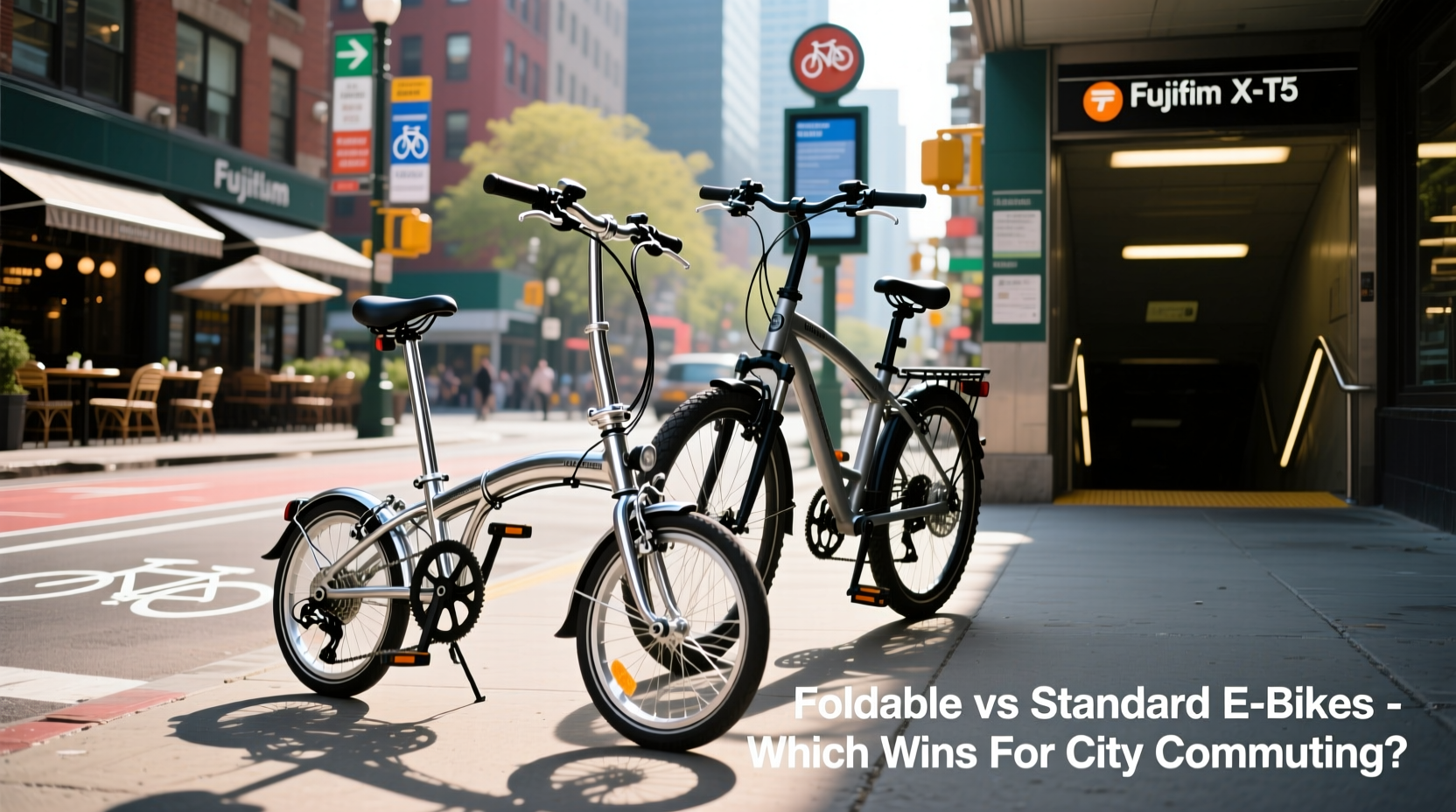
The most obvious benefit of a foldable e-bike is its compactness. When folded, many models reduce their footprint by up to 50%, making them easier to store in small apartments, under desks, or in office closets. This is especially valuable in high-density urban areas where garage or outdoor storage isn’t an option.
Foldable e-bikes are designed with hinges at the frame and handlebars, allowing users to collapse the structure in under 30 seconds. Some advanced models even feature quick-release pedals and adjustable stems to further minimize bulk. Once folded, they can be wheeled like luggage using integrated rear wheels and a pull handle—ideal for last-mile travel after hopping off a train or bus.
Tip: Always lock both the front and rear wheels when folding your e-bike in public spaces—even if it's folded, components can still be stolen.In contrast, standard e-bikes maintain a traditional bicycle frame and typically require dedicated wall mounts, floor stands, or secure outdoor racks. While some are equipped with removable batteries and seats to deter theft, their overall size makes indoor storage impractical for many city residents.
Ride Quality and Performance Comparison
While foldables win on convenience, standard e-bikes generally deliver a smoother, more stable ride. Their longer wheelbase, larger wheels (usually 26” or 700c), and rigid frames absorb road vibrations better, offering improved handling over uneven pavement, potholes, and curbs—common features in urban landscapes.
Foldable e-bikes often use smaller wheels (16”–20”) to accommodate compact design. Smaller wheels increase maneuverability but transmit more shock from bumps, leading to a bumpier experience on rough roads. Additionally, the hinge mechanisms in the frame can introduce slight flex during aggressive pedaling or braking, reducing overall stiffness and responsiveness.
Motor power and battery capacity also tend to favor standard models. Most full-sized e-bikes come with motors ranging from 500W to 750W and batteries exceeding 600Wh, enabling longer ranges (up to 80 km or more per charge) and stronger hill-climbing ability. Foldable models usually cap out around 36V/10Ah (360Wh), limiting range to 40–60 km depending on assist level and rider weight.
“Foldable e-bikes have made huge strides in performance, but physics still favors larger frames and wheels when it comes to stability and efficiency.” — Dr. Lena Torres, Urban Mobility Researcher at MIT Sustainable Transport Lab
Practical Use Cases: Who Benefits From Each Type?
Understanding how you’ll actually use the bike matters more than technical specs alone. Consider your commute pattern, living situation, and transportation ecosystem.
Foldable E-Bikes Are Ideal If You:
- Live in a small apartment or shared housing with limited storage
- Combine cycling with public transit (e.g., taking the subway or commuter rail)
- Need to bring your bike indoors frequently—for security or weather protection
- Travel often and want a portable option for business trips or weekend getaways
- Primarily ride short distances (under 10 km one way)
Standard E-Bikes Make More Sense If You:
- Commute longer distances (15+ km each way)
- Ride on mixed terrain, including hills or poorly paved streets
- Have access to secure storage like a basement, garage, or private balcony
- Prioritize comfort and ride quality over portability
- Plan to carry cargo, children, or use panniers regularly
Mini Case Study: Two Commuters, Two Choices
Maria, 29 – Downtown Apartment Dweller
Maria lives in a 450-square-foot studio in downtown Seattle. Her office is 6 km away, but the route includes a steep hill and unpredictable weather. She takes the light rail partway and bikes the rest. A foldable e-bike was essential—she folds it at the station and rolls it into her office. Though the ride feels slightly less smooth uphill, the portability outweighs the minor discomfort. She charges the battery every two days and appreciates never needing a parking spot.
Derek, 37 – Suburban-to-City Commuter
Derek drives to a park-and-ride lot outside Portland and bikes 12 km into the financial district. He owns a standard e-bike with a long-range battery and suspension fork. The extra weight doesn’t matter since he leaves it parked in a secured bike cage all day. On rainy mornings, he uses fenders and cargo racks to carry his laptop and lunch. For him, comfort, reliability, and range trump compactness.
Comparison Table: Key Features at a Glance
| Feature | Foldable E-Bike | Standard E-Bike |
|---|---|---|
| Weight | 18–25 kg | 20–30 kg |
| Wheel Size | 16”–20” | 26”–700c |
| Battery Range | 40–60 km | 60–100 km |
| Storage Space Needed | Fits in closet or under desk | Requires wall mount or floor space |
| Transit Compatibility | Easy to carry on buses/trains | Often restricted or requires disassembly |
| Ride Comfort | Moderate; bumpy on rough surfaces | High; better shock absorption |
| Average Price | $1,800–$2,800 | $1,500–$3,500 |
Step-by-Step Guide: Choosing the Right Model for Your City Commute
Selecting between a foldable and standard e-bike shouldn’t be arbitrary. Follow this process to ensure your choice fits your lifestyle:
- Map Your Daily Route – Use Google Maps or Strava to measure distance, elevation gain, and surface conditions. Routes with frequent hills or poor pavement favor standard e-bikes.
- Evaluate Your Storage Options – Can you safely store a full-sized bike indoors? If not, folding may be necessary. Measure your available space against product dimensions.
- Assess Multi-Modal Needs – Do you take trains, buses, or ferries? Check local transit rules on e-bike carriage. Foldables are almost always permitted; standard bikes may face restrictions.
- Test Ride Both Types – Visit local dealerships or rent models for a weekend. Pay attention to ease of folding, seat height adjustment, and throttle response.
- Calculate Total Cost of Ownership – Include insurance, locks, maintenance, and potential accessories like lights or racks. Foldables sometimes require specialized parts due to proprietary designs.
- Consider Future Use – Will your needs change in a year? Moving to a house with a garage? Starting a family? Plan ahead to avoid premature replacement.
Frequently Asked Questions
Can foldable e-bikes handle hills as well as standard ones?
Most modern foldable e-bikes come with mid-drive or hub motors capable of climbing moderate inclines. However, due to shorter wheelbases and lighter frames, they may feel less stable on steep grades compared to heavier, full-sized models. Riders should check motor torque ratings—higher Nm values (e.g., 60Nm+) indicate better hill performance.
Are foldable e-bikes harder to steal?
Not necessarily. While their portability allows owners to bring them indoors—a major security advantage—their popularity also makes them targets in public spaces. Always use a sturdy U-lock or folding lock, and remove the battery when unattended. GPS trackers are recommended for high-end models.
Do standard e-bikes depreciate faster than foldables?
No clear trend exists. Depreciation depends more on brand reputation, usage, and condition than form factor. Premium foldables (like Brompton Electric or Tern Vektron) retain value well due to niche demand, while mass-market standard bikes may lose value quicker unless well-maintained.
Checklist: Final Decision-Making Tool
Before purchasing, go through this checklist to confirm your choice aligns with your needs:
- ✅ I know my average commute distance and elevation profile
- ✅ I’ve measured my available storage space
- ✅ I understand local transit policies on e-bike carriage
- ✅ I’ve test-ridden at least one model of each type
- ✅ I’ve budgeted for essential accessories (lock, helmet, lights)
- ✅ I’m confident in charging logistics (outlet access, frequency)
- ✅ I’ve reviewed warranty terms and service availability nearby
Conclusion: Matching Form to Function
There’s no universal “better” option between foldable and standard e-bikes. The best choice depends entirely on how, where, and why you commute. Foldable models excel in hyper-urban environments where space is scarce and transit integration is key. They empower riders who value discretion, flexibility, and indoor security. Standard e-bikes shine when performance, comfort, and range are top priorities—especially for longer or more physically demanding routes.
Ultimately, the ideal city e-bike blends seamlessly into your life rather than dictating new habits. Whether you fold it up beside your desk or park it in a secure rack, what matters is that it gets you where you need to go—efficiently, reliably, and without stress.
🚀 Ready to upgrade your commute? Try a rental or demo model this week and see firsthand which style suits your rhythm. Share your experience in the comments and help others navigate the future of urban riding.








