
For city dwellers living in compact apartments, every square foot counts. As urban transportation evolves, electric bikes have become a go-to solution for fast, eco-friendly commutes. But when space is limited, the choice between a foldable e-bike and a standard commuter e-bike becomes critical. Both offer distinct advantages, but only one may truly align with the realities of apartment living. Understanding their differences in size, storage, usability, and performance helps make an informed decision that supports both lifestyle and spatial constraints.
Space Efficiency: The Core Challenge
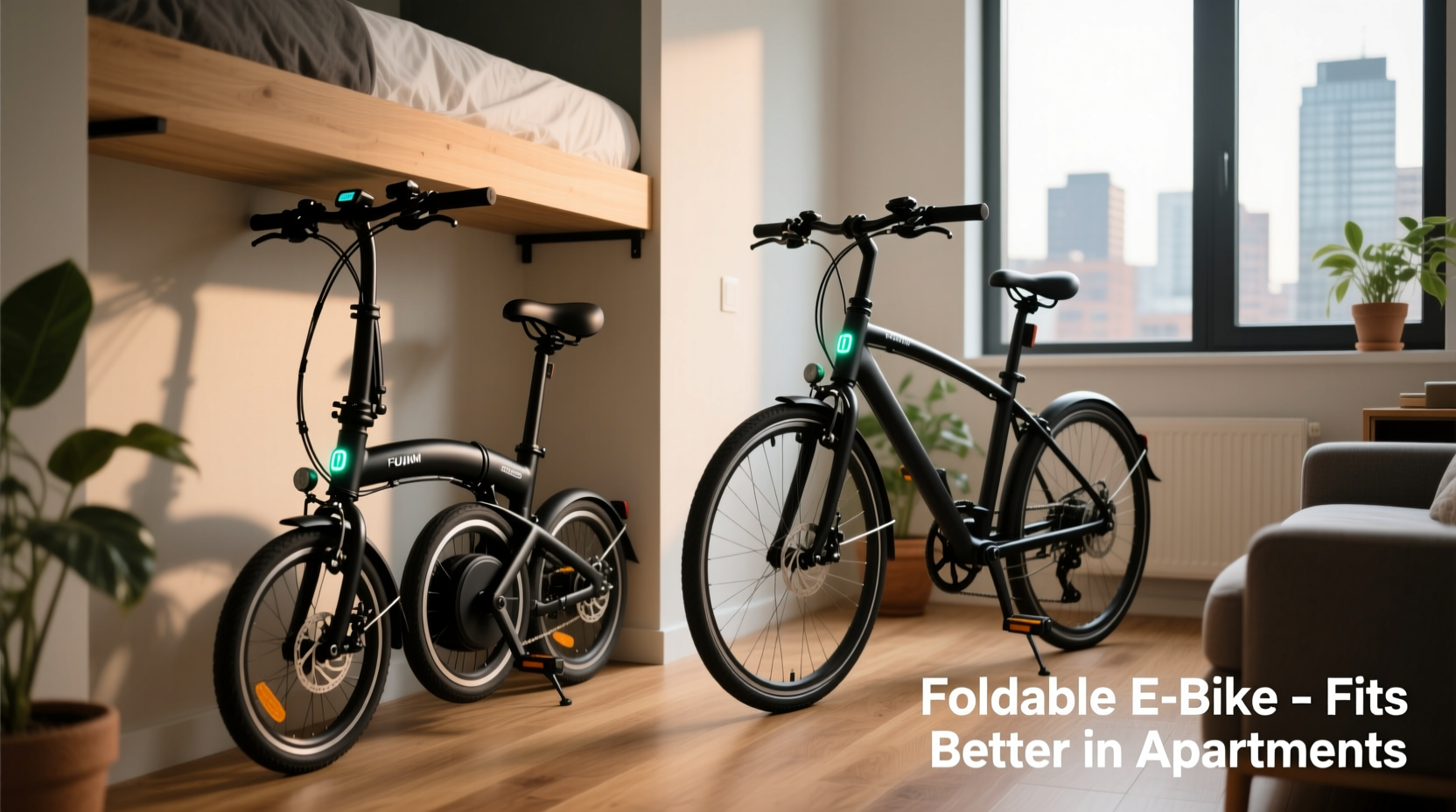
In many urban apartments—especially studio units or converted lofts—floor space is at a premium. Bikes stored in hallways can violate fire codes, and leaving them on balconies exposes them to weather and theft. This makes indoor storage not just a preference but a necessity.
Foldable e-bikes are specifically engineered for compactness. When folded, they typically measure around 30–36 inches in height and 20–24 inches in width, allowing them to fit under a bed, in a closet, or tucked beside a sofa. Their weight, while still substantial due to the battery and motor (usually 40–50 lbs), is manageable for lifting into storage spots.
Standard commuter e-bikes, by contrast, maintain a traditional bicycle frame. Even the most streamlined models require at least 6 feet of floor length and often stand over 4 feet tall. Storing one indoors without disrupting daily movement is difficult unless you have a dedicated utility room or large entryway.
Tip: Measure your tightest storage area before purchasing any e-bike—door frames, stairwells, and elevator dimensions matter just as much as the apartment itself.Performance and Ride Quality Comparison
While foldable e-bikes win in space savings, compromises exist in ride dynamics. Smaller wheels (typically 16” to 20”) reduce stability and increase vibration on uneven pavement. The shorter wheelbase can make high-speed riding feel twitchy, especially in windy conditions or during sudden maneuvers.
Standard commuter e-bikes usually feature 26” or 27.5” wheels, offering smoother rolling over cracks, potholes, and curbs. Their longer frames provide better weight distribution, making them more comfortable for rides exceeding 5 miles. Suspension forks, ergonomic grips, and wider saddles further enhance comfort during longer commutes.
Motor output and battery capacity also differ. Foldable models often use smaller batteries (36V 10Ah or less) to keep weight down, resulting in average ranges of 25–40 miles per charge. Standard commuters frequently pack larger batteries (up to 500–750Wh), delivering 50+ mile ranges—ideal for multi-stop errands or hybrid work commutes.
“Urban riders need reliability and range, but space limitations can’t be ignored. Foldable e-bikes serve well for short trips, but serious commuters should assess total weekly mileage.” — Marcus Lin, Urban Mobility Engineer at CityTransit Labs
Detailed Comparison Table: Foldable vs Standard Commuter E-Bikes
| Feature | Foldable E-Bike | Standard Commuter E-Bike |
|---|---|---|
| Average Weight | 40–50 lbs | 45–60 lbs |
| Stored Dimensions | 30” x 20” x 24” (approx.) | 72” x 28” x 40” (approx.) |
| Wheel Size | 16”–20” | 26”–27.5” |
| Battery Range | 25–40 miles | 40–70 miles |
| Charging Time | 3–5 hours | 4–6 hours |
| Storage Flexibility | High – fits under beds, closets | Low – requires dedicated space |
| Ride Comfort | Moderate – stiff on rough roads | High – better shock absorption |
| Theft Risk (Indoor Storage) | Lower – easier to bring inside | Higher – often left in hallways |
| Price Range | $1,200–$2,000 | $1,500–$3,000+ |
Real-Life Scenario: Two Commuters, Two Choices
Jamal lives in a 550-square-foot Brooklyn studio. His commute is 3.5 miles each way through mixed bike lanes and traffic. He shares a narrow hallway with five neighbors and has no storage room. After researching options, he bought a Brompton Electric foldable e-bike. He folds it in under two minutes and stores it behind his couch. On rainy days, he brings it fully indoors. While he notices the small wheels bounce on cobblestone streets, the convenience outweighs minor discomfort.
Meanwhile, Lena rents a ground-floor unit in Portland with a private patio. Her job is 12 miles away, requiring her to navigate hills and long stretches of road. She chose a Trek Allant+ 7S, a full-sized commuter e-bike with pedal assist up to 28 mph and a 60-mile range. She locks it in her secured patio shed. Although she couldn’t store it inside her apartment, the extra space outside made it feasible. For her, performance and endurance mattered more than portability.
Their stories highlight a crucial point: the best choice depends not just on bike specs, but on personal context—commute length, terrain, building layout, and security concerns.
Practical Checklist: Choosing the Right E-Bike for Apartment Living
- ✅ Measure your available indoor storage space (height, width, depth)
- ✅ Confirm building rules on indoor bike storage and lithium battery policies
- ✅ Calculate your average one-way commute distance
- ✅ Test ride both foldable and standard models if possible
- ✅ Consider how often you’ll carry the bike up stairs or onto transit
- ✅ Evaluate battery removal ease for indoor charging
- ✅ Check local theft rates and garage/lobby security
- ✅ Factor in long-term maintenance access and service centers
Step-by-Step Decision Guide
- Assess Your Space: Use a tape measure to determine the largest object you can realistically store indoors. Include clearance for opening doors or drawers nearby.
- Map Your Commute: Use Google Maps or Strava to log your typical route. Note elevation changes, surface types, and total distance.
- Determine Usage Frequency: Will you ride 2 days a week or 5? Frequent riders benefit from comfort and durability found in standard models—if space allows.
- Research Building Policies: Some landlords prohibit indoor storage of e-bikes due to fire risks from lithium batteries. Others allow it only if the battery is removed.
- Test Foldability: Watch video demos or visit a dealer. Folding shouldn’t take more than 90 seconds and should not require tools.
- Evaluate Charging Setup: Can you plug in near your storage spot? Avoid extension cords; they’re fire hazards and inefficient.
- Compare Total Cost of Ownership: Include insurance, maintenance, lock quality, and potential replacement parts like tires or brake pads.
- Make a Shortlist: Narrow to 2–3 models and read verified owner reviews focusing on long-term reliability and customer support.
Frequently Asked Questions
Can I take a foldable e-bike on public transit?
Yes, in most cases. Foldable e-bikes are permitted on subways, buses, and commuter trains in cities like New York, London, and Tokyo, provided they are fully folded and do not obstruct aisles. Always check local transit authority rules—some ban motorized bikes entirely or restrict peak-hour usage.
Are foldable e-bikes safe for daily commuting?
They are safe when used appropriately. Ensure brakes, lights, and tire pressure are checked weekly. Due to smaller wheels, avoid high speeds on rough surfaces. Wear a helmet and use reflective gear, especially in low-light conditions.
Do standard commuter e-bikes depreciate faster than foldable ones?
Depreciation depends more on brand, condition, and usage than type. However, foldable e-bikes from reputable brands like Brompton or Tern tend to hold value better due to niche demand and perceived innovation. Standard models from mass-market brands may see steeper declines after 2–3 years.
Expert Insight: Design Trade-offs in Compact Mobility
Engineering a foldable e-bike involves balancing strength, weight, and folding mechanics. Hinges and joints introduce potential failure points, so manufacturers must reinforce these areas without adding excessive bulk. Meanwhile, integrating a powerful motor and sufficient battery into a tiny frame limits design flexibility.
“The real breakthrough isn’t just folding—it’s making a compact bike feel stable and responsive. That takes advanced geometry tuning and smart component selection.” — Dr. Elena Ruiz, Mechanical Design Lead at UrbanVolt Bikes
This explains why higher-end foldable models cost nearly as much as premium commuters. You're paying for miniaturization, precision engineering, and materials that withstand repeated folding stress.
Final Recommendation Based on Lifestyle
If you live in a small apartment with no secure outdoor storage and commute less than 10 miles round-trip, a foldable e-bike is likely the superior choice. It maximizes convenience, reduces theft risk, and integrates seamlessly into tight living spaces. Look for models with integrated lights, puncture-resistant tires, and removable batteries for hassle-free charging.
If your commute exceeds 15 miles daily, includes steep hills, or demands extended range, and you have access to secure off-street storage (like a basement locker or gated yard), a standard commuter e-bike offers unmatched performance and comfort. In this case, sacrificing some indoor space pays off in reduced fatigue and greater reliability over time.
Hybrid solutions also exist. Some mid-sized e-bikes offer partial folding (e.g., handlebars and seat post collapse) or quick-release frames that split in half. These strike a middle ground—more compact than full commuters but more stable than ultra-minis.
Conclusion: Make Space Work for You
The decision between a foldable e-bike and a standard commuter isn’t about which is objectively better—it’s about which fits your life. In dense urban environments where space dictates functionality, foldables offer a compelling advantage. But for those prioritizing ride quality and distance, a standard model remains the gold standard—provided storage challenges are solved.
Don’t let limited square footage limit your mobility. By evaluating your real-world needs—not just marketing claims—you can choose an e-bike that enhances your commute, protects your investment, and respects your living space.
🚀 Ready to simplify your urban commute? Reassess your storage options today, test a foldable model at a local shop, and see how a compact e-bike could transform your daily routine. Share your experience below—your insight might help another city dweller make the right call.








