
When it comes to carrying essentials on a hiking trail—phone, snacks, water, first aid, or a rain jacket—your choice of gear can make the difference between a smooth trek and constant readjustments. Two popular options have emerged in recent years: the fanny pack (or waist pack) and the chest harness. Both promise hands-free convenience, but they differ significantly in how securely they stay in place during movement. For hikers who prioritize stability, accessibility, and long-term comfort, understanding these differences is essential.
While fanny packs have enjoyed a fashion revival, their functional design has roots in outdoor utility. Chest harnesses, traditionally used with hydration packs or tactical vests, are gaining traction among minimalist hikers for their balanced weight distribution. But which one truly stays put when the terrain gets steep, the pace quickens, or the weather turns unpredictable?
Understanding Movement Dynamics on the Trail
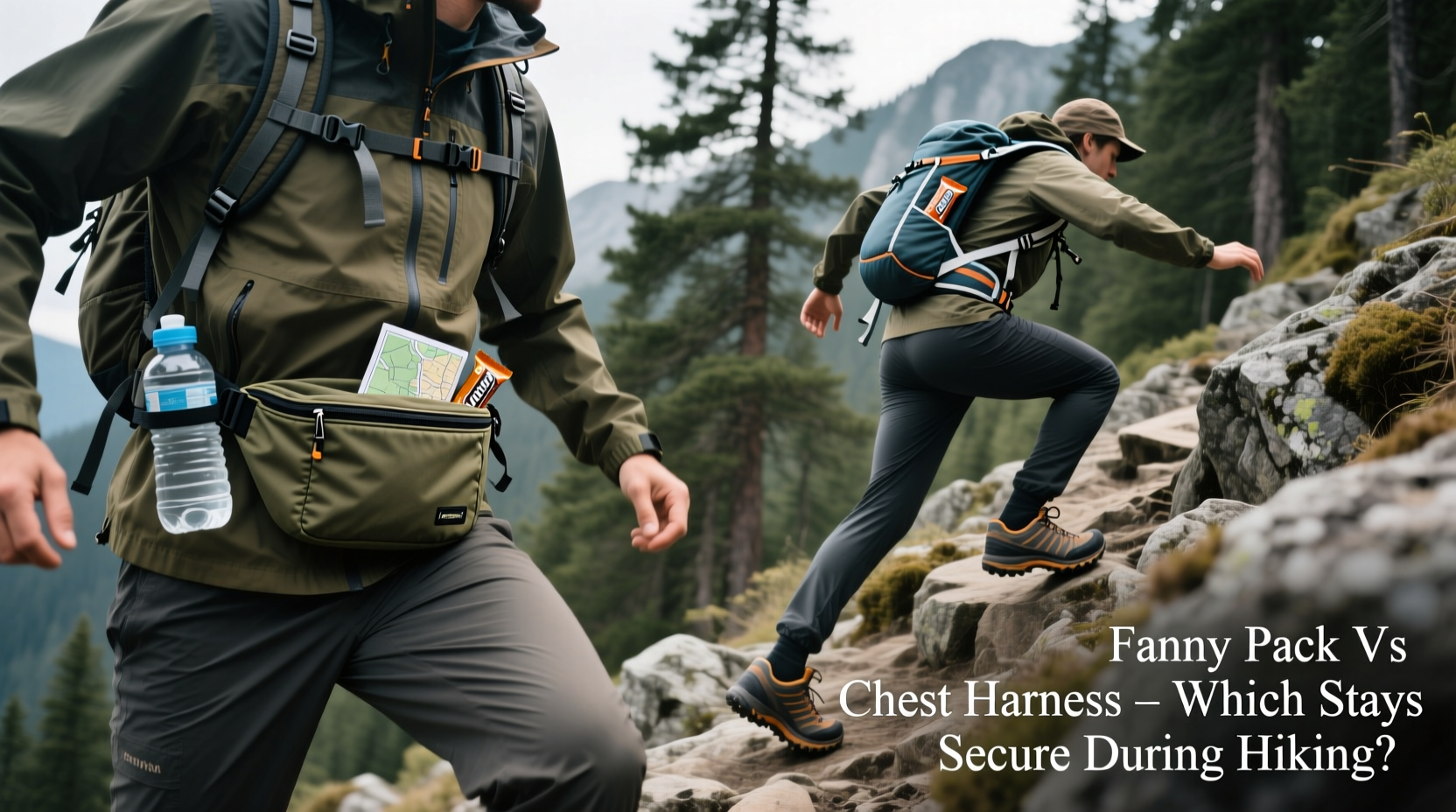
Hiking isn’t just walking—it involves climbing, scrambling, bending, and sudden shifts in balance. The way gear moves with your body determines both comfort and safety. A shifting load can throw off your center of gravity, cause chafing, or force you to stop frequently to reposition your pack.
The human body’s core rotates slightly with each stride, especially uphill. Waist-level items naturally sway side-to-side, while chest-mounted gear moves more vertically with breathing and arm motion. This biomechanical reality shapes how well each system performs under exertion.
A 2022 field study by the Outdoor Gear Lab found that “load position significantly affects perceived fatigue and postural control during sustained uphill hiking.” Items worn at the waist were more likely to bounce during rapid ascents, while chest-mounted loads showed less lateral displacement but required stronger shoulder stabilization.
“Stability isn't just about staying in place—it's about minimizing energy loss from unnecessary motion.” — Dr. Lena Torres, Biomechanics Researcher, University of Colorado
Design & Fit: How Each System Works
To evaluate security, we must examine how each system interfaces with the body.
Fanny Pack: Simplicity Meets Mobility
A fanny pack wraps around the hips or upper waist, typically secured with an adjustable strap. Modern versions range from sleek neoprene pouches to rugged, multi-compartment models designed for outdoor use. They’re lightweight, low-profile, and easy to access—especially when reaching behind or to the side.
However, their effectiveness depends heavily on fit. A loose or poorly positioned fanny pack will shift with every step. High-waisted designs worn above the hip bones tend to stay more stable than those slung below the waist, where natural hip swing increases movement.
Chest Harness: Balanced Weight Distribution
A chest harness secures across the upper torso, usually with two shoulder straps connected by a horizontal sternum band. It’s often used to stabilize backpacks, but standalone versions now carry phones, GPS units, or small emergency kits. Because it sits higher on the body, it moves less with lower-body motion and aligns closer to your center of mass during forward movement.
The key advantage lies in synchronization: since your arms and shoulders move together during hiking, items on a chest harness experience smoother, more predictable motion. However, improper fit—such as overly tight straps or poor pad placement—can restrict breathing or cause collarbone pressure.
Tip: For maximum stability, wear your fanny pack high on the waist—just below the ribcage—not low on the hips.Comparative Analysis: Security During Hiking Conditions
Security isn’t just about staying attached—it’s about staying usable. A bouncing pack might not fall off, but if it jostles so much you can’t reach your map without stopping, it’s functionally insecure.
| Feature | Fanny Pack | Chest Harness |
|---|---|---|
| Movement Stability | Moderate; prone to side-to-side sway on uneven terrain | High; minimal lateral movement, synced with upper body |
| Access Ease | Excellent; front or side access without removing | Fair; may require leaning forward or unzipping outer layer |
| Sweat & Chafing Risk | Low; minimal contact area | Moderate; shoulder and sternum straps can rub during long hikes |
| Ventilation | Good; doesn’t cover back or chest | Poor; traps heat under straps, especially in humidity |
| Weight Capacity | Low to moderate (typically 1–3 lbs) | Moderate (up to 4–5 lbs with reinforced models) |
| Theft Resistance | Moderate; visible and accessible from behind | High; front-facing, hard to reach unnoticed |
On technical trails involving scrambling or steep inclines, testers reported that chest harnesses maintained better positional consistency. One thru-hiker noted, “My phone stayed perfectly still in the chest pouch even when I was lunging over boulders. With a fanny pack, I’d feel it swinging and had to pause to recenter it.”
Conversely, in hot climates, users favored fanny packs for breathability. A chest harness, particularly one made with padded nylon, can become clammy after several hours of sun exposure.
Real-World Scenario: A Day Hike in the Rockies
Consider Sarah, an experienced day hiker tackling a 7-mile loop in Colorado’s Front Range. Her route includes rocky switchbacks, river crossings, and variable weather. She carries 2 liters of water, a windbreaker, energy bars, a headlamp, and her phone.
She tries two setups:
- Option A: A waterproof fanny pack worn mid-waist with all items inside.
- Option B: A ventilated chest harness with phone and snacks in front pockets, water bottle in a side holster.
On the ascent, the fanny pack begins to rotate with each step, requiring frequent tugging to keep centered. When she stops to refill water, she notices sand has worked into the zipper. Midway, a sudden downpour forces her to dig out her jacket—awkward with gloves on and one hand holding a trekking pole.
With the chest harness, retrieval is faster—jacket and snacks are within sight and reach. The load feels integrated with her posture, not lagging behind. However, after three hours, sweat builds under the straps, causing mild irritation near her right shoulder.
Verdict: The chest harness wins on security and accessibility, but only if properly fitted and used in cooler conditions.
Choosing Based on Your Hiking Style
No single solution fits all hikers. Your decision should reflect trip length, terrain, climate, and personal physiology.
Best for Fanny Packs:
- Short, flat trails with minimal elevation gain
- Hot or humid environments where ventilation matters
- Hikers who prefer low-profile, minimalist carry
- Urban hiking or mixed-use trails where theft risk is moderate
Best for Chest Harnesses:
- Steep, technical routes with scrambling or fast pacing
- Carrying critical items like GPS, whistle, or medical devices
- Winter hiking, where waist layers (like insulated pants) interfere with belt fit
- Photographers or birdwatchers needing quick front access to gear
Step-by-Step: Optimizing Security for Either Option
Regardless of your choice, proper setup maximizes performance. Follow this checklist before hitting the trail:
- Measure your torso or waist accurately. Don’t guess—use a soft tape measure. For fanny packs, measure at your preferred wearing height (high waist vs. hips). For chest harnesses, measure around the fullest part of your chest, just under the armpits.
- Adjust straps snugly but comfortably. You should be able to slide two fingers under any strap. Over-tightening causes discomfort; under-tightening leads to bounce.
- Distribute weight evenly. Place heavier items (like water or power banks) closest to your body’s centerline. Avoid lopsided loading.
- Test mobility before departure. Simulate hiking motions: squat, twist, raise arms, walk briskly. Adjust until no shifting occurs.
- Check closure security. Ensure zippers are fully closed and Velcro is pressed firmly. Consider adding a carabiner clip for extra insurance on critical items.
Expert Recommendations and Common Pitfalls
Outdoor educators emphasize that gear security starts with fit, not brand loyalty. “I’ve seen $20 fanny packs outperform premium models simply because they were worn correctly,” says Mark Delgado, lead guide at Sierra Wilderness Expeditions.
“The biggest mistake? Wearing the fanny pack too low. It becomes a pendulum. Wear it where your core rotates, not where your hips swing.” — Mark Delgado, Wilderness Guide
Common issues include:
- Overloading: Even durable packs fail when overstuffed. Stick to 10–15% of your body weight for waist or chest carriers.
- Neglecting fabric stretch: Nylon expands when wet. If your harness fits perfectly dry, it may loosen in rain.
- Ignoring gender-specific designs: Women’s torsos are often shorter with narrower shoulders. Unisex harnesses may gape or pinch.
FAQ: Quick Answers for Hikers
Can a fanny pack be secure enough for running or fast hiking?
Yes, but only if it’s high-waisted, snug, and designed for activity. Look for models with anti-slip backing or secondary stabilizer straps that wrap around the thigh or chest.
Are chest harnesses safe in bear country?
Generally yes, but avoid storing food or scented items in them. Bears are attracted to smells, not location. Keep odor-containing items in bear canisters or hung properly away from camp.
Which is easier to take on and off quickly?
Fanny packs win here. Most clip or buckle at the side, allowing removal without taking off jackets or layers. Chest harnesses often require lifting over the head, which is cumbersome with bulky clothing.
Final Verdict: Security Depends on Context
There’s no universal winner between fanny packs and chest harnesses. But when security during dynamic hiking is the top priority—especially on rugged, uneven, or steep terrain—the chest harness holds a clear edge. Its alignment with the body’s center of mass reduces bounce, improves balance, and keeps essentials immediately accessible.
Fanny packs remain excellent for casual use, warm weather, or minimalist carry. With correct fit and smart loading, they can handle moderate trails reliably. But for serious hikers facing challenging conditions, the chest harness offers superior stability and integration with body movement.
The best approach may be hybrid: use a lightweight fanny pack for longer storage and a slim chest harness for mission-critical items. This distributes load intelligently and gives you redundancy—if one fails, the other still holds essentials.
🚀 Ready to upgrade your hiking carry system? Try a chest harness on your next technical trail and notice the difference in stability. Or optimize your fanny pack fit using the steps above. Share your experience in the comments—what works for you?








