Stretchy watch straps, commonly made from silicone, rubber, or nylon with elastic fibers, offer comfort and flexibility. However, their elasticity can lead to looseness over time or an initially poor fit. Many users resort to cutting or knotting the strap—methods that often compromise durability or aesthetics. With the right approach, you can shorten a stretchy watch strap safely, preserving both function and appearance. This guide delivers expert-backed techniques to adjust your strap effectively, without causing tears, warping, or long-term degradation.
Understanding Stretchy Watch Strap Materials
Before altering any strap, it’s essential to identify its composition. Most stretchy straps fall into one of three categories:
- Silicone/Rubber: Flexible, water-resistant, and durable. Common in sports and smartwatches.
- Elastic Nylon: Lightweight and breathable, often used in NATO-style stretch variants.
- Hybrid Blends: Combine spandex or lycra with polyester or TPU for enhanced stretch and recovery.
Each material responds differently to tension, heat, and manipulation. For example, silicone tolerates mild heat better than nylon, which may melt or warp. Knowing your strap type ensures you choose a method that won’t degrade its integrity.
“Improper shortening can break the polymer bonds in elastic materials, leading to permanent sagging or snapping.” — Daniel Reyes, Watch Accessory Engineer at ChronoFit Labs
Step-by-Step: Safe Methods to Shorten Your Strap
The goal is to reduce slack while maintaining even tension, structural balance, and aesthetic continuity. Below are five proven techniques, ranked by safety and reversibility.
1. The Loop-and-Tuck Method (No Tools Required)
Ideal for silicone and rubber straps with extra length, this non-invasive method uses folding instead of cutting.
- Wear the watch and determine how many links or inches need removal.
- Fold the excess strap back toward the watch case.
- Tuck the loose end under the folded loop, creating a snug second layer.
- Ensure the clasp still secures properly over the double thickness.
2. Heat-Assisted Shrinking (For Silicone & Rubber)
Elastomers like silicone contract when exposed to controlled heat. This method alters the molecular structure slightly to reduce size.
- Clean the strap thoroughly to remove oils or debris.
- Immerse the excess portion in hot water (around 70–80°C / 158–176°F) for 2–3 minutes.
- Remove and immediately roll the heated section in a tight coil using pliers wrapped in cloth.
- Let cool completely (10–15 minutes) to set the new shape.
- Trim any remaining frayed ends with sharp scissors if needed.
Note: Avoid boiling water or open flames. Excessive heat causes bubbling or cracking.
3. Elastic Band Insert Adjustment
If your strap has a removable inner elastic band (common in Apple Watch-style bands), you can shorten just the core component.
- Use a seam ripper or small flat tool to open the stitching at one end.
- Extract the elastic cord carefully.
- Cut 1–2 cm off the cord using fabric scissors.
- Re-thread it through the casing using a bodkin or safety pin.
- Re-stitch the opening by hand with strong nylon thread.
This maintains the outer shell’s appearance while reducing internal stretch.
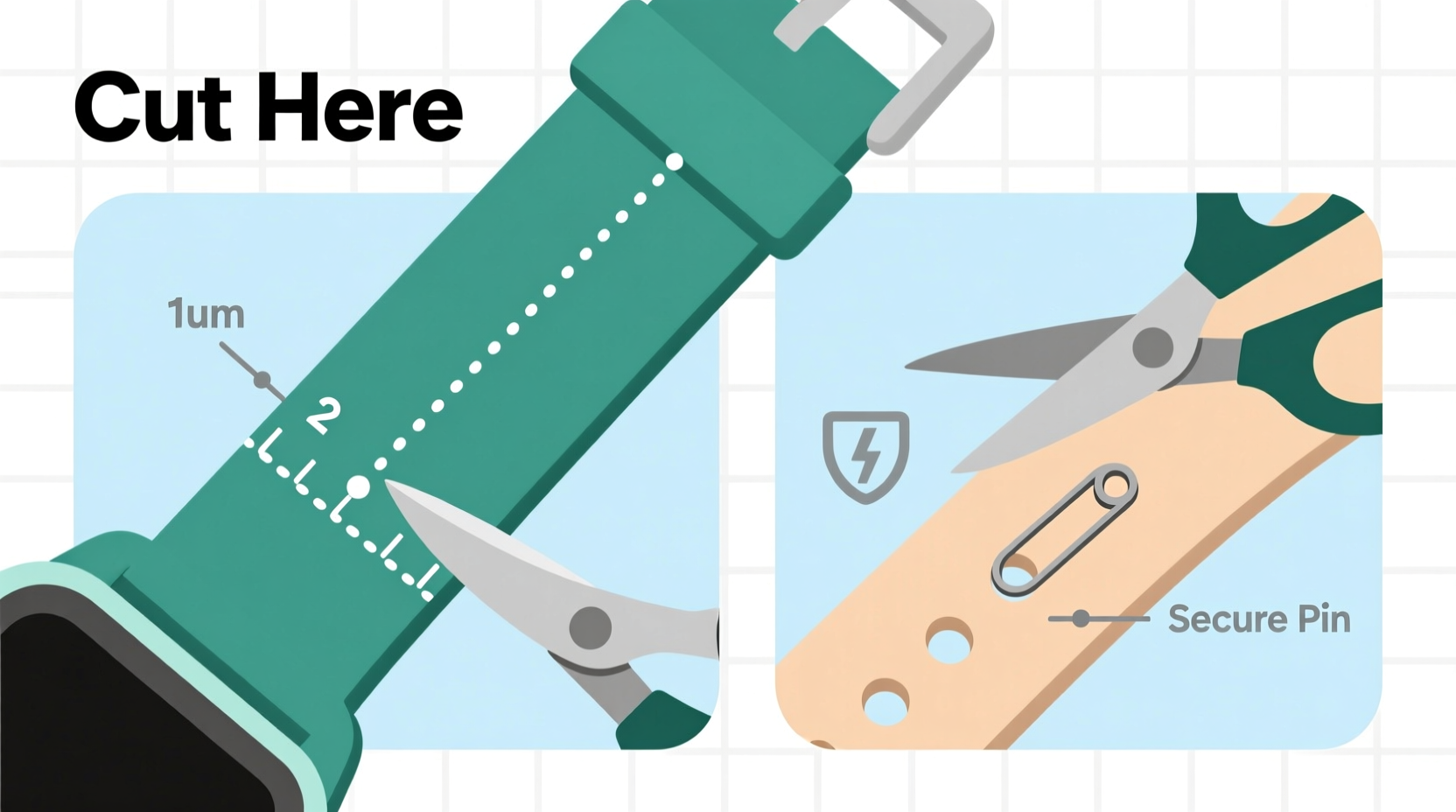
4. Precision Cutting with Sealant Finish
When folding or shrinking isn't enough, cutting may be necessary—but only with precautions.
| Do | Don’t |
|---|---|
| Mark cut lines with a fine pencil and ruler | Make uneven or angled cuts |
| Use sharp utility knife or rotary cutter | Use dull scissors that cause tearing |
| Apply clear nail polish or fray check to edges | Leave raw edges exposed to moisture |
| Test fit frequently during trimming | Cut more than 5 mm at once |
After cutting, seal the edge to prevent unraveling. Let dry fully before wearing.
5. Replacement Link Removal (Modular Straps)
Some stretchy straps use segmented links connected by pins. These allow true resizing.
- Lay the strap flat and count how many outer links need removal.
- Use a spring bar tool to push out the connecting pins symmetrically.
- Reassemble the shortened strap, ensuring smooth clasp operation.
- Store removed links in case future expansion is needed.
This is the most professional-looking solution for modular designs.
Checklist: Preparing for Strap Adjustment
Follow this checklist before beginning any modification:
- ✔ Identify the strap material and construction
- ✔ Measure current length and desired fit (use a flexible tape)
- ✔ Gather tools: ruler, fine marker, sharp cutter, heat source, sealant
- ✔ Test temporary solutions first (e.g., tucking)
- ✔ Work slowly—adjustments are easier to make than to reverse
- ✔ Clean the strap before applying heat or sealants
Real Example: Adjusting a Loose Fitness Tracker Band
Sarah, a daily runner, found her silicone fitness tracker band slipping during workouts. The standard size was too long for her slender wrist, and taping it caused irritation. She tried the heat-shrink method: after measuring a 1.5-inch excess, she dipped the end in hot water for 2.5 minutes, coiled it tightly, and cooled it under running tap water. Once dry, she trimmed 6 mm of residual slack and sealed the edge with clear nail polish. The result? A secure, custom fit that survived months of sweat, rain, and repeated stretching without deformation.
This case illustrates how understanding material behavior leads to effective, lasting results without damaging expensive gear.
Common Mistakes That Cause Damage
Even well-intentioned adjustments can backfire. Avoid these frequent errors:
- Overheating: Melts adhesive layers or deforms shape-memory elastomers.
- Uneven Cuts: Creates pressure points that accelerate wear.
- Ignoring Symmetry: Removing links only from one side throws off balance and clasp alignment.
- Skipping Edge Sealing: Leads to fraying, especially in woven elastic fabrics.
- Forceful Folding: Repeated creasing weakens polymer chains over time.
FAQ: Frequently Asked Questions
Can I reverse a shortened stretchy strap?
Most physical alterations—like cutting or shrinking—are irreversible. However, loop-and-tuck and modular link removal are reversible. If uncertain, opt for temporary fixes first.
Will shrinking affect the strap’s flexibility?
Controlled heat shrinking slightly reduces elasticity in the treated area but improves overall tension. Over-shrinking can make the strap stiff or brittle, so moderation is key.
Is it safe to use super glue on silicone straps?
No. Standard cyanoacrylate glues do not bond well with silicone and may degrade the material. Use specialized silicone adhesives only if reattaching broken parts.
Conclusion: Achieve a Perfect Fit with Confidence
A well-fitted watch enhances both comfort and functionality. Whether you're adjusting a smartwatch band or a sporty analog model, shortening a stretchy strap doesn’t require guesswork or risk. By selecting the right method for your strap type and following precise steps, you preserve longevity and performance. From simple tucks to precision modifications, these expert techniques empower you to customize your wearable with care and confidence.
💬 Have a favorite strap adjustment trick? Share your experience in the comments and help others maintain their timepieces in top condition!








