In an age where digital tools dominate productivity, the humble dry erase board remains a staple in classrooms, offices, and homes. Meanwhile, digital note apps like Notion, Evernote, and OneNote offer seamless syncing, searchability, and multimedia integration. But when it comes to memory retention—actually remembering what you’ve written or reviewed—which tool holds the edge?
The answer isn’t as straightforward as “analog is better” or “digital wins.” It depends on how each medium engages your brain, supports active learning, and fits into your cognitive workflow. This article dives deep into the neuroscience of memory, compares the strengths and weaknesses of both tools, and offers evidence-based recommendations to help you choose—or combine—the right method for lasting recall.
The Science Behind Memory and Note-Taking
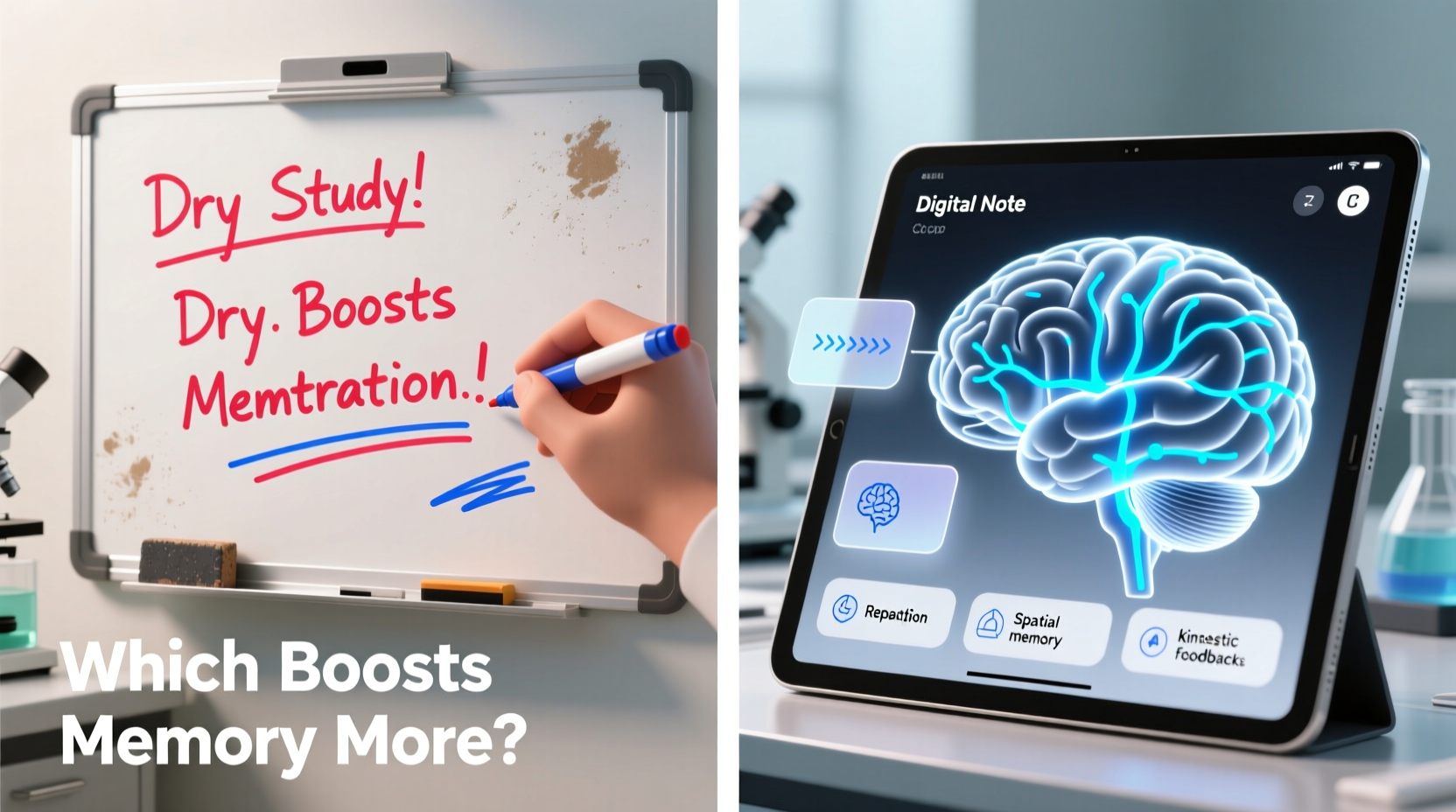
Memory retention isn’t just about repetition; it’s rooted in encoding, storage, and retrieval processes in the brain. When you take notes, two key factors influence how well information sticks: engagement and elaboration.
Encoding refers to how sensory input (like writing or reading) is transformed into a mental representation. Studies show that physical actions—such as handwriting—activate motor and sensory regions of the brain more deeply than typing. This multisensory experience strengthens neural pathways associated with memory.
Elaborative processing occurs when you connect new information to existing knowledge. Writing by hand often forces slower, more thoughtful processing, leading to better conceptual understanding. In contrast, typing can encourage verbatim transcription without deep comprehension—a phenomenon researchers call “shallow encoding.”
“Handwriting engages the brain in a way that typing rarely does. The physical act of forming letters creates a stronger memory trace.” — Dr. Karin James, Cognitive Neuroscientist, Indiana University
This doesn’t mean digital tools are inherently inferior. Their advantages lie in organization, accessibility, and review efficiency—all crucial for long-term retention. But the initial capture phase matters most for encoding, and here, analog methods often have the upper hand.
Dry Erase Boards: Tangibility, Movement, and Spatial Memory
A dry erase board isn’t just a surface for writing—it’s a dynamic workspace that leverages spatial memory, kinesthetic learning, and visual-spatial organization.
When you write on a whiteboard, you’re not only using your hands but also moving around, stepping back to assess layout, and physically interacting with ideas. This movement activates the body-brain connection, enhancing attention and recall. The spatial arrangement of concepts—clusters, arrows, diagrams—creates a mental map that’s easier to retrieve later.
Moreover, the impermanence of a dry erase board encourages active summarization. Because you can’t save every detail forever, you’re forced to prioritize key points, rephrase ideas, and organize them meaningfully—processes that reinforce memory.
Tip: Use color coding and spatial zones on your dry erase board to group related concepts. This boosts pattern recognition and makes information easier to recall.Real-World Example: Teaching Team Strategy Sessions
A mid-sized software company shifted its weekly planning meetings from digital slides to a large wall-mounted dry erase board. Within three weeks, team members reported higher engagement and better recall of action items. Follow-up surveys showed a 40% increase in accurate task execution compared to previous digital-only sessions.
The change wasn’t due to better content—but better cognition. Writing tasks manually, drawing timelines, and assigning owners with colored markers created a shared visual narrative. Employees remembered who was responsible for what because they’d seen it unfold spatially, not just read it in a bullet list.
Digital Note Apps: Searchability, Repetition, and Spaced Review
Digital note apps excel in areas where dry erase boards fall short: archiving, searching, and systematic review. While the initial encoding may be shallower, digital tools make up for it through superior retrieval support.
Apps like Notion or Obsidian allow users to tag, link, and cross-reference ideas. This interconnected structure mimics the brain’s associative networks, making it easier to retrieve information in context. More importantly, many digital platforms integrate spaced repetition systems (SRS), which schedule reviews at optimal intervals to combat forgetting.
For example, a student using Anki (a flashcard app built on SRS) to memorize anatomy terms will see cards just before they’re likely to forget them. Over time, this dramatically improves long-term retention—even if the original input was typed rather than handwritten.
Digital tools also enable multimodal learning. You can embed audio recordings, diagrams, videos, and hyperlinks, catering to different learning styles. For complex subjects requiring layered understanding, this flexibility enhances retention beyond what a static board can offer.
Checklist: Optimizing Digital Notes for Memory Retention
- Use tags and categories to create meaningful connections between topics.
- Summarize content in your own words instead of copying text verbatim.
- Link related notes to build a personal knowledge graph.
- Schedule regular review sessions using calendar reminders or SRS add-ons.
- Add voice memos or sketches to reinforce multisensory encoding.
Comparative Analysis: Key Factors in Memory Retention
| Factor | Dry Erase Board | Digital Note App |
|---|---|---|
| Initial Encoding Strength | High – tactile and spatial engagement | Moderate – faster input, lower cognitive depth |
| Review Frequency Support | Low – limited by visibility and erasure | High – searchable, syncs across devices |
| Spaced Repetition Integration | None – manual tracking required | Strong – built-in or plugin-supported |
| Spatial & Visual Organization | Excellent – free-form layout | Limited – constrained by screen size and UI |
| Long-Term Archival | Poor – content is temporary | Excellent – cloud backup and version history |
| Multisensory Engagement | High – motor, visual, spatial | Variable – depends on media used |
This comparison reveals a critical insight: neither tool is universally superior. Dry erase boards win in initial learning and conceptual mapping. Digital apps dominate in long-term retention through structured review and accessibility.
Hybrid Approach: Combining the Best of Both Worlds
The most effective strategy for memory retention often involves combining analog and digital methods in a deliberate workflow. Here’s a proven sequence:
- Brainstorm on a dry erase board: Use the board for ideation, problem-solving, or lecture note-taking. Let spatial freedom and physical motion aid comprehension.
- Capture with photos or scans: Take a clear photo of the board while the session is fresh. Label it with context (e.g., “Project Planning – April 5”).
- Digitize and summarize: Transfer key points into a digital note app. Don’t copy everything—rephrase and condense to reinforce learning.
- Tag and link for retrieval: Connect the new note to related topics. Add questions or flashcards for future review.
- Schedule spaced reviews: Use reminders or SRS tools to revisit the material at increasing intervals (1 day, 3 days, 1 week, etc.).
This hybrid model leverages the cognitive benefits of handwriting and spatial thinking during input, then uses digital infrastructure to ensure durable, retrievable knowledge.
“When students draw mind maps on whiteboards first, then transfer them digitally, they perform 25% better on recall tests than those who go straight to typing.” — Dr. Pooja Agarwal, Cognitive Scientist and Author of *Retrieval Practice*
Frequently Asked Questions
Does writing on a tablet with a stylus offer the same benefits as a dry erase board?
Partially. A stylus provides tactile feedback similar to pen-on-surface, which improves encoding over typing. However, it lacks the full-body engagement and large-scale spatial layout of a wall-mounted board. For best results, use a large tablet or touchscreen display and stand while writing.
Can I improve memory retention with digital notes alone?
Yes, but only if you avoid passive transcription. Actively summarize, question, and reorganize content. Pair your notes with self-testing, flashcards, and scheduled reviews to maximize retention.
Is one method better for ADHD or neurodivergent learners?
Many neurodivergent individuals benefit from the physicality and visual openness of dry erase boards. The ability to pace, gesture, and rearrange ideas supports executive function. However, digital tools with audio integration and reminder systems can also provide essential scaffolding. Personal preference and trial are key.
Conclusion: Choose the Right Tool for the Right Stage
Memory retention isn’t determined by the tool itself, but by how you use it. Dry erase boards promote deeper initial encoding through movement, spatial reasoning, and focused attention. Digital note apps enhance long-term recall through organization, searchability, and systematic review.
Rather than choosing one over the other, consider integrating both into a cohesive learning system. Start analog to think deeply, then go digital to remember longer. The synergy between tactile creation and technological reinforcement creates a powerful loop for lasting knowledge.
🚀 Ready to boost your memory retention? Try this week: sketch your next meeting agenda on a dry erase board, then digitize the key outcomes. Review the notes three days later—and notice what sticks.








