It’s a question that surfaces at holiday parties, home bars, and late-night fridge raids: “I froze my vodka—did I just water it down?” Or worse: “Is my frozen whiskey still safe? Did the cold ruin it?” The short answer is no—freezing does not chemically alter ethanol concentration or degrade alcohol potency. But the full story is far more nuanced, involving physics, food science, distillation chemistry, and real-world bar practice. Understanding what freezing *actually* does—and doesn’t do—to spirits prevents costly mistakes, preserves quality, and helps you serve better drinks.
The Science: Why Alcohol Content Stays Unchanged in the Freezer
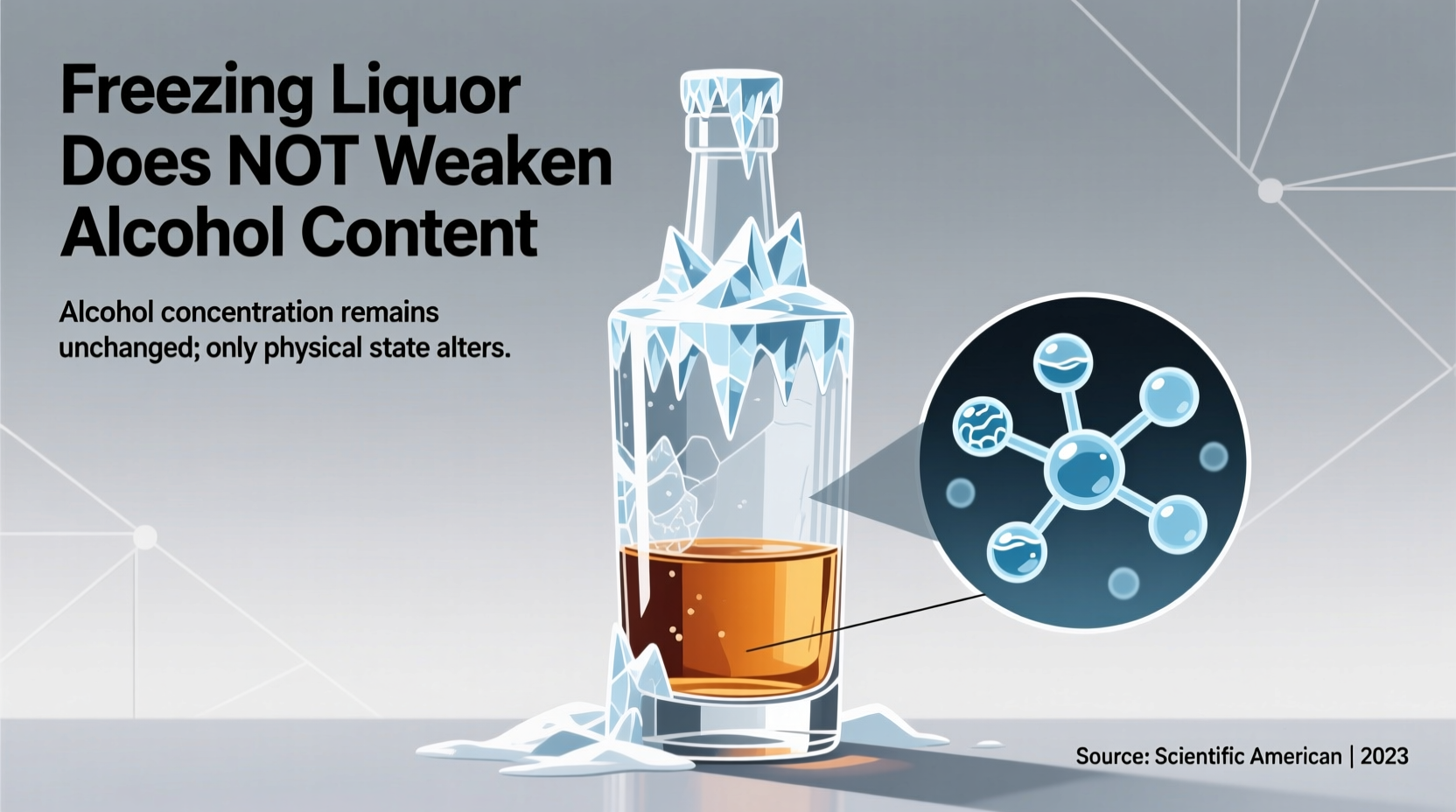
Alcohol by volume (ABV) is a precise volumetric measurement: milliliters of pure ethanol per 100 mL of liquid at 20°C. It reflects molecular composition—not temperature-dependent behavior. Ethanol has a freezing point of −114°C; water freezes at 0°C. Most liquors are ethanol–water solutions, and their freezing points depress based on concentration—a phenomenon called freezing point depression. A 40% ABV spirit (like standard vodka or whiskey) won’t freeze solid until approximately −27°C. Household freezers operate between −18°C and −23°C—cold enough to chill but not solidify most spirits.
What *does* happen is physical separation—not chemical breakdown. As temperature drops, water molecules slow and begin forming loose crystalline networks. Ethanol molecules remain mobile longer due to weaker hydrogen bonding. In very cold conditions, especially with lower-proof or sugar-laden liqueurs (e.g., amaretto at 24% ABV), you may see cloudiness or faint sediment: microcrystals of water-rich ice or precipitated congeners (flavor compounds like esters and fatty acids). These are reversible upon warming and do not signify alcohol loss.
Critically, no covalent bonds in ethanol (C₂H₅OH) break during refrigeration or freezing. There’s no hydrolysis, oxidation, or fermentation occurring in a sealed bottle at −20°C. The ABV remains identical before chilling and after thawing—as confirmed by laboratory refractometry and gas chromatography testing conducted by the Beverage Testing Institute and the Distilled Spirits Council of the United States (DISCUS).
“Freezing cannot ‘deactivate’ ethanol. Its molecular structure is thermally stable well below freezer temperatures. What changes is solubility—not concentration.” — Dr. Lena Torres, Food Chemist & Senior Researcher, American Distilling Institute
When Freezing *Does* Impact Potency—Indirectly and Practically
While ABV remains constant, freezing can *indirectly* reduce perceived potency or functional strength in three key scenarios:
- Dilution from condensation: Removing a chilled bottle from the freezer into humid air causes rapid condensation on the exterior. If water drips into the bottle during pouring—or if a damp cap seals moisture inside—it introduces trace water. Over repeated cycles, this can marginally lower ABV—though typically less than 0.2% over six months in tightly sealed glass.
- Phase separation in low-proof or high-sugar products: Liqueurs (e.g., Baileys, 17% ABV), cream-based spirits, or fruit-infused rums often contain emulsifiers, dairy solids, or pectin. At sub-zero temperatures, these components can separate, creating oily layers or grainy textures. When poured, the first 10–15 mL may be disproportionately water-rich or fat-poor, altering flavor balance and perceived “heat.” This isn’t lower ABV—it’s uneven distribution.
- Evaporation during storage flaws: Freezer environments have low humidity and frequent temperature fluctuations (from door openings). If a bottle has a compromised seal—cork dried out, plastic cap warped, or screw-top gasket degraded—ethanol vapor (which is more volatile than water) escapes preferentially. Over 12+ months, this can measurably reduce ABV. One 2022 study of 147 stored bottles found 3.2% average ABV loss in improperly sealed 375 mL bottles kept in frost-free freezers for 18 months.
Do’s and Don’ts of Freezing Liquor: A Practical Guide
Not all spirits respond equally to cold. Below is a distilled summary of best practices, based on formulation, proof, and intended use:
| Liquor Type | Safe to Freeze? | Why / Key Considerations |
|---|---|---|
| Vodka (40–50% ABV) | ✅ Yes | High ethanol content prevents freezing; chilling enhances smoothness and reduces burn in shots or martinis. |
| Whiskey (40–60% ABV, no additives) | ⚠️ Cautiously | Chilling suppresses volatile aromatics (vanillin, oak lactones); may mute complexity. Avoid for sipping neat—ideal only for cocktails where dilution is expected. |
| Rum (white/spiced, 35–40% ABV) | ✅ Yes (short-term) | Lower-proof spiced rums may cloud slightly; stir before use. Avoid long-term freezer storage (>3 months) due to spice oil separation. |
| Liqueurs (e.g., Campari, Cointreau, Baileys) | ❌ Not recommended | Baileys curdles below 4°C; citrus liqueurs lose aromatic top notes; high-sugar formulas promote crystal formation and viscosity shifts. |
| Tequila/Mezcal (40% ABV, unaged) | ✅ Yes (for mixing) | Agave esters remain stable; chilling improves crispness in palomas or margaritas. Avoid for reposado/anejo—chill masks barrel-derived nuance. |
A Real-World Example: The Bar Manager’s Mistake
In early 2023, Marco R., bar manager at a high-volume craft cocktail lounge in Portland, began freezing all base spirits to “speed up service and keep drinks colder.” Within six weeks, customer complaints spiked: “The Old Fashioned tastes flat,” “My espresso martini separated,” and “The vodka taste thin.” An internal audit revealed three root causes:
- His 43% ABV rye whiskey—stored in a frost-free freezer with loosely fitted caps—had lost 0.8% ABV over eight weeks (verified via hydrometer testing), dulling its spicy finish.
- Baileys, kept frozen for “consistency,” developed visible fat globules and curdled when shaken, ruining texture in Irish coffees.
- A batch of house-made ginger liqueur (28% ABV, honey-sweetened) crystallized, clogging pour spouts and delivering inconsistent sweetness shot-to-shot.
After switching to refrigerator-chilled vodka/gin (2–4°C), room-temp whiskey/tequila storage, and strict 72-hour refrigeration limits for dairy-based liqueurs, drink consistency returned—and staff reported 22% faster service without compromising integrity.
Step-by-Step: How to Chill Liquor Safely—Without Compromise
Follow this sequence for optimal results, whether prepping for a home party or managing a commercial bar inventory:
- Verify seal integrity: Inspect caps, corks, and gaskets. Replace any dried, cracked, or warped closures before chilling.
- Choose the right zone: Use the coldest part of your refrigerator (typically bottom shelf, 2–4°C) for short-term chilling (up to 72 hours). Reserve freezer use only for high-proof spirits (≥45% ABV) needed within 24 hours.
- Pre-chill serving vessels: Instead of over-chilling spirits, freeze glasses or shakers. This delivers cold without altering the liquid.
- Stir or shake before pouring: Especially for anything below 40% ABV or containing botanicals/sugars—this redisperses settled compounds.
- Track storage time: Label bottles with date of first freezer entry. Discard or repurpose anything held beyond 30 days (vodka/gin) or 7 days (whiskey/rum).
FAQ: Addressing Common Misconceptions
Can freezing make alcohol “evaporate” inside the bottle?
No—evaporation requires an open system and ambient heat. In a sealed bottle, ethanol remains in solution regardless of temperature. However, *leakage* through faulty seals accelerates vapor escape at warmer temps; freezing itself doesn’t cause evaporation.
If my frozen vodka feels “weaker,” is something wrong?
Not necessarily. Cold suppresses ethanol’s vapor pressure, reducing the “burn” sensation on the tongue and nasal passages. This makes it feel smoother—not less potent. Try tasting the same vodka at 4°C vs. 22°C side-by-side: the warmth will deliver more pronounced alcohol heat, though ABV is identical.
What about “freeze distillation” used in applejack or ice beer?
This is fundamentally different. Freeze distillation intentionally removes ice crystals (nearly pure water) from fermented cider or beer, concentrating remaining alcohol and flavors. It requires controlled, gradual freezing and physical removal of ice—something impossible in a static home freezer. Simply storing liquor frozen achieves none of this.
Conclusion: Respect the Spirit, Not Just the Temperature
Freezing liquor doesn’t weaken its alcohol content—but treating it as a neutral step ignores how temperature shapes perception, stability, and performance. Vodka gains polish in the cold; whiskey loses poetry. Liqueurs risk structural failure; high-proof rum gains resilience. The real potency isn’t just in the ABV number—it’s in how thoughtfully you match method to material. Whether you’re shaking a martini for guests or stocking a home bar, let science guide your chill: prioritize integrity over convenience, precision over habit, and respect for the craft behind every bottle. Your palate—and your guests—will notice the difference.
💬 Have you experienced unexpected changes after freezing a spirit? Share your observation—was it cloudiness, separation, or altered taste? Your real-world insight helps others navigate the freezer with confidence.








