Many people assume that drinking a higher-alcohol beverage—like a 14% wine versus a 5% lager—means they’ll feel intoxicated faster. While this intuition holds some truth, the reality is more nuanced. Alcohol content (measured as alcohol by volume, or ABV) is one key variable among several that shape how quickly ethanol enters your bloodstream and reaches your brain. Understanding this interplay helps people make safer, more informed choices—not just about what to drink, but how, when, and why.
Alcohol doesn’t act like caffeine, where effects are nearly immediate. Instead, its impact depends on a cascade of physiological events: gastric emptying, intestinal absorption, liver metabolism, blood-brain barrier permeability, and neural receptor sensitivity. Misunderstanding this process contributes to risky drinking patterns—especially among those who underestimate how rapidly high-ABV spirits can elevate blood alcohol concentration (BAC) when consumed neat or in small volumes.
How Alcohol Absorption Actually Works
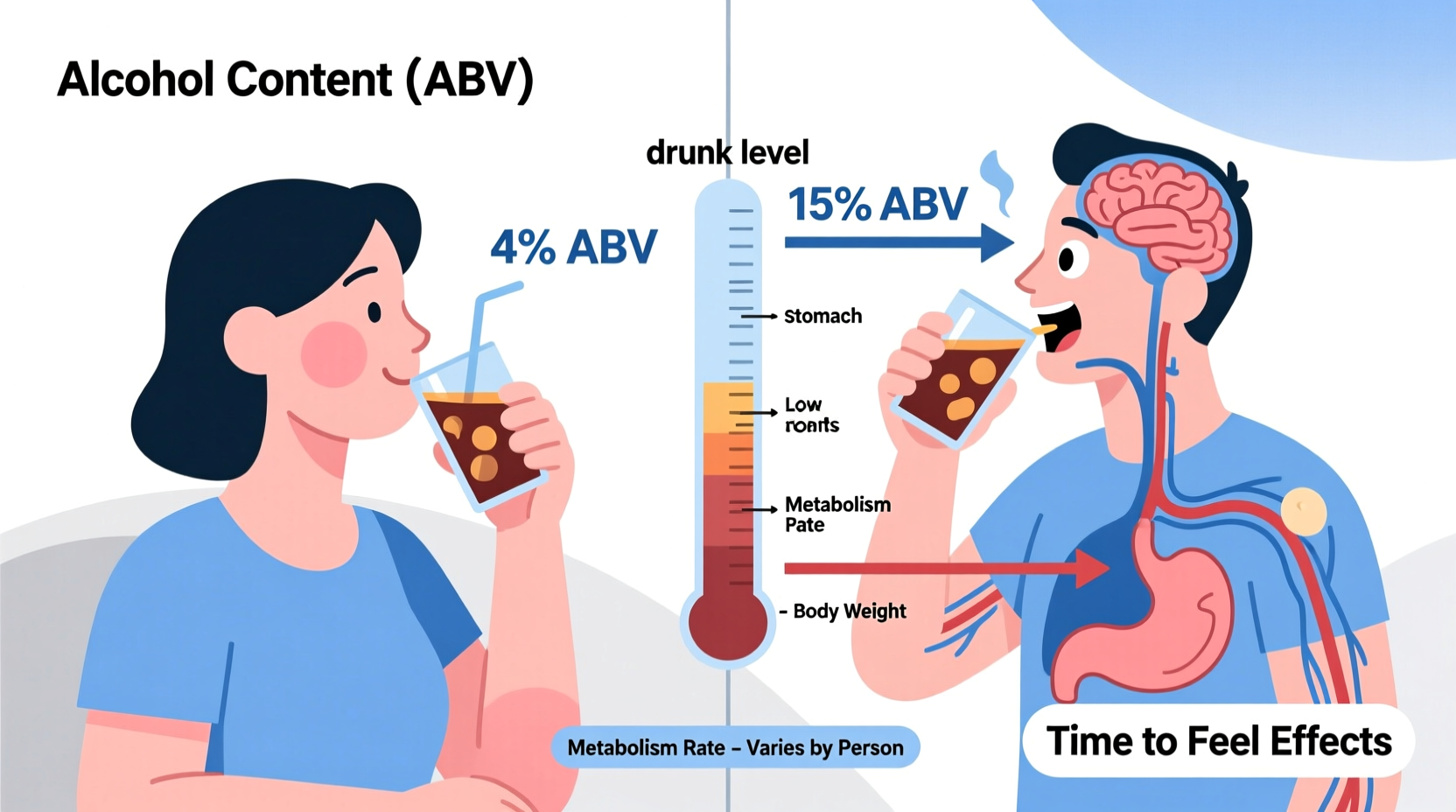
When you swallow alcohol, less than 20% is absorbed in the stomach; the majority—roughly 80%—enters the bloodstream through the walls of the small intestine. This is why speed of absorption matters more than total alcohol consumed in the first 30 minutes. Several factors accelerate or delay that process:
- Stomach contents: A full stomach slows gastric emptying, delaying alcohol’s arrival in the small intestine—and thus delaying peak BAC by 30–90 minutes.
- Carbonation: Bubbly drinks like champagne or mixed sodas increase gastric pressure and may speed up gastric emptying, leading to faster absorption—even if ABV is moderate.
- Drink temperature and concentration: Warm, concentrated alcohol (e.g., room-temperature whiskey) is absorbed faster than cold, diluted versions (e.g., an iced highball).
- Individual physiology: Genetic variations in alcohol dehydrogenase (ADH) and aldehyde dehydrogenase (ALDH) enzymes significantly alter how efficiently someone metabolizes ethanol—especially relevant for East Asian populations where ALDH2 deficiency is common.
Crucially, ABV alone doesn’t dictate intoxication speed—it sets the *potential dose per unit volume*. A 30 mL shot of 40% vodka contains 12 mL (≈9.6 g) of pure ethanol. That same amount of 5% beer would require 240 mL—nearly a full can—to deliver equivalent ethanol. So while ABV determines concentration, the *volume consumed* and *rate of consumption* determine actual delivery speed.
The ABV Threshold Effect: Why 10% Is a Turning Point
Research shows a non-linear relationship between ABV and absorption rate. Below ~10% ABV, alcohol tends to behave like a dilute solute—absorbed steadily with minimal gastric irritation. Above ~10%, ethanol begins to irritate gastric mucosa, triggering compensatory mechanisms: increased mucus secretion, reduced motilin release, and delayed gastric emptying. Paradoxically, very high-ABV drinks (≥30%) may slow initial absorption *if consumed neat*, because the stomach holds them longer to dilute before releasing into the intestine.
However, this protective delay vanishes when high-ABV spirits are mixed with carbonated or sugary beverages—or consumed rapidly on an empty stomach. In those cases, the sheer ethanol load overwhelms regulatory mechanisms, and absorption surges.
| ABV Range | Typical Beverages | Absorption Characteristics | Time to Noticeable Effects (on empty stomach) |
|---|---|---|---|
| 3–5% | Lagers, ciders, light beers | Slow, steady absorption; minimal gastric irritation | 20–35 minutes |
| 10–14% | Wines, fortified wines (e.g., port), hard seltzers | Moderate gastric irritation; absorption accelerates after initial delay | 15–25 minutes |
| 35–50% | Vodka, gin, whiskey, rum (neat or on ice) | Strong mucosal irritation; delayed gastric emptying unless diluted or consumed rapidly | 12–20 minutes (if sipped slowly); as fast as 8–12 minutes if chugged |
| 75–95% | Rectified spirit (e.g., Everclear), fuel-grade ethanol (not for consumption) | Severe tissue damage risk; absorption highly unpredictable and dangerous | Unreliable—often accompanied by vomiting or loss of consciousness before meaningful absorption |
A Real-World Example: The “Two-Glass” Misconception
Sarah, 28, attended a dinner party where she drank two 150 mL glasses of 13.5% red wine over 45 minutes. She felt lightheaded and slightly uncoordinated within 20 minutes of her first sip—despite having eaten a full meal. Later, she learned her host had served a low-acid, high-sugar wine, which accelerated gastric emptying. She also drank her second glass quickly—within three minutes—after finishing the first. Her estimated peak BAC reached 0.06% within 32 minutes, well above the legal driving limit in most countries.
Contrast this with Mark, 32, who drank four 330 mL cans of 4.8% lager over two hours at a barbecue. He ate continuously and paced himself—one can per 30 minutes. His peak BAC peaked at 0.04% after 75 minutes and declined steadily. Though he consumed more total ethanol (≈14.3 g vs. Sarah’s ≈12.2 g), his slower, distributed intake and food co-ingestion prevented rapid intoxication.
This case illustrates that ABV is necessary—but insufficient—for predicting intoxication speed. Volume, timing, food, and drink composition collectively determine pharmacokinetic behavior far more than ABV alone.
What the Science Says: Expert Insights on Timing and Thresholds
Dr. Elena Rodriguez, a clinical pharmacologist specializing in substance metabolism at the University of California, San Francisco, explains the physiological tipping point:
“The idea that ‘higher ABV = faster drunk’ is oversimplified. What actually governs onset is the rate of ethanol delivery to the portal vein. A 40% spirit consumed in 10 mL increments every five minutes delivers ethanol more slowly than the same spirit chugged in one go—even though the ABV is identical. We’ve measured BAC spikes up to 40% faster in subjects who consumed high-ABV drinks rapidly versus those who sipped them alongside water.”
Further supporting this, a 2022 double-blind study published in Alcoholism: Clinical and Experimental Research tracked 84 healthy adults consuming standardized ethanol doses (0.6 g/kg) across four beverage types: 4% beer, 12% wine, 37% vodka soda, and 40% neat vodka. Results showed:
- Peak BAC occurred fastest with neat vodka (mean: 22.4 minutes), but only when consumed without food.
- With a standard meal, peak BAC timing equalized across all groups—ranging from 58 to 67 minutes.
- Subjective intoxication (“feeling drunk”) correlated more strongly with BAC slope (rate of rise) than absolute BAC value—meaning someone whose BAC climbed from 0.01% to 0.05% in 10 minutes reported stronger effects than another whose BAC rose to 0.06% over 40 minutes.
Actionable Strategies to Manage Intoxication Onset
You can’t change your genetics or stomach pH—but you can control variables that influence how fast alcohol affects you. These evidence-based strategies reduce risk while preserving enjoyment.
- Eat before drinking—not just during. A meal rich in protein and fat (e.g., grilled chicken with avocado and whole grains) slows gastric emptying more effectively than snacks consumed mid-drink.
- Hydrate intentionally. Alternate each alcoholic drink with 150–200 mL of water—not just “a glass between drinks,” but timed: sip water immediately after finishing your drink, before reaching for the next.
- Choose lower-ABV options when pacing is uncertain. Opt for session IPAs (4.2–4.8%), brut sparkling wines (11–12% but low sugar), or wine spritzers (wine + soda water, ABV ~5–7%).
- Avoid carbonated mixers with high-ABV spirits. Champagne + vodka (a “vodka fizz”) absorbs faster than vodka + still water—even if total ABV is identical.
- Use portion discipline—not just counting drinks. Measure pours: 35 mL for spirits, 125 mL for wine, 330 mL for beer. Free-pouring often delivers 50–100% more than intended.
FAQ: Clarifying Common Misconceptions
Does drinking coffee or taking a cold shower help you sober up faster?
No. Neither affects blood alcohol concentration. Caffeine may mask fatigue but does not accelerate ethanol metabolism—your liver processes alcohol at ~7 grams per hour, regardless of stimulants or temperature exposure. Cold showers pose hypothermia risk and impair judgment further.
If I feel fine after two shots, does that mean my tolerance is high—and I’m safe to drive?
Feeling “fine” reflects acute functional tolerance—not metabolic tolerance. Your brain adapts temporarily to ethanol’s sedative effects, but reaction time, visual tracking, and divided attention remain impaired long before subjective symptoms appear. At a BAC of 0.04%, crash risk doubles; at 0.05%, it triples. Never rely on self-assessment for driving decisions.
Are “low-ABV” or “non-alcoholic” beers truly safe before operating machinery?
Most contain ≤0.5% ABV—legally non-intoxicating, but not zero. Consuming >1 L rapidly could theoretically elevate BAC to 0.01–0.02% in sensitive individuals. More importantly, flavor cues and ritual can trigger expectancy effects (e.g., relaxed inhibition). For absolute safety before driving or precision tasks, stick to 0.0% ABV beverages certified by independent lab testing.
Conclusion: Knowledge Is the First Line of Defense
Alcohol content absolutely affects how fast you feel drunk—but it’s never acting alone. ABV is the spark; your physiology, behavior, and environment are the kindling and airflow. Recognizing that intoxication isn’t dictated by a single number on a label empowers you to drink more thoughtfully, safely, and sustainably. It shifts focus from “how much can I handle?” to “how do I want to feel—and for how long?”
This understanding doesn’t eliminate risk—it illuminates it. When you know why a neat whiskey hits faster than a wine spritzer, you’re better equipped to choose the latter at a work event. When you understand that carbonation speeds absorption, you’ll skip the tonic and reach for soda water instead. These aren’t restrictions—they’re refinements. Small, deliberate adjustments compound into meaningful protection for your health, relationships, and responsibilities.
Start tonight: measure one pour. Eat 20 minutes before your first drink. Keep a glass of water beside your glass. Observe—not just how you feel, but *when* you begin to feel it. That awareness is the foundation of intentional drinking.
💬 Your experience matters. Have you noticed how different ABVs or drinking contexts changed your intoxication timeline? Share your observations in the comments—we learn best when knowledge flows both ways.








