Hair serums have become a staple in modern beauty routines, especially those marketed as “split-end repair” solutions. With price tags ranging from $10 to over $100, consumers are left wondering: Are these high-end products delivering actual biological repair, or are they simply offering a temporary cosmetic fix? The truth lies somewhere between marketing claims and molecular science. Understanding how hair works—and what serums can and cannot do—reveals that while no product can truly “heal” a split end, some formulations come remarkably close to restoring strength, appearance, and manageability.
The Anatomy of Split Ends: What Happens at the Hair Level?
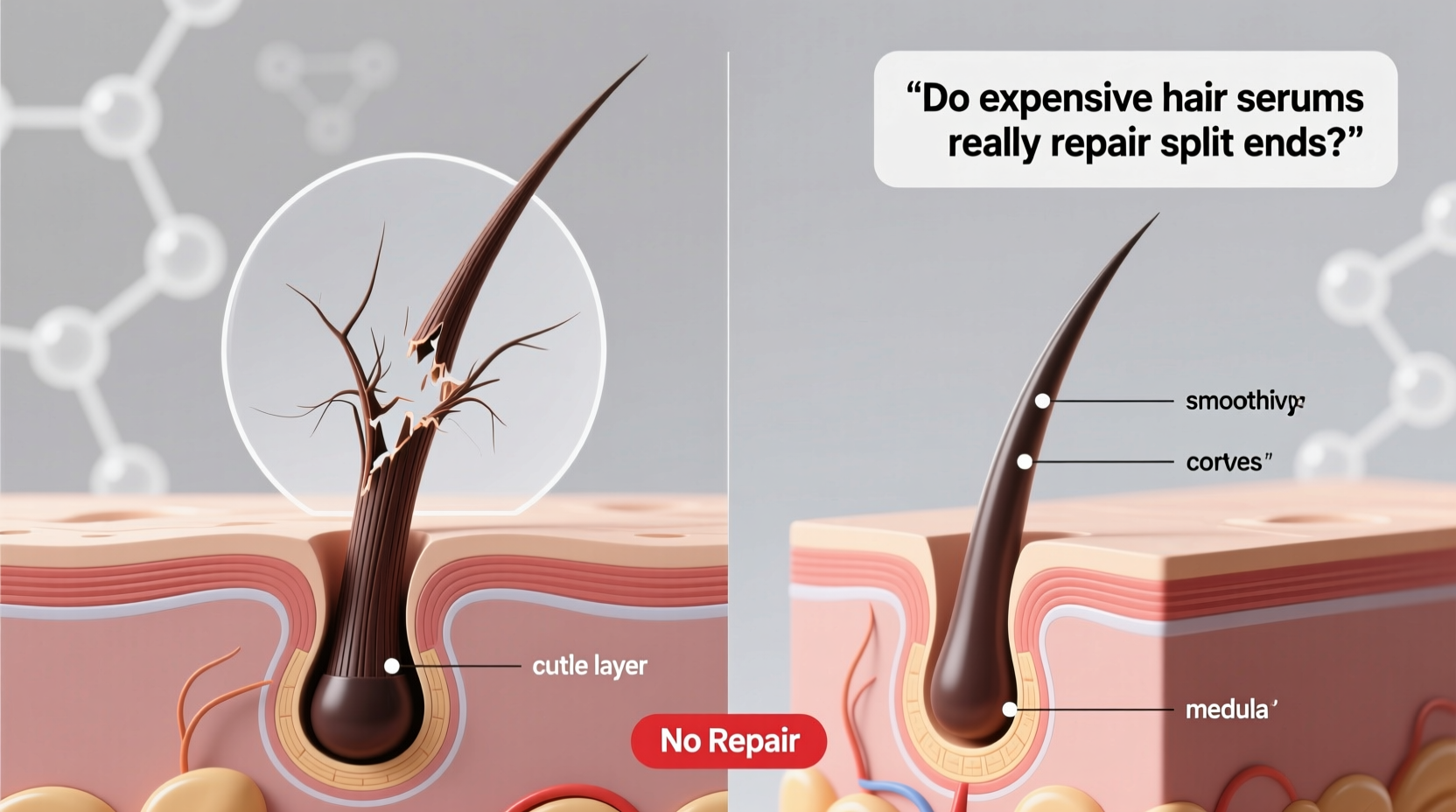
To evaluate whether any serum can repair split ends, it’s essential to understand hair structure. Each strand consists of three layers: the medulla (innermost), cortex (middle), and cuticle (outer layer). Split ends occur when the protective cuticle wears away due to heat styling, chemical processing, mechanical stress, or environmental exposure. Once the cortex is exposed, the fiber begins to fray, leading to splits that travel up the shaft if untreated.
Unlike skin cells, hair is made of dead keratinized protein and lacks blood supply or regenerative capacity. This means once damage occurs, the only permanent solution is cutting it off. No topical treatment can regenerate or biologically heal a split end. However, certain ingredients can temporarily bind frayed fibers, reinforce weak areas, and prevent further splitting.
“Hair is non-living tissue. Any claim of ‘repair’ should be interpreted as structural reinforcement, not biological regeneration.” — Dr. Lisa Chen, Trichologist and Cosmetic Chemist
How Hair Serums Work: Smoothing vs. Strengthening
Most hair serums rely on silicones, oils, and conditioning agents to create an instant visual improvement. These substances coat the hair shaft, filling in gaps in the damaged cuticle and creating a smoother surface. This reduces friction, static, and light scattering, making hair appear shinier and feel softer.
While this effect is undeniably beneficial, it's primarily cosmetic. But newer advanced serums go beyond simple coating by incorporating film-forming polymers and hydrolyzed proteins that penetrate slightly beneath the cuticle to provide structural support.
Key Ingredients That Mimic Repair
- Silicones (e.g., dimethicone, cyclomethicone): Form a protective layer, reduce frizz, and improve slip. Fast-acting but can build up over time.
- Hydrolyzed Keratin: Small protein fragments that can partially penetrate the hair shaft, reinforcing weakened areas and improving tensile strength.
- Ceramides: Naturally occurring lipids that help glue cuticle scales together, restoring cohesion in damaged zones.
- Polyquaterniums: Cationic polymers that adhere to negatively charged damaged sites, providing long-lasting conditioning and anti-static benefits.
- Plant Oils (e.g., argan, marula, coconut): Penetrate to varying degrees, improving moisture retention and reducing breakage.
Expensive vs. Drugstore: Is Price a Reliable Indicator?
High-end serums often cost significantly more due to brand prestige, packaging, fragrance, and marketing. But does that translate into better performance? Not always. Some luxury brands use higher concentrations of effective actives, but many drugstore options contain similar core ingredients at lower prices.
A comparative analysis of five popular serums reveals that formulation quality matters more than price alone.
| Product | Price (USD) | Key Active Ingredients | Repair Claim? | Realistic Benefit |
|---|---|---|---|---|
| Olaplex No.7 Bonding Oil | $28 | Bis-Aminopropyl Diglycol Dimaleate | Yes – repairs bonds | Reduces breakage, strengthens internally |
| Moroccanoil Treatment | $44 | Argan oil, linseed extract, silicones | No – smoothing only | Instant shine, frizz control |
| Living Proof Restore Perfecting Spray | $32 | Proprietary Healthy Hair Molecule (OFPMA) | Yes – prevents future damage | Heat protection, reduced porosity |
| L'Oréal Paris Elvive 8 Second Wonder Water | $10 | Castor oil, glycerin, silicones | Yes – \"instant repair\" | Temporary smoothing, lightweight |
| Kérastase Double Force Serum | $45 | Ceramide, vitamin B6, polymers | Yes – reinforces fiber | Long-term strengthening with consistent use |
The data shows that while premium products may offer superior delivery systems or patented technologies, affordable alternatives can deliver comparable smoothing effects. However, true structural reinforcement—such as Olaplex’s bond-building technology—is typically found in higher-priced, scientifically formulated products.
What “Repair” Really Means in Hair Care
The term “repair” is widely used in beauty marketing, but its definition varies. In dermatology and cosmetic chemistry, “repair” refers to restoration of function or appearance, not cellular regeneration. So when a serum claims to “repair split ends,” it usually means one or more of the following:
- Sealing split tips temporarily using film-formers
- Reducing further splitting through improved elasticity
- Improving surface texture and reflectivity
- Rebuilding internal disulfide bonds (in rare cases like Olaplex)
Only bond-rebuilding technologies can claim a form of genuine internal repair. These work by reconnecting broken sulfur bonds within the cortex, effectively reversing some types of chemical damage. However, even these cannot fuse a fully separated split end back together.
Case Study: Real Results After 6 Weeks of Use
Samantha, a 34-year-old with color-treated wavy hair, had been struggling with persistent split ends despite regular trims. She began using Olaplex No.3 once a week and applied Olaplex No.7 serum daily. After six weeks, her stylist noted significantly less fraying during a trim, and breakage during brushing dropped by nearly 60%. While her ends weren’t “cured,” they were stronger, easier to detangle, and required fewer cuts than usual.
This illustrates a key point: consistent use of advanced serums can slow down deterioration and improve hair resilience—even if they don’t eliminate splits entirely.
How to Choose a Serum That Delivers Real Benefits
Not all serums are created equal. To separate marketing hype from functional performance, consider the following checklist before purchasing.
✅ Serum Selection Checklist
- Check the ingredient list: Prioritize products with hydrolyzed proteins, ceramides, or bond-rebuilding agents (like bis-aminopropyl diglycol dimaleate).
- Avoid heavy silicones if you wash infrequently: Dimethicone and amodimethicone can build up, requiring clarifying shampoos.
- Match the formula to your hair type: Fine hair needs lightweight, fast-absorbing serums; thick or curly hair benefits from richer oils.
- Look for heat protection: If you style with heat, choose a serum with thermal shielding properties.
- Test longevity: Does the effect last 6+ hours, or does hair revert quickly? Long-lasting hold suggests deeper conditioning.
- Assess impact over time: Track changes in breakage, softness, and manageability after 4–6 weeks of use.
Step-by-Step: Maximizing Serum Effectiveness
Even the best serum won’t perform well if used incorrectly. Follow this routine to get the most out of your product.
- Start with clean, damp hair: After shampooing and conditioning, gently towel-dry to remove excess water.
- Apply sparingly: One to two drops for fine hair, up to a full pump for thick or long hair.
- Warm between palms: Rub the serum between your hands to distribute evenly and activate ingredients. <4> Focus on damage zones: Run fingers through mid-lengths to ends, concentrating on visibly frayed areas.
- Style as usual: Proceed with blow-drying or air-drying. For added protection, reapply a tiny amount to dry hair before heat styling.
- Weekly deep treatment: Once a week, apply a generous layer before bed, wrap hair loosely, and rinse in the morning for intensive conditioning.
Consistency is critical. Like sunscreen for the skin, hair serums work best as preventive maintenance rather than emergency fixes.
Frequently Asked Questions
Can any serum actually heal split ends permanently?
No. Once a hair strand splits, the damage cannot be reversed because hair is composed of dead cells. Only cutting removes split ends permanently. Serums can only mask or slow progression.
Are natural or silicone-free serums as effective?
Some are, but they often lack the immediate smoothing power of silicones. Plant-based alternatives like squalane, jojoba oil, or rice bran wax can condition well but may require more frequent application and don’t provide the same level of frizz control.
How often should I use a hair serum?
Daily use is safe for most formulas, especially on dry or damaged hair. Lightweight versions can be used every day; heavier oils may be better suited for nightly application or post-wash use.
Conclusion: Smart Choices Over Hype
Expensive hair serums don’t “repair” split ends in the biological sense—but the best ones come remarkably close by reinforcing weak spots, sealing frays, and preventing future damage. The distinction between surface smoothing and structural support is crucial. While budget-friendly options excel at instant gratification, high-end serums with proven active ingredients offer longer-term benefits that justify their cost for those with severely damaged hair.
Rather than chasing miracle claims, focus on consistency, ingredient transparency, and realistic expectations. Pair your serum with gentle handling, minimal heat, and regular trims to keep your ends healthy. When you understand what these products can and cannot do, you're no longer buying promises—you're investing in smarter hair care.
💬 Have you found a serum that genuinely improved your hair health? Share your experience in the comments and help others make informed choices.








