
Living in an apartment often means limited space, fewer tools, and a need for precision when handling minor repairs. Whether you're assembling furniture, hanging shelves, or tightening loose cabinet screws, having the right tool makes all the difference. The debate between a cordless drill and a manual screwdriver isn't just about power—it's about practicality, control, noise, and long-term value. For urban dwellers managing routine fixes in compact environments, understanding the strengths and limitations of each tool can save time, reduce frustration, and protect your walls—and your peace.
Understanding Your Apartment Repair Needs
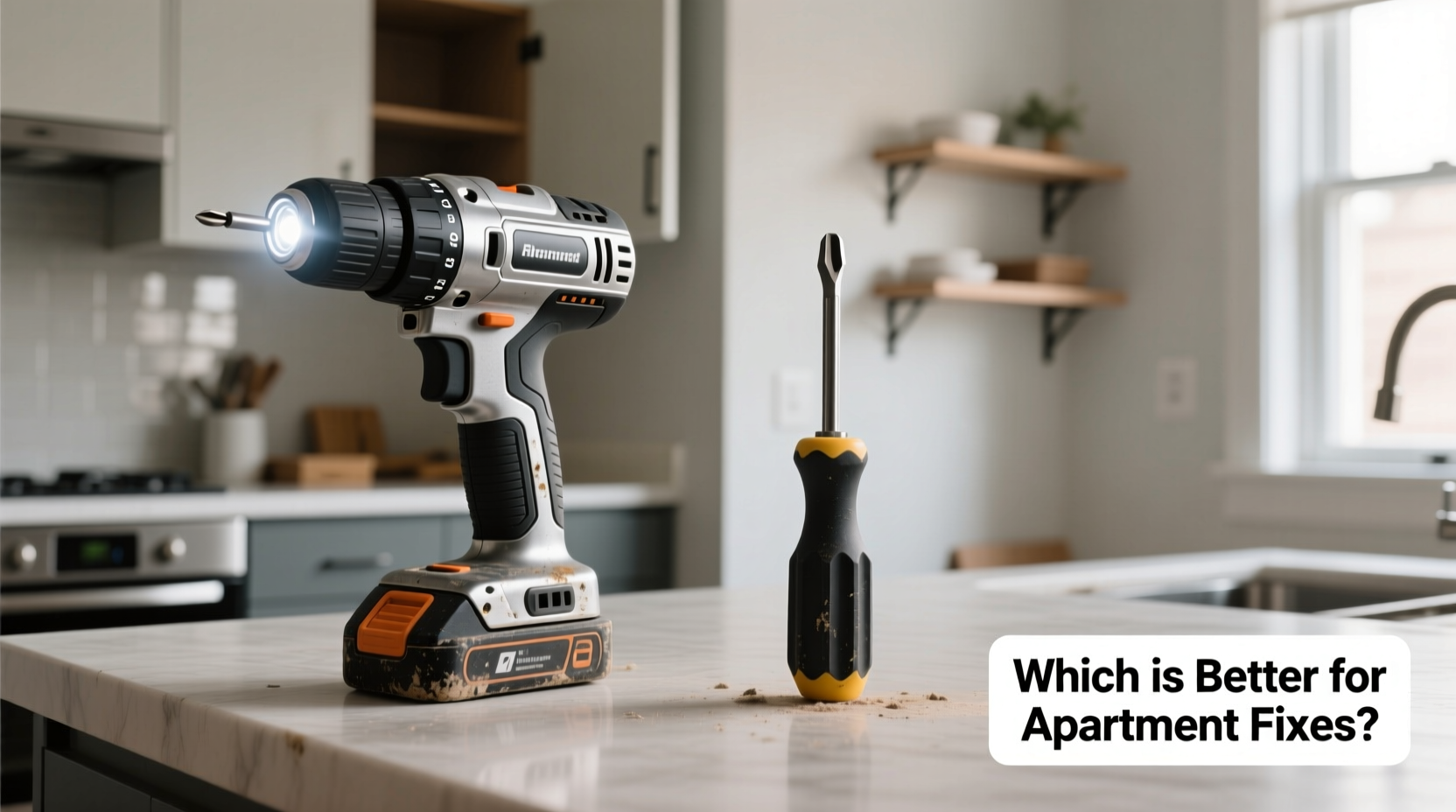
Apartments present unique challenges for DIY projects. Space is tight, storage is limited, and noise restrictions may apply—especially in shared buildings. Most apartment maintenance revolves around light-duty tasks: installing curtain rods, mounting picture frames, assembling flat-pack furniture, or replacing hardware on cabinets and doors. These jobs rarely require heavy drilling into concrete or masonry, which shifts the advantage toward simpler, quieter, and more manageable tools.
The key is matching the tool to the task frequency and complexity. If you’re someone who rarely picks up a screwdriver, investing in a cordless drill might seem excessive. On the other hand, if you frequently rearrange your space or handle multiple setups per year, a drill could streamline your workflow significantly.
Tip: Assess how often you perform household fixes. If it’s less than four times a year, a manual screwdriver may suffice. More frequent use favors a cordless drill.Cordless Drill: Power, Speed, and Versatility
A cordless drill offers undeniable advantages in speed and efficiency. With adjustable torque settings and interchangeable bits, it handles a wide range of screw types and materials—from drywall anchors to wood and plastic. Modern models are lightweight, battery-powered, and designed with ergonomics in mind, making them ideal even for beginners.
One of the biggest benefits is consistency. A cordless drill applies uniform pressure and rotation, reducing the risk of stripping screw heads—a common issue when using manual tools with uneven force. Many drills also feature a clutch mechanism that stops turning once resistance reaches a set level, preventing over-tightening and damage to surfaces.
For apartment dwellers who enjoy upgrading their space, a cordless drill opens possibilities beyond basic repairs. You can install smart home devices, mount TVs securely, or build custom shelving without relying on professional help. Battery life on newer 12V or 18V models lasts through dozens of screw insertions on a single charge, and compact designs make storage feasible in closets or under sinks.
“Modern cordless drills have become essential for urban homeowners. They combine portability with enough power to handle 95% of indoor tasks.” — Daniel Reeves, Residential Electrician & DIY Consultant
When a Cordless Drill Shines
- Assembling multiple pieces of flat-pack furniture (e.g., IKEA)
- Installing wall-mounted units like floating shelves or TV brackets
- Driving screws into harder materials like plywood or pre-drilled metal
- Projects requiring repetitive screwing (e.g., building a bed frame)
Manual Screwdriver: Simplicity, Control, and Quiet Operation
The manual screwdriver remains a staple in many households—not because it’s flashy, but because it works. It requires no charging, produces zero noise, and takes up almost no storage space. For quick fixes like tightening a wobbly doorknob or adjusting hinge screws, nothing beats grabbing a screwdriver from a drawer and getting the job done in under a minute.
Where the manual tool excels is in precision. When working near delicate surfaces—such as painted walls, glass-backed cabinets, or thin veneers—you have full control over applied force. This minimizes the risk of cracking drywall or splitting wood, common pitfalls when using power tools at high torque.
Additionally, manual screwdrivers are inherently safer in tight spaces. There’s no risk of sudden kickback, and they don’t require protective eyewear for simple tasks. They’re also completely silent, making them ideal for early morning or late-night repairs when noise sensitivity matters most in apartment complexes.
Limitations of Manual Tools
While reliable, manual screwdrivers demand physical effort. Tightening multiple screws into dense material can be tiring and time-consuming. Stripping screw heads is more likely due to inconsistent hand pressure, especially with Phillips tips. And unlike drills, they lack depth control, increasing the chance of damaging underlying structures if you push too hard.
Tip: Use a magnetic bit holder or jeweler’s screwdriver for small screws to avoid dropping them behind appliances or into tight corners.Head-to-Head Comparison: Key Factors for Apartment Living
| Factor | Cordless Drill | Manual Screwdriver |
|---|---|---|
| Speed & Efficiency | High – completes repetitive tasks quickly | Low – slower, especially for multiple screws |
| Noise Level | Moderate to high – may disturb neighbors | Negligible – ideal for quiet hours |
| Storage Space | Requires dedicated space for tool and charger | Takes minimal drawer space |
| Precision & Control | Good with low torque settings; risk of overdriving | Excellent – full user control |
| Battery/Maintenance | Needs charging; batteries degrade over time | None – no moving parts or power source |
| Cost | $30–$100+ depending on brand and features | $5–$20 for quality multi-bit models |
| Versatility | Can drill holes, drive screws, mix adhesives (with attachments) | Limited to screw driving only |
Real-World Scenario: Mounting a Floating Shelf
Consider this common apartment project: installing a floating shelf in the living room to display decor. The instructions call for four lag bolts into wall studs, with pilot holes required. Using a cordless drill, you’d mark the spots, switch to a drill bit, create the pilot holes, then change to a driver bit to secure the screws. Total time: approximately 12 minutes. The process is smooth, consistent, and requires minimal physical strain.
With a manual screwdriver, the same task becomes significantly more demanding. Drilling pilot holes manually is impractical without a hand brace, so you’d likely skip this step—increasing the risk of splitting the stud or cracking surrounding drywall. Driving lag bolts by hand takes considerable effort and time, and maintaining straight alignment is difficult. Total time: 25–30 minutes, with higher likelihood of errors.
In this case, the cordless drill proves superior not just in speed, but in safety and outcome quality. However, if you were simply reattaching a loose towel bar with small screws in drywall anchors, the manual screwdriver would be faster, quieter, and entirely sufficient.
Step-by-Step: Choosing the Right Tool for Your Fix
- Identify the Task Type: Is it light assembly, hardware tightening, or structural mounting?
- Check Material Involved: Softwood, drywall, metal, or hardwood? Harder materials favor drills.
- Evaluate Quantity of Screws: More than five screws? A drill saves time and effort.
- Assess Time and Noise Constraints: Need silence or working late? Manual tools win here.
- Review Storage Availability: Do you have space for a drill and charger?
- Determine Frequency of Use: Occasional fixes vs. regular renovations changes the value proposition.
- Make Your Choice: Match the tool to the context, not just convenience.
Essential Checklist for Apartment-Friendly Tool Selection
- ✅ Define the repair scope before selecting a tool
- ✅ Keep a multi-bit manual screwdriver for quick adjustments
- ✅ Invest in a compact 12V cordless drill if doing furniture builds or wall mounts
- ✅ Use masking tape on screw heads to prevent slipping and stripping
- ✅ Store bits in labeled containers to avoid misplacing them
- ✅ Charge your drill battery monthly, even if unused
- ✅ Test torque settings on scrap material before starting real work
Frequently Asked Questions
Can I use a cordless drill for delicate tasks like tightening eyeglass screws?
No—cordless drills lack the finesse needed for micro-screws. Use a precision manual screwdriver with a jeweler’s tip instead. Drills generate too much torque and can easily strip tiny fasteners.
Is a cordless screwdriver a good middle ground?
Yes. A cordless screwdriver (distinct from a drill) offers powered assistance with lower torque and compact size. It’s ideal for apartment use—quieter and smaller than a full drill, yet faster than manual turning. Models like the DeWalt DXD560 or Bosch IXO are popular for light-duty indoor work.
Do I need special bits for a cordless drill in drywall?
Standard Phillips or square-drive bits work fine, but consider using a self-drilling drywall anchor bit combo for installations. These eliminate the need for separate pilot holes and streamline the process when mounting lightweight fixtures.
Final Recommendation: Balance Over Bias
Neither tool universally outperforms the other in an apartment setting. The best approach is balanced: keep a quality manual screwdriver for daily touch-ups and silent operations, and own a compact cordless drill for larger, infrequent projects. Think of them as complementary, not competing, tools.
If you must choose one, prioritize based on your lifestyle. Renters who move often benefit more from a cordless drill—it speeds up furniture disassembly and reassembly. Long-term residents who prefer minimalism may find a durable manual screwdriver meets nearly all their needs.
Technology has made cordless drills lighter, smarter, and more accessible than ever. But simplicity still holds value. In the close quarters of apartment life, sometimes the quietest tool is the most powerful one.
💬 What’s your go-to tool for apartment fixes? Share your experience—whether you swear by your drill or never leave home without a screwdriver. Your insight could help others find their perfect fit!








