For homeowners tackling everything from assembling furniture to mounting shelves or building backyard decks, having the right power tool makes all the difference. Two of the most common tools found in modern toolkits are the cordless drill and the impact driver. While they may look similar and both drive screws, their design, performance, and ideal applications vary significantly. Using the wrong one can lead to stripped screws, damaged materials, or unnecessary fatigue. Understanding when to reach for a cordless drill versus an impact driver ensures cleaner results, longer tool life, and greater efficiency on every job.
Key Differences Between Cordless Drills and Impact Drivers
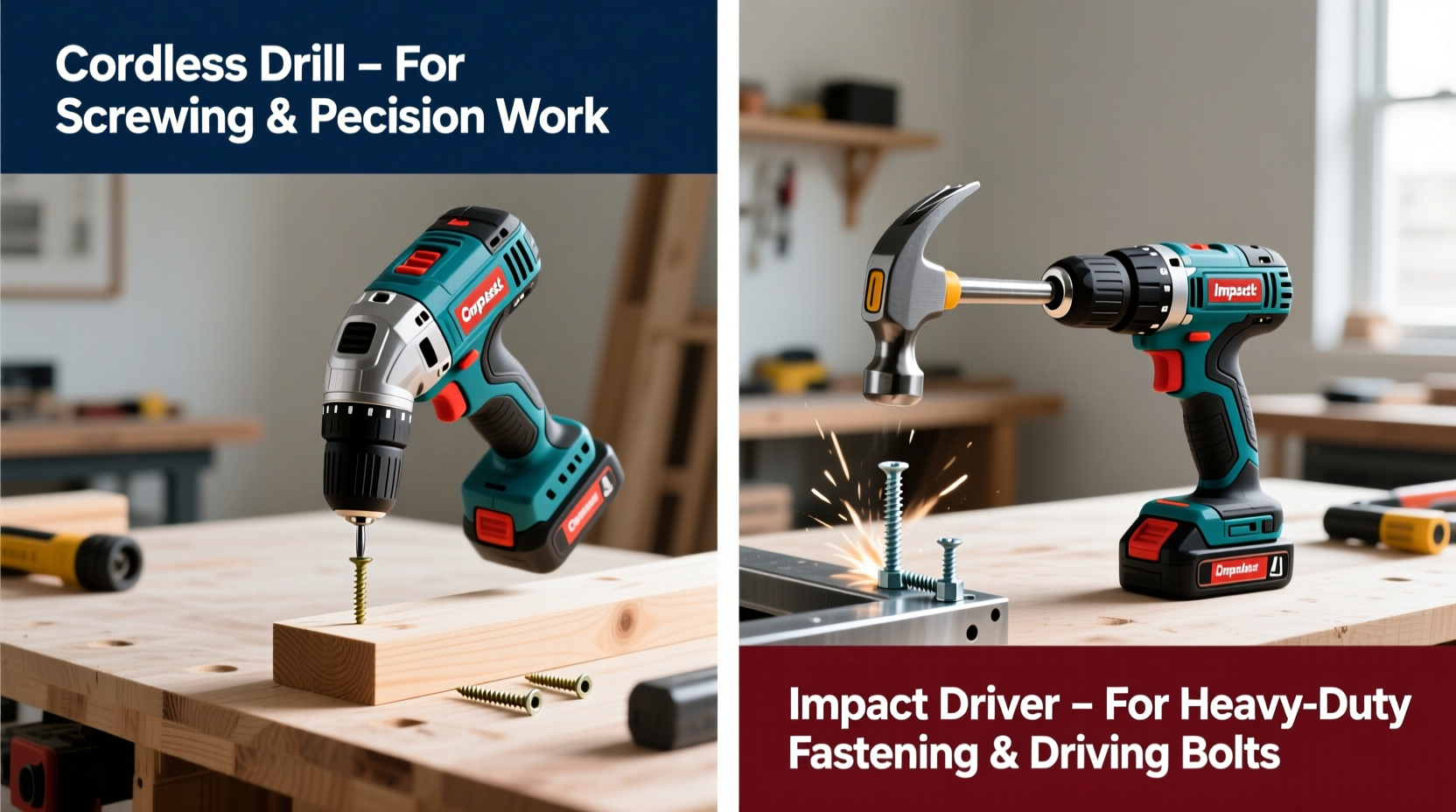
At first glance, both tools are compact, battery-powered, and accept hex-shank bits. However, their internal mechanics and torque delivery systems set them apart fundamentally.
- Cordless Drill: Designed primarily for drilling holes and driving screws with consistent rotational force. It offers variable speed control via trigger pressure and a clutch to prevent over-tightening.
- Impact Driver: Built for high-torque applications. It delivers rotational force combined with sudden bursts of concussive power (impacts), making it ideal for driving long screws, lag bolts, or working with tough materials like pressure-treated wood or metal.
The key distinction lies in how force is applied. A drill turns steadily; an impact driver \"hammers\" as it turns—up to 3,000 to 4,500 impacts per minute (IPM)—multiplying torque without straining your wrist.
“Many DIYers think more power is always better, but precision matters just as much as strength. Using an impact driver on delicate trim work is like using a sledgehammer to hang a picture.” — Mark Reynolds, Professional Carpenter & Tool Instructor
When to Use a Cordless Drill
The cordless drill is the Swiss Army knife of power tools—versatile, precise, and suitable for a wide range of household tasks. Its balanced combination of speed control, clutch settings, and drilling capability makes it indispensable for everyday projects.
Best Applications for a Cordless Drill
- Drilling holes in wood, plastic, or light metal: With the right bit, a cordless drill handles pilot holes, clearance holes, and small-diameter holes efficiently.
- Driving screws into softwood or drywall: Whether installing cabinet hardware or hanging curtain rods, the drill’s clutch prevents over-driving and damaging surfaces.
- Assembling flat-pack furniture: Precision and control matter more than raw power here. The drill allows careful screw depth adjustment.
- Installing door hinges or light fixtures: These jobs require accuracy and moderate torque—perfect for a drill’s adjustable settings.
- Using accessories like sanding drums or wire brushes: Many drills accept multi-tool attachments, expanding their utility beyond fastening.
When to Use an Impact Driver
If you're working with dense materials, large fasteners, or repetitive heavy-duty tasks, the impact driver shines. It excels where sustained high torque is needed and where a standard drill would stall or strain.
Best Applications for an Impact Driver
- Driving long deck screws or lag bolts: When building outdoor structures, impact drivers sink fasteners quickly without cam-out (slipping out of the screw head).
- Working with pressure-treated lumber or composite decking: These materials resist penetration and demand higher torque to avoid stripping.
- Removing stubborn or rusted screws: The hammering action helps break loose seized fasteners that a regular drill can’t budge.
- Framing or subflooring projects: Contractors rely on impact drivers for rapid, reliable fastening during structural builds.
- Automotive repairs around the garage: From wheel lug nuts (with proper socket adapter) to chassis bolts, the extra punch is invaluable.
Because of its compact size and high power-to-weight ratio, the impact driver reduces user fatigue during extended use—especially when driving dozens of screws in a single session.
Comparison Table: Cordless Drill vs Impact Driver
| Feature | Cordless Drill | Impact Driver |
|---|---|---|
| Torque Type | Constant rotational force | Rotational + concussive impacts |
| Max Torque (in-lbs) | 300–600 (standard models) | 1,000–1,800+ |
| Speed (RPM) | 0–1,500 RPM (2-speed gears common) | 0–3,000+ RPM with up to 4,500 IPM |
| Chuck Type | Keyless or keyed (¼” to ½”) | Hex collet (usually ¼”) |
| Primary Function | Drilling and light-to-medium screwdriving | High-torque fastening only |
| Clutch? | Yes – adjustable slip clutch | No – full torque until release |
| Best For | Precision work, beginners, general DIY | Heavy-duty tasks, pros, repetitive driving |
Real-World Example: Building a Garden Bench
Consider a homeowner constructing a garden bench from pressure-treated pine. The project involves drilling pilot holes, driving 3-inch structural screws, and assembling multiple joints.
Using only a cordless drill, the user struggles to drive the final inch of each screw. The motor whines, the bit slips, and several screw heads strip. Frustration builds, and progress slows. After switching to an impact driver, the same screws seat cleanly in seconds with no slippage.
However, when attaching decorative end caps made of soft cedar, the homeowner returns to the cordless drill. The impact driver is too aggressive and splits the thin wood. By choosing the right tool for each phase—impact driver for framing, cordless drill for finishing—the project finishes faster, cleaner, and with fewer damaged parts.
This scenario illustrates why owning both tools—or knowing when to rent or borrow one—is smart for serious DIYers.
Checklist: Choosing the Right Tool for Your Project
- ✅ Will you be drilling holes? → Choose a cordless drill.
- ✅ Are you driving small-to-medium screws into soft materials? → Cordless drill with clutch setting.
- ✅ Working with thick wood, metal, or outdoor structures? → Impact driver recommended.
- ✅ Need fine control to avoid over-driving? → Stick with a cordless drill.
- ✅ Removing stuck screws or bolts? → Impact driver provides superior breakout torque.
- ✅ Using a variety of bit types or attachments? → Cordless drill offers broader compatibility.
- ✅ Doing repetitive fastening (e.g., decking, fencing)? → Impact driver saves time and effort.
Frequently Asked Questions
Can I use an impact driver to drill holes?
Not effectively. Most impact drivers lack the chuck size and continuous rotation needed for drilling. While you can attach a drill bit, the hammering action damages masonry or tile and offers no benefit in wood. Use a cordless drill for any hole larger than a pilot hole.
Do I need both tools at home?
For casual DIYers, a good cordless drill suffices for most tasks. But if you frequently build decks, install railings, or tackle car repairs, adding an impact driver greatly expands your capability. Many manufacturers sell combo kits with both tools and shared batteries.
Are impact drivers harder to control?
They require some adjustment. Because they deliver sudden bursts of force, starting screws can be trickier—especially overhead. Practice on scrap material first. Use a magnetic bit holder to keep screws aligned, and start slowly to set the screw before applying full pressure.
Expert Tip: Bit Selection Matters
Even the best tool fails with poor accessories. Use high-quality, hardened bits designed for impact use when operating an impact driver. Standard cheap bits can shatter under stress, creating safety hazards and reducing performance.
“Invest in impact-rated bits. They’re heat-treated to withstand repeated shock loads. I’ve seen DIYers ruin $150 tools because they used $2 bits.” — Lena Patel, Master Electrician & Workshop Trainer
Conclusion: Match the Tool to the Task
The choice between a cordless drill and an impact driver isn’t about which is “better”—it’s about which is right for the job at hand. The cordless drill remains the cornerstone of home toolkits: precise, adaptable, and essential for drilling and controlled fastening. The impact driver is the specialist—unmatched when brute force and speed are required.
Understanding their strengths prevents damage, boosts productivity, and protects your investment in tools and materials. For many homeowners, owning both represents a smart upgrade from basic DIY to confident, professional-grade workmanship.
🚀 Ready to upgrade your toolkit? Assess your next three projects—will you need precision or power? Choose wisely, work safely, and build with confidence.








