For homeowners tackling weekend repairs or ambitious renovation projects, the question often arises: do I really need both a cordless drill and an impact driver? At first glance, these two power tools look similar—compact, battery-powered, and designed to drive fasteners. But beneath their shared form factor lies a world of functional difference. Understanding when and how each tool excels can save time, prevent stripped screws, and even protect your wrists from unnecessary strain. The answer isn’t always straightforward, but with the right insight, you can decide whether investing in both tools makes sense for your DIY toolkit.
Understanding the Core Differences
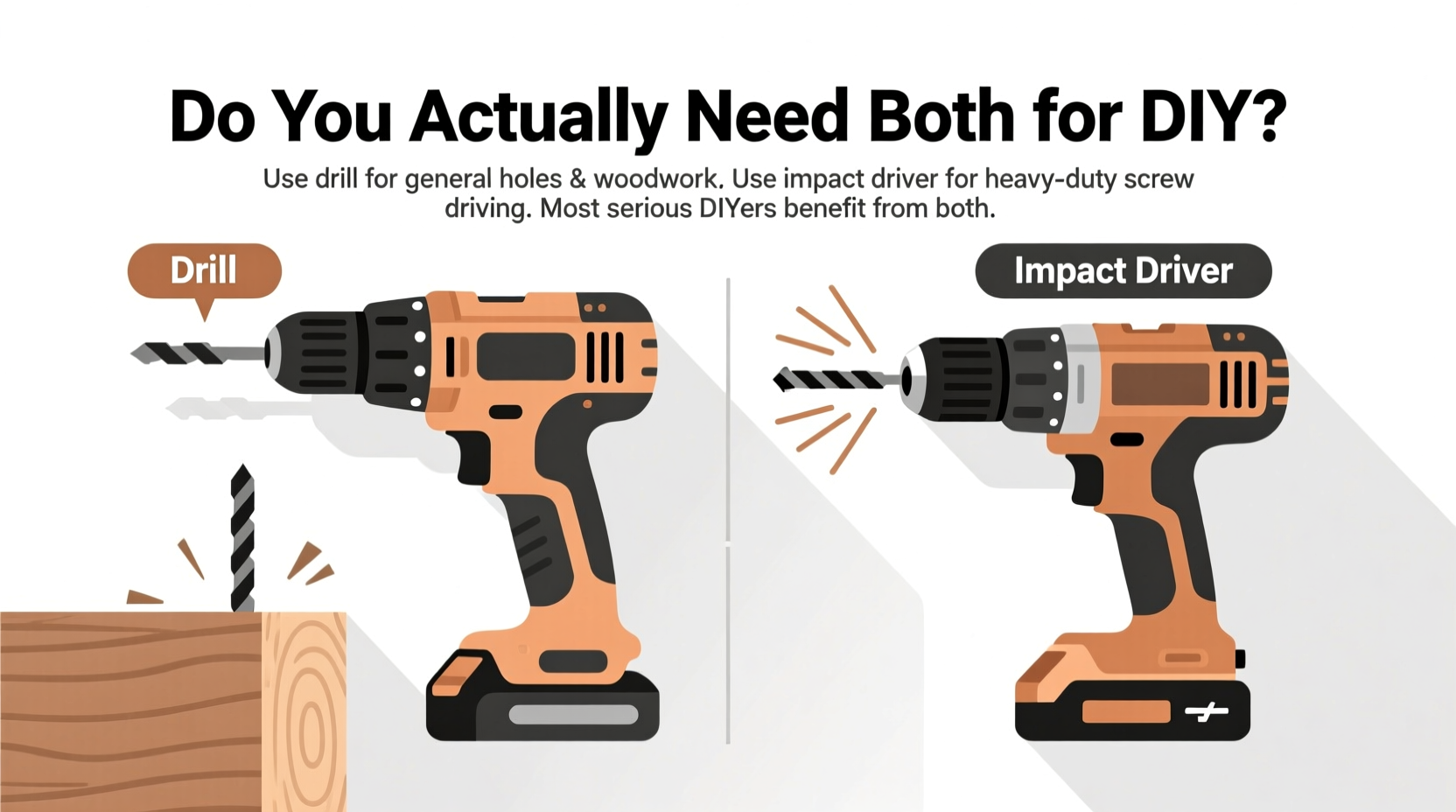
The fundamental distinction between a cordless drill and an impact driver lies in their torque delivery and operational mechanics. A cordless drill delivers consistent rotational force (torque) at variable speeds, making it ideal for drilling holes and driving smaller fasteners. It typically features a keyed or keyless chuck that holds drill bits and screwdriver bits securely. Most models offer adjustable clutch settings, allowing users to control how much torque is applied before the tool disengages—critical for avoiding overdriven screws in delicate materials like drywall or softwood.
In contrast, an impact driver generates high rotational force combined with sudden bursts of concussive power. This \"hammering\" action happens thousands of times per minute, delivering peak torque without requiring continuous pressure from the user. Instead of a chuck, impact drivers use a hex collet system that accepts 1/4-inch hex shank bits directly. This design allows for faster bit changes and better grip under heavy load. While drills excel in precision and versatility, impact drivers dominate in raw power and efficiency when dealing with long screws, lag bolts, or tough materials like pressure-treated lumber or metal framing.
Tip: Always match the bit type to your tool—standard screwdriver bits work in drills, but only hex-shank bits should be used in impact drivers.When Each Tool Shines: Practical Use Cases
Knowing what each tool does best helps clarify whether one or both are necessary for your typical DIY workload.
Cordless Drill: The All-Rounder
- Drilling holes in wood, plastic, masonry (with appropriate bits)
- Driving small-to-medium screws into cabinetry, shelves, or furniture
- Working in tight spaces where precision matters more than brute force
- Countersinking screws thanks to clutch control
- Light-duty tasks such as assembling flat-pack furniture or installing light fixtures
The cordless drill remains indispensable for general-purpose tasks. Its ability to switch between drilling and driving, coupled with speed and clutch adjustments, makes it the go-to tool for most household projects. For someone doing occasional repairs or light remodeling, a good-quality 12V or 18V drill may be sufficient for years.
Impact Driver: The Power Specialist
- Driving long deck screws or structural fasteners into dense materials
- Removing stubborn bolts or rusted screws (in reverse mode)
- Framing walls, building decks, or working with treated lumber
- Installing subfloors or sheathing with hundreds of fasteners
- Automotive or metalwork projects involving high-torque applications
If you've ever struggled to sink a 3-inch screw into pressure-treated wood using a standard drill, you’ve encountered the limitation impact drivers were built to overcome. Their pulsating force reduces binding and cam-out, meaning less frustration and fewer damaged screw heads. They’re also lighter and more ergonomic than many bulky drills, which enhances comfort during extended use.
“An impact driver isn't just a stronger drill—it’s a different animal altogether. It’s engineered for sustained high-torque performance, not precision work.” — Mark Reynolds, Residential Contractor & Tool Instructor
Comparison Table: Key Features Side-by-Side
| Feature | Cordless Drill | Impact Driver |
|---|---|---|
| Torque Delivery | Constant rotation | Rotational + concussive impacts |
| Chuck Type | Keyed or keyless (holds round shanks) | Hex collet (accepts 1/4\" hex bits) |
| Typical Torque Range | 200–600 in-lbs | 1,000–1,800+ in-lbs |
| Best For | Drilling, light driving, precision work | Heavy driving, tough fasteners, repetitive tasks |
| Clutch Settings | Yes (adjustable) | No (full power only) |
| Size & Weight | Moderate length, balanced weight | Shorter, lighter, compact nose |
| Can It Drill Masonry? | Yes (with hammer function on some models) | No – not designed for drilling |
Real-World Example: Building a Backyard Deck
Consider a common DIY project: constructing a wooden deck in your backyard. You’ll likely need to drill pilot holes through joists and drive numerous 3-inch composite deck screws. Using only a cordless drill might get the job done, but you’ll face challenges. Many screws will bind before fully seating, especially in dense timber. The drill’s motor may whine under load, and repeated high-torque demands could drain the battery quickly or even overheat the tool. Stripped screw heads become common, leading to wasted time and materials.
Now, introduce an impact driver. With its superior torque and impact mechanism, each screw drives smoothly and seats flush with minimal effort. The reduced user fatigue means you can work longer without hand strain. Additionally, because impact drivers are shorter and more maneuverable, they fit better in tight corners between joists. In this scenario, having both tools becomes practical: use the drill to create pilot holes (protecting against split wood), then switch to the impact driver for fast, reliable screw installation. One tool alone works—but two make the job significantly easier and more professional.
Do You Actually Need Both?
The short answer: it depends on the scope and frequency of your DIY activities.
For casual fixers who hang pictures, assemble IKEA furniture, or perform minor repairs, a quality cordless drill with a decent battery and set of bits will cover nearly every need. Modern 18V drills offer enough torque for most household tasks, and their versatility makes them a smart single-tool investment.
However, if you regularly engage in carpentry, outdoor construction, or any project involving large fasteners, hardwoods, or metal, an impact driver becomes far more valuable. It's not merely a luxury; it improves efficiency, reduces physical strain, and prevents damage to materials. Over time, the productivity gains justify the additional cost.
Many professionals and serious DIYers maintain both tools in their kits—not because they lack confidence in one, but because each serves a distinct role. Think of it like having both a chef’s knife and a paring knife: interchangeable in theory, but optimized for different jobs.
Tip: If space or budget is tight, consider a combo kit that includes both a drill and impact driver from the same brand and voltage platform—this ensures battery compatibility and saves money.Checklist: Choosing the Right Tool(s) for Your Needs
- Assess your typical projects: Are they light repair, furniture assembly, or major builds?
- Evaluate material types: Do you frequently work with hardwood, metal, or outdoor composites?
- Count fastener volume: Will you install dozens or hundreds of screws in a single session?
- Check existing tools: Do you already own a capable drill? Can it handle occasional heavy loads?
- Consider ergonomics: Do you experience wrist fatigue? An impact driver’s lightweight design may help.
- Budget for batteries: Buying both tools is easier if they share the same battery system.
- Storage space: Do you have room for multiple tools and chargers?
Common Misconceptions Debunked
Misconception 1: “An impact driver can replace a drill.”
While some people attempt to use impact drivers for drilling, this is ill-advised. Impact drivers lack the precise speed control and chuck versatility needed for clean hole-making. Attempting to drill masonry or deep holes with an impact driver risks damaging the tool and compromising accuracy.
Misconception 2: “More torque always means better.”
Excessive torque without control leads to stripped screws, cracked wood, or broken fasteners. Drills with adjustable clutches allow fine-tuning—something impact drivers cannot provide. There’s a reason surgeons don’t use sledgehammers.
Misconception 3: “One multi-tool can do everything.”
While 3-in-1 hybrid tools exist, they often compromise performance in both roles. Dedicated tools outperform hybrids in real-world conditions. Specialization beats generalization when precision and durability matter.
FAQ
Can I use drill bits in an impact driver?
No, standard twist drill bits are not designed for the high-impact forces generated by an impact driver and may break or shatter. Only use hex-shank impact-rated bits in an impact driver. For drilling, stick to your cordless drill with proper bits.
Is it safe to use an impact driver for small screws?
It’s possible, but risky. Without a clutch, impact drivers apply full force, increasing the chance of overdriving or damaging small screws and delicate materials. Use a cordless drill for precision tasks involving small fasteners.
Are 12V tools strong enough for impact driving?
Some compact 12V impact drivers exist, primarily for tight spaces or light-duty use. However, they lack the torque of full-size 18V models. For serious fastening work, 18V remains the standard.
Conclusion: Make the Choice That Fits Your Workshop
The decision between a cordless drill, an impact driver, or both ultimately hinges on how you define your DIY identity. If your garage hosts occasional repairs and simple upgrades, a single high-quality cordless drill will serve you well. But if you're building decks, renovating bathrooms, or tackling projects that demand speed and endurance, adding an impact driver transforms your workflow. It’s not about owning more tools—it’s about equipping yourself with the right ones.
Many experienced DIYers find that once they try an impact driver for a demanding task, going back feels inefficient. The smooth, powerful drive, reduced fatigue, and cleaner results make a compelling case for ownership. And with modern battery platforms allowing shared power sources, maintaining both tools is more affordable and convenient than ever.
🚀 Ready to upgrade your toolkit? Start by evaluating your last three projects—did you struggle with driving screws or wish for more power? If so, it might be time to add an impact driver to your collection. Share your experiences or ask questions in the comments below.








