The placement of hash marks on a football field may seem like a minor detail to casual fans, but their position significantly influences offensive strategy, defensive alignment, and overall game dynamics. In American football, both college (NCAA) and professional (NFL) fields are 53.3 yards wide, yet the hash marks—the vertical lines that determine where plays are spotted—differ dramatically between the two levels. College hash marks are spaced much farther apart than those in the NFL, creating a wider effective playing area near the sidelines. This seemingly small distinction has profound implications for how teams operate, from quarterback reads to route design and defensive coverage.
This article breaks down the technical differences, explores the historical reasons behind the gap, and analyzes how the wider college hash marks shape play-calling, player adaptation, and even draft evaluation.
The Technical Difference: Measurements Matter
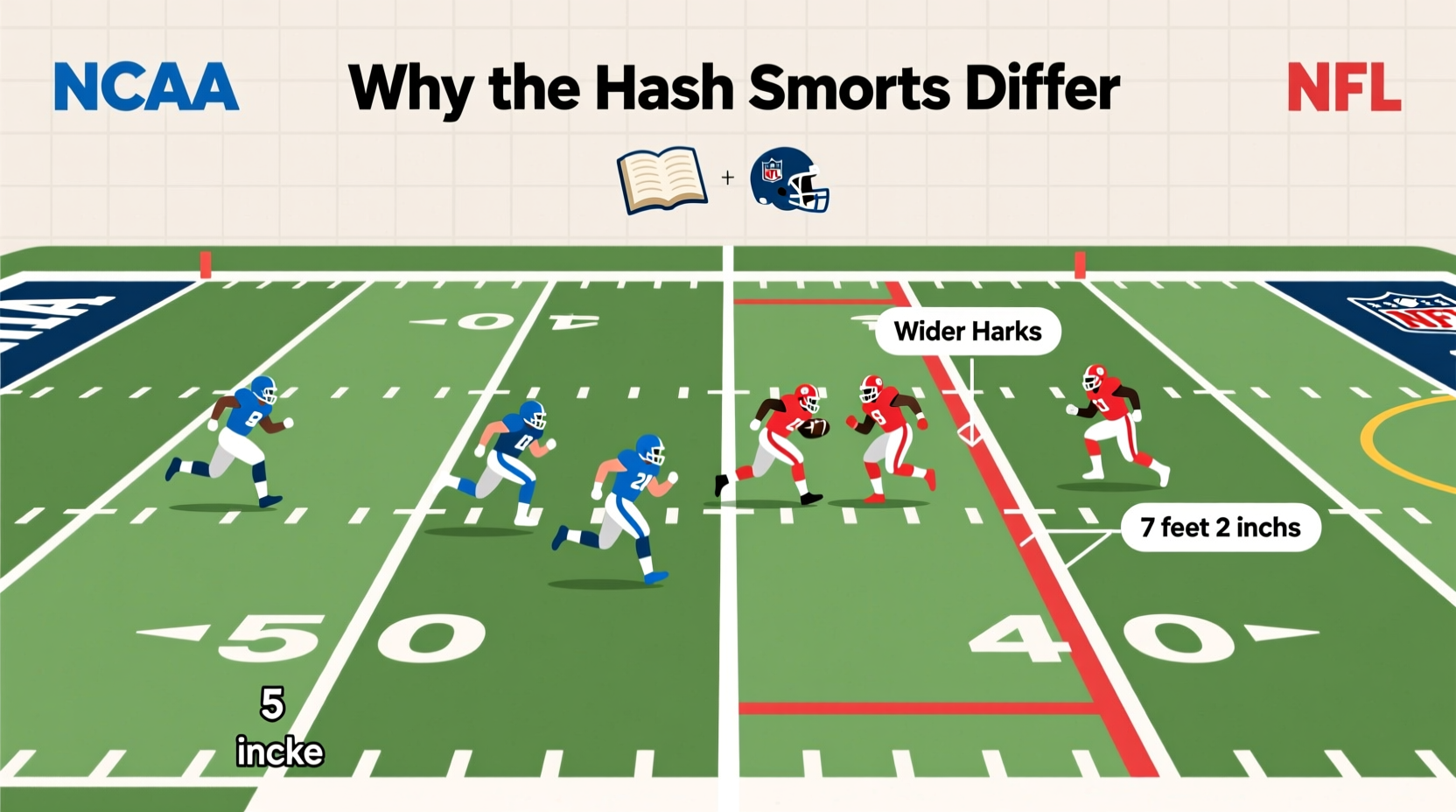
The standard football field is 160 feet wide. The hash marks run the length of the field and indicate where the ball is placed after each play, depending on where the previous play ended. Their spacing varies:
| League | Hash Mark Width (from sideline) | Distance Between Hash Marks | Field Width |
|---|---|---|---|
| NFL | 70 feet, 9 inches | 18 feet, 6 inches | 160 feet |
| NCAA (College) | 53 feet, 4 inches | 53 feet, 4 inches | 160 feet |
In the NFL, the close proximity of the hash marks—just over 18 feet apart—means most plays are run near the center of the field. In contrast, college hash marks are more than double that width, allowing the ball to be snapped much closer to the sideline. This creates a fundamentally different spatial challenge for offenses and defenses alike.
Tip: When analyzing college quarterbacks for the NFL Draft, scouts closely examine how they perform when forced to throw toward the boundary—skills less frequently tested in wide-hash college games.Historical Origins: Why the Split Exists
The divergence in hash mark placement dates back to the early days of football, when field dimensions were not standardized. As television broadcasting grew in the 1970s, the NFL sought to improve viewer experience by keeping action centralized. Tighter hash marks ensured that plays were less likely to be crowded near the edges of the screen, improving visibility and reducing obscured angles.
In contrast, college football retained its wider hash configuration partly due to tradition and infrastructure. Many college stadiums have narrower sidelines or advertising placements that make reconfiguring fields costly. Additionally, NCAA rules prioritize competitive balance across programs with varying resources, and maintaining the wider hashes allows spread offenses—common in college—to thrive without requiring complex field modifications.
“Tighter hash marks force precision. In the NFL, there’s no hiding from pressure or poor footwork—every throw is scrutinized within a compressed space.” — Mike Shanahan, Former NFL Head Coach and Offensive Strategist
Impact on Offensive Strategy and Play Design
The width of hash marks directly affects offensive philosophy. In college, the wider spacing enables creative use of the perimeter. Teams can run sideline-heavy formations and still have room to execute horizontal routes like screens, slants, and flare passes without immediately stepping out of bounds.
However, this also presents challenges:
- Limited field vision: Quarterbacks often face tighter windows when throwing toward the sideline because defenders can align closer to the boundary without fear of being outflanked.
- Reduced pocket mobility: Offensive tackles have less margin for error when pass protecting near the edge, increasing sack risk.
- Route compression: Receivers must adjust their breaks to stay inbounds, altering timing and spacing.
In the NFL, the narrow hash marks create a more condensed, chess-like environment. Offenses cluster around the middle, forcing defenses to cover shorter horizontal distances. This encourages zone-heavy schemes and increases the value of quick-strike, high-percentage throws.
Adapting from College to Pro: A Quarterback’s Challenge
One of the most critical transitions for rookie quarterbacks is adjusting to tighter throwing lanes and reduced field width. College stars accustomed to launching deep balls from wide hash positions often struggle when entering the NFL, where misjudging a sideline route by a few feet results in incompletions or interceptions.
For example, consider a quarterback who thrived in a spread offense at Oklahoma. He regularly threw fade routes from the left hash to a receiver tracking toward the corner of the end zone. In college, there was ample space between the receiver and the sideline. In the NFL, the same throw from the same hash mark brings the receiver dangerously close to going out of bounds, requiring earlier release and sharper accuracy.
Defensive Adjustments and Coverage Implications
Defenses benefit differently under each system. In college, wider hashes allow defensive coordinators to compress the formation and funnel receivers toward help. With less horizontal space between the ball and the sideline, safeties can cheat toward one side without leaving the opposite flank exposed.
In the NFL, the centralization of play demands greater versatility. Cornerbacks must defend deeper outside routes without the safety net of an imminent sideline. Zone defenses expand laterally, while man coverage requires elite stamina and recovery speed.
Additionally, blitz packages are more effective in the NFL due to the tighter spacing. Rushers have less ground to cover to impact the quarterback, and stunts are harder for offensive linemen to pick up in confined areas.
Tip: Defensive backs transitioning from college to the NFL should focus on improving backpedal efficiency and off-man technique to handle expanded route trees in tighter spaces.Real-World Example: The Dak Prescott Transition
When Dak Prescott moved from Mississippi State to the Dallas Cowboys, analysts questioned how his college production would translate. At MSU, he operated behind a pro-style offense but often worked from wide hash marks, limiting his exposure to tight-window throws over the middle.
Early in his rookie season, Prescott faced difficulties reading stacked linebacker sets and fitting passes into compact zones between the hashes. However, his rapid adaptation—aided by extensive film study and rep-based training in simulated NFL field conditions—showcased how elite prospects can overcome environmental shifts. By year two, he was among the league leaders in completion percentage on throws between the numbers.
This case illustrates that while hash mark differences pose real challenges, proper preparation and coaching can bridge the gap.
Actionable Checklist for Coaches and Players
Whether you're a high school coach preparing athletes for college, or a college program grooming players for the pros, understanding hash mark implications is essential. Use this checklist to prepare:
- Evaluate quarterback mechanics on throws toward the boundary—especially timing and shoulder alignment.
- Simulate NFL hash spacing during practice using cones or tape on the field.
- Train receivers to adjust break points on outs and curls to account for reduced sideline margin.
- Emphasize footwork for offensive linemen when setting edges near the tackle box.
- Analyze game film comparing performance from wide vs. central hash placements.
- Develop situational awareness drills focused on field position and spatial constraints.
Frequently Asked Questions
Why don’t college teams use NFL hash marks?
Standardizing to NFL hash marks would require re-marking thousands of college fields, many of which have fixed sideline advertising or structural limitations. Additionally, the wider hashes support the diverse offensive systems used in college, promoting innovation and scoring appeal.
Does the hash mark difference affect kicking accuracy?
Yes. In college, extra point and field goal attempts from the right or left hash have a more acute angle due to the wider spacing, making kicks slightly more difficult. In the NFL, the tighter hashes result in straighter, more consistent angles for kickers.
Will the NFL ever widen its hash marks?
It’s unlikely. The current configuration supports the league’s emphasis on quarterback protection, defensive complexity, and broadcast clarity. Any change would disrupt decades of strategic development and could increase injury risk due to crowding near the sidelines.
Conclusion: Embracing the Gap
The difference between college and NFL hash marks is more than a line on the grass—it’s a defining factor in how the game is played at each level. From influencing offensive creativity to shaping player development pipelines, the wider spacing in college football creates a unique ecosystem that contrasts sharply with the precision-driven NFL environment.
Understanding this distinction empowers coaches, players, and fans to appreciate the nuances of the sport beyond the stat sheet. For aspiring professionals, mastering the transition means embracing tighter spaces, sharper throws, and smarter decisions. For teams, it means evaluating talent with context, recognizing that success in one environment doesn’t guarantee results in another.
🚀 Ready to deepen your football IQ? Share this breakdown with a coach, player, or fellow fan—and start a conversation about how small details shape the biggest moments in the game.








