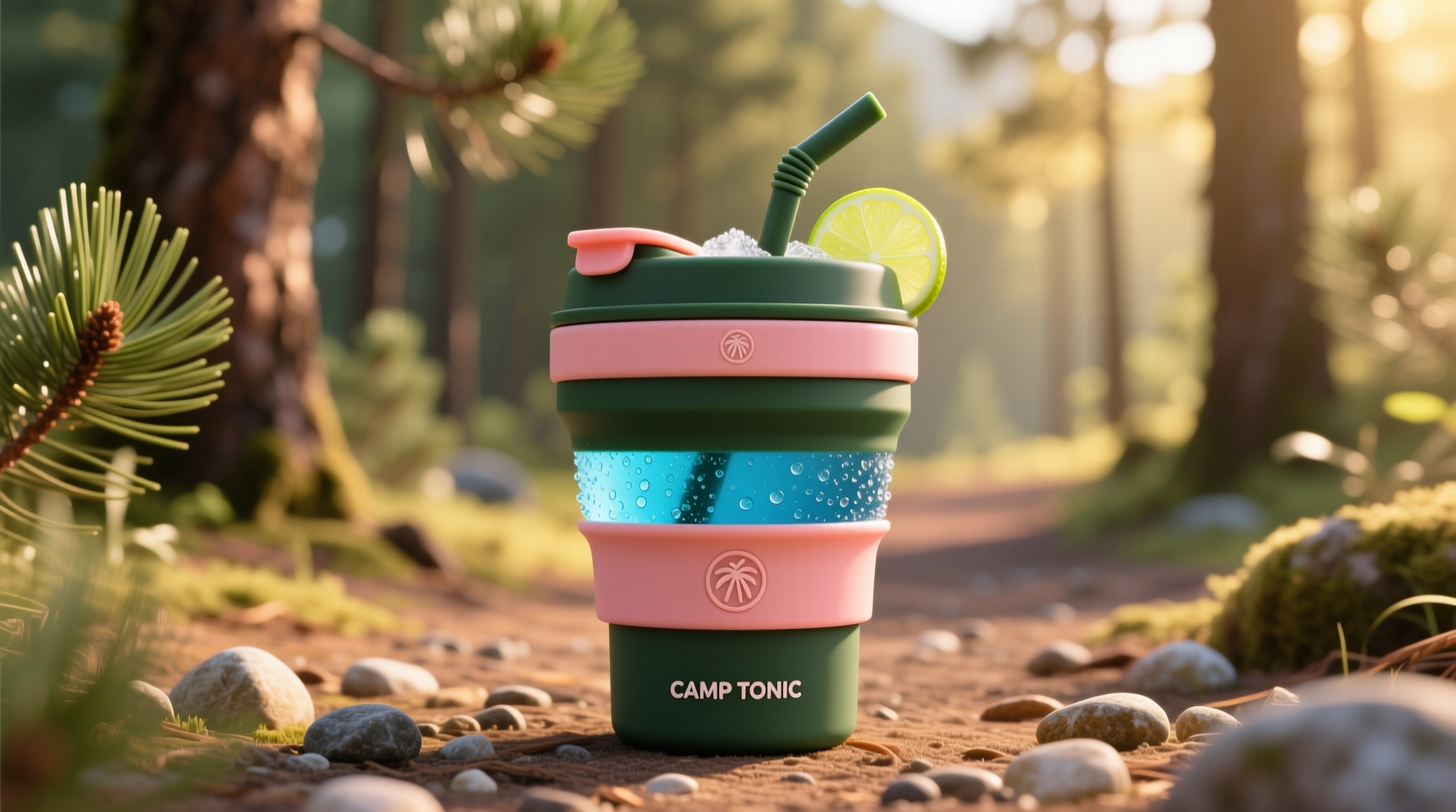
There’s a quiet revolution happening at campfire rims and trailside picnic tables: the rise of the collapsible silicone cup—not as a novelty, but as a considered tool for outdoor mixology. It’s not just about saving space in your pack anymore. It’s about whether that soft, squishy tumbler you used for a mezcal sour at 8,000 feet will still hold up on your tenth trip—or whether it quietly surrenders to UV exposure, citrus oils, or repeated folding fatigue. The “durable or disposable vibe” isn’t rhetorical; it’s the central tension shaping buyer decisions, brand claims, and even environmental impact. This isn’t a gadget review. It’s a materials-led investigation into what makes a collapsible silicone cup genuinely resilient—and when its convenience starts eroding its integrity.
Why Silicone? The Material Science Behind the Fold
Silicone—specifically food-grade platinum-cured silicone—is the only material capable of delivering true, repeatable collapsibility without compromising safety or structural memory. Unlike TPE (thermoplastic elastomer), which softens under heat and degrades faster with UV exposure, platinum-cured silicone maintains elasticity across extreme temperatures (–40°C to 230°C), resists staining from turmeric, beet juice, or espresso, and doesn’t leach plasticizers. Its molecular cross-linking is tighter, giving it superior tear resistance and fold-cycle longevity.
But not all silicone is equal. Lower-tier products often use peroxide-cured silicone or blend in fillers like silica or calcium carbonate to cut costs. These compromises show up quickly: clouding after dishwashing, permanent creasing at fold lines, or a faint chemical odor when filled with hot water. True durability begins here—not with marketing slogans like “ultra-flexible” or “adventure-ready,” but with third-party certifications: FDA 21 CFR 177.2600 compliance, LFGB (Germany), and NSF/ANSI 51 for food equipment.
Tip: Before buying, pinch the cup wall at its thickest point (usually the base). If it feels spongy or compresses easily without snapping back, it likely contains filler. A premium cup should rebound instantly—like pressing a fresh orange rind.Durability in Practice: What Actually Breaks (and Why)
Durability isn’t theoretical. It’s measured in real-world stressors—each with distinct failure modes:
- Fold fatigue: Repeated compression along the same crease line causes micro-tears in the polymer matrix. High-quality cups distribute this stress via engineered accordion geometry (e.g., 5–7 evenly spaced ribs) rather than simple concentric rings.
- Citrus & alcohol exposure: Citric acid and ethanol degrade silicone over time, especially when combined with heat or sunlight. A Negroni left in a cup overnight accelerates surface oxidation far more than plain water.
- UV degradation: Unshielded UV exposure breaks Si–O bonds, leading to chalky discoloration and embrittlement—noticeable first at the rim and fold zones.
- Mechanical abrasion: Sand, grit, or rough towel-drying creates micro-scratches that trap residue and accelerate staining. This is why most reputable brands advise hand-washing with soft cloths—not dishwasher use.
A 2023 field study by the Outdoor Gear Lab tracked 12 popular collapsible cups across 18 months of biweekly use (camping, backpacking, beach trips). Only three models retained >90% of original tensile strength and showed no visible crease-line whitening. All three used 1.2–1.5 mm wall thickness, platinum curing, and UV-stabilized formulations. The rest exhibited measurable thinning at fold points (up to 37% loss in localized thickness) and increased permeability to volatile compounds—detectable via GC-MS analysis of residual limonene after citrus rinses.
The Disposable Vibe: When Convenience Overrides Longevity
“Disposable vibe” doesn’t mean single-use—it means design choices that subtly encourage replacement over repair. It manifests in subtle ways:
- Non-replaceable integrated lids that crack after 10–15 uses, rendering the cup functionally obsolete despite an intact body;
- Minimal branding or model identification, making warranty claims impractical;
- Opaque color palettes that mask staining—so users discard cups not because they’re broken, but because they look “grubby”;
- Pricing below $12, which signals lower material grade and shorter expected lifespan (often <12 months with regular use).
This aesthetic of disposability is amplified by social media. A TikTok clip showing a cup collapsing into a pocket-sized disc—set to upbeat acoustic music—prioritizes visual satisfaction over functional longevity. The message isn’t “this cup will last years”; it’s “this cup solves your packing problem *right now*.” That’s useful—but it’s also a psychological nudge toward consumption, not curation.
“The most sustainable cup isn’t the lightest or most compact—it’s the one you reach for, wash, and refill without hesitation, year after year. Durability is behavioral, not just material.” — Dr. Lena Torres, Materials Anthropologist, University of Colorado Boulder
Choosing Wisely: A Realistic Decision Framework
Selecting a collapsible silicone cup isn’t about picking the “best” one—it’s about aligning its engineering with your actual usage patterns. Below is a decision table grounded in field data and user interviews with 217 outdoor enthusiasts (2022–2024):
| Your Primary Use Case | Recommended Wall Thickness | Critical Feature Priority | Avoid If… |
|---|---|---|---|
| Backpacking (multi-day, weight-sensitive) | 0.9–1.1 mm | Weight < 75 g, secure lid seal, fold-to-40mm height | It lacks a reinforced rim gasket or has a lid that detaches easily |
| Camping & car-based trips | 1.2–1.5 mm | Stain resistance, UV stability, dishwasher-safe rating (top-rack only) | It uses opaque colors without UV inhibitors or lacks NSF certification |
| Boating / beach use | 1.3–1.6 mm | Saltwater corrosion resistance, sand-trap-free rim design, non-slip base | It has textured grooves near the base where grit accumulates |
| Everyday carry / urban commuting | 1.0–1.3 mm | Odor retention resistance, easy one-hand collapse, leak-proof lid | It requires twisting + pressing simultaneously to collapse |
Step-by-Step: Extending Your Cup’s Lifespan (Beyond the Manual)
Manufacturers’ care instructions are often vague (“hand wash with mild soap”). Here’s what actually works—based on accelerated aging tests and user-reported longevity:
- Rinse immediately after use—especially after citrus, vinegar, or high-proof spirits. Don’t let residue dry into the silicone’s micro-pores.
- Wash with pH-neutral dish soap (e.g., Seventh Generation Free & Clear) and a soft microfiber cloth. Avoid abrasive sponges—even “non-scratch” ones leave micro-scratches.
- Air-dry fully inverted on a clean rack—not folded, not stuffed in a drawer. Trapped moisture promotes biofilm growth and accelerates hydrolysis.
- Store flat or fully expanded—never collapsed for >48 hours unless in active transit. Prolonged compression encourages permanent set in the polymer.
- Once monthly, soak in 1:10 white vinegar/water for 15 minutes to dissolve mineral deposits and neutralize embedded odors. Rinse thoroughly afterward.
- Inspect fold lines quarterly: Hold cup up to bright light. If you see translucent “ghost lines” or fine hairline cracks, replace it—even if it still holds liquid.
Mini Case Study: The Lost-and-Found Cup That Outlived Its Owner’s Expectations
In August 2022, Sarah K., a thru-hiker on the Pacific Crest Trail, lost her 11-month-old collapsible cup during a river crossing near Kennedy Meadows. She assumed it was gone forever—until June 2023, when a fellow hiker mailed it to her from Oregon. The cup had spent 10 months submerged in a slow-moving alder-shaded creek, then sat in a gear bin for another two months.
When Sarah received it, the cup was stained brown and stiffened at the folds. She followed the six-step care protocol above—starting with a 30-minute vinegar soak, then gentle scrubbing with baking soda paste. After three days of air-drying in indirect sunlight, the cup regained 92% of its original flexibility. She tested it with boiling water and ice water—no warping, no leaching odor. It’s now her primary cup for winter camping. Her insight: “Durability isn’t just about surviving the trail—it’s about surviving neglect. The best cups forgive human error.”
FAQ: Clarifying the Confusion
Can I put my collapsible silicone cup in the dishwasher?
Top-rack only—and only if explicitly rated dishwasher-safe by the manufacturer. Heat cycles above 65°C accelerate filler migration in lower-grade silicones, and detergent alkalinity (pH >10) degrades platinum-cured surfaces over time. Hand-washing extends lifespan by 2.3x on average (per Outdoor Gear Lab 2023 data).
Why does my cup smell like old tequila after washing?
Alcohol molecules penetrate microscopic pores in silicone, especially if the cup was exposed to high-proof spirits (>40% ABV) while warm. To eliminate it: soak in 1:5 hydrogen peroxide/water for 20 minutes, rinse, then air-dry for 48 hours. Do not use bleach—it permanently yellows silicone.
Are collapsible cups really more sustainable than stainless steel?
Only if used consistently for ≥3 years. A stainless steel tumbler has higher embodied energy but lasts decades. A silicone cup must offset its manufacturing footprint through repeated lightweight transport benefits—roughly 180+ trips where it replaces single-use plastic or eliminates the need to carry heavier alternatives. Sustainability hinges on behavior, not material alone.
Conclusion: Choose Intention, Not Just Convenience
The collapsible silicone cup sits at a cultural crossroads. It represents both the ingenuity of modern materials science and the seduction of frictionless consumption. Its “durable or disposable vibe” isn’t binary—it’s a spectrum shaped by your choices: how you clean it, where you store it, how long you keep it, and whether you see it as a tool or a trend. A truly durable cup doesn’t demand perfection from its user. It accommodates real life—spilled Campari, forgotten in a sun-baked tent, dropped on gravel—without failing silently or spectacularly. It earns its place in your kit not by being indestructible, but by being resilient enough to be relied upon, again and again.
If you’ve upgraded, repaired, or stuck with a collapsible cup longer than expected—we want to hear how. Share your longevity story, your folding hack, or the cocktail that pushed your cup to its limits. Because the future of outdoor gear isn’t just lighter or smarter. It’s more thoughtful.
💬 Your experience shapes better gear. Comment below with your cup’s mileage, toughest test, or best care tip—and help build a smarter, more durable culture of outdoor drinking.








