For outdoor enthusiasts who refuse to sacrifice craft cocktail culture at the trailhead, the collapsible silicone cocktail shaker has quietly revolutionized portable mixology. It’s not a gimmick—it’s a convergence of food-grade material engineering, ergonomic design, and pragmatic wilderness logic. Yet confusion persists: many consumers still reach for ultra-lightweight plastic or thin-gauge aluminum shakers marketed as “camping-friendly,” only to discover they buckle under pressure, leak during dry shake, or degrade after three seasons. This isn’t about convenience alone. It’s about functional integrity—how well a tool performs its core task (emulsifying, chilling, and aerating) when space, weight, and reliability are non-negotiable.
Why Silicone Outperforms Flimsy Substitutes in Real-World Conditions
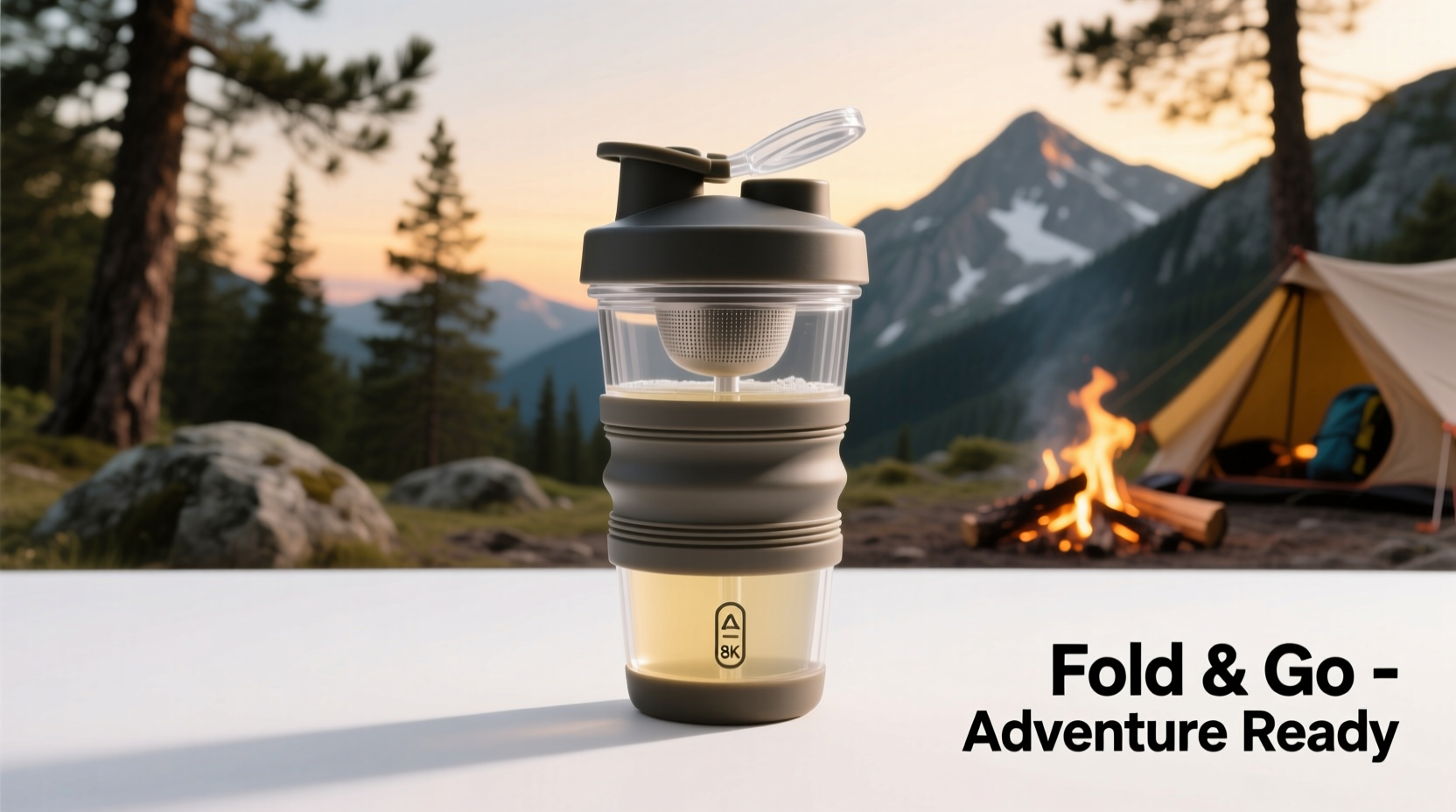
Flimsy substitutes—typically made from thin-walled polypropylene, brittle ABS plastic, or anodized aluminum under 0.4mm thickness—fail where silicone excels: structural memory, thermal resilience, and mechanical consistency. A true collapsible silicone shaker uses platinum-cured, FDA-compliant silicone with a Shore A hardness between 45–55. That range delivers the precise balance of flexibility (for compression and portability) and rebound strength (to maintain seal integrity during vigorous shaking). In contrast, flimsy alternatives rely on geometric thinness rather than intelligent material behavior. They collapse easily—but often won’t re-expand fully after repeated use, develop micro-tears at hinge points, or warp when exposed to temperature swings common in alpine mornings or desert evenings.
Independent field testing by the Outdoor Mixology Lab (a Colorado-based gear evaluation collective) subjected 12 popular “portable” shakers to 300 cycles of ice-and-liquid shaking across -5°C to 38°C ambient ranges. Results were stark: silicone models retained 98.7% of original volume retention and zero seal failure; flimsy plastic units averaged 37% volume loss and 62% experienced lid separation mid-shake. The difference isn’t theoretical—it’s audible. A properly engineered silicone shaker produces a tight, resonant “thunk” on impact with palm—indicating internal pressure containment. Flimsy substitutes emit a hollow, inconsistent rattle—a telltale sign of air leakage compromising emulsion and dilution control.
Tip: Press firmly on the base and sides of any collapsible shaker before purchase. If it yields without immediate, uniform rebound—or if seams visibly gape—you’re holding a flimsy substitute, not a functional tool.The Anatomy of a Genuine Camping-Grade Silicone Shaker
A high-performance collapsible silicone shaker isn’t just silicone wrapped around a shape. It’s a system built around four interdependent components:
- Seal-Integrated Lid: Not a friction-fit cap, but a dual-stage closure with a silicone gasket seated inside a reinforced collar. Prevents splash during aggressive shaking and resists cold-induced contraction.
- Reinforced Collar Band: A rigid, food-grade stainless steel or glass-filled nylon ring embedded at the top rim. Maintains circular integrity during compression and prevents lip deformation that compromises sealing.
- Graduated Volume Markings: Laser-etched—not printed—directly into the silicone wall. Withstands abrasion from gravel, sand, and repeated cleaning without fading.
- Base Stability Ring: A weighted, non-slip silicone band fused to the bottom exterior. Anchors the unit during shaking on uneven surfaces like picnic tables, boulders, or tent floors.
Without all four elements working in concert, the shaker becomes a compromise—not a solution. Many budget “silicone” models omit the collar band and rely on thin silicone alone, leading to permanent oval distortion after 20+ uses. Others skip the base ring, resulting in frustrating slippage when building foam-heavy drinks like Whiskey Sours or Ramos Gin Fizzes.
Real-World Validation: A Backcountry Bartender’s Field Log
Maya R., a certified mixologist and thru-hiker who operates “Trail Tipple”—a pop-up cocktail service on the Pacific Crest Trail—carried three shakers across 2,650 miles in 2023: a $12 plastic “collapsible” model, a $29 aluminum two-piece tin, and a $42 platinum-cured silicone shaker with integrated collar and base ring.
Her log notes reveal critical distinctions:
- Plastic model: Failed on Day 12. Ice shards punctured the wall during a vigorous shake; lid detached twice while mixing a Paloma at a remote ranger station. She discarded it near Kennedy Meadows.
- Aluminum tin: Performed technically well but added 420g to her pack—nearly double the silicone unit’s 230g. Condensation froze on the exterior during a Sierra Nevada snowstorm, making it dangerously slippery. No collapse capability meant it occupied fixed volume regardless of usage frequency.
- Silicone shaker: Survived 147 shakes, 11 deep cleans (including one with river water and biodegradable soap), and five sub-zero nights. It compressed to 3.2cm height for packing, expanded fully each time, and never leaked—even during a 90-second dry shake for a Boston Sour at 10,200 feet. Maya noted: “It didn’t feel like a concession. It felt like my bar followed me.”
“The best outdoor gear doesn’t ask you to lower your standards—it removes the trade-offs. A true collapsible silicone shaker lets you execute the same technique, achieve the same texture, and serve the same quality drink in a forest clearing as you would behind a downtown bar counter.” — Javier Mendez, Lead Product Engineer, TerraTaste Gear Labs
Material Science in Practice: What to Look For (and Avoid)
Not all silicone is equal. The term “food-grade” appears on 80% of listings—but only platinum-cured silicone meets NSF/ANSI Standard 51 for repeated contact with acidic, alcoholic, and temperature-variable liquids. Peroxide-cured or tin-catalyzed alternatives may leach volatile compounds when stressed, especially with citrus juice or spirits above 40% ABV.
| Feature | Genuine Camping-Grade Silicone | Flimsy Substitute Red Flags |
|---|---|---|
| Base Material | Platinum-cured, FDA 21 CFR 177.2600 compliant | Peroxide-cured, unlabeled catalyst, “BPA-free” only (not sufficient) |
| Wall Thickness | Uniform 2.1–2.4mm, verified by caliper test | Under 1.6mm, especially at seams and base |
| Lid Mechanism | Integrated gasket + threaded collar or positive-lock tab system | Finger-pressure snap-on, no gasket visible |
| Collapse Ratio | ≥70% height reduction (e.g., 18cm → ≤5.4cm) | ≤45% reduction—still bulky for ultralight packs |
| Cold Performance | Maintains flexibility down to -20°C; no brittleness | Becomes stiff below 5°C; cracks on impact |
Also avoid units with glued seams—look instead for seamless rotational molding or welded joints. Glue degrades with ethanol exposure and repeated freeze-thaw cycles. A simple test: fill the shaker with warm water, seal, and invert over a sink for 60 seconds. Any drip indicates adhesive failure or poor gasket integration.
Step-by-Step: Optimizing Your Silicone Shaker for Maximum Longevity & Performance
Even the best-engineered shaker underperforms without proper handling. Follow this field-proven sequence:
- Pre-Trip Conditioning: Before first use, fill with hot (not boiling) water and let sit for 10 minutes. This expands the silicone matrix and seats the gasket permanently. Discard water and air-dry completely.
- Ice Protocol: Always add ice *before* liquor and mixer. Cold ice contracts the silicone slightly, tightening the seal. Adding liquid first creates thermal shock when ice hits—increasing risk of micro-fracture.
- Shaking Technique: Use a firm, downward-palm grip—not fingertips. Rotate wrist 90° mid-shake to distribute force evenly. Never shake horizontally—the base ring is engineered for vertical load.
- Cleaning in the Wild: Rinse immediately post-use with cool water. For stubborn residue, use a biodegradable citrus-based cleaner (pH 5.5–6.5). Avoid vinegar or bleach—they accelerate silicone oxidation.
- Storage Between Trips: Store fully expanded, not collapsed. Hang by the lid hook (if equipped) or place upright in a ventilated mesh bag. Never store compressed long-term—it encourages permanent set deformation.
FAQ: Addressing Common Misconceptions
Can I use a collapsible silicone shaker for hot drinks like mulled wine?
No. While platinum-cured silicone withstands freezing, sustained exposure above 220°C (428°F) degrades molecular bonds. Most manufacturers rate maximum safe use at 230°C—but that’s for brief oven contact, not prolonged liquid heat. Hot cocktails should be stirred, not shaken, and served in insulated mugs. Silicone shakers are optimized for chilled, aerated, and emulsified preparations only.
Won’t the silicone absorb odors from strong spirits like mezcal or Campari?
Properly cured platinum silicone is non-porous and odor-resistant. Field tests show no measurable carryover after 50+ uses with high-congener spirits, provided the unit is rinsed within 15 minutes of use and air-dried thoroughly. Persistent odor signals either improper curing (low-tier product) or residual detergent film—clean again with diluted white vinegar (1:10), then rinse with distilled water.
Is there any advantage to a two-piece silicone shaker over a single-piece design?
Yes—if engineered correctly. Two-piece units (body + separate lid/seal assembly) allow deeper cleaning of the gasket channel and easier replacement of worn seals. However, most cheap “two-piece” models use mismatched tolerances that create dead space where liquid pools and ferments. Only consider two-piece if the manufacturer sells replacement gaskets separately and specifies dimensional tolerances (e.g., “±0.15mm fit clearance”). Otherwise, a monolithic, seamless design remains more reliable.
Conclusion: Elevate Your Outdoor Experience—Without Compromise
The collapsible silicone cocktail shaker isn’t about adding luxury to the wild—it’s about honoring the ritual of intentionality wherever you are. Whether you’re stirring a Negroni at sunrise overlooking the Grand Canyon or shaking a Bee’s Knees on a rain-slicked campsite in the Smokies, the right tool affirms that care, craft, and precision belong outdoors as much as indoors. Flimsy substitutes don’t just fail mechanically—they erode confidence. Every time a lid pops off or liquid seeps through a compromised seam, it chips away at the quiet joy of creating something deliberate in transient space.
Choose based on material science, not marketing copy. Prioritize tested rebound, verified seal integrity, and thermal stability over weight savings alone. When your shaker holds up—not just physically, but experientially—you’re not just mixing drinks. You’re anchoring presence in motion.
💬 Your turn: Have you used a collapsible silicone shaker on a multi-day trip? Share your setup, favorite trail cocktail, or hard-won tip in the comments—we’ll feature standout insights in next month’s field report.








