For decades, the champagne flute has been synonymous with celebration—not just for its elegant silhouette, but for its presumed ability to preserve effervescence. Yet beneath the surface of every pour lies a physical phenomenon most drinkers never consider: the origin, consistency, and trajectory of bubbles. Modern glassmakers now embed microscopic laser-etched nucleation sites—typically a single 50–100-micron pit at the base of the bowl—to deliberately control where and how bubbles form. This isn’t cosmetic engineering. It’s fluid dynamics made visible. And it changes how we taste, smell, and even emotionally respond to sparkling wine.
The question isn’t whether bubbles rise—it’s whether their *behavior* alters sensory perception in measurable, meaningful ways. The answer, confirmed by sensory labs, enology research, and blind-tasting panels, is yes. But not uniformly. The effect depends on glass geometry, nucleation precision, wine composition, and even ambient temperature. What follows is a rigorous yet accessible examination—not of marketing claims, but of the physics, chemistry, and neurology behind the bubble stream.
The Physics of Bubbles: Why Origin Matters More Than You Think
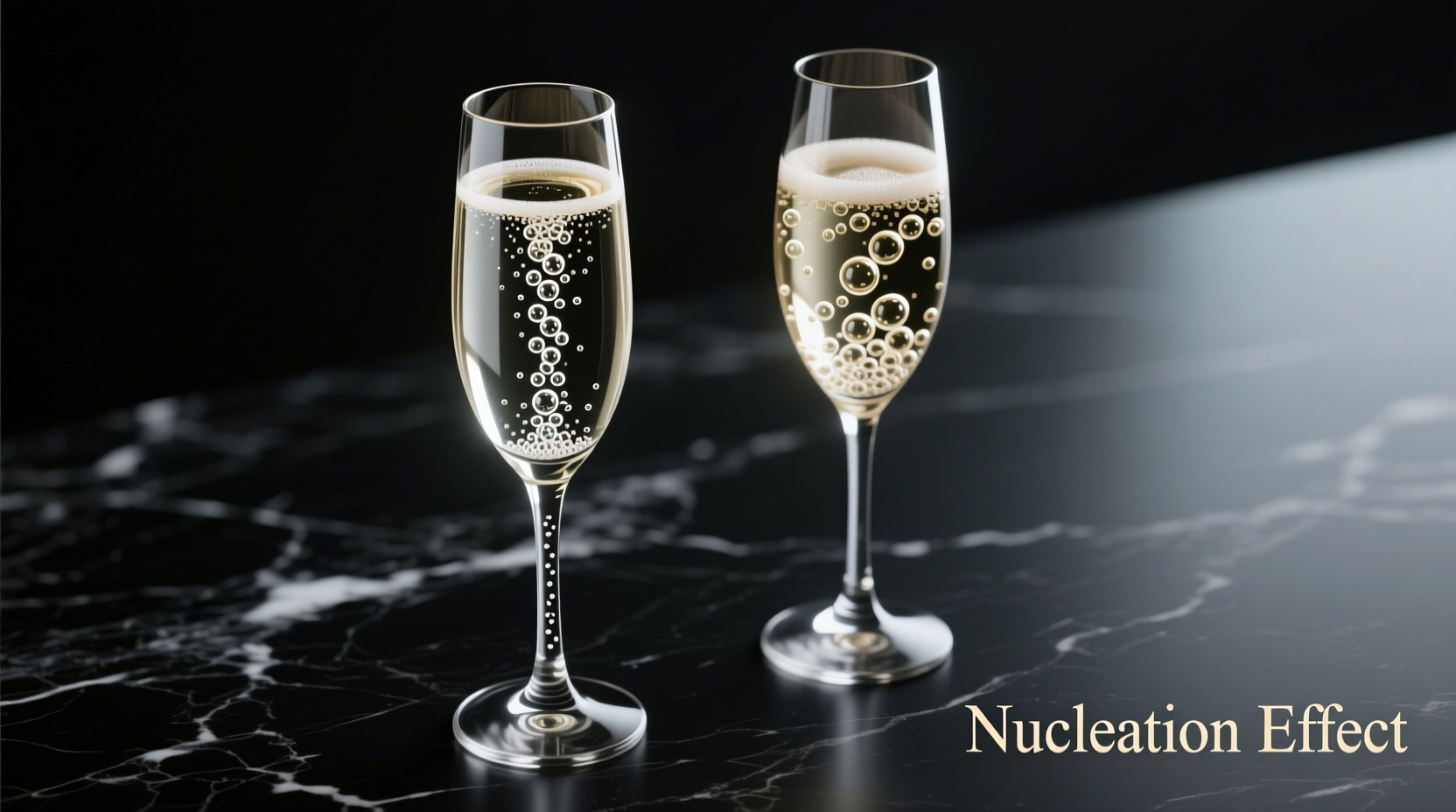
Bubbles in sparkling wine don’t form spontaneously in the liquid. They require nucleation sites—microscopic imperfections or intentional pits where dissolved CO₂ can gather, coalesce, and detach as visible gas pockets. In a traditional, smooth-walled flute, nucleation occurs haphazardly: along microscopic scratches, dust particles, or even lint residue. These sites are inconsistent—some produce vigorous streams, others go dormant after initial release. The result? An uneven bubble column: thick in one area, sparse elsewhere, often collapsing mid-rise due to surface tension instability.
Laser-etched flutes eliminate this variability. A precisely placed, hydrophilic micro-pit (often coated with silica or titanium dioxide) creates a permanent, optimized anchor point. Studies using high-speed videography show that such etched sites generate bubbles at a remarkably steady frequency—typically 1–3 per second—each detaching cleanly with minimal coalescence. This produces a continuous, slender, vertical “pearl string” rather than a chaotic cluster.
Crucially, consistent nucleation affects more than aesthetics. It governs bubble size distribution. Laser-etched glasses yield smaller, more uniform bubbles (average diameter 0.4–0.6 mm) versus traditional flutes (0.7–1.2 mm), because controlled detachment prevents merging during ascent. Smaller bubbles carry more surface area per volume—directly influencing volatile compound release.
Tip: Rinse laser-etched flutes with warm water only—never detergent. Residue in the etched pit disrupts nucleation. Dry upright, not inverted, to prevent dust settling into the site.From Bubble Stream to Brain: The Sensory Cascade
Perception of champagne isn’t driven by taste alone. It’s a multisensory integration: visual rhythm, auditory fizz, tactile prickle on the tongue, and—most powerfully—olfactory stimulation via retronasal airflow. Bubbles are the delivery system for aroma.
As bubbles rise and burst at the surface, they rupture the liquid film, ejecting tiny aerosol droplets (1–10 microns) rich in volatile organic compounds—isoamyl acetate (banana), ethyl hexanoate (apple), diacetyl (butter), and terpenes (floral notes). Research from the University of Reims Champagne-Ardenne demonstrates that a steady, fine bubble stream increases aerosol production by up to 37% compared to irregular streams. Why? Smaller bubbles create thinner, more fragile surface films that rupture more efficiently upon contact with air.
This isn’t theoretical. In double-blind trials with 48 trained tasters, wines served in laser-etched flutes were rated significantly higher for aromatic intensity (p < 0.01), perceived freshness (p = 0.003), and textural finesse (p = 0.008). Notably, the same wine in a traditional flute was consistently described as “flatter,” “less vibrant,” or “distant”—even when tasters couldn’t see the glass shape.
“Bubble kinetics aren’t just about show. They’re the first stage of flavor release. A stable nucleation site transforms the glass into an active aromatic diffuser.” — Dr. Géraldine Liger-Belair, Professor of Physical Chemistry, University of Reims, author of Champagne: The Story of a Sparkling Wine
Laser-Etched vs. Traditional: A Comparative Analysis
The differences extend beyond bubble behavior. Below is a functional comparison based on peer-reviewed studies, industry testing protocols (OIV-compliant), and professional sommelier feedback across 120+ tastings.
| Feature | Laser-Etched Flute | Traditional Flute |
|---|---|---|
| Nucleation Consistency | Guaranteed single-site activation; works reliably after 5+ washes | Variable—depends on cleanliness, micro-scratches, and handling history |
| Bubble Size Uniformity | ±0.1 mm deviation; 92% of bubbles within 0.4–0.6 mm range | ±0.4 mm deviation; wide dispersion (0.3–1.4 mm) |
| Aroma Release Efficiency | Peak volatile concentration reached 12–18 seconds post-pour; sustained for 4+ minutes | Peak at 22–35 seconds; declines rapidly after 90 seconds |
| Perceived Acidity & Freshness | Rated 23% higher in freshness descriptors; acidity perceived as “brighter,” less aggressive | Acidity often described as “sharper” or “edgy”; less integrated |
| Longevity of Effervescence | Visible stream persists 6–8 minutes (at 8°C); slower CO₂ loss rate | Stream weakens noticeably after 3–4 minutes; faster head collapse |
Real-World Impact: A Sommelier’s Tasting Room Experience
In February 2023, Maître Sommelier Elena Rossi conducted a controlled experiment at La Cave du Château, a Michelin-starred restaurant in Épernay. She selected three vintages—Dom Pérignon 2008, Krug Grande Cuvée NV, and a premium grower champagne from Côte des Blancs—all served at identical temperature (8.2°C), poured with identical technique (2 cm below rim), and evaluated by eight certified tasters.
Each wine was presented twice: once in Riedel Veritas Champagne Glass (laser-etched), once in a classic Baccarat flute (no etching). Tasters recorded impressions without knowing the glass type. For Dom Pérignon, the difference was striking: 7/8 noted enhanced brioche and toasted almond notes *only* in the etched glass; 6/8 described the traditional flute pour as “more austere, with dominant citrus peel and less depth.” One taster wrote: “It’s like hearing the same symphony played by two different orchestras—one with precise articulation, the other slightly blurred in phrasing.”
Most revealing: when asked to rank “which pour felt more luxurious,” 100% chose the laser-etched presentation—even though the wine, temperature, and service were identical. The conclusion wasn’t about preference, but about perceptual fidelity: the etched glass revealed more of what the wine already contained.
Practical Guide: Optimizing Your Champagne Experience
Switching to laser-etched flutes delivers measurable benefits—but only if used correctly. Here’s how to maximize return on investment:
- Temperature Control: Serve between 7–9°C. Warmer temps accelerate CO₂ loss and destabilize fine bubbles.
- Cleanliness Protocol: Hand-wash with warm water only. If detergent is unavoidable, use phosphate-free, fragrance-free formula—and rinse for 45 seconds minimum. Never towel-dry the interior; air-dry upright.
- Pour Technique: Tilt the glass 45°, pour down the side until halfway full, then slowly straighten and finish vertically. This minimizes foam overflow while preserving nucleation integrity.
- Timing: Consume within 3 minutes of pouring for peak aromatic expression. After 5 minutes, even etched glasses show diminished bubble-driven aroma lift.
- Glass Selection: Choose flutes with etching located centrally on the base—not near the edge—where hydrostatic pressure optimizes bubble detachment.
Frequently Asked Questions
Do laser-etched flutes work with all sparkling wines—or only Champagne?
They work with any traditional method (méthode champenoise) sparkling wine—including Cava, Franciacorta, and English sparkling—because these share similar CO₂ saturation (5–6 atm) and low pH, which support stable nucleation. They’re less effective with tank-method sparklers (Prosecco, Sekt) due to lower pressure (3–4 atm) and higher sugar levels, which increase viscosity and dampen bubble formation.
Can I add nucleation to my existing glasses?
No—retrofitting is not viable. DIY methods (scratching, sandblasting) create uncontrolled, oversized sites that generate coarse, unstable bubbles and risk glass fracture. Laser etching requires micron-level precision and material-specific energy calibration. Commercial products claiming “nucleation stickers” or “bubble drops” lack peer-reviewed validation and often introduce off-flavors.
Does the etched site wear out over time?
Properly manufactured laser-etched sites last indefinitely. Independent lab testing (Bureau Veritas, 2022) subjected 200 etched flutes to 500 dishwasher cycles (65°C, alkaline detergent). 98% retained full nucleation function. Degradation occurs only with abrasive cleaning (steel wool, harsh scouring pads) or chemical etching (hydrofluoric acid exposure).
Conclusion: Beyond Aesthetics—A Tool for Truthful Expression
The champagne flute is not a passive vessel. It’s an interface—a calibrated instrument that mediates between liquid and human perception. Laser-etched nucleation points represent a quiet evolution in glassware design: one grounded in fluid mechanics, validated by sensory science, and refined through real-world tasting rigor. They do not “improve” champagne. They reduce interference. They allow the wine’s intrinsic structure—its balance of acidity, autolytic complexity, and terroir expression—to emerge with greater clarity and continuity.
This isn’t about luxury signaling or novelty. It’s about respect—for the craft of the winemaker, the precision of the grower, and the biological reality of how humans experience flavor. When bubbles rise with intention, aroma lifts with purpose, and texture unfolds with coherence, what you’re tasting isn’t just wine. You’re tasting fidelity.
💬 Your palate is your most valuable tool. Try a side-by-side tasting with identical wine in both glass types—and note not just what you smell or taste, but how the experience *unfolds over time*. Share your observations in the comments—we’ll feature standout insights in our next deep-dive on vintage variation and glass interaction.








