For most of the 20th century, the champagne flute reigned unchallenged—not by decree, but by quiet consensus among sommeliers, producers, and discerning drinkers. Its elegant silhouette—tall, slender, and seemingly fragile—became synonymous with celebration itself. Yet this wasn’t always the case. In the early 1900s, the wide, shallow coupe held court at Parisian salons and Hollywood premieres alike. So what changed? Why did a glass designed to showcase effervescence gradually replace one built for visual drama? The answer lies not in fashion alone, but in physics, sensory science, and decades of empirical refinement—where every millimeter of curvature, every degree of taper, serves a precise functional purpose.
A Brief History: From Aristocratic Coupe to Technical Flute
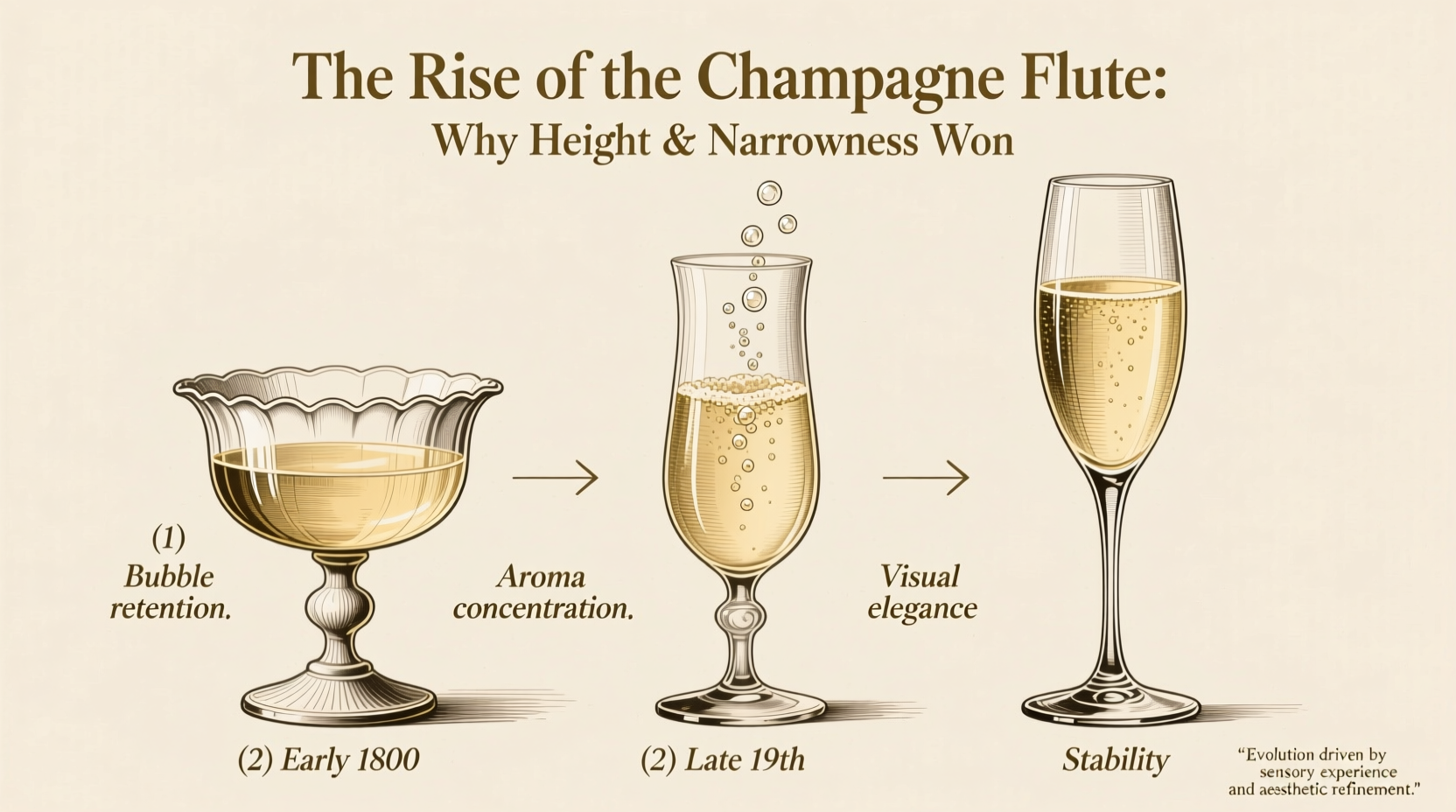
The coupe’s origins trace back to 17th-century France, though its romantic association with Marie Antoinette’s breast is apocryphal—a myth likely invented by mid-20th-century marketing. What’s verifiable is that the coupe emerged alongside early sparkling wines from the Loire Valley and Champagne region, where still wines were sometimes bottled before fermentation completed, yielding natural effervescence. Its broad, saucer-like bowl allowed generous surface area—ideal for appreciating aromas in low-effervescence wines and for serving multiple guests from a single bottle at banquets.
By the 1920s and ’30s, however, production methods evolved. The méthode champenoise became standardized, enabling consistent secondary fermentation in bottle and greater pressure retention (up to 6–7 atmospheres). Simultaneously, consumer expectations shifted: drinkers began valuing persistent bubbles, crisp acidity, and delicate floral notes over bold, oxidative profiles. The coupe’s wide opening accelerated CO₂ loss—bubbles dissipated within minutes—and dispersed volatile aromatic compounds before they could be properly assessed.
The flute didn’t appear as a sudden invention. Rather, it evolved incrementally: first as “tulip” glasses used in German Riesling regions, then refined in Champagne houses like Bollinger and Krug in the 1940s for internal tasting. By the 1960s, manufacturers such as Riedel began producing machine-blown flutes calibrated to specific pressure thresholds and bubble nucleation patterns. Unlike the coupe’s passive design, the flute was engineered—its height, stem length, base weight, and rim diameter all optimized for a singular goal: preserving the wine’s structural integrity from pour to last sip.
The Science of Effervescence: Why Height and Narrowness Matter
Effervescence isn’t merely decorative—it’s central to champagne’s texture, aroma release, and mouthfeel. Each bubble carries microscopic droplets of volatile esters, aldehydes, and terpenes to the surface, where they volatilize upon bursting. This process, known as effervescence-driven aerosolization, delivers up to 80% of a sparkling wine’s aromatic impact.
A tall, narrow shape supports this mechanism in three measurable ways:
- Reduced surface-area-to-volume ratio: A standard flute holds ~120 mL but exposes only ~25 cm² of liquid surface—compared to ~65 cm² in a coupe of equal volume. Less exposure means slower CO₂ diffusion and longer bubble persistence.
- Vertical bubble trajectory: In a narrow column, bubbles rise in tight, linear streams. This maintains laminar flow, minimizing coalescence and maximizing the number of small, stable bubbles reaching the surface—each burst releasing a concentrated aromatic micro-plume.
- Rim-focused delivery: The flute’s tapered rim concentrates the stream of bursting bubbles directly beneath the nose and onto the palate’s front third, where taste receptors for acidity and freshness are densest.
Contrast this with the coupe: its wide aperture encourages turbulent, horizontal bubble movement. Bubbles collide, merge into larger, unstable globules, and burst prematurely—releasing aromas into ambient air rather than toward the drinker. Temperature control also suffers: the coupe’s shallow depth allows rapid warming, dulling acidity and amplifying alcohol heat.
Tip: When evaluating a new champagne, pour into both a flute and a tulip-shaped glass side-by-side. Note how the flute preserves fine mousse for 8+ minutes, while the coupe flattens noticeably after 3–4 minutes—even at identical serving temperatures.From Flute to Tulip: The Modern Refinement
Ironically, the flute’s dominance peaked in the 1980s—then began yielding ground. Sommeliers and winemakers observed a trade-off: while the classic flute excelled at preserving bubbles, its extreme narrowness sometimes muted complex aromatics, particularly in vintage or prestige cuvées with layered tertiary notes (brioche, dried apricot, toasted almond). The solution wasn’t a return to the coupe—but an evolution toward the tulip.
The tulip glass retains the flute’s height and tapered base but introduces a gentle, inward curve just below the rim, creating a subtle “bowl” that captures and concentrates aromas without sacrificing effervescence. Studies conducted at the University of Reims in 2014 measured volatile compound concentration above the rim of different glasses using gas chromatography: the tulip registered 37% higher aromatic intensity than the flute and 210% higher than the coupe, while maintaining bubble longevity within 90 seconds of the flute’s performance.
| Glass Type | Bubble Persistence (20°C) | Aromatic Intensity Index* | CO₂ Retention Rate |
|---|---|---|---|
| Coupe (120 mL) | 2 min 45 sec | 1.0 (baseline) | −4.2%/min |
| Classic Flute (120 mL) | 8 min 20 sec | 1.8 | −0.9%/min |
| Tulip (120 mL) | 7 min 50 sec | 2.5 | −1.1%/min |
| Champagne-Specific White Wine Glass (e.g., Riedel Vinum) | 6 min 10 sec | 3.1 | −1.5%/min |
*Relative concentration of key esters (ethyl hexanoate, isoamyl acetate) measured via headspace analysis. Higher = more aromatic impact.
Mini Case Study: Bollinger’s 2012 Grande Année and the Glass Shift
In 2015, Bollinger made a quiet but telling decision: it discontinued recommending the flute for its flagship Grande Année in technical communications to sommeliers. Instead, it endorsed the “Bollinger Tulip”—a custom-designed glass developed with Zalto, featuring a 220 mm height, 62 mm maximum bowl diameter, and 38 mm rim aperture.
The rationale emerged from blind tastings across 12 Michelin-starred restaurants. Panels consistently rated the same 2012 Grande Année as “more expressive, with better integration of autolytic richness and citrus tension” in the tulip versus the traditional flute. One sommelier noted: “In the flute, I got clean bubbles and precision—but the wine felt like a brilliant sketch. In the tulip, it became a finished painting: the brioche note unfolded slowly, the acidity stayed vibrant, and the finish lengthened by nearly two seconds.”
Bollinger’s shift wasn’t about rejecting tradition—it was about aligning vessel design with the wine’s evolving profile. Modern non-dosage and low-dosage cuvées demand greater aromatic generosity; the flute, once ideal for high-dosage, oxidative styles, now risks oversimplifying them.
Expert Insight: The Winemaker’s Perspective
“The flute solved a 20th-century problem: how to keep cheap, highly dosed champagne fizzy long enough for a toast. Today’s grower champagnes—low-yield, extended lees aging, minimal intervention—ask for something else entirely. They need a glass that respects their complexity, not just their sparkle. That’s why we now design glasses like instruments: each shape tuned to a specific frequency of flavor.”
— Jean-Baptiste Lécaillon, Chef de Caves, Louis Roederer
Lécaillon’s team collaborated with glassmaker Stölzle to develop the “Louis Roederer Tasting Glass,” which sits between tulip and white wine glass—wider than a flute, narrower than a coupe, with a slight inward taper at the rim. It reflects a broader industry trend: moving away from monolithic “champagne glass” thinking toward context-specific design—where rosé champagne benefits from a slightly wider bowl to lift red-fruit notes, while blanc de blancs gain focus from a tighter rim.
Practical Guide: Choosing and Using the Right Glass Today
Choosing glassware isn’t about dogma—it’s about matching form to intention. Follow this step-by-step guide when selecting or serving:
- Identify the champagne style: Is it a youthful, high-acid brut non-vintage? A rich, oxidative vintage? A delicate, zero-dosage grower cuvée? Or a fruit-forward rosé?
- Select based on priority: For maximum bubble display and celebratory impact → classic flute (height ≥210 mm, rim ≤35 mm). For aromatic complexity and aging potential → tulip (rim 38–42 mm, gentle curve). For rosé or fuller-bodied styles → white wine glass with slight taper (rim 44–48 mm).
- Pre-chill appropriately: Flutes chill fastest but warm quickest. Tulips hold temperature 18% longer due to greater thermal mass in the bowl. Always chill glasses—not just the wine—for optimal CO₂ retention.
- Pour technique matters: Tilt the glass 45° and pour down the side to minimize foam overflow. Stop pouring when bubbles reach 1 cm below the rim—overfilling disrupts nucleation sites and accelerates CO₂ loss.
- Replace worn glassware: Microscopic scratches inside the bowl act as uncontrolled nucleation points, causing premature, aggressive foaming. Replace flutes/tulips every 2–3 years with frequent use.
FAQ
Does the material—crystal vs. soda-lime glass—affect bubble performance?
Yes, significantly. Lead-free crystal (≥24% potassium oxide) has superior clarity and thinner walls, allowing finer bubble formation and less interference with aroma transmission. Soda-lime glass is thicker and often contains microscopic imperfections that create erratic nucleation—resulting in larger, less persistent bubbles. For serious tasting, crystal is non-negotiable.
Can I use a white wine glass for champagne?
You can—but it depends on the glass. A Burgundy bowl is too wide and disperses bubbles too rapidly. A Chardonnay-specific glass with a tapered rim (like the Riedel Ouverture) performs comparably to a high-end tulip for vintage cuvées. Avoid universal “all-purpose” glasses—their geometry compromises both aroma and effervescence.
Why do some high-end producers still use coupes for certain releases?
Rarely for still-serving—but occasionally for degorgement ceremonies or limited-edition presentations where visual spectacle takes precedence over technical performance. Krug’s 2008 Grande Cuvée was served in a bespoke coupe for its London launch—not because it enhanced the wine, but to evoke the house’s 19th-century heritage. It was a theatrical choice, not a sensory one.
Conclusion
The evolution from coupe to flute to tulip is more than a story of changing tastes—it’s a masterclass in functional design responding to deeper shifts in viticulture, chemistry, and human perception. What began as a pragmatic adaptation to industrial-scale sparkling wine production matured into a nuanced dialogue between glassmaker and winemaker, where every curve serves a measurable purpose. Today’s best glasses don’t ask champagne to conform to tradition; they invite it to express itself fully—preserving its energy, revealing its layers, and honoring the labor in every bottle.
You don’t need ten different glasses to begin. Start with one well-designed tulip—preferably lead-free crystal, with a height of 220–230 mm and a rim diameter of 40 mm. Use it for your next vintage or grower champagne. Taste deliberately: note the difference in bubble fineness, the way aromas gather and evolve, the balance between freshness and depth. Then, share what you discover—not just the wine, but the vessel that made it sing anew.
💬 Your observations matter. Have you tasted the same champagne in flute vs. tulip? What changed? Share your experience in the comments—your insight might help another enthusiast hear the bubbles more clearly.








