
For aspiring creators entering the world of photography and videography, choosing the right entry-level mirrorless camera can set the tone for years of creative growth. Canon’s recent lineup has made a strong case with two compelling APS-C models: the R50 and the R10. Both are built on Canon’s RF mount system, promising excellent image quality and future-proof lens compatibility. But when it comes to content creation—whether that's YouTube videos, vlogs, social media reels, or hybrid photo-video work—which one truly stands out for beginners?
This guide dives deep into their design, performance, autofocus systems, video capabilities, and usability to help you make an informed decision based on your creative goals.
Design and Build: Compact vs Capable
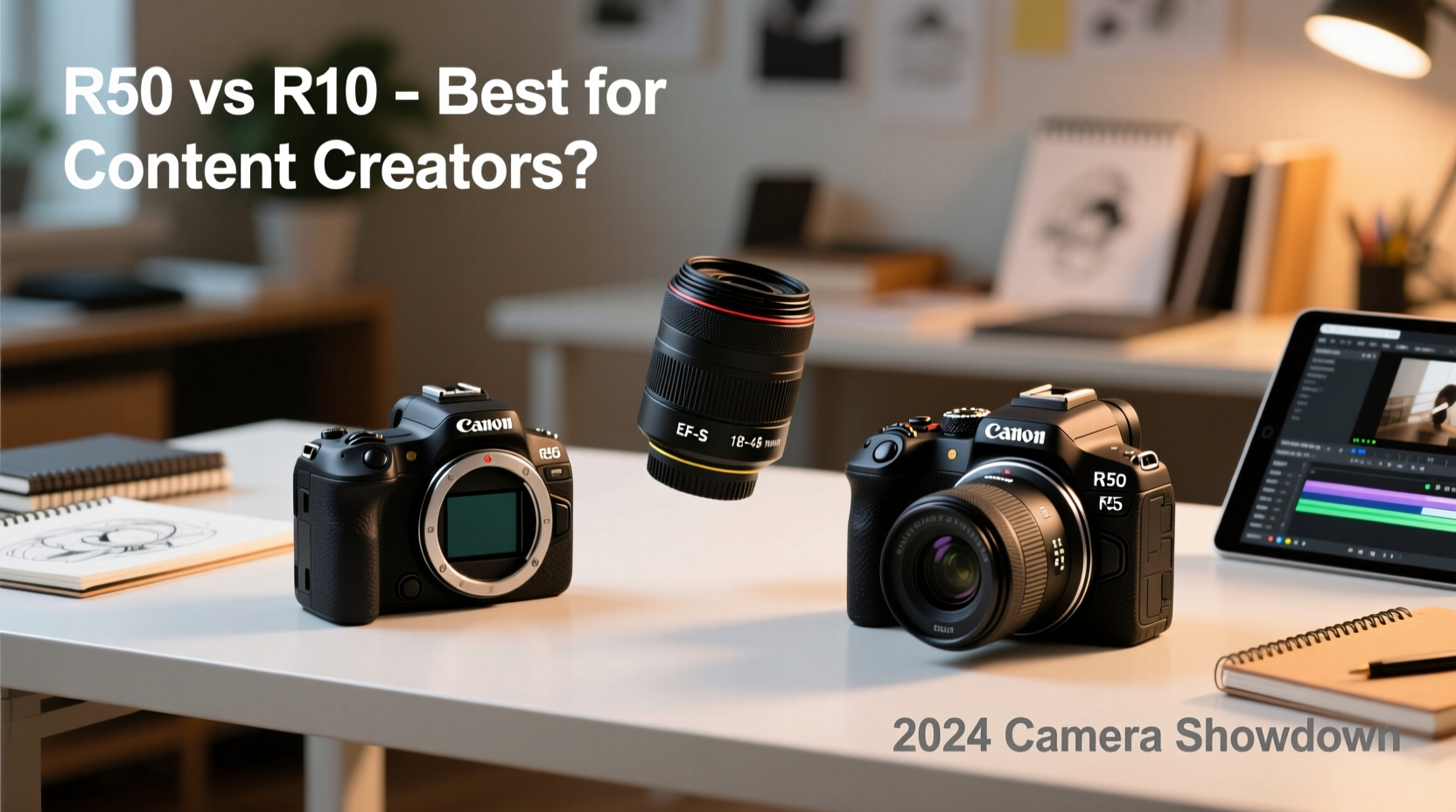
The Canon R50 and R10 share a similar aesthetic language, but their physical design reflects different priorities. The R50 is designed with portability and simplicity in mind. Weighing just 375g (including battery and card), it’s one of the lightest RF-mount cameras available. Its compact frame makes it ideal for travel, handheld shooting, and long recording sessions where fatigue matters.
In contrast, the R10 weighs in at 429g—a noticeable difference when carried all day. However, this added heft comes with tangible benefits: a more robust magnesium alloy chassis, deeper grip, and dual control dials. These elements enhance handling, especially when using larger lenses or shooting in manual modes frequently.
Both cameras feature a 2.1 million-dot electronic viewfinder and a fully articulating touchscreen LCD—critical for vloggers who need to see themselves while filming. However, the R10’s higher-resolution EVF (2.36M dots) offers a slightly clearer preview, which can be helpful when manually focusing or checking exposure in bright conditions.
Tip: If you plan to shoot primarily handheld or use gimbals, the R50’s lighter body may offer better balance and reduce strain over time.Image Quality and Sensor Performance
At their core, both cameras use a 24.2-megapixel APS-C CMOS sensor and Canon’s DIGIC X processor. This means they deliver nearly identical still image quality—sharp detail, accurate colors, and solid dynamic range under good lighting.
Where they diverge is in processing speed and buffer depth. The R10, positioned as a step up in Canon’s hierarchy, supports faster continuous shooting: up to 15 fps mechanical shutter and 23 fps electronic shutter (with rolling shutter trade-offs). The R50 tops out at 12 fps mechanical and 15 fps electronic. For content creators capturing fast-moving subjects—like pets, kids, or action shots—the R10’s burst rate offers greater flexibility.
In low-light scenarios, both cameras perform admirably up to ISO 3200, with usable results even at ISO 6400 when noise reduction is applied in post. However, the R10’s slightly better heat dissipation and marginally improved signal-to-noise ratio give it a small edge in high-sensitivity situations.
Autofocus: AI Smarts vs Speed
One area where both cameras shine is autofocus. They inherit Canon’s Dual Pixel CMOS AF II system with Deep Learning AI, enabling precise subject detection for humans, animals, and vehicles. Eye Detection AF works reliably in both photo and video modes, crucial for vloggers who want consistent focus on their face.
The R10 goes further by offering advanced tracking algorithms typically found in higher-end models like the R7 and R3. It maintains focus more tenaciously during erratic movement and performs better in cluttered scenes. For example, if you’re walking through a busy street while filming, the R10 is less likely to lose lock on your eyes.
The R50, while capable, occasionally hesitates when subjects move quickly across the frame or enter low-contrast environments. It also lacks some customization options—such as adjustable tracking sensitivity—that the R10 provides. For beginners who prioritize ease of use over fine-tuning, this may not matter. But for those planning to grow into more complex shooting styles, the R10 offers room to evolve.
“Canon’s implementation of AI-driven autofocus has redefined what entry-level cameras can do. The R10, in particular, feels like a pro tool disguised as a beginner model.” — Jordan Lee, Cinematographer & Camera Reviewer
Video Capabilities: Who Wins for Content Creation?
This is where the decision becomes most nuanced. Both cameras support 4K 30fps video recording, but there are critical differences in how that footage is captured.
The R50 records 4K using a cropped portion of the sensor (approx. 1.5x crop), which limits wide-angle possibilities and increases the magnification effect—something undesirable for vlogging or tight indoor spaces. Additionally, 4K on the R50 suffers from significant rolling shutter, making it less ideal for fast pans or shaky handheld work.
The R10, however, records uncropped 4K 30fps using full-width sensor readout. This means wider field of view, better low-light performance due to more data capture, and reduced rolling shutter artifacts. It’s a major advantage for filmmakers and YouTubers who rely on natural framing and smooth motion.
Both support 10-bit HDR PQ and Canon Log 3 (via firmware update), giving creators access to professional-grade color grading. But only the R10 supports vertical video recording with metadata—a useful feature for Instagram Reels and TikTok creators.
| Feature | Canon R50 | Canon R10 |
|---|---|---|
| 4K Video Crop | Yes (1.5x) | No (Full-width) |
| Max Frame Rate (HD) | 120fps | 120fps |
| Log Profile | Canon Log 3 (firmware update) | Canon Log 3 |
| Vertical Video Support | No | Yes |
| Microphone Input | Yes (3.5mm) | Yes (3.5mm) |
| HDMI Output | No | Yes (clean 4K) |
Note the HDMI output difference: the R10 allows clean 4K feed to external recorders or capture cards, essential for high-bitrate streaming or professional editing workflows. The R50 lacks this entirely���limiting its use in studio setups or multi-camera productions.
Real-World Example: Vlogging with the R50 vs R10
Sophia, a lifestyle content creator based in Portland, started with the R50 for her travel vlogs. She loved its light weight and intuitive interface. However, after six months, she noticed recurring issues: shaky 4K footage due to rolling shutter, difficulty maintaining focus when turning her head, and limited audio options without an external recorder.
She upgraded to the R10 and immediately saw improvements. Shooting in parks and city streets, the uncropped 4K allowed her to keep wide lenses effective without stepping back. The enhanced AF tracked her face even when partially obscured by hats or sunglasses. And because she could output clean HDMI to a portable recorder, her podcast segments gained broadcast-quality sound sync.
While the R50 got her started, the R10 empowered her to scale her production value without switching brands or ecosystems.
Battery Life and Usability for Creators
Battery performance is often overlooked until you're stranded without a charger. The R50 uses the smaller LP-E17 battery, rated for approximately 230 shots per charge (CIPA standard). In real-world video use, expect about 60–75 minutes of continuous recording.
The R10 uses the same battery but manages power more efficiently thanks to its advanced power-saving modes. It averages around 280 shots and slightly longer video runtime—closer to 80 minutes. Still modest, but meaningful during long shoots.
Neither camera supports USB-C charging during operation, which is a missed opportunity. However, both allow USB tethering for live streaming to platforms like YouTube and Zoom—ideal for remote presentations or educational content.
Tip: Carry at least two spare batteries and a dual charger. For extended filming, consider a USB power bank connected via dummy battery adapter.Step-by-Step: Setting Up for Your First Vlog
Whether you choose the R50 or R10, follow these steps to optimize your setup:
- Mount the camera securely on a tripod or gimbal. Use the flip screen to frame yourself accurately.
- Enable Face + Eye Detection AF in menu settings to ensure sharp focus throughout recording.
- Select C-Log 3 profile if you plan to color grade later; otherwise, use Neutral picture style for natural tones.
- Connect an external microphone via 3.5mm jack—lavalier mics dramatically improve vocal clarity.
- Set resolution to 4K 30fps (or 1080p 120fps for slow motion).
- Monitor audio levels to avoid clipping, especially outdoors.
- Use ND filters in bright light to maintain cinematic shutter speeds (e.g., 1/60s at f/2.8).
These practices apply equally to both cameras—but the R10’s superior video engine ensures cleaner files and fewer technical compromises.
Price and Lens Ecosystem: Value Over Time
The R50 starts at around $679 (body only), making it one of Canon’s most affordable RF-mount options. The R10 retails for approximately $999, reflecting its higher-tier positioning. That $320 gap is significant for budget-conscious beginners.
However, consider long-term investment. The R10’s durability, expandability, and professional features mean you’re less likely to outgrow it within a few years. Pair either with Canon’s RF-S 18-45mm kit lens, and you have a capable starter combo. But upgrading to primes like the RF 35mm f/1.8 or zooms like the RF-S 10-18mm opens creative doors—especially for low-light vlogging or cinematic looks.
Because both use the RF mount, every lens you buy today will work on future Canon bodies. This backward compatibility enhances value retention.
Frequently Asked Questions
Can the Canon R50 shoot 4K without crop?
No. The R50 applies a 1.5x crop to its 4K footage, reducing the field of view and increasing the telephoto effect. This can make framing difficult in tight spaces.
Is the R10 worth the extra cost for a beginner?
If your goal is serious content creation—with plans to grow into higher production standards—the R10 is absolutely worth the investment. It avoids key limitations of the R50 and scales well with skill development.
Do both cameras have Bluetooth and Wi-Fi?
Yes. Both support Bluetooth for constant low-power connection to smartphones and Wi-Fi for fast image transfer and remote control via Canon Camera Connect app.
Final Verdict: Which Should You Choose?
The Canon R50 is an excellent entry point for casual creators. It’s lightweight, easy to use, and delivers strong photo and decent video quality. If you’re just starting out, posting occasional videos, or want a simple upgrade from smartphone photography, the R50 checks most boxes at a friendly price.
But for anyone serious about content creation—the YouTuber building a channel, the influencer producing daily reels, the hybrid shooter wanting both photos and film—the R10 is the superior choice. Its uncropped 4K, faster processing, better autofocus, HDMI output, and rugged build make it a true long-term tool.
You won’t outgrow the R10 quickly. It strikes a rare balance: beginner-friendly enough to learn on, yet powerful enough to produce professional results.
🚀 Ready to elevate your content? Whether you start with the R50 or invest in the R10, the most important step is to begin creating. Share your journey, refine your technique, and let your gear grow with you.








