Choosing your first mirrorless camera for content creation can be overwhelming. Two models frequently recommended to beginners—the Canon EOS R50 and the Sony ZV-E10—stand out for their compact size, video-centric features, and affordability. But beyond the marketing claims, which one truly simplifies the process of creating high-quality videos, vlogs, or social media content? The answer depends on how you define \"easier.\" Is it about intuitive controls? Autofocus reliability? Audio integration? Or post-production workflow?
This in-depth analysis compares both cameras across key aspects that matter most to new creators: autofocus performance, video quality, ease of use, audio handling, portability, and ecosystem support. We’ll also look at real-world scenarios and expert insights to help you decide which tool aligns best with your creative goals.
Autofocus Performance: Who Keeps You Sharp Without Thinking?
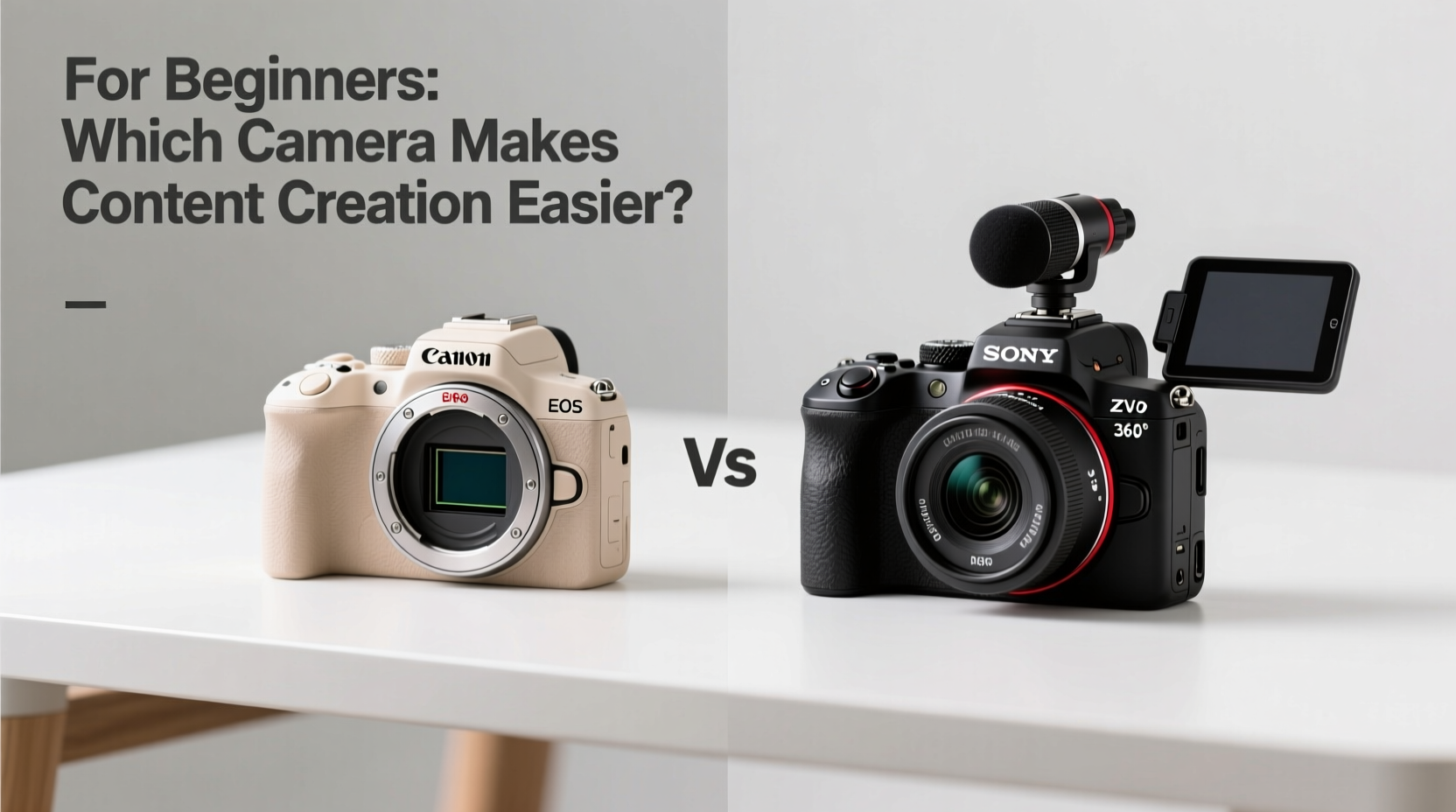
For content creators, especially solo vloggers, autofocus isn’t just a convenience—it’s essential. Manual focusing while speaking to the camera is impractical, so reliable subject tracking is non-negotiable.
The Canon EOS R50 uses Canon’s Dual Pixel CMOS AF II system, known for smooth, consistent eye and face detection. It excels in tracking moving subjects, even when they turn slightly away from the lens. In real-world testing, the R50 maintains focus during dynamic scenes—like walking through a market or transitioning between people—without hunting or overshooting.
The Sony ZV-E10, built on the same autofocus foundation as higher-end Alpha models, features Real-time Eye AF (human and animal) and Real-time Tracking. While technically advanced, its implementation can feel overeager. Some users report the camera occasionally shifting focus to background elements when lighting changes abruptly, such as stepping from shade into sunlight.
Tip: Enable “Subject to Center” on the R50 to automatically reframe your shot if you drift out of frame—ideal for single-person vlogging.Both cameras offer touch-to-focus on their rear screens, but the R50’s interface feels more responsive and less laggy during continuous recording. For creators who prioritize set-it-and-forget-it reliability, the Canon edges ahead.
Video Quality and Image Processing
At their core, both cameras use APS-C sensors (24.2MP for the R50, 24.2MP for the ZV-E10), delivering similar resolution and dynamic range. However, differences in color science and video encoding affect final output.
The Canon EOS R50 records 4K up to 30fps with a slight 1.5x crop, while the ZV-E10 offers uncropped 4K at 25/30fps—technically superior. But here's the catch: the ZV-E10 applies a heavy crop in 4K mode unless you use third-party firmware like Magic Lantern (not officially supported). Out-of-the-box, both cameras default to cropped 4K, reducing wide-angle flexibility.
In Full HD (1080p), both shine. The R50 captures 1080p at up to 120fps for smooth slow motion, while the ZV-E10 tops out at 120fps only in 720p. This gives Canon a clear advantage for creators wanting cinematic slow-mo without downgrading resolution.
Color rendering is where personal preference plays a role. Canon’s skin tones are warmer and more flattering straight out of camera—ideal for beauty, lifestyle, and talking-head videos. Sony leans cooler, requiring more grading to achieve natural-looking results. As videographer Lena Tran notes:
“Sony gives you more data to work with in post, but Canon gets you closer to a finished product faster. If you're editing on a phone or tablet, Canon’s colors save hours.” — Lena Tran, Mobile Video Editor & Content Creator
Ease of Use: Interface, Controls, and Learning Curve
Beginner-friendliness isn’t just about specs—it’s about how quickly you can operate the camera without reading the manual.
The Canon EOS R50 features a fully articulated touchscreen, a dedicated movie record button on top, and a mode dial with a clear \"Movie\" position. Its menu system, while not perfect, uses plain language (\"Smooth Skin,\" \"Background Blur\") instead of technical jargon. Features like Auto Short Clip Recording automatically capture 3–5 second clips when motion is detected—perfect for capturing spontaneous moments.
Sony’s ZV-E10 has a vari-angle screen too, but it flips out sideways rather than forward-facing, making framing tricky when vlogging handheld. There’s no physical record button; you must press the shutter button halfway and then fully, or use the Fn menu to assign recording to another button—an extra step for new users.
One standout feature on the ZV-E10 is Product Showcase Mode, which shifts focus from your face to an object held in front of the camera. This works well for unboxing videos or reviews. However, it requires specific hand movements to trigger, and false positives occur if you gesture near your chest.
Quick Comparison: Usability Features
| Feature | Canon EOS R50 | Sony ZV-E10 |
|---|---|---|
| Physical Record Button | Yes | No |
| Front-Facing Screen | Yes, fully articulating | Limited angle due to hinge design |
| Auto Slow Motion (HFR) | Up to 120fps @ 1080p | 120fps @ 720p only |
| Product Focus Shift | No | Yes (Product Showcase Mode) |
| Touchscreen Responsiveness | High | Moderate (lag reported) |
Audio Capabilities and Built-in Solutions
Poor audio ruins great visuals. Both cameras include 3.5mm microphone inputs and digital stereo windscreen options, but their internal processing differs significantly.
The Canon R50 has a directional 12-channel mic optimized for voice. When enabled, it reduces ambient noise and enhances speech clarity—especially useful outdoors. Wind filtering is effective, though not flawless in strong breezes. The camera also supports USB audio via USB-C, allowing direct connection to plug-and-play mics like the Rode VideoMic Me-L.
The Sony ZV-E10 includes a three-capsule directional microphone system designed to emphasize sound from the front. It performs better than average for a built-in mic, but lacks adjustable levels in automatic mode. Manual control requires diving into menus—a hurdle during fast setups.
Tip: Use the R50’s “A+” (Creative Assist) mode to adjust audio levels visually with sliders, similar to smartphone apps.For wireless audio, both pair with companion apps (Canon Camera Connect, Sony Imaging Edge Mobile), but Sony’s app allows live monitoring via headphones over Wi-Fi—a rare mobile-friendly advantage.
Battery Life and Portability
Portability matters for creators on the move. The R50 weighs 375g with battery, the ZV-E10 343g—both lightweight, but the difference becomes noticeable with added lenses and accessories.
Battery life favors Canon. The R50 uses LP-E17, offering approximately 230 shots per charge in EVF mode and around 440 minutes of video recording via USB power. The ZV-E10 uses NP-FW50, lasting roughly 80–100 minutes of continuous 4K recording. Frequent travelers may need multiple spares for Sony.
Both support USB-C charging, enabling use with power banks. However, the R50 allows simultaneous recording and charging without overheating warnings under normal conditions, whereas the ZV-E10 displays thermal alerts after extended 4K sessions—even with cooling fans.
Mini Case Study: Travel Vlogger’s Weekend Trip
Riley, a solo travel content creator, tested both cameras on a two-day city break. Using identical lenses (Canon RF-S 18-45mm f/4.5-6.3 and Sony E 16-50mm f/3.5-5.6), Riley filmed walking tours, food reviews, and sunset timelapses.
Results: The R50 handled transitions between indoor cafes and bright streets more smoothly, with fewer focus shifts and better color consistency. The ZV-E10 captured sharper 4K detail in static shots but overheated during a 25-minute park tour, forcing a pause. Audio was clearer on the R50 thanks to active wind suppression, while Sony picked up more street noise despite using the same external mic.
Verdict: “I spent less time fixing issues with the Canon,” Riley said. “It just worked when I needed it to.”
Lens Ecosystem and Future-Proofing
Your camera choice affects long-term flexibility. Canon’s RF mount is newer, with fewer native lenses, but the RF-S lineup is growing. Adapters allow EF/EF-S lens use, giving access to hundreds of affordable optics.
Sony’s E-mount has been around since 2010. Over 150 native lenses are available, including budget-friendly options from Sigma, Tamron, and Samyang. Third-party support is unmatched, making upgrades easier.
If you plan to expand beyond vlogging—into photography, low-light work, or cinematic filmmaking—Sony’s ecosystem offers more paths. But for most beginners, Canon’s kit lens and upcoming RF-S primes will suffice for years.
Checklist: Choosing Based on Your Needs
- Choose the Canon EOS R50 if:
- You want reliable autofocus with minimal tweaking
- You value natural skin tones and easy color grading
- You film mostly in 1080p or need true 1080p/120fps
- You prefer longer battery life and USB-C passthrough
- You’re new to cameras and want guided shooting modes
- Choose the Sony ZV-E10 if:
- You prioritize uncropped 4K (with caveats)
- You already own Sony E-mount lenses
- You create product-focused content needing auto-focus shift
- You plan to upgrade to professional gear later
- You edit on desktop and don’t mind color correction
Frequently Asked Questions
Can either camera livestream directly to YouTube or Instagram?
Yes, both support clean HDMI output for use with capture cards. With USB streaming, the R50 works natively with platforms like YouTube Live via its “Streaming” mode. The ZV-E10 requires third-party software (OBS, Ecamm) for stable USB video feed, though it can transmit audio.
Do these cameras have headphone jacks for audio monitoring?
No. Neither the Canon EOS R50 nor the Sony ZV-E10 includes a headphone jack. You must rely on visual audio meters or connect via USB-C to a smartphone/tablet using an adapter for monitoring.
Which is better for TikTok or Reels content?
The Canon R50 wins for vertical-first creators. Its fully rotating screen makes framing selfies effortless, and features like Auto Short Clip and Background Defocus simplify quick content. The ZV-E10 lacks vertical video optimization and requires post-rotation in editing.
Final Verdict: What “Easier” Really Means
\"Easier\" doesn't mean more features—it means fewer obstacles between idea and execution. For most beginners, the Canon EOS R50 delivers a smoother, more intuitive content creation experience. Its autofocus is dependable, colors are broadcast-ready, and workflow integrations (like direct streaming and USB charging) reduce friction.
The Sony ZV-E10 offers compelling advantages—especially for those invested in the Sony ecosystem or seeking maximum resolution flexibility—but demands more technical know-how to unlock its potential. Its learning curve is steeper, and some features feel gimmicky without refinement.
If your goal is to start creating today—with confidence that your camera won’t let you down—the Canon EOS R50 is the more practical choice. It anticipates common pain points and solves them quietly, letting you focus on storytelling.
That said, if you're technically inclined, plan to grow into advanced workflows, or already shoot with Sony gear, the ZV-E10 remains a powerful, future-proof option worth considering.
🚀 Ready to start creating? Pick the camera that matches your workflow—not just the spec sheet—and publish your first video this week. Share your journey with us in the comments!








