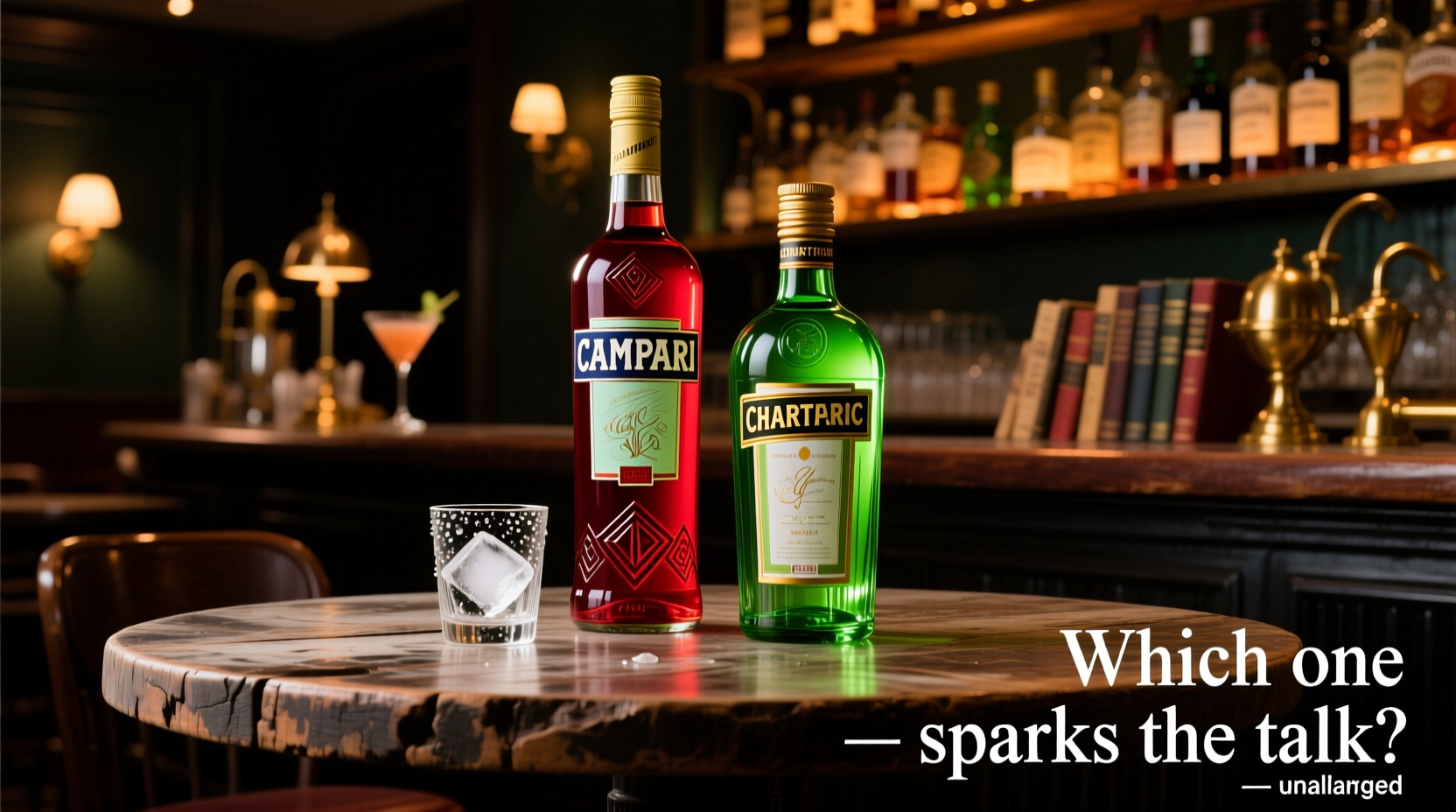
Walk into any serious cocktail bar and watch what happens when someone orders a Negroni—or a Last Word. The bartender’s posture shifts. A subtle nod passes between colleagues. Someone leans in. That’s the power of Campari and Chartreuse: two fiercely distinctive, unapologetically herbal liqueurs that don’t blend in—they command attention, provoke debate, and catalyze connection. Neither is background noise. Both are conversation starters, but for profoundly different reasons. Understanding why requires more than tasting notes—it demands context: centuries of monastic secrecy, Italian industrial ambition, botanical alchemy, and the quiet rebellion of choosing complexity over convenience.
A Tale of Two Traditions: Origins That Define Identity
Campari and Chartreuse occupy opposite poles of the liqueur world—not just in flavor, but in philosophy and provenance. Campari was born in 1860 Milan as a product of modernity: Gaspare Campari, a young bartender and entrepreneur, sought to create a bitter, refreshing aperitif suited to the urban rhythms of a newly unified Italy. His formula—reportedly developed through relentless experimentation with herbs, roots, and citrus peels—was designed for accessibility, consistency, and mass appeal. By the 1920s, Campari had become synonymous with Italian sophistication, its vibrant red hue and sharp bitterness appearing in early cocktail manuals alongside vermouth and gin.
Chartreuse, by contrast, emerged from silence and seclusion. Since 1605, Carthusian monks at the Grande Chartreuse monastery in France’s Alpine wilderness have guarded a single, immutable recipe—a “secret elixir” gifted to them by François Annibal d’Estrées, a marshal of France. For over 400 years, only two monks at a time know the full formula; they oversee the harvesting, maceration, and aging of over 130 botanicals—including rare alpine herbs like saxifrage, lemon balm, and arnica. Chartreuse isn’t produced for the market—it’s distilled as an act of devotion. Its existence predates modern branding by centuries. When it finally reached wider audiences in the 19th century, it carried the weight of sacred tradition, not marketing strategy.
“The difference between Campari and Chartreuse isn’t just taste—it’s intention. Campari asks, ‘How can I enhance your drink?’ Chartreuse asks, ‘Are you ready to be transformed by it?’” — Laurent Boudou, Master Distiller & Former Cellar Director, Maison Ferrand
Flavor Architecture: Bitterness vs. Botanical Symphony
Both liqueurs are undeniably bold—but their boldness operates on entirely different sensory axes.
Campari’s identity rests on calibrated, assertive bitterness. Its dominant notes are grapefruit rind, orange peel, gentian root, and quinine—sharp, drying, and bracing. It’s sweetened just enough (about 25% sugar) to balance the bitterness without softening its edge. The finish is clean, almost medicinal, with a lingering citrus-zest snap. It doesn’t invite slow sipping; it demands engagement—often diluted, chilled, or tempered by vermouth or soda.
Chartreuse, especially the Green variant (55% ABV), is an immersive, evolving experience. Its 130+ botanicals unfold in waves: first, intense mint and thyme; then warm spice (clove, cinnamon); followed by floral honey, pine resin, and a deep, earthy sweetness from aged distillate. The bitterness is present but integrated—subordinate to aromatic complexity and textural richness. Yellow Chartreuse (40% ABV) is gentler, with more pronounced honeyed florals and vanilla, yet still unmistakably layered. Neither version is merely “bitter”—they’re botanical ecosystems in liquid form.
Tip: Never serve Chartreuse too cold. Chill it to 8–10°C (46–50°F) to preserve aromatic nuance. Campari, however, shines straight from the fridge—its bitterness tightens and brightens with chill.Role in Cocktails: Catalyst vs. Co-Star
In practice, these differences dictate how each liqueur functions behind the bar.
Campari excels as a structural catalyst. Its consistent bitterness cuts through richness, lifts citrus, and provides backbone. In the Negroni (equal parts Campari, gin, sweet vermouth), it’s the hinge—the element that transforms three ingredients into something greater than the sum. It works similarly in the Americano (Campari, vermouth, soda) and the Boulevardier (Campari, bourbon, vermouth), where its role is to define the drink’s character and provide contrast. It’s rarely the sole focus—except perhaps in a simple Campari & Soda, where its assertiveness is the point.
Chartreuse, especially Green, is a co-star—or sometimes, the undisputed lead. Its complexity means it doesn’t just add bitterness or sweetness; it adds dimension, depth, and mystery. In the Last Word (equal parts Green Chartreuse, gin, lime juice, maraschino), it’s the aromatic engine—balancing acidity with herbaceous warmth and lending the cocktail its signature roundness and longevity on the palate. In the Bijou (gin, green Chartreuse, sweet vermouth), it replaces Campari entirely, transforming a Negroni-adjacent structure into something lush, green, and contemplative. Chartreuse also shines in spirit-forward drinks like the Tuxedo No. 2 (rye, dry vermouth, maraschino, Green Chartreuse), where its botanical density holds its own against high-proof whiskey.
| Attribute | Campari | Green Chartreuse |
|---|---|---|
| ABV | 20.5–28.5% (varies by region) | 55% |
| Sugar Content | ~25% (medium-sweet) | ~40% (rich, honeyed) |
| Primary Function | Bitter counterpoint / structural anchor | Aromatic complexity / textural depth |
| Best Served | Chilled, diluted, or in balanced cocktails | Neat (slightly chilled), or in precise, low-volume cocktails |
| Shelf Life (Unopened) | Indefinite, but color may fade over decades | Indefinite—flavor deepens with age |
The Conversation Spark: Why These Liqueurs Make People Talk
What makes a spirit spark conversation? Not novelty alone—many new releases vanish without a whisper. It’s the collision of authenticity, challenge, and cultural resonance.
Campari sparks conversation because it’s democratic provocation. Ordering a Negroni signals confidence—not in expertise, but in embracing boldness. Its vivid red color is instantly recognizable; its bitterness is a shared rite of passage. Bartenders love it because it’s reliable, versatile, and tells a story of Italian modernity. Guests debate its merits: “Too bitter?” “Needs more vermouth?” “Try it with mezcal instead of gin.” It’s a social lubricant with teeth.
Chartreuse sparks deeper, quieter conversation—often among those who’ve already moved past the basics. Mentioning it in passing (“I’ve been exploring pre-Prohibition Chartreuse cocktails”) cues recognition among enthusiasts. Its monastic origin invites questions: “Do they really not tell anyone the recipe?” “How do they source all those herbs?” “Why does the Green version taste so different from the Yellow?” It’s a gateway to discussions about terroir, preservation, and the ethics of secrecy in food culture. A guest ordering a Last Word isn’t just choosing a drink—they’re signaling curiosity, patience, and respect for craft that transcends trend.
Mini Case Study: The Bar Where Everything Changed
In 2017, Portland’s now-closed bar *The Verdant* hosted a “Bitter & Botanical” tasting night. Owner Mara Chen invited guests to compare five amari and two Chartreuse expressions side-by-side. Most attendees arrived expecting Campari to dominate—its reputation precedes it. But halfway through the flight, something shifted. As guests tasted Green Chartreuse neat, then in a modified Last Word with barrel-aged gin, murmurs turned to sustained silence, then animated exchange. One regular, a software engineer, later wrote in a review: “I’d ordered Negronis for ten years. That night, I realized I’d never actually *tasted* bitterness—I’d just accepted it as a sensation. Chartreuse made me listen to my tongue for the first time.” Within six months, The Verdant’s Chartreuse sales tripled—and its house-made “Alpine Spritz” (Yellow Chartreuse, sparkling wine, lemon verbena) became a signature. The conversation didn’t start with opinion. It started with attention.
Your Practical Guide: Choosing, Serving, and Mastering Each
Understanding theory matters—but applying it does more. Here’s how to move beyond comparison to confident use:
- Start with purpose: Need a crowd-pleasing aperitif? Choose Campari. Hosting a small group of curious drinkers? Open Chartreuse.
- Respect the ABV: Campari’s lower proof makes it ideal for longer drinks and spritzes. Chartreuse’s strength demands precision—measure carefully, especially Green.
- Balance acidity: Campari pairs naturally with citrus and vermouth. Chartreuse needs brighter acid (lime, grapefruit) or rich sweetness (aged rum, PX sherry) to harmonize.
- Consider the glass: Serve Campari-based drinks in highballs or rocks glasses. Chartreuse—neat or in spirit-forward cocktails—deserves a small snifter or coupe to capture aromas.
- Store wisely: Keep both upright, away from light and heat. Chartreuse benefits from long-term cellaring (especially Green); Campari is best consumed within 2–3 years of opening for peak vibrancy.
FAQ: Clearing Up Common Confusion
Can I substitute Chartreuse for Campari (or vice versa) in cocktails?
Rarely—and only with significant adjustment. Swapping Green Chartreuse for Campari in a Negroni creates an unbalanced, overly sweet, and cloying drink lacking structural bitterness. Replacing Chartreuse with Campari in a Last Word strips away its aromatic soul, leaving a thin, sour gin-lime cocktail. They’re not interchangeable; they’re complementary alternatives for different expressive goals.
Is Chartreuse gluten-free and vegan?
Yes—both Green and Yellow Chartreuse are certified gluten-free and contain no animal products. The base spirit is distilled from French wheat and grapes; botanicals are plant-derived; caramel coloring (in Green) is vegetable-based. Campari is also gluten-free and vegan, though its original formula used caramel derived from cane sugar (modern versions confirm plant-based sourcing).
Why does Campari taste different in Europe vs. the US?
Historically, US Campari used synthetic dyes (like Red 40) and adjusted botanical ratios to comply with FDA regulations, resulting in a slightly sweeter, less bitter profile. Since 2021, Campari Group has standardized global production using natural cochineal dye (from insects) and the original Italian botanical blend. Today’s US Campari closely mirrors the European expression—though subtle regional variations in water and aging conditions persist.
Conclusion: Choose Your Boldness—Then Share It
Campari and Chartreuse aren’t competitors. They’re two vital dialects in the language of bold liqueurs—each speaking truth to different aspects of human appetite: for clarity and energy, or for depth and revelation. Campari meets you where you are—brisk, social, alive with the pulse of the city. Chartreuse invites you deeper—inward, upward, into the mountains of patience and presence. Neither asks for passive consumption. Both demand presence: the presence to taste, to question, to adjust, to share.
So next time you reach for one—or introduce it to a friend—do so intentionally. Pour Campari not just for its color, but for its courage to be uncompromising. Serve Chartreuse not as a curiosity, but as a covenant with centuries of quiet devotion. Then watch what happens: the pause before the first sip, the raised eyebrow, the lean-in, the question asked not out of confusion, but genuine interest. That’s where conversation begins—not with agreement, but with attention. And in a world saturated with easy flavors and fleeting trends, that kind of attention is the rarest, boldest spirit of all.
💬 Your turn: Which liqueur sparked your most memorable cocktail conversation? Did Campari surprise you with its versatility—or did Chartreuse shift your understanding of what “bitter” can mean? Share your story in the comments—we’re listening.








