The Aperol Spritz has become a global phenomenon — a sun-drenched symbol of Italian dolce vita, served in sidewalk cafés from Venice to Vancouver. Yet just steps away on the same bar shelf sits its bolder, more complex sibling: Campari. Both are Italian bitter aperitifs, both star in spritzes, and both carry centuries of tradition — but they are not interchangeable. Confusing them is like substituting espresso for decaf and wondering why your afternoon feels different. This isn’t about preference alone; it’s about intention, balance, and understanding what each liqueur brings to the glass — and to the experience.
A Brief History: Two Bitters, Two Eras
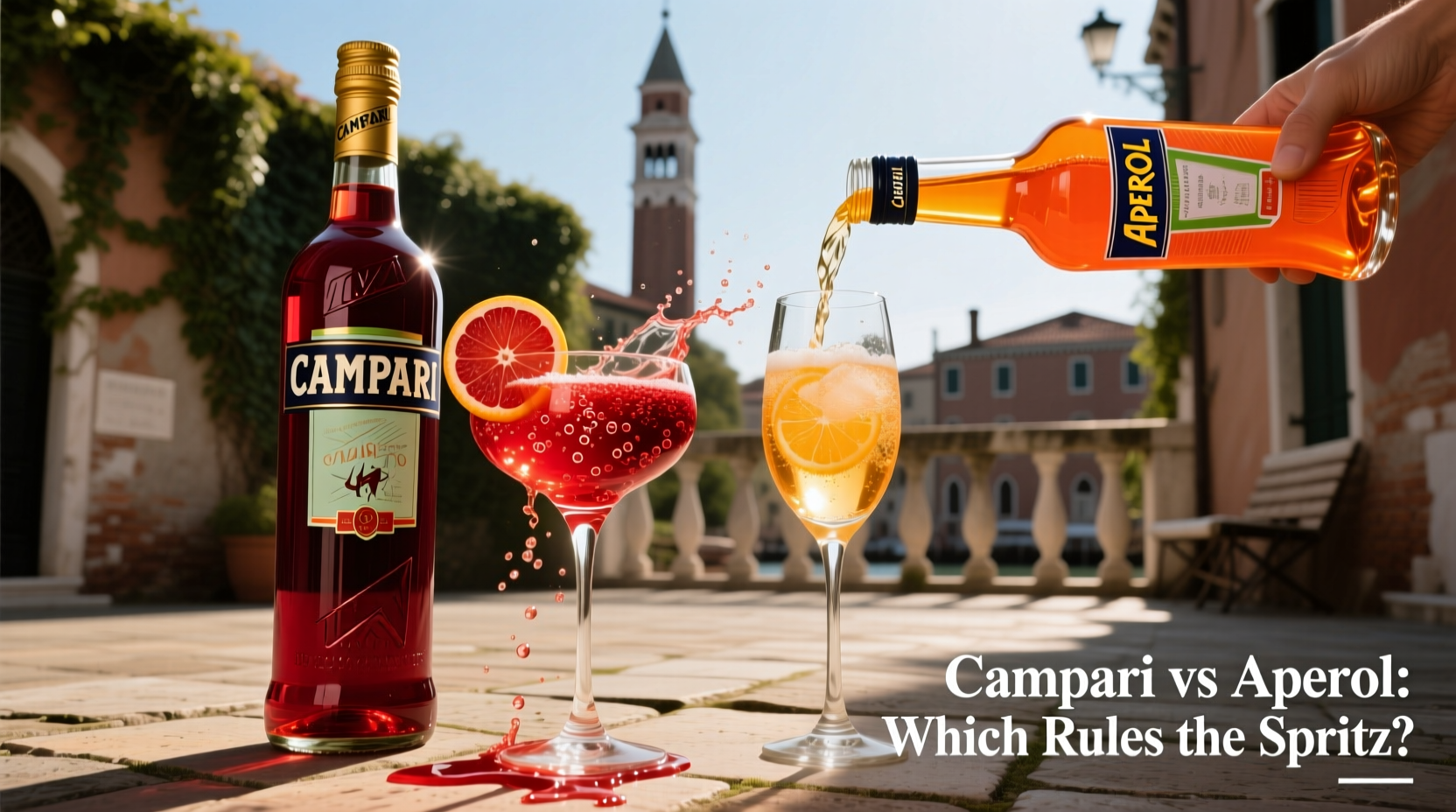
Campari predates Aperol by nearly half a century. Gaspare Campari created his namesake liqueur in Novara, Italy, in 1860 — a time when herbal bitters were medicinal tonics as much as social lubricants. His formula, still secret today (reportedly involving over 60 botanicals including chinotto, cascarilla bark, and orange peel), was aggressively bitter, deeply crimson, and unapologetically assertive. It was designed to stimulate digestion — and, frankly, to challenge the palate.
Aperol arrived in 1919, born from the vision of brothers Luigi and Silvio Barbieri in Padua. They sought something gentler: an accessible, daytime-friendly aperitif that retained bitterness but softened its edge with pronounced citrus and herbaceous sweetness. Its name may derive from the French word *apéritif*, or from the Italian *aperire* (“to open”) — a nod to its role in opening the appetite without overwhelming it. Its signature orange hue came not from artificial dye but from natural beta-carotene and rhubarb root.
This historical divergence explains their enduring roles: Campari became the backbone of serious cocktails like the Negroni and Americano — drinks built for depth and structure. Aperol found its home in the light, effervescent, low-ABV spritz — a drink for lingering, not locking horns with your taste buds.
Flavor & Composition: A Study in Contrast
At first glance, both liqueurs share citrus and herb notes. But beneath the surface lies a fundamental divergence in philosophy and formulation.
| Characteristic | Campari | Aperol |
|---|---|---|
| Alcohol by Volume (ABV) | 20.5–28.5% (varies by market) | 11% |
| Primary Bittering Agents | Chinotto, quinine, cascarilla, rhubarb | Chinotto, gentian, rhubarb, cinchona |
| Sugar Content (g/100ml) | ~25–30g | ~12–14g |
| Perceived Bitterness | High — sharp, medicinal, tannic | Medium-low — rounded, citrus-forward, gently astringent |
| Key Flavor Notes | Bitter orange rind, dried herbs, clove, burnt sugar, earthy root | Orange zest, grapefruit, gentian root, vanilla, subtle anise |
| Color Origin | Natural carmine (cochineal insects) + caramel | Natural beta-carotene (carrots/rhubarb) + caramel |
Crucially, Campari’s higher ABV and greater sugar content don’t make it “sweeter” — they create a denser, more viscous mouthfeel that carries its bitterness with gravity. Aperol’s lower alcohol and lighter sugar profile yield brightness and lift. As master distiller Giuseppe Rinaldi of Casoni Distillery observes:
“Aperol is a conversation starter — friendly, approachable, generous with its fruit. Campari is the person who joins the table later, listens quietly, then says something unforgettable. Neither is better. They serve different moments.”
The Spritz Showdown: How Each Performs in Practice
The classic spritz formula is simple: bitter liqueur + sparkling wine + soda water. But the choice of bitter liqueur transforms the drink’s character entirely.
An Aperol Spritz (typically 3 parts Prosecco, 2 parts Aperol, 1 part soda) delivers immediate refreshment. The lower ABV keeps it sessionable — ideal for long afternoons. Its citrus-forward profile harmonizes seamlessly with Prosecco’s green apple and pear notes, while the soda adds crisp, clean cut. It’s bright, slightly sweet, gently bitter, and finishes dry without lingering intensity. It invites repetition.
A Campari Spritz (often adjusted to 2 parts Prosecco, 1 part Campari, 1 part soda — sometimes with a twist of orange) is a different proposition. Its higher bitterness demands attention. The Campari’s deep, resonant notes clash beautifully with Prosecco’s fruit, creating tension and complexity. The finish is drier, longer, and more contemplative — less “sip all afternoon,” more “sip thoughtfully before dinner.” It’s a spritz with gravitas.
Tip: Never substitute Campari for Aperol (or vice versa) in a recipe without adjusting ratios. A straight 1:1 swap will make an Aperol Spritz cloying and flat, and a Campari Spritz undrinkably harsh. Reduce Campari to 0.75 parts and increase soda to 1.25 parts for balance.Real-World Context: When to Choose Which (and Why It Matters)
Consider Marco, a sommelier at a bustling enoteca in Bologna. On a sweltering June Saturday, his terrace fills with groups celebrating birthdays and graduations. He serves 80+ Aperol Spritzes before sunset — guests appreciate its easy charm, photogenic color, and ability to pair effortlessly with olives, bruschetta, and light antipasti. “It’s the social glue,” he says. “People relax into it. They talk louder, laugh easier.”
But later that same evening, a regular named Sofia arrives alone at the bar. She orders a Campari Spritz — no garnish beyond a single orange twist expressed over the top. “I need something that matches my mood,” she explains. “Not cheerful. Not distracting. Something that tastes like focus.” For her, the Campari Spritz is ritual, not refreshment. It signals transition — from day to night, from casual to intentional.
This distinction matters because choosing the right bitter isn’t just about taste — it’s about aligning the drink with your intention, setting, and even physiology. Aperol’s lower ABV makes it safer for daytime consumption and social settings where multiple drinks are likely. Campari’s higher bitterness stimulates gastric juices more robustly — clinically shown to enhance digestion — making it a more functional pre-dinner choice when paired with richer fare.
Your Spritz Decision Framework: A Practical Checklist
Still unsure which to reach for? Use this actionable checklist before you pour:
- Time of day: Daytime (before 6 p.m.) → Aperol. Evening (after 7 p.m.) → Campari.
- Food pairing: Light appetizers (crudités, crostini) → Aperol. Charcuterie, aged cheeses, grilled vegetables → Campari.
- Guest profile: Mixed group, including newcomers to bitter drinks → Aperol. Cocktail enthusiasts or seasoned drinkers → Campari.
- Desired effect: Uplifting, refreshing, sociable → Aperol. Centering, digestive, palate-cleansing → Campari.
- Prosecco style: Fruity, floral, delicate → Aperol. Fuller-bodied, yeasty, nutty → Campari.
And remember: the best spritz is the one that suits the moment — not the one trending on Instagram. Authenticity begins with honesty about what you need from the drink, not what you think you should be drinking.
Common Misconceptions — And What to Do Instead
Misconception #1: “Aperol is just ‘light Campari.’”
Reality: They share botanical families, but their formulations, extraction methods, and balancing philosophies differ fundamentally. Aperol isn’t diluted Campari — it’s a distinct product engineered for a different purpose.
Misconception #2: “Campari Spritz is ‘too strong’ for summer.”
Reality: Strength isn’t just about ABV — it’s about perception. A well-balanced Campari Spritz (with sufficient soda and quality Prosecco) is remarkably refreshing. Try chilling all components thoroughly and using a larger ice cube to minimize dilution without watering down flavor.
Misconception #3: “You must use Prosecco — no substitutions.”
Reality: While traditional, flexibility enhances authenticity. In Trentino, locals often use local sparkling Pinot Nero. In Sicily, some bars substitute Grillo-based spumante. Even dry cider works surprisingly well with Aperol. The rule isn’t “Prosecco only” — it’s “dry, acidic, lightly effervescent wine only.”
Step-by-Step: Crafting the Perfect Spritz for Your Needs
- Define your intention: Are you welcoming guests, winding down, or preparing for a rich meal? Write it down.
- Select your bitter: Use the checklist above. Don’t default — decide.
- Chill everything: Glasses, Prosecco, bitter, and soda — minimum 2 hours in the fridge. Warm ingredients mute aroma and accelerate bubble loss.
- Build in order: Ice first (large cube or sphere), then bitter, then Prosecco, then soda. Pour Prosecco last to preserve effervescence.
- Garnish intentionally: Orange for Campari (express oils over the surface); orange slice or twist for Aperol. Never omit — citrus oil is essential for aromatic lift.
- Serve immediately: A spritz peaks within 90 seconds of pouring. No stirring. No waiting. Sip while alive with bubbles and scent.
FAQ: Clarifying the Confusion
Can I mix Campari and Aperol in one spritz?
Yes — and many modern bartenders do. A 1:1 blend (e.g., 1 part Campari + 1 part Aperol) creates a hybrid profile: brighter than Campari alone, deeper than Aperol alone. Start with 1.5 parts total bitter (0.75 each), 3 parts Prosecco, 1.5 parts soda. Taste and adjust — it’s an excellent bridge for those transitioning between the two.
Why does my Campari Spritz taste overly bitter or medicinal?
Most likely causes: using warm Prosecco (which dulls fruit and amplifies bitterness), insufficient soda (reducing dilution and lift), or cheap Prosecco with low acidity (failing to counterbalance Campari’s tannins). Always use a dry, high-acid Prosecco — look for “Brut” and “Rive” or “Valdobbiadene” on the label.
Is there a non-alcoholic alternative that captures either profile?
True non-alcoholic substitutes remain elusive due to the complexity of botanical extraction. However, high-quality bitter shrubs (like San Pellegrino’s Chinotto or Rutabaga’s Campari-style shrub) come closest — especially when mixed 1:1:1 with sparkling water and dry white grape juice. Avoid syrupy “mocktail” brands; they lack the necessary astringency and aromatic nuance.
The Verdict: Not a Competition — A Conversation
Declaring a “winner” between Campari and Aperol misses the point entirely. This isn’t a contest to be judged by points or popularity. It’s a dialogue between two expressions of Italian aperitivo culture — one rooted in 19th-century apothecary rigor, the other in early 20th-century democratic elegance. To ask which “rules the spritz” is like asking whether salt or pepper rules the kitchen: each governs a different dimension of flavor, timing, and function.
Aperol reigns in accessibility, sociability, and daytime vibrancy. It lowers barriers, invites participation, and embodies joy as a shared, uncomplicated act. Campari rules in depth, contrast, and intentionality. It rewards attention, deepens meals, and honors the ritual of transition — from work to rest, from noise to presence.
The most sophisticated spritz drinkers don’t choose one over the other. They curate. They rotate. They match the bitter to the hour, the company, the weather, the menu. They understand that the true mark of expertise isn’t loyalty to a single bottle — it’s fluency in the language each one speaks.
💬 Your turn: Next time you order a spritz, pause before you speak. Ask yourself: What do I need right now — brightness or balance? Ease or engagement? Then choose deliberately. Share your moment — and your choice — in the comments below. Let’s deepen the conversation, one thoughtful sip at a time.








