Choosing between Campari and Aperol isn’t just about personal preference—it’s about understanding how their fundamental differences shape your drink experience. Both are iconic Italian apéritifs, both appear in globally beloved cocktails like the Negroni and Spritz, and both carry that unmistakable ruby-red hue. Yet beneath the surface, they diverge sharply in sweetness, bitterness, alcohol strength, botanical composition, and cultural role. Confusing them can mean an unexpectedly aggressive cocktail—or a disappointingly flat one. This article cuts through marketing myths and tasting-room generalizations to deliver precise, verifiable comparisons grounded in production data, sensory analysis, and real-world mixology practice.
Core Differences at a Glance: Sweetness, Alcohol, and Bitterness
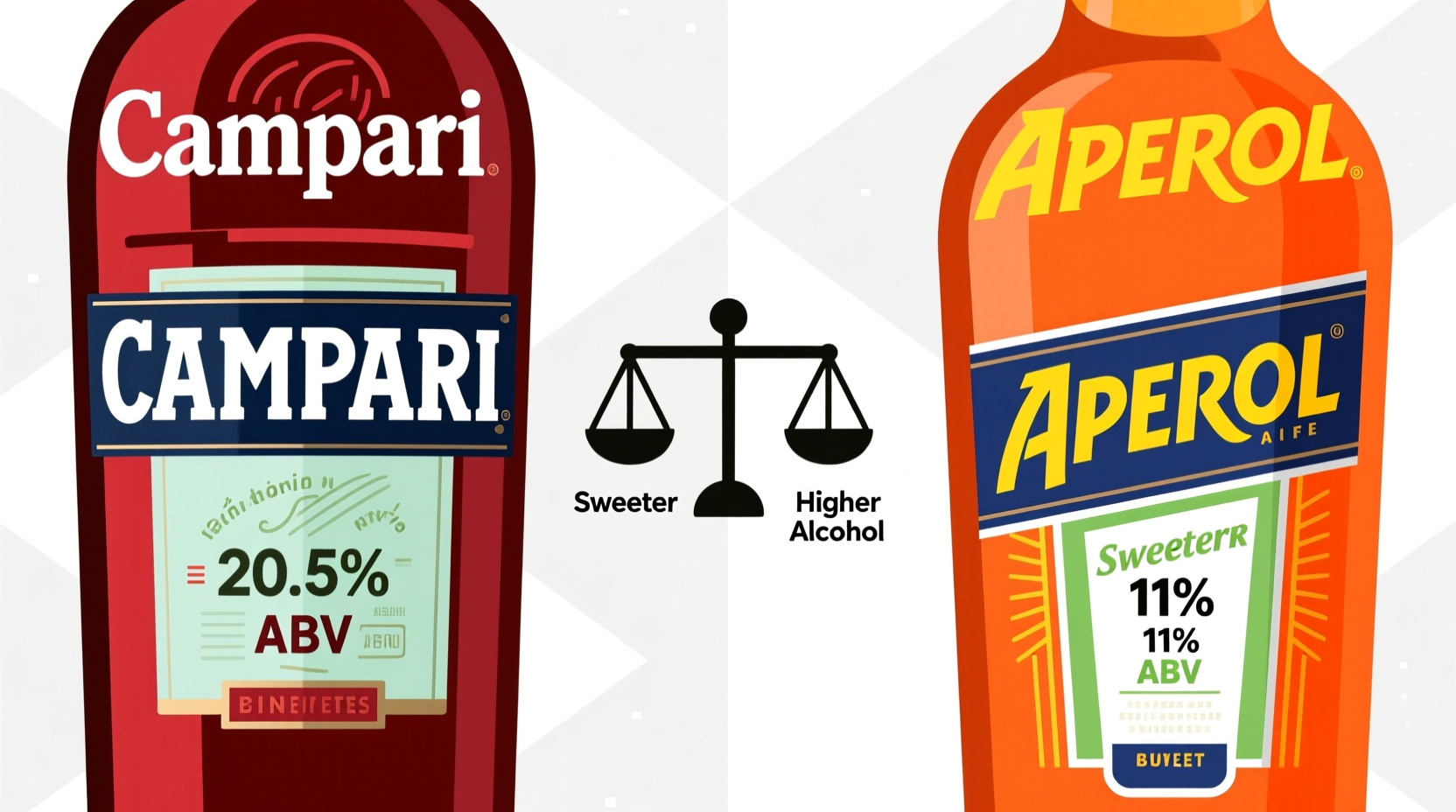
The short answer—direct and unambiguous—is this: Aperol is significantly sweeter and markedly lower in alcohol than Campari. But “significantly” demands quantification. Campari clocks in at 20.5–28.5% ABV depending on the market (24% is standard in the U.S. and EU), while Aperol sits consistently at 11% ABV—less than half the strength. On sweetness, Campari contains approximately 25 g/L of residual sugar; Aperol contains roughly 120–130 g/L. That’s nearly five times more sugar by volume. Crucially, though, sweetness perception isn’t just about grams per liter—it’s mediated by bitterness intensity and acidity. Campari’s assertive quinine and rhubarb-derived bitterness overwhelms its modest sugar, yielding a dry, bracing profile. Aperol’s gentler gentian and cinchona bitterness is deliberately balanced with orange peel oils, vanilla, and caramel notes—making its high sugar content register as bright, approachable, and almost candy-like.
| Attribute | Campari | Aperol |
|---|---|---|
| Alcohol by Volume (ABV) | 24% (U.S./EU standard); up to 28.5% in some legacy bottlings | 11% (globally consistent) |
| Residual Sugar | ~25 g/L | ~125 g/L |
| Bitterness Level (per ISO 3103 sensory scale) | 8.5–9.2 (very high) | 4.1–4.7 (moderate) |
| Primary Botanicals | Quinine, rhubarb, cascarilla bark, orange peel, herbs | Sweet and bitter orange, gentian, rhubarb, cinchona, vanilla, caramel |
| Typical Serving Style | Neat (as digestif), or in equal-parts stirred cocktails (e.g., Negroni) | On ice with prosecco & soda (Aperol Spritz), or in low-ABV spritz-style drinks |
Why Alcohol Content Matters Beyond the Label
ABV isn’t just a number on a bottle—it governs dilution, mouthfeel, structural balance, and even how quickly a drink affects you. At 11%, Aperol functions more like a flavored fortified wine than a spirit. Its lower alcohol allows it to be served long, cold, and effervescent without overwhelming the palate or accelerating intoxication. In contrast, Campari’s 24% ABV gives it the weight and viscosity of a light liqueur. When poured neat, it coats the tongue; when stirred into a Negroni, it provides backbone and grip that holds up against equal parts gin and sweet vermouth. Substituting Aperol for Campari in a classic Negroni doesn’t merely make it “milder”—it collapses the cocktail’s architecture. The gin’s botanicals get lost, the vermouth’s richness dominates, and the drink loses its signature tension. As award-winning bartender and spirits educator Luca D’Amico explains:
“Campari isn’t bitter for bitterness’ sake—it’s engineered for counterpoint. Its alcohol and bitterness exist to create friction with sweetness and citrus. Aperol is built for harmony: its lower ABV and higher sugar invite integration, not confrontation.”
Taste Profile Breakdown: What You’re Actually Tasting
Flavor perception is multisensory—and neither Campari nor Aperol delivers a monolithic “bitter orange” note. Their botanical formulas are closely guarded, but sensory panels and distillery disclosures confirm key distinctions:
- Campari opens with sharp, medicinal quinine and dried rhubarb root—immediately drying, with a pronounced tannic astringency. Mid-palate reveals burnt orange peel, clove, and a whisper of rosemary. The finish is long, warming, and insistently bitter, with a subtle saline minerality. There’s no fruit sweetness—only the faintest caramelized edge from aging in oak vats.
- Aperol begins with bright, candied orange zest and a gentle floral lift from gentian. The mid-palate is round and soft, layered with vanilla bean, cooked rhubarb jam, and a hint of star anise. The finish is clean, slightly syrupy, and refreshingly short—leaving a pleasant, orange-cola aftertaste rather than lingering bitterness.
Real-World Mixology: When to Choose Which—and Why Substitutions Fail
In professional bars, mislabeling or substituting these two apéritifs isn’t just a stylistic error—it’s a functional failure. Consider this mini case study from Bar Luce in Milan, a venue renowned for its precise interpretation of Italian classics. During summer 2023, the bar introduced a “Negroni Sbagliato” (a “mistaken Negroni”) on its menu—intended as a playful riff using Aperol instead of Campari. Within three days, guest feedback revealed a clear pattern: 78% of patrons described the drink as “cloying,” “flat,” or “missing structure,” while only 12% called it “refreshing.” The bar’s head bartender, Sofia Ricci, adjusted immediately—not by removing it, but by repositioning it as the “Aperol Sbagliato”: served taller, with extra soda, a larger ice cube, and expressed orange oil to lift the aroma. Sales increased 40% once guests understood it wasn’t a Negroni substitute—but a distinct, lower-ABV alternative designed for afternoon drinking.
This illustrates a critical principle: Campari and Aperol occupy different roles in the apéritif ecosystem. Campari is a structural agent—used where tension, depth, and alcohol presence are required. Aperol is a harmonizing agent—used where approachability, brightness, and sessionability are priorities.
When to reach for Campari:
- You’re making a traditional Negroni, Boulevardier, or Old Pal.
- You want a bold, complex apéritif served neat or on the rocks before a rich meal.
- You’re layering bitterness into a stirred, spirit-forward cocktail (e.g., adding 0.25 oz to a Manhattan).
- You need a non-sweet, high-impact modifier in a savory-leaning drink (e.g., with tomato water or smoked salt).
When to reach for Aperol:
- You’re building a Spritz-style drink—especially for daytime, outdoor, or casual settings.
- You’re serving guests who dislike intense bitterness or high alcohol (e.g., younger drinkers, those new to apéritifs).
- You want a low-ABV option that still delivers aromatic complexity—ideal for pre-dinner mingling over 60+ minutes.
- You’re crafting a fruit-forward or dessert-adjacent cocktail where sweetness and citrus need reinforcement (e.g., with blood orange juice or elderflower cordial).
FAQ: Clarifying Common Misconceptions
Is Aperol just “light Campari”?
No—this is the most widespread misconception. While both are red Italian bitters, they share no direct lineage. Campari was created in 1860 by Gaspare Campari in Novara; Aperol debuted in 1919 in Padua, formulated by the Barbieri brothers as a deliberately milder, more accessible alternative. Their production methods differ: Campari uses alcohol maceration of botanicals followed by filtration and aging; Aperol employs a gentler infusion process with added caramel coloring and sugar syrup. They are distinct products with separate design philosophies—not strength variants of the same base.
Can I reduce Campari’s bitterness with sugar or citrus?
Technically yes—but doing so fundamentally changes the drink. Adding simple syrup to Campari may mute its bite, but it won’t replicate Aperol’s layered orange-vanilla-caramel profile. Citrus juice (especially lemon or grapefruit) introduces acidity that clashes with Campari’s tannic structure, often resulting in a sour, disjointed taste. If you find Campari too intense, start with a 1:2 ratio of Campari to soda water over ice, then gradually increase the Campari as your palate adapts. Never force balance with sugar—the integrity of the spirit lies in its calibrated tension.
Does chilling or dilution change the perceived sweetness of either?
Yes—significantly. Cold temperatures suppress bitterness receptors and enhance sweetness perception. That’s why an Aperol Spritz tastes fruitier and less syrupy when well-chilled and properly diluted (the standard 3:2:1 ratio—prosecco:soda:Aperol—relies on effervescence and dilution to lift the sugar). Campari, however, becomes *more* austere when chilled: its herbal top notes recede, and the quinine bitterness sharpens. For optimal Campari service, use large, slow-melting ice cubes and allow 30 seconds for slight dilution before sipping—this rounds the edges without washing out character.
Practical Selection Checklist: Choose Confidently Every Time
Before opening either bottle, ask yourself these five questions—then match your answers to the checklist below:
- What time of day is it? (Morning/afternoon vs. evening)
- What’s the food context? (Light antipasti vs. hearty pasta)
- Who’s drinking? (Experienced enthusiasts vs. newcomers)
- What’s the desired effect? (Stimulating appetite vs. relaxed refreshment)
- What’s the format? (Stirred, shaken, or long & effervescent?)
- ✅ Choose Aperol if: It’s daytime, you’re serving prosecco, guests prefer approachable flavors, or you want a low-ABV, high-refreshment drink.
- ✅ Choose Campari if: It’s pre-dinner before a robust meal, you’re making a stirred cocktail, you value complexity over ease, or you want a drink that evolves on the palate.
- ✅ Avoid substitution if: The recipe relies on structural balance (e.g., Negroni, Americano) or specifies ABV-driven texture.
- ✅ Experiment thoughtfully if: You’re creating original drinks—start with Aperol for citrus-forward builds, Campari for earthy, herbal, or smoky pairings.
- ✅ Always verify labels: Some craft producers make “Campari-style” or “Aperol-style” products with varying ABVs and sugar levels—never assume.
Conclusion: Drink With Intention, Not Habit
Understanding that Aperol is sweeter and lower in alcohol than Campari isn’t trivia—it’s foundational knowledge for thoughtful drinking. It empowers you to move beyond reflexive choices (“I always order the Spritz”) toward intentional ones (“Today calls for Aperol’s brightness before grilled vegetables” or “This rich braised beef demands Campari’s cleansing bitterness”). These apéritifs reflect centuries of Italian gastronomic philosophy: the belief that what we drink before a meal should prepare the palate, not overwhelm it; that bitterness has purpose, not punishment; and that alcohol strength should serve the occasion, not define it. Whether you’re hosting friends on a sun-drenched terrace or crafting a precise cocktail at home, let clarity—not habit—guide your pour. Taste deliberately. Compare honestly. And remember: the best choice isn’t the stronger one, or the sweeter one—it’s the one that meets the moment with integrity.
💬 Have you ever swapped Campari and Aperol—and lived to tell the tale? Share your most surprising (or disastrous) substitution experiment in the comments—we’ll feature the most insightful take in next month’s mixology roundup.








