Sun protection isn’t just about sunscreen. The right hat can be one of the most effective tools in shielding your face from harmful UV rays. With outdoor activities on the rise and awareness of skin cancer growing, choosing between a bucket hat and a baseball cap has become more than a fashion decision—it’s a health consideration. While both are popular, their performance in protecting facial skin varies significantly. Understanding these differences helps you make an informed choice based on lifestyle, environment, and actual coverage needs.
Understanding UV Exposure and Facial Vulnerability
The face is one of the most exposed areas of the body and particularly susceptible to UV damage. Dermatologists consistently point out that the nose, cheeks, forehead, and ears receive disproportionate sun exposure due to their prominence and frequent lack of protection. According to the Skin Cancer Foundation, up to 80% of visible facial aging is caused by sun exposure, and chronic UV radiation increases the risk of basal cell carcinoma, squamous cell carcinoma, and melanoma.
Facial anatomy plays a role in this vulnerability. The nose protrudes forward, catching direct sunlight even when partially shaded. Ears are often overlooked in sun protection routines, yet they are common sites for skin cancers. The neck and jawline—especially under the chin—are also frequently missed by sunscreen and poorly covered by many hats. This makes the design and brim structure of headwear critical in blocking not just overhead but also angled and reflected UV rays.
“Most people don’t realize how much UV reaches their face from below or the sides. A wide, downward-sloping brim makes a significant difference in cumulative exposure.” — Dr. Lena Reyes, Board-Certified Dermatologist
Design and Coverage: Bucket Hat vs Baseball Cap
The fundamental difference between a bucket hat and a baseball cap lies in their structural design, which directly impacts sun protection.
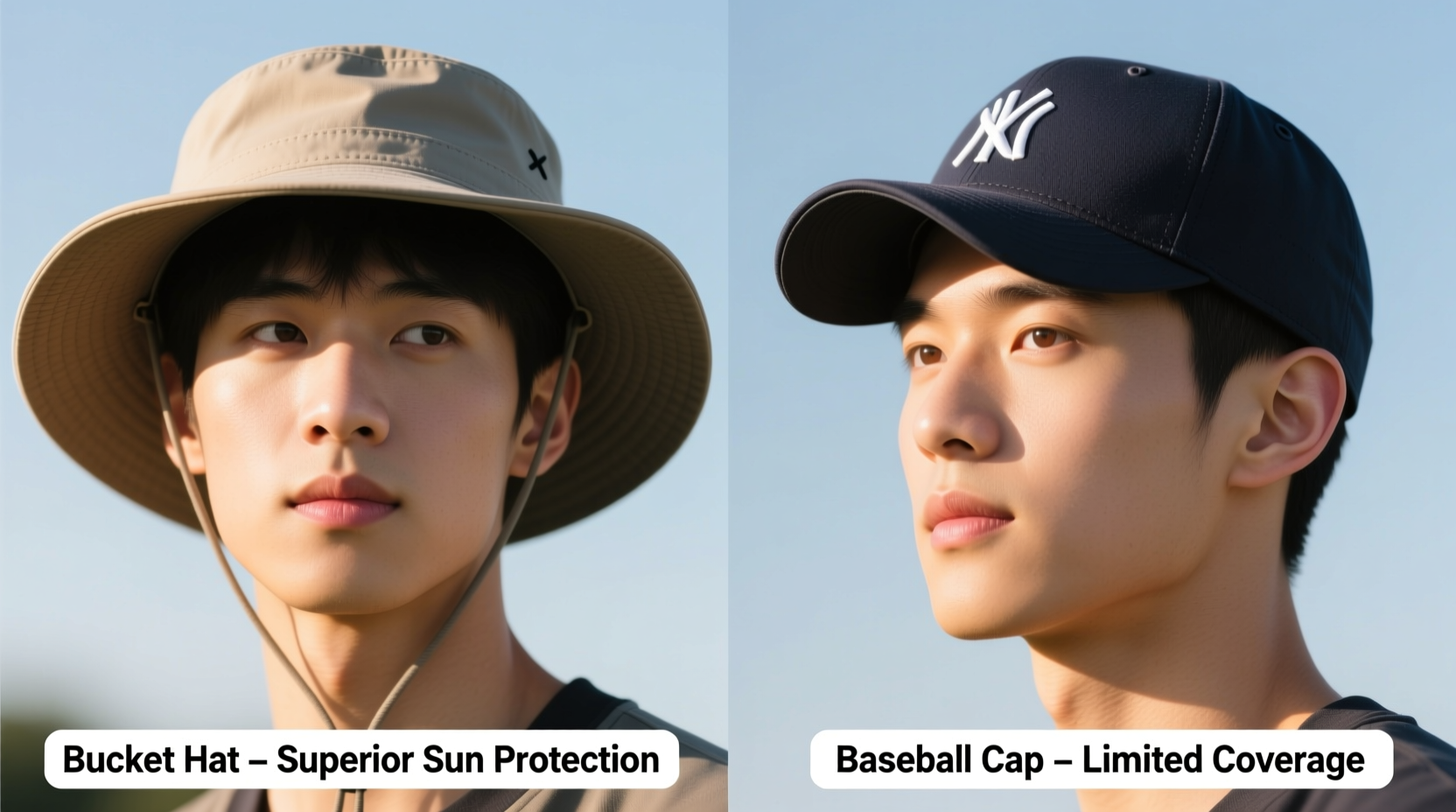
A **baseball cap** features a stiff, curved front brim and a closed crown with an adjustable strap or fitted back. Its primary function is sport utility—keeping sweat out of the eyes and offering minimal frontal shade. The brim typically measures 2.5 to 3 inches and extends only over the forehead and upper cheeks. It provides little to no protection for the ears, neck, temples, or lower face.
In contrast, a **bucket hat** has a deep, downward-sloping circular brim (usually 3 to 4 inches) and a soft, unstructured crown. The full-circle brim wraps around the entire head, casting a consistent shadow over the face, ears, and neck. Many modern bucket hats are made from tightly woven fabrics like nylon, cotton canvas, or UPF-rated synthetics designed specifically for sun safety.
This distinction becomes crucial during prolonged outdoor exposure. For example, while hiking or gardening, the angle of the sun changes throughout the day. A baseball cap may block midday overhead rays but fails when the sun sits low in the morning or evening. A bucket hat maintains protection across all daylight hours due to its 360-degree coverage.
Tip: If you wear glasses, look for bucket hats with a slightly stiffer brim to prevent sagging into your line of sight while still covering your ears.Comparative Analysis: Sun Protection Performance
To evaluate which hat truly offers better facial sun protection, consider several key factors: brim width, coverage area, material composition, and fit stability.
| Feature | Baseball Cap | Bucket Hat |
|---|---|---|
| Brim Width | 2.5–3 inches (front only) | 3–4 inches (full circle) |
| Ear Coverage | None | Full or partial, depending on size |
| Neck & Jaw Protection | Negligible | Significant |
| Material Options | Cotton, polyester, mesh (often non-UPF) | UPF 30–50+ nylon, canvas, recycled fabrics |
| Wind Stability | High (structured fit) | Moderate (can lift in strong wind) |
| Foldability & Portability | Low (retains shape) | High (packable) |
The data shows that while baseball caps win in durability and sport-oriented aesthetics, bucket hats outperform them decisively in overall UV protection. A study published in *Photodermatology, Photoimmunology & Photomedicine* found that individuals wearing wide-brimmed hats (including bucket-style) reduced their facial UV exposure by up to 75% compared to those wearing baseball caps, which offered only 30–40% reduction.
Another critical factor is fabric density. Many bucket hats are now labeled with UPF (Ultraviolet Protection Factor) ratings, indicating how effectively the material blocks UV radiation. A UPF 50 fabric blocks 98% of UV rays. Most traditional baseball caps use loosely woven cotton or breathable mesh panels that offer minimal inherent protection unless specially treated.
Real-World Scenarios: When Each Hat Makes Sense
Not every situation calls for maximum coverage. Lifestyle and activity matter when selecting headwear.
Consider Alex, a weekend cyclist who commutes to trailheads early in the morning. He wears a baseball cap under his helmet for comfort and sweat absorption. While it keeps glare out of his eyes, he notices persistent sunburn behind his ears and along his neck after long rides. Switching to a bucket hat isn’t feasible due to helmet compatibility, so he opts for a cap with a built-in neck flap—a hybrid solution that adds coverage without sacrificing safety.
On the other hand, Maria, a landscape photographer, spends hours outdoors at various times of day. She used to wear a baseball cap but developed actinic keratosis on her left ear—likely from side-angle exposure during late-afternoon shoots. After consulting her dermatologist, she switched to a UPF 50 bucket hat. Within a year, her skin lesions stabilized, and she reported noticeably less facial heat stress and fewer reapplications of sunscreen.
These examples highlight that context determines functionality. For fast-paced urban environments or sports where aerodynamics and visibility are key, a baseball cap may suffice—especially if paired with sunscreen and sunglasses. But for extended outdoor work, beach outings, gardening, or travel in high-sun regions, the bucket hat provides superior, all-around defense.
Action Checklist: Choosing the Right Sun-Safe Hat
- Measure brim width: Aim for at least 3 inches of coverage around the entire head.
- Check for UPF rating: Look for UPF 30 or higher; avoid plain cotton without certification.
- Evaluate ear and neck coverage: Ensure the brim extends past your ears and shades your neck.
- Assess ventilation: Choose moisture-wicking linings if wearing in hot climates.
- Test field of vision: Make sure the brim doesn’t obstruct peripheral sight.
- Pair with other protections: Use broad-spectrum SPF 30+ sunscreen on exposed areas, even under a hat.
Expert Recommendations and Medical Insights
Dermatological associations have long advocated for broad-brimmed hats as part of a complete sun protection strategy. The American Academy of Dermatology (AAD) recommends hats with a minimum 3-inch brim that encircle the entire head for optimal protection.
“A baseball cap leaves the ears, neck, and parts of the face completely vulnerable. That’s why we see so many skin cancers in those areas. A bucket hat, especially one with UPF fabric, closes those gaps.” — Dr. Rajiv Mehta, Clinical Professor of Dermatology, UCLA
Some misconceptions persist, however. One common belief is that any hat is better than no hat. While true in principle, research suggests that wearing a baseball cap alone may create a false sense of security. Users often neglect applying sunscreen to areas outside the cap’s limited shade zone, increasing the risk of uneven exposure and patchy burns.
Additionally, color and reflectivity matter. Light-colored hats reflect more solar radiation away from the head, reducing heat absorption. Darker hats, while stylish, absorb heat and may increase thermal discomfort—even if they block UV effectively. For maximum benefit, experts recommend light beige, khaki, or white bucket hats made from tightly woven, non-transparent fabrics.
Practical Tips for Maximizing Sun Protection
Even the best hat won’t perform well if used incorrectly. Follow these guidelines to get the most out of your sun-safe headwear:
Tip: Wetting a bucket hat slightly before wearing can enhance its UV-blocking ability—damp fabric scatters more radiation than dry fabric, according to Australian Radiation Protection standards.- Wear it low: Position the hat so the brim sits just above your eyebrows, maximizing forehead coverage without blocking vision.
- Secure it in wind: Use a chin strap during breezy conditions to prevent lift and maintain consistent protection.
- Replace when worn: Over time, fabric degrades. Faded, stretched, or thinning hats lose UV-blocking efficiency—replace every 1–2 years with frequent use.
- Layer protection: Combine your hat with UV-blocking sunglasses (wraparound style) and SPF lip balm for total facial defense.
FAQ: Common Questions About Sun Protection Hats
Do bucket hats really protect the face better than baseball caps?
Yes. Bucket hats provide uniform 360-degree coverage, protecting the face, ears, and neck—areas commonly burned when wearing only a baseball cap. Their wider, downward-angled brims block both direct and indirect sunlight more effectively.
Can I wear a bucket hat for sports or workouts?
It depends on the activity. For running or gym workouts, a bucket hat may be impractical due to sweat retention and bounce. However, for golf, fishing, tennis, or walking, many athletes successfully use lightweight, ventilated bucket hats with moisture-wicking bands.
Are all bucket hats sun-safe?
No. Not all bucket hats are created equal. Check for a UPF (Ultraviolet Protection Factor) rating of 30 or higher. Avoid thin, loosely woven fabrics or transparent materials. Some fashion-forward bucket hats prioritize style over function and offer minimal UV protection.
Final Thoughts: Prioritizing Health Over Habit
The choice between a bucket hat and a baseball cap ultimately comes down to intent. If your goal is fashion or athletic performance, a baseball cap fits naturally into that role. But if your priority is minimizing UV damage and protecting your skin long-term, the bucket hat is the superior option.
Sun protection is cumulative. Every minute spent outdoors adds to your lifetime UV exposure. Small improvements—like switching to a wider-brimmed, UPF-rated hat—compound over time into meaningful reductions in skin damage, premature aging, and cancer risk.
It’s not necessary to abandon baseball caps entirely. Instead, reserve them for short errands or indoor-outdoor transitions. Keep a packable bucket hat in your bag, car, or backpack for extended sun exposure. Think of it as wearable insurance for your skin.
🚀 Ready to upgrade your sun safety routine? Swap one baseball cap for a UPF-rated bucket hat this season and track how much less you reach for sunscreen on your ears and neck. Your future self will thank you.








