When it comes to everyday carry items like keys, tools, or small gear, the choice between a brass hook keychain and a carabiner clip might seem minor. But for those who rely on these fasteners daily—whether attaching keys to a belt loop, clipping gear onto a backpack, or securing outdoor equipment—the strength and reliability of the connector can make a significant difference. A broken clasp means lost items, inconvenience, and sometimes safety risks. So, which option holds up better over time: a solid brass hook keychain or a modern carabiner clip?
This article examines both options in terms of material integrity, structural design, load capacity, corrosion resistance, and real-world usage to determine which is less likely to fail under stress.
Material Composition and Strength
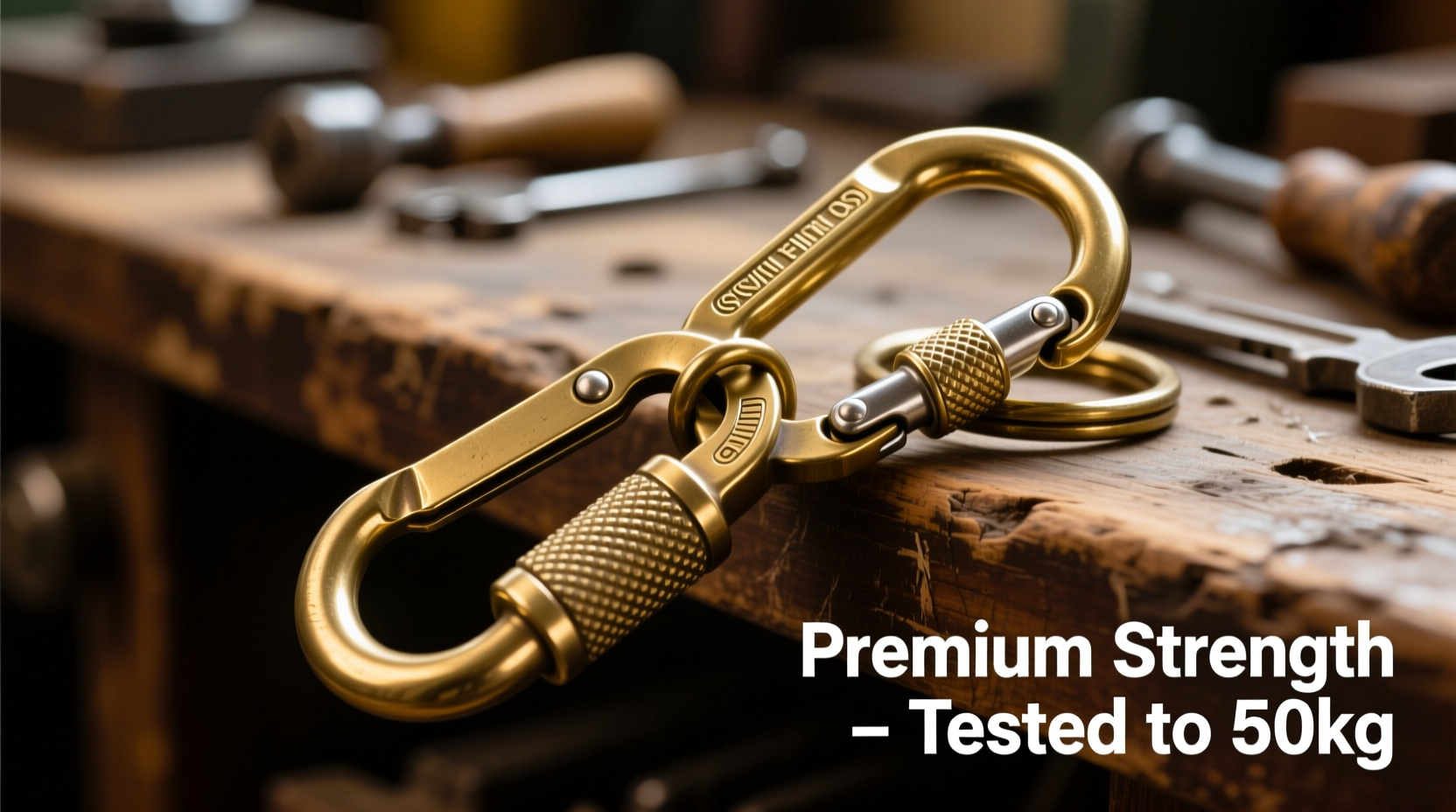
The foundation of any durable fastener lies in its material. Brass, an alloy primarily composed of copper and zinc, has long been used in hardware due to its malleability, corrosion resistance, and attractive gold-like finish. However, while brass resists rust and tarnish well, it is not known for high tensile strength compared to steel or aluminum alloys.
Carabiners, on the other hand, are typically made from aerospace-grade aluminum (like 7075-T6) or stainless steel, both of which offer superior strength-to-weight ratios. Aluminum carabiners are lightweight and strong enough for most non-climbing applications, while steel versions provide exceptional durability and resistance to deformation under heavy loads.
Tip: For maximum strength, choose a steel carabiner over brass—especially if carrying heavier loads or using in rugged environments.Brass hooks may look elegant and resist oxidation better than some metals, but they lack the yield strength needed to withstand repeated mechanical stress without bending or cracking. In contrast, even budget-friendly forged aluminum carabiners undergo standardized testing for gate strength, major axis strength, and minor axis loading—metrics rarely applied to decorative brass keychains.
Structural Design and Load Distribution
Design plays a critical role in how force is distributed across a connector. The classic \"S\" or \"J\" shaped brass hook relies on a single point of curvature to bear all lateral and vertical forces. This creates a natural weak spot at the bend, where metal fatigue can accumulate over time, especially when subjected to twisting motions or sudden tugs.
Carabiners use an oval, D-shaped, or pear-shaped frame engineered to distribute weight along the spine—the strongest part of the body. When loaded correctly (along the major axis), modern carabiners can handle thousands of newtons of force. Even entry-level models rated for general utility often support 8–10 kN (kilonewtons), equivalent to roughly 1,800–2,200 pounds of static force.
In contrast, there is no standard rating system for brass keychain hooks. Most manufacturers do not publish breaking strength data, and informal tests suggest failure points ranging from 30 to 150 pounds depending on thickness and alloy quality—far below typical carabiner performance.
| Feature | Brass Hook Keychain | Carabiner Clip |
|---|---|---|
| Typical Material | Brass (Cu-Zn alloy) | Aluminum or Stainless Steel |
| Tensile Strength | Low to moderate (~300–500 MPa) | High (up to 700+ MPa for steel) |
| Load Rating Available? | No | Yes (e.g., 22 kN gate closed) |
| Corrosion Resistance | Excellent | Good (aluminum), Excellent (stainless) |
| Durability Under Stress | Poor – prone to bending/fatigue | High – designed for dynamic loads |
Real-World Performance: A Mini Case Study
Consider the experience of Alex Rivera, an urban cyclist and EMT based in Portland, Oregon. For years, he used a polished brass hook keychain clipped to his work pants to hold his house keys, bike lock key, and pocket flashlight. After six months of regular use—including jostling during emergency responses and rainy commutes—the hook developed a slight bend. One evening, after catching the chain on a stair railing, the hook snapped completely, resulting in the loss of all attached items.
Switching to a compact stainless steel carabiner with a screw-lock mechanism, Alex reported zero issues over the next two years, despite similar daily wear and exposure to moisture and impact. “I didn’t realize how unreliable that brass hook was until it failed,” he said. “Now I trust my gear stays put.”
This scenario reflects a common pattern: brass hooks perform adequately under light, consistent loads but fail unpredictably when exposed to shocks, abrasion, or off-axis forces.
“Hardware meant for functional attachment should be tested, not assumed. Carabiners follow engineering standards; decorative brass does not.” — Dr. Lena Park, Materials Engineer at Pacific Testing Labs
Environmental and Longevity Factors
While brass excels in resisting corrosion—particularly in humid or salty environments—it still suffers from galvanic degradation when in contact with dissimilar metals. Additionally, frequent handling leads to micro-scratches that can become stress concentrators over time.
Stainless steel carabiners, particularly those with passivated finishes, maintain structural integrity in wet, acidic, or abrasive conditions. Many also feature gated mechanisms with spring-loaded seals that prevent grit ingress—a major cause of premature wear.
Another factor is user behavior. Brass hooks are often thinner and more delicate by design, appealing for fashion-forward accessories. But their slim profiles reduce cross-sectional area, weakening them against shear and torsional stress. Carabiners, even small ones, are built with thicker walls and reinforced noses and gates to endure rough treatment.
Step-by-Step Guide: Choosing the Right Option for Your Needs
- Assess your load: Are you carrying just keys, or additional tools, lights, or multitools? Anything over 1 pound benefits from a rated carabiner.
- Evaluate environment: Frequent exposure to water, dirt, or temperature swings favors stainless steel or sealed aluminum carabiners.
- Check for locking mechanisms: If security is vital (e.g., climbing, medical gear), opt for a screw-gate or auto-locking carabiner.
- Consider aesthetics vs. function: Brass offers vintage appeal but shouldn’t be relied upon for critical attachments.
- Inspect regularly: Look for bends, cracks, or gate misalignment—replace immediately if found.
Common Misconceptions About Brass Durability
Many consumers assume that because brass feels dense and doesn’t rust, it must be strong. This is a misconception. Corrosion resistance does not equate to mechanical strength. Brass is relatively soft and ductile, meaning it deforms easily under pressure rather than resisting it. Over time, repeated flexing—even within normal use—can lead to work hardening followed by brittle fracture.
Carabiners, especially those manufactured to UIAA or CE safety standards, are designed specifically to avoid such failures. They undergo drop tests, cyclic loading simulations, and gate endurance trials before reaching the market.
FAQ
Can a brass hook keychain support the weight of multiple keys?
Yes, under ideal conditions—but only temporarily. While most brass hooks can hold 3–5 keys initially, long-term use increases the risk of metal fatigue. Sudden impacts or snagging can cause immediate failure.
Are all carabiners equally strong?
No. Strength varies significantly by material, shape, and manufacturing method. Climbing-rated carabiners are strongest, followed by industrial and utility models. Avoid unmarked, ultra-cheap imports with no load ratings.
Is brass safer than steel for skin contact?
Brass is generally hypoallergenic and less likely to cause reactions than nickel-plated steels. However, for non-worn connectors (like keychains), this benefit is minimal compared to the importance of reliability.
Final Recommendation: Prioritize Function Over Form
If your priority is minimizing the chance of breakage, the carabiner clip is the clear winner. Its engineered design, standardized strength ratings, and robust materials make it far less likely to fail than a brass hook keychain. While brass may suit decorative or low-stress uses—such as hanging indoor ornaments or serving as a fashion accent—it lacks the structural rigor required for dependable everyday carry.
For anyone relying on secure attachment—outdoor enthusiasts, first responders, travelers, or busy professionals—a quality carabiner provides peace of mind that a brass hook simply cannot match.
💬 Have you experienced a keychain failure? Share your story or preferred gear setup in the comments—your insight could help others make smarter choices!








