For decades, the debate between ballet flats and Mary Janes has simmered in fashion circles. One is celebrated as a timeless symbol of elegance; the other often dismissed as juvenile. But appearances can be deceiving. As fashion evolves, so do perceptions—and Mary Janes are stepping confidently out of the schoolyard and onto runways, city streets, and office floors. The real question isn’t just about comfort or design—it’s about identity, versatility, and style evolution.
Ballet flats have long reigned as the go-to flat shoe for women seeking polish without pain. Clean lines, minimal straps, and soft leather make them a wardrobe staple. Mary Janes, with their signature single strap across the instep, carry a nostalgic charm. But calling them “just for kids” overlooks their rich history and modern reinvention. Let’s dissect both styles beyond surface-level assumptions and explore which truly holds more fashion potential today.
A Brief History: Origins and Evolution
The ballet flat traces its roots to dancers in the 1940s. Designers like Claire McCardell and later designers such as Repetto brought the lightweight, flexible shoe into mainstream fashion. By the 1950s, icons like Audrey Hepburn wore them offstage, cementing their status as symbols of understated sophistication.
Mary Janes, named after a character in the early 20th-century comic strip Buster Brown, were originally designed as practical children's shoes—durable, secure, and easy to wear. Their defining feature—a low heel and a single strap fastened with a buckle or button—made them ideal for active young girls. Over time, however, subcultures adopted the style for its quirky charm. From 1960s mod fashion to 1990s grunge and goth aesthetics, Mary Janes found new life beyond childhood wardrobes.
“Fashion cycles repeat every 20 to 30 years, but what returns isn’t identical—it’s reinterpreted.” — Dr. Lila Chen, Fashion Historian, Parsons School of Design
Today, brands like Miu Miu, Comme des Garçons, and even Dr. Martens are reimagining Mary Janes with bold platforms, patent finishes, and avant-garde proportions. This resurgence signals not nostalgia, but transformation.
Design & Structure: What Sets Them Apart?
At first glance, ballet flats and Mary Janes may seem interchangeable—both are closed-toe, flat (or low-heeled), and typically made from leather or fabric. But structural differences impact both function and fashion.
| Feature | Ballet Flats | Mary Janes |
|---|---|---|
| Strap | No strap or decorative bow only | Single wide strap across instep |
| Closure | Slip-on | Buckle, snap, or elastic |
| Fit Security | Looser; may slip off heel | Tighter hold due to strap |
| Style Range | Classic, minimalist | Variety: retro, punk, preppy, edgy |
| Fashion Flexibility | Elegant, professional | Depends on material and heel height |
The presence of the strap fundamentally changes how Mary Janes perform. They offer better foot containment, making them more stable during walking. This functional advantage translates into confidence—especially when paired with tailored trousers or midi skirts where movement matters.
Tip: If you struggle with flats slipping off your heels, choose Mary Janes—the strap keeps them securely in place.Styling Realities: Can Adults Wear Mary Janes Seriously?
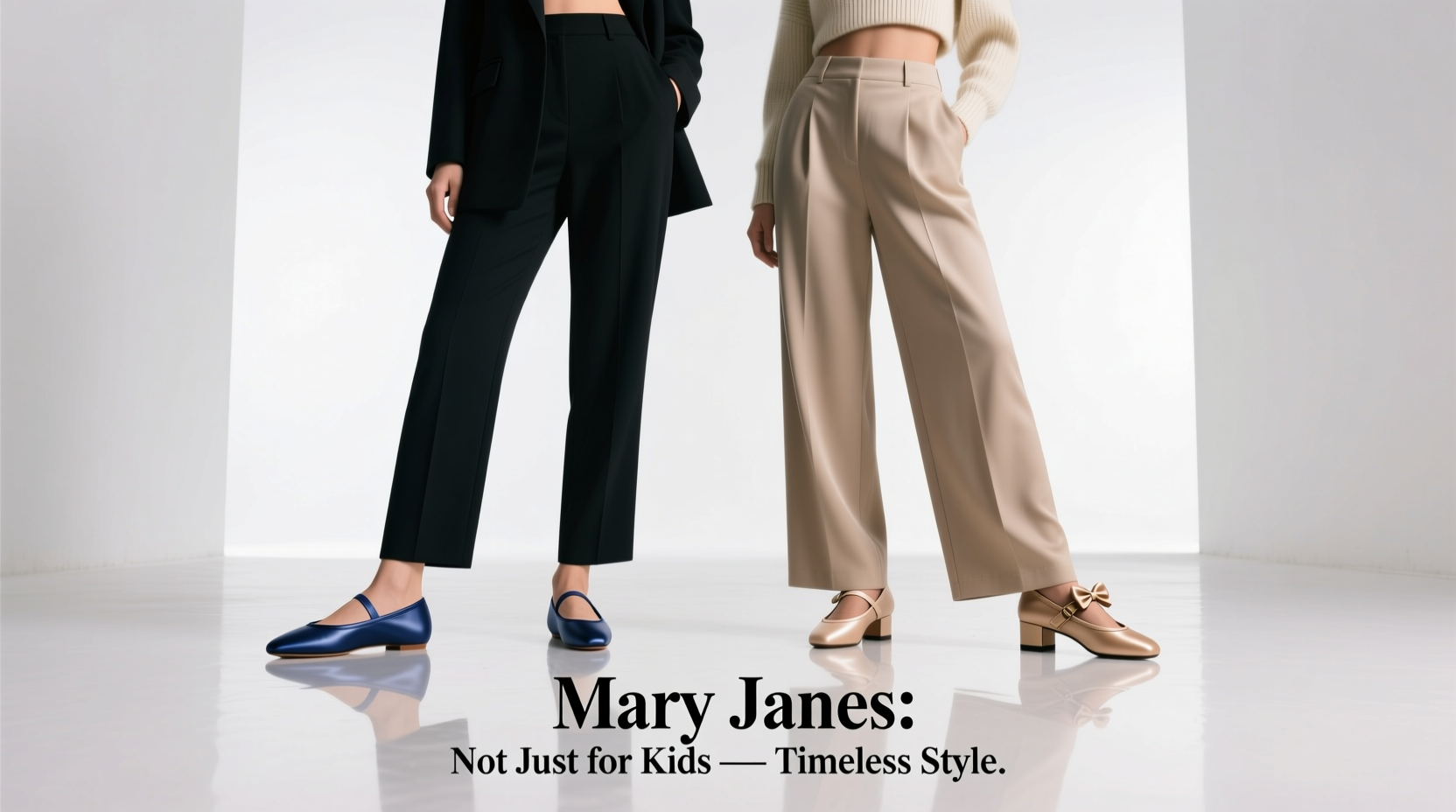
The stigma that Mary Janes are “only for kids” persists—but it’s increasingly outdated. Context is everything. A shiny black patent pair with a rounded toe and thick sole worn with pinafores might lean childish. But a sleek, pointed-toe Mary Jane in matte leather with a 1.5-inch block heel? That’s editorial gold.
Fashion editors at Vogue and Harper’s Bazaar have styled Mary Janes with wide-leg wool trousers, trench coats, and even tailored suits. The key lies in proportion, color, and silhouette. Pairing them with cropped denim and a tucked-in sweater creates a Parisian-inspired look. Worn with a pleated mini dress and sheer tights, they channel Y2K nostalgia with modern edge.
Real Example: Emma’s Style Shift
Emma, a 34-year-old graphic designer in Portland, avoided Mary Janes her entire adult life. “I associated them with Catholic school uniforms,” she says. But after seeing a colleague pair chunky white Mary Janes with cuffed jeans and an oversized blazer, she reconsidered. She bought a minimalist black leather pair with a subtle almond toe. Now, they’re her favorite spring shoe. “They feel more put-together than ballet flats,” she notes. “The strap makes them look intentional.”
When to Choose Ballet Flats vs. Mary Janes
Both styles have their place. Here’s how to decide based on occasion, outfit, and personal needs.
- Ballet flats are best when: You need a polished, neutral shoe for long hours at work, travel, or formal events. They pair seamlessly with pencil skirts, sheath dresses, and business attire.
- Mary Janes shine when: You want to add subtle personality to an outfit. Their structured look works well with vintage-inspired pieces, minimalist tailoring, or alternative fashion.
Checklist: Choosing the Right Flat for Your Lifestyle
- Assess your daily activities—do you walk a lot? Choose Mary Janes for better support.
- Determine your dominant style—classic, edgy, minimalist, romantic.
- Try both styles with your most-worn outfits (jeans, dresses, workwear).
- Look for quality materials—genuine leather molds to your foot over time.
- Consider heel height—even flats vary in elevation from 0.5” to 1.5”.
Debunking the “Too Juvenile” Myth
The idea that certain shoes are “age-appropriate” is one of fashion’s most arbitrary rules. No item of clothing or footwear carries an expiration date based on the wearer’s age. Yet Mary Janes face disproportionate scrutiny. Why?
Part of the bias stems from uniform culture. In many countries, young girls wear strap shoes as part of school dress codes. This repeated association conditions people to link the style with youth. But the same logic could wrongly label loafers or oxfords as “school-only”—which we know isn’t true.
Modern styling breaks these mental barriers. A 2023 trend report from WGSN highlighted “kindercore”—a blend of childlike aesthetics and adult sophistication—as a rising influence in womenswear. Think Mary Janes in deep burgundy velvet with lace socks and a silk slip dress. It’s whimsical yet refined.
“The moment we stop questioning ‘Is this appropriate for my age?’ and start asking ‘Does this express who I am?’ fashion becomes truly liberating.” — Naomi Reed, Stylist & Creative Director
FAQ: Common Questions About Ballet Flats and Mary Janes
Can I wear Mary Janes to the office?
Absolutely—if styled professionally. Choose a closed-toe, low-block version in black, navy, or taupe. Pair with tailored pants or a knee-length skirt. Avoid exaggerated buckles or cartoonish details.
Are ballet flats bad for your feet?
Some models lack arch support, especially ultra-thin ones. If you stand for long periods, consider adding orthotic insoles or alternating with supportive loafers. Mary Janes often provide slightly better stability due to the strap.
Do Mary Janes work with wide feet?
Yes, but fit varies by brand. Look for adjustable straps or elastic side gussets. Brands like Clarks, Naturalizer, and Dear Frances offer wider widths and roomier toe boxes.
Conclusion: Style Has No Age Limit
The comparison between ballet flats and Mary Janes isn’t about superiority—it’s about intention. Ballet flats offer quiet elegance. Mary Janes, when chosen thoughtfully, deliver structure, security, and a touch of character. To dismiss them as childish is to ignore their cultural journey and contemporary reinvention.
Fashion thrives on evolution, not exclusion. Whether you gravitate toward the simplicity of a classic ballerina flat or the defined silhouette of a modern Mary Jane, what matters most is how the shoe makes you feel. Confident? Balanced? Like yourself? That’s the true mark of style.
🚀 Ready to rethink your footwear choices? Try pairing a sophisticated Mary Jane with your next work outfit or weekend look. Share your experience—what did you wear them with, and how did they change your vibe?








