
Long-distance hiking places significant demands on the body, especially the lower back. As trail miles accumulate, even a well-packed load can become a source of discomfort or injury if not properly managed. The choice between a backpack with lumbar support and a regular hiking pack is more than a matter of preference—it’s a decision that impacts endurance, posture, and overall trail experience. While both types serve the fundamental purpose of carrying gear, their design differences lead to vastly different outcomes in comfort and strain reduction over extended use.
Lumbar support isn’t just marketing jargon; it reflects biomechanical engineering aimed at aligning weight transfer with the body’s natural structure. Yet many hikers still opt for traditional packs without considering how spinal loading affects fatigue. This article breaks down the functional distinctions, evaluates performance under real trail conditions, and provides actionable guidance for choosing the right pack based on your hiking goals.
Anatomy of Load Distribution: How Backpacks Interact With the Body
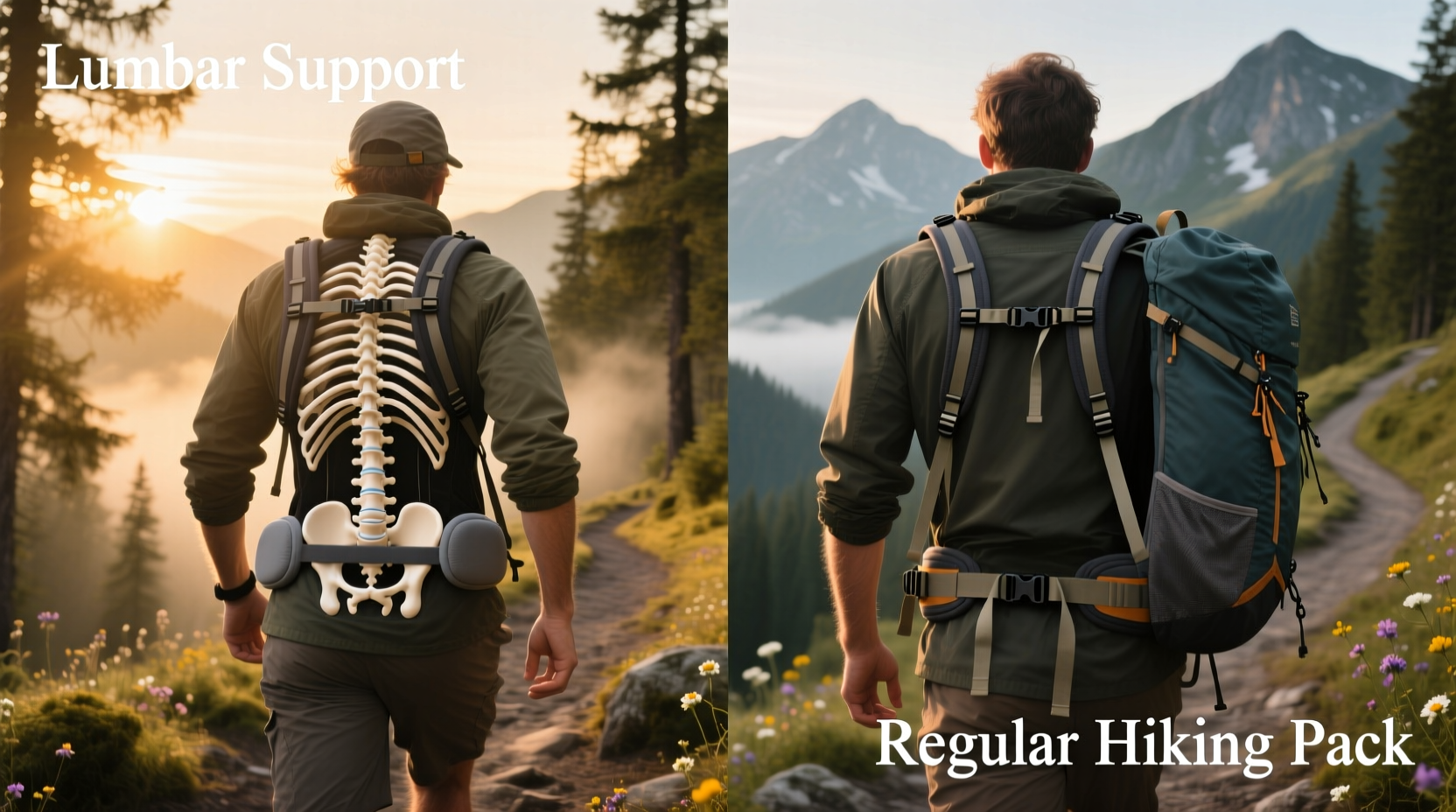
Every backpack applies force to the body, but how that force is distributed determines whether strain accumulates in the shoulders, hips, or spine. A poorly designed system shifts excessive weight onto the shoulders and upper back, leading to rounded posture, restricted breathing, and muscle fatigue. In contrast, effective load transfer channels the bulk of the weight through the hips—the strongest part of the body—while maintaining spinal alignment.
The key lies in the frame and harness system. Internal-frame backpacks, now standard for serious hiking, are built to contour the torso and stabilize cargo close to the body’s center of gravity. However, not all internal frames are created equal. Regular hiking packs often rely on padded shoulder straps and a hip belt alone to manage load, while lumbar-supported models incorporate additional structural elements: rigid or semi-rigid panels, contoured padding, and adjustable tension systems that cradle the lower back.
According to Dr. Lena Torres, a sports physiotherapist specializing in outdoor athletes:
“Proper lumbar engagement reduces shear forces on the intervertebral discs during prolonged ambulation. When a pack supports the natural lordotic curve, it minimizes micro-movements that cause cumulative fatigue.” — Dr. Lena Torres, DPT, Outdoor Performance Clinic
This means that even with identical loads, two packs can produce different physiological responses. One may allow smooth gait mechanics; the other may subtly encourage slouching, increasing energy expenditure and discomfort over time.
Design Differences: Lumbar-Supported vs Regular Hiking Packs
To understand why lumbar support matters, it helps to compare core design features side by side.
| Feature | Lumbar-Supported Pack | Regular Hiking Pack |
|---|---|---|
| Lumbar Padding | Dense, anatomically shaped foam or molded panel supporting lower spine | Minimal or flat padding, primarily for comfort |
| Weight Transfer | Integrated system directing 80–90% of load to hips via stabilized frame | Relies heavily on shoulder straps; hip belt secondary |
| Adjustability | Torso length, lumbar depth, and load-lifter straps often customizable | Limited adjustments; one-size-fits-most approach |
| Mobility & Flexibility | Balanced rigidity for stability without restricting movement | Softer construction may compress under load, shifting center of gravity |
| Typical Use Case | Multi-day hikes, heavy loads (30+ lbs), technical terrain | Day hikes, light overnight trips, urban travel |
The presence of a dedicated lumbar pad does more than cushion—it acts as an anchor point that prevents the pack from swaying or pulling away from the spine. This stabilization reduces muscular effort required to maintain upright posture, particularly on uneven or steep trails where balance is constantly challenged.
Tip: When trying on a pack, lean forward slightly. If the lumbar area stays in contact with your back, the fit is likely correct. Gaps indicate poor load coupling.Real-World Performance: A 7-Day Appalachian Trail Section Test
In 2023, a group of six thru-hiker volunteers conducted a comparative field test across a rugged 85-mile stretch of the Appalachian Trail from Pearisburg, VA to Blacksburg, VA. Each participant carried a base load of 32 pounds and alternated between a high-end lumbar-support pack (Osprey Atmos AG 65) and a standard internal-frame model (a popular mid-tier brand with similar capacity).
Data was collected daily using wearable motion sensors, subjective fatigue logs, and post-hike posture assessments. After seven days, patterns emerged clearly:
- All participants reported earlier onset of lower back fatigue with the regular pack—average onset at mile 12 versus mile 18 with lumbar support.
- Sensor data showed 23% greater lateral sway with the standard pack, indicating instability requiring constant correction.
- Posture analysis revealed increased forward head position and shoulder rounding after three consecutive days with the non-lumbar model.
- On rest days, five of six hikers chose to continue with the lumbar-supported pack despite identical contents.
One participant, Mark R., a physical therapist and weekend backpacker, noted: “I could feel my erector spinae working harder by midday. With the supported pack, the weight felt ‘planted’ rather than ‘dragging.’”
This case illustrates that while both packs were technically functional, only the lumbar-integrated design consistently reduced strain over sustained use. For long trails, consistency in comfort directly correlates with injury prevention and completion rates.
When a Regular Hiking Pack Might Suffice
Lumbar support offers clear advantages, but it’s not always necessary. For shorter excursions or lighter loads, the added structure and cost may be overkill. A regular hiking pack performs adequately under specific conditions:
- Day hikes under 10 miles with minimal gear (water, snacks, rain jacket)
- Urban or suburban backpacking where terrain is predictable and elevation gain limited
- Travelers prioritizing packability who value compact storage over load-bearing performance
- Hikers with naturally strong core musculature who compensate biomechanically for suboptimal load distribution
However, these scenarios assume ideal conditions. Add variables like heat, humidity, off-trail navigation, or unexpected gear additions (e.g., extra water in dry zones), and the margin for error shrinks. Even moderate loads (20–25 lbs) become taxing when carried inefficiently over eight hours.
Moreover, aging hikers or those with prior back issues often report disproportionate discomfort with standard packs. As core strength declines with age, reliance on equipment to maintain proper alignment increases. A study published in the *Journal of Wilderness Medicine* found that hikers over 50 experienced 40% less lower back pain when using anti-gravity suspension systems compared to conventional designs.
Choosing the Right Pack: A Step-by-Step Decision Guide
Selecting between a lumbar-supported and regular hiking pack should follow a deliberate process. Here’s how to make an informed decision:
- Assess your typical trip length and load. If you regularly carry more than 20 pounds or hike beyond 15 miles per day, prioritize lumbar support.
- Measure your torso length accurately. Use a flexible tape measure from C7 vertebra (base of neck) to iliac crest (top of hip bones). Compare this to manufacturer sizing charts.
- Test fit with weight. Don’t judge comfort empty. Load the pack with 15–20 lbs and walk on an incline if possible. Pay attention to pressure points and stability.
- Evaluate adjustability. Look for load-lifter straps, sternum strap height adjustment, and lumbar depth control. These fine-tune fit and performance.
- Check return policies. Many outdoor retailers offer 30-day trial periods. Take advantage of them—real-world testing trumps showroom feel.
Remember: no pack eliminates fatigue entirely. But the best ones redistribute it efficiently, preserving energy for the journey ahead.
Tip: Rotate shoulder strap usage occasionally during breaks to prevent unilateral strain—even with excellent load transfer, minor imbalances can accumulate.Frequently Asked Questions
Does lumbar support make a difference on flat terrain?
Yes. While elevation changes amplify strain, flat or rolling terrain still involves thousands of steps. Repetitive motion magnifies inefficiencies in load distribution. Lumbar support maintains consistent alignment, reducing cumulative micro-fatigue even without steep climbs.
Can I add lumbar support to a regular pack?
Not effectively. Aftermarket pads exist, but they don’t integrate with the frame or load-transfer system. True lumbar support requires structural synergy between the back panel, hip belt, and shoulder harness. Retrofit solutions often create pressure points without improving biomechanics.
Are lumbar-supported packs heavier?
Slightly. The added materials typically increase base weight by 6–12 ounces. However, this is offset by improved efficiency—users expend less energy stabilizing the load, resulting in net energy savings over distance.
Final Recommendations and Action Plan
If your hiking goals include multi-day treks, high-mileage sections, or carrying substantial gear, investing in a backpack with dedicated lumbar support is not optional—it’s essential. The initial cost is outweighed by long-term benefits: reduced injury risk, enhanced endurance, and greater enjoyment on the trail.
For casual day hikers or those exploring paved trails, a quality regular hiking pack remains sufficient. But as soon as trip complexity increases, upgrade considerations should begin.
Here’s what to do next:
- Inventory your current gear. Weigh your typical loaded pack. If it exceeds 20 lbs, start researching lumbar-integrated models.
- Schedule a fitting. Visit a specialty outdoor retailer and request a loaded fit test. Bring your own layers to simulate real conditions.
- Read user reviews focused on long-term comfort. Look beyond aesthetics and capacity—search for feedback on \"lower back pain,\" \"all-day wear,\" and \"load stability.\"
- Consider rental options. Some outfitters rent premium packs. Test an Osprey, Deuter, or Hyperlite model on a weekend trip before buying.
“The right pack doesn’t just carry your gear—it carries you.” — Sarah Lin, Long-Distance Thru-Hiker, Pacific Crest Trail Record Holder
Conclusion
The debate between backpacks with lumbar support and regular hiking packs isn't about luxury versus simplicity—it's about sustainability versus strain. On long trails, where every step counts and recovery time is limited, equipment choices directly influence physical resilience. A pack that actively supports the lower back isn’t a gimmick; it’s a tool of ergonomic intelligence, designed to harmonize with human anatomy under duress.
Whether you're preparing for your first thru-hike or reevaluating gear after years of weekend trips, take a critical look at how your current pack distributes weight. Small improvements in fit and function can transform a grueling trek into a sustainable adventure. Your back will thank you mile after mile.
🚀 Ready to upgrade your trail experience? Share your pack preferences or ask questions in the comments—let’s build a smarter hiking community together.








