
Sitting for extended periods has become a norm in modern work culture, especially with the rise of remote and hybrid jobs. While convenient, long hours at a desk often come at a cost: chronic back pain. The spine wasn't designed to remain static for hours on end. Poor posture, weak core muscles, and tight hip flexors compound the issue, leading to discomfort that can reduce productivity and overall well-being.
The good news is that relief doesn’t require drastic changes. Simple, intentional movements throughout the day can counteract the effects of prolonged sitting. Incorporating targeted stretches into your routine—even while seated or standing at your workspace—can dramatically reduce lower back strain, loosen stiff muscles, and restore mobility. These aren’t time-consuming exercises; they’re practical interventions you can perform without leaving your desk.
Below are five evidence-based stretches proven to alleviate back pain caused by sedentary work. Each targets key muscle groups affected by sitting: the lower back, glutes, hip flexors, hamstrings, and spinal erectors. Done consistently, they can help reset your posture, improve circulation, and prevent long-term musculoskeletal issues.
Why Sitting Causes Back Pain
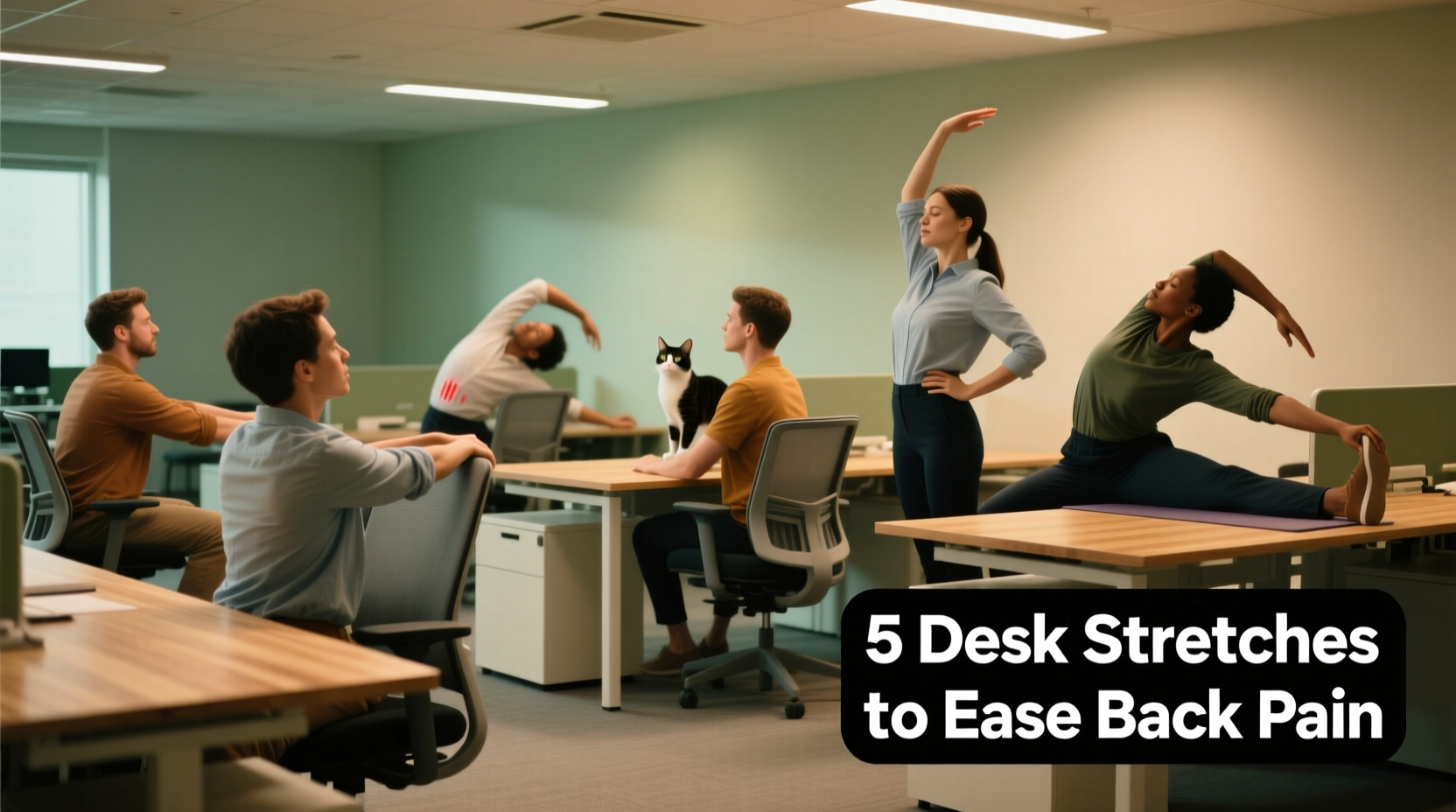
When you sit, your hips flex and your pelvis tilts backward, flattening the natural curve of the lumbar spine. This position increases pressure on the intervertebral discs by up to 40% compared to standing. Over time, this compressive load contributes to disc degeneration and nerve irritation.
Additionally, sitting shortens the hip flexor muscles (like the psoas and iliacus), which pull on the lower spine when tight. Simultaneously, the gluteal muscles—critical for pelvic stability—become underused and weakened. This imbalance creates what physical therapists call “lower crossed syndrome,” a common postural dysfunction linked to chronic low back pain.
“Prolonged sitting alters muscle length-tension relationships and disrupts neuromuscular control. Regular stretching helps restore balance and reduces mechanical stress on the spine.” — Dr. Lena Patel, DPT, Board-Certified Orthopedic Specialist
The solution isn’t just to stand more (though that helps). It’s to actively engage opposing muscle groups through stretching, creating dynamic support for the spine throughout the day.
5 Essential Desk Stretches for Back Pain Relief
The following stretches are specifically chosen for their effectiveness, ease of execution, and minimal space requirements. Perform each stretch 2–3 times daily—especially after sitting for more than 60 minutes—to maintain spinal health.
1. Seated Forward Bend (Hamstring & Lower Back Release)
Tight hamstrings pull on the sit bones, increasing strain on the lower back during sitting. This gentle forward fold elongates the posterior chain while promoting spinal decompression.
Tip: Keep your back straight as you hinge forward. Avoid rounding your spine by leading with your chest, not your head.- Sit at the edge of your chair with feet flat on the floor, legs slightly apart.
- Inhale and lengthen your spine, lifting the crown of your head toward the ceiling.
- Exhale and slowly hinge forward from the hips, reaching your hands toward your toes.
- Stop when you feel a mild stretch along the back of your legs or lower back—do not force it.
- Hold for 20–30 seconds, breathing deeply. Return slowly to upright.
Repeat 2–3 times. If you can’t reach your toes, let your hands rest on your shins or thighs—flexibility improves over time.
2. Chair Spinal Twist (Spinal Mobility & Glute Release)
This rotation mobilizes the thoracic and lumbar spine while releasing tension in the glutes and piriformis—common sources of referred back pain.
- Sit tall with both feet flat and knees aligned with hips.
- Place your right hand on the outside of your left thigh.
- Place your left hand on the armrest or behind you for leverage.
- Inhale to lengthen your spine, then exhale and gently twist to the left.
- Keep hips facing forward; only your upper body should rotate.
- Hold for 20–30 seconds, then switch sides.
This stretch also massages internal organs and improves breathing mechanics by freeing up rib cage movement.
3. Hip Flexor Stretch in Standing Position
Tight hip flexors from sitting tilt the pelvis anteriorly, increasing lumbar lordosis and compressing vertebrae. This stretch counters that imbalance.
- Stand and step your right foot back about 12–18 inches.
- Bend your left knee and lower your right hip forward and down.
- Keep your torso upright and tuck your pelvis slightly to intensify the stretch.
- You should feel tension in the front of your right hip and thigh.
- Hold for 30 seconds, then switch legs.
4. Cat-Cow Stretch (Dynamic Spinal Articulation)
This rhythmic movement restores fluid motion between vertebrae, lubricates spinal joints, and activates deep stabilizing muscles.
- Stand in front of your chair and place your hands on the seat at shoulder height.
- Step back until your body forms a straight diagonal line from head to heels.
- Inhale: Drop your belly, lift your head and tailbone (Cow Pose).
- Exhale: Round your spine upward, tucking your chin and pelvis (Cat Pose).
- Move slowly and deliberately for 1 minute, syncing breath with motion.
If standing is difficult, perform this seated: inhale to arch your back slightly, exhale to round it.
5. Figure-Four Stretch (Piriformis & Glute Activation)
The piriformis muscle runs deep in the buttocks and can irritate the sciatic nerve when tight. This stretch targets that area directly.
- Sit upright in your chair.
- Cross your right ankle over your left thigh, just above the knee.
- Flex your right foot to protect the knee joint.
- Gently press down on your right thigh to deepen the stretch in your right buttock.
- Hold for 25–30 seconds, then switch sides.
If you feel no stretch, lean forward slightly while keeping your back straight. This variation combines hip external rotation with a mild forward fold.
Maximizing Effectiveness: A Daily Routine Checklist
To get lasting results, consistency matters more than intensity. Use this checklist to integrate stretching into your workday seamlessly.
✅ Daily Desk Stretching Checklist
- Perform at least 3 of the 5 stretches every workday
- Set hourly reminders to stand and move for 1–2 minutes
- Stretch after long meetings or phone calls
- Combine stretches with deep breathing for enhanced relaxation
- Track improvements in flexibility and pain levels weekly
- Pair with ergonomic adjustments (chair height, monitor level)
- Avoid holding stretches beyond 30 seconds initially
Common Mistakes to Avoid
Even well-intentioned stretching can backfire if done incorrectly. Below is a summary of frequent errors and how to correct them.
| Mistake | Why It’s Harmful | How to Fix It |
|---|---|---|
| Bouncing during stretches | Triggers muscle guarding and may cause micro-tears | Use smooth, static holds instead of ballistic motions |
| Holding breath | Increases tension and reduces oxygen to muscles | Breathe deeply and rhythmically throughout |
| Overarching the lower back | Compresses lumbar vertebrae and strains discs | Engage core and tuck pelvis slightly when needed |
| Skipping warm-up | Cold muscles are less pliable and more prone to injury | Do light movement (shoulder rolls, ankle circles) first |
| Ignoring pain signals | Pain indicates tissue stress; pushing through risks injury | Stretch only to mild tension, never sharp pain |
Real-World Example: How Sarah Reduced Her Back Pain in Two Weeks
Sarah, a 34-year-old software developer, began experiencing persistent lower back pain after transitioning to full-time remote work. She sat 9–10 hours daily, often skipping breaks. After two months, her discomfort escalated to radiating tingling down her right leg—signs of early sciatica.
Her physical therapist recommended the five stretches outlined here, along with hourly movement breaks. Sarah set calendar alerts and used her lunch break to repeat the full sequence. Within seven days, she noticed reduced stiffness upon waking. By day 14, her leg tingling had subsided, and she reported a 70% drop in daily pain levels.
“I didn’t think something so simple could make such a difference,” Sarah said. “Now I do the twists and hip flexor stretch during every coffee break. My posture feels stronger, and I’m more aware of how I sit.”
Frequently Asked Questions
How often should I stretch if I sit all day?
For optimal results, stretch at least 2–3 times per workday—morning, midday, and late afternoon. Even 5 minutes per session can prevent cumulative strain. Setting recurring alarms ensures consistency.
Can these stretches help with sciatica symptoms?
Yes, particularly the figure-four and seated forward bend, which release the piriformis and hamstrings—both common contributors to sciatic nerve compression. However, if symptoms persist or worsen, consult a healthcare provider.
Is it better to stretch before or after exercise?
These are primarily recovery-focused stretches for sedentary strain. For pre-workout routines, dynamic movements (leg swings, torso circles) are preferred. Save static stretches like these for post-sitting or post-exercise cooldowns.
Final Thoughts: Small Movements, Lasting Impact
Back pain from sitting isn’t inevitable—it’s a signal from your body asking for movement. The stretches listed here are not quick fixes but foundational habits that build resilience over time. They require no special equipment, take minimal time, and can be performed anywhere with a sturdy chair.
What matters most is regularity. Just as poor posture develops gradually, so too does improved alignment and strength. By integrating these five stretches into your daily rhythm, you reclaim control over your physical comfort and long-term spinal health.
💬 Start today: Pick one stretch and do it after your next meeting. Then add another tomorrow. Your back will thank you—not just now, but years down the road.








