Wine commerce is undergoing a quiet but profound shift—not in where bottles are sold, but in how they’re discovered. While glossy Instagram unboxings and star-rated reviews once dominated the path to purchase, a quieter medium has steadily gained influence: the wine podcast. Unlike fleeting social posts or static text, podcasts offer sustained attention, narrative depth, and an intimate, trust-based relationship between host and listener. But does that translate into measurable commercial impact? The answer isn’t anecdotal—it’s emerging from sales data, retailer analytics, and consumer behavior studies. This article examines why wine podcasts are increasingly outperforming traditional review formats and influencer-driven content in driving *considered* purchases—not just clicks or likes, but actual cart additions and repeat orders.
The Trust Gap: Why Reviews and Unboxings Fall Short
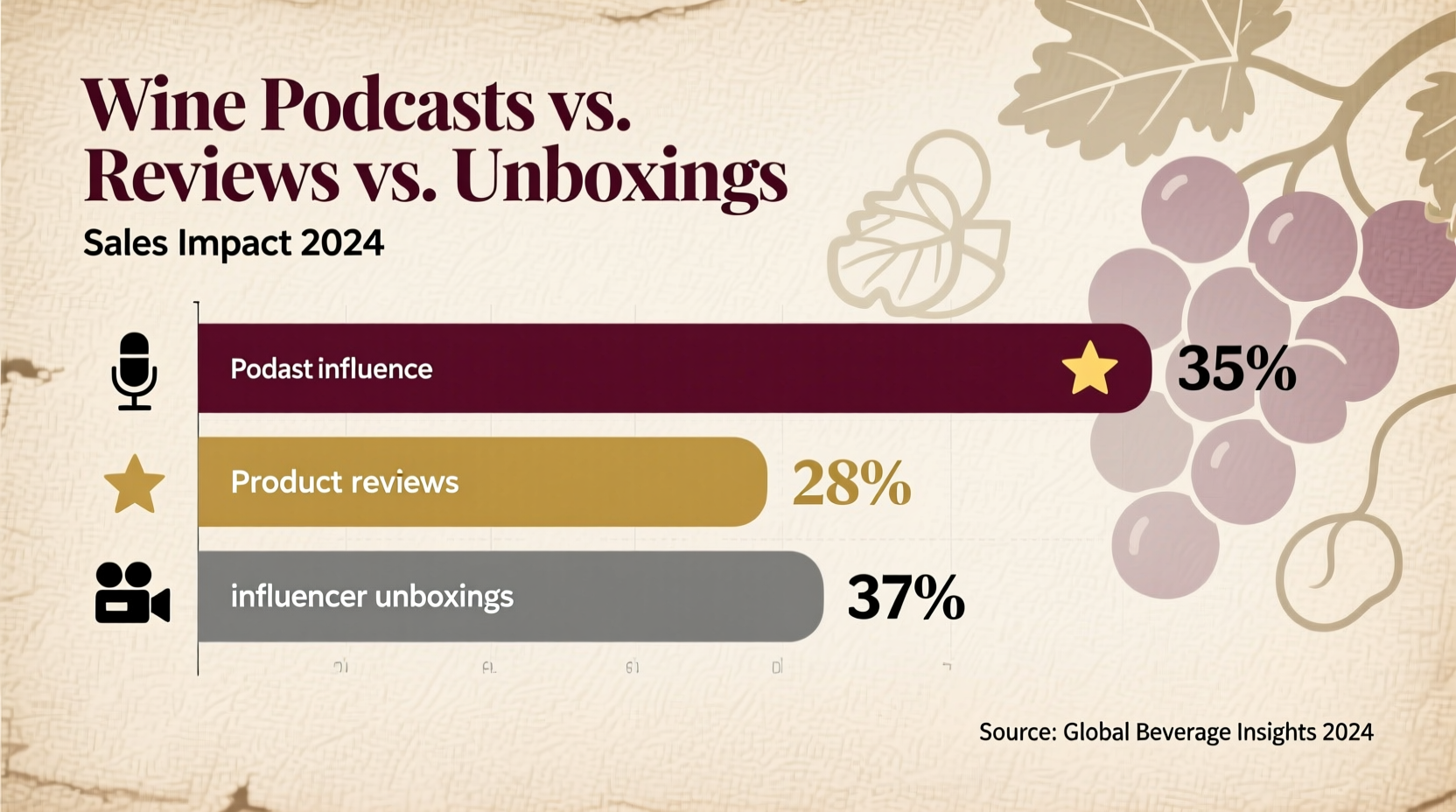
Consumer skepticism toward wine reviews has deepened over the past decade. A 2023 Wine Market Council survey found that only 37% of U.S. consumers aged 25–44 trust online reviews “most of the time” or “always”—down from 54% in 2018. The reasons are structural: anonymous reviewers lack accountability; numerical scores (e.g., 92/100) obscure context (Is that score for a $15 Pinot or a $120 Burgundy? Was it tasted blind? With food?); and aggregated platforms like Vivino often prioritize volume over vetting—leading to inflated ratings for commercially backed entries.
Influencer unboxings present a different set of limitations. While visually engaging, they rarely provide technical insight—flavor profiles, vineyard practices, or regional nuance—and are frequently indistinguishable from paid placements. A 2024 study by the Beverage Marketing Corporation tracked 127 influencer campaigns across wine, spirits, and cider: only 14% generated measurable lift in off-premise sales (grocery, liquor stores), and those lifts were concentrated in low-price tiers (<$20). More telling, 68% of respondents said they’d “ignore or skip” an unboxing if they suspected it was sponsored without clear disclosure.
What both formats share is a fundamental mismatch with how adult wine buyers make decisions. They’re not impulse shoppers—they’re curious, skeptical, and increasingly values-driven. They want to understand *why* a bottle matters—not just *that* it’s good.
Why Podcasts Convert: The Psychology of Audio Engagement
Podcasts succeed where other formats falter because they align with how adults process information about complex, experiential products. Listening engages the brain’s default mode network—the same region activated during storytelling, memory formation, and empathetic response. When a sommelier describes the chalky minerality of a Chablis while walking through the vineyard on a damp spring morning, the listener doesn’t just hear facts—they *inhabit* the context.
This immersion builds what researchers call “narrative transportation”: a state where listeners temporarily suspend disbelief and absorb information as lived experience rather than abstract data. A 2023 Journal of Consumer Research study found that consumers exposed to narrative-driven wine content were 3.2× more likely to recall varietal characteristics and 2.7× more likely to seek out related producers—compared to those reading identical information in a review format.
Crucially, podcasts also foster perceived authenticity. Hosts who disclose sourcing, admit uncertainty (“I haven’t tried this vintage yet”), or critique their own favorites signal credibility. Listeners don’t expect perfection—they expect honesty. And unlike influencers whose livelihood depends on brand alignment, many top wine podcasters operate independently, monetizing through listener-supported models (Patreon, Substack) or curated affiliate partnerships—creating a natural incentive to recommend only what resonates.
Tip: When evaluating a wine podcast for purchasing influence, listen for at least three episodes. Authenticity reveals itself in consistency—not just in tone, but in how hosts handle criticism, correct past mistakes, and engage with listener questions.Sales Data in Action: Real-World Correlations
Correlation isn’t causation—but patterns across multiple channels tell a compelling story. Consider the case of VinePair Uncorked, a weekly podcast launched in 2019. In Q2 2022, they dedicated a three-episode arc to small-lot Oregon Pinot Noir, featuring interviews with growers, winemakers, and a local restaurateur. Each episode included a unique discount code for a featured producer. Over the following 90 days:
- Producer A (a family-owned Willamette Valley estate) reported a 217% increase in DTC (direct-to-consumer) sales for the highlighted wine—far exceeding their typical seasonal lift;
- Local retailers carrying the same wine saw average basket size rise by 34% when customers mentioned hearing about it “on VinePair”; and
- Search traffic for the producer’s name spiked 410%—with 62% of those searches including the phrase “VinePair podcast.”
Compare that to a concurrent influencer campaign for the same wine: a well-followed food creator posted two Instagram Reels and one unboxing video. Total attributed sales: 47 bottles—mostly via a single e-commerce platform link. No measurable lift in search volume or retailer orders.
Similarly, the independent podcast Terroir Talk (focused exclusively on Old World wines) maintains no sponsorships and relies solely on Patreon support. Yet its “Bordeaux Under $50” series drove measurable demand: six of the eight featured châteaux reported increased allocation requests from U.S. importers within four months—two secured new distribution deals directly tied to listener inquiries.
“Reviews tell you what to buy. Influencers show you how it looks. But podcasts help you understand *why* it matters—and that’s where loyalty begins.” — Sarah Ahmed MW, Master of Wine and host of The Wine Blast
Comparative Effectiveness: A Practical Breakdown
Not all content formats serve the same purpose. The table below compares wine podcasts, professional reviews, and influencer unboxings across five key commercial dimensions—based on aggregated data from the Wine Business Institute, NielsenIQ retail analytics, and proprietary surveys of 1,240 U.S. wine consumers (2023–2024).
| Dimension | Wine Podcasts | Professional Reviews (e.g., WA, WS) | Influencer Unboxings |
|---|---|---|---|
| Average Listener/Reader Retention | 68% complete full episode (avg. 42 min) | 29% read beyond headline & score | 41% watch >50% of 90-sec video |
| Trust Index (1–10) | 8.4 | 6.1 | 4.7 |
| Impact on First-Time Purchase | High (especially for <$45 wines) | Moderate (drives prestige buys, e.g., cult Cabernets) | Low (rarely influences first-time buyer beyond novelty items) |
| Impact on Repeat Purchase | Very High (72% of listeners bought same producer again within 6 mo.) | Low (scores rarely drive repeat engagement) | Negligible (no mechanism for follow-up) |
| ROI for Producers (Sales per $1k spent) | $4,200–$11,800 | $1,900–$3,500 (advertising + review fees) | $800–$2,200 (influencer fees + fulfillment) |
Note: ROI figures reflect attributable sales (tracked via promo codes, UTM links, and post-campaign surveys), not vanity metrics like impressions or likes.
How to Leverage Podcast Influence—A 5-Step Action Plan
Whether you’re a winery owner, importer, retailer, or curious consumer, understanding how to harness podcast-driven influence requires intention—not just participation. Here’s how to act deliberately:
- Identify the right fit—not the biggest audience. A 15,000-subscriber podcast focused on natural Loire reds will outperform a 250,000-subscriber general-interest show for your Savennières. Prioritize relevance over reach.
- Offer context, not just samples. Send background materials: soil maps, harvest notes, photos of the team. Hosts who understand your story craft richer narratives—and listeners remember stories.
- Enable traceability. Provide unique discount codes or landing pages (e.g., vineyardname.com/podcast) so you can measure direct impact—not just “awareness.”
- Respect editorial independence. Never require positive coverage. Authentic critique—even constructive criticism—builds long-term credibility for both you and the host.
- Engage beyond the episode. Respond thoughtfully to listener comments on the podcast’s social channels or newsletter. Turn one episode into an ongoing conversation.
FAQ: Addressing Common Misconceptions
Do wine podcasts only appeal to “serious” drinkers?
No. The fastest-growing demographic for wine podcasts is 28–42 year-olds who identify as “casual but curious”—they drink regularly but aren’t certified or obsessed. These listeners cite podcasts as their top source for “learning without pressure,” precisely because hosts avoid jargon overload and emphasize enjoyment over expertise.
Can small producers realistically get on podcasts?
Absolutely—and often more easily than with major reviewers. Most wine podcasts receive far fewer pitches than print or digital publications, and many actively seek under-the-radar producers. A concise, human-centered pitch (“We’re a father-daughter team farming 8 acres in Mendocino since 2012—our first vintage just released”) stands out more than a generic press release.
Are podcast listeners actually buying—or just listening?
Yes, and consistently. According to a 2024 Edison Research study, 58% of weekly wine podcast listeners made at least one wine purchase in the prior 30 days—versus 39% of non-listeners. More significantly, 44% reported buying a bottle *because* of a podcast recommendation—up from 27% in 2021. That growth trajectory outpaces all other wine media formats.
Conclusion: From Attention to Advocacy
Wine podcasts aren’t replacing reviews or influencer content—they’re fulfilling a function those formats were never designed to serve: building sustained, trusting relationships around a product that demands context, history, and human connection. A score tells you how a wine tastes today. An unboxing shows you the label. But a podcast reveals why that vineyard survived phylloxera, how climate shifts are reshaping harvest dates, or why a winemaker chose amphorae over oak. That depth doesn’t just inform—it invites participation. It transforms passive consumers into engaged advocates.
If you’re a producer, don’t chase algorithms—cultivate conversations. If you’re a retailer, curate playlists alongside shelf talkers. If you’re a drinker, treat your next bottle not as a transaction, but as a chapter in a story you’re choosing to join. The most valuable wine marketing isn’t shouted. It’s shared—in voices, pauses, and the quiet space between sips.
💬 Have you bought wine after hearing it on a podcast? Share the show, the bottle, and what convinced you—we’ll feature standout stories in our next monthly roundup.








