Weightlifting belts are a common sight in gyms, powerlifting meets, and even home workout spaces. They’re often associated with heavy lifts and elite athletes, but as more people build home gyms and take strength training seriously, the question arises: do you actually need a belt if you're not a professional? Or worse—could relying on one too soon do more harm than good?
The answer isn’t a simple yes or no. It depends on your goals, experience level, the exercises you perform, and how you train. While belts can offer real benefits under certain conditions, they’re frequently misunderstood and misused—even by experienced lifters. This article breaks down the science, practical applications, and misconceptions surrounding weightlifting belts, helping you decide whether one belongs in your home gym setup.
How Weightlifting Belts Work: The Science Behind Intra-Abdominal Pressure
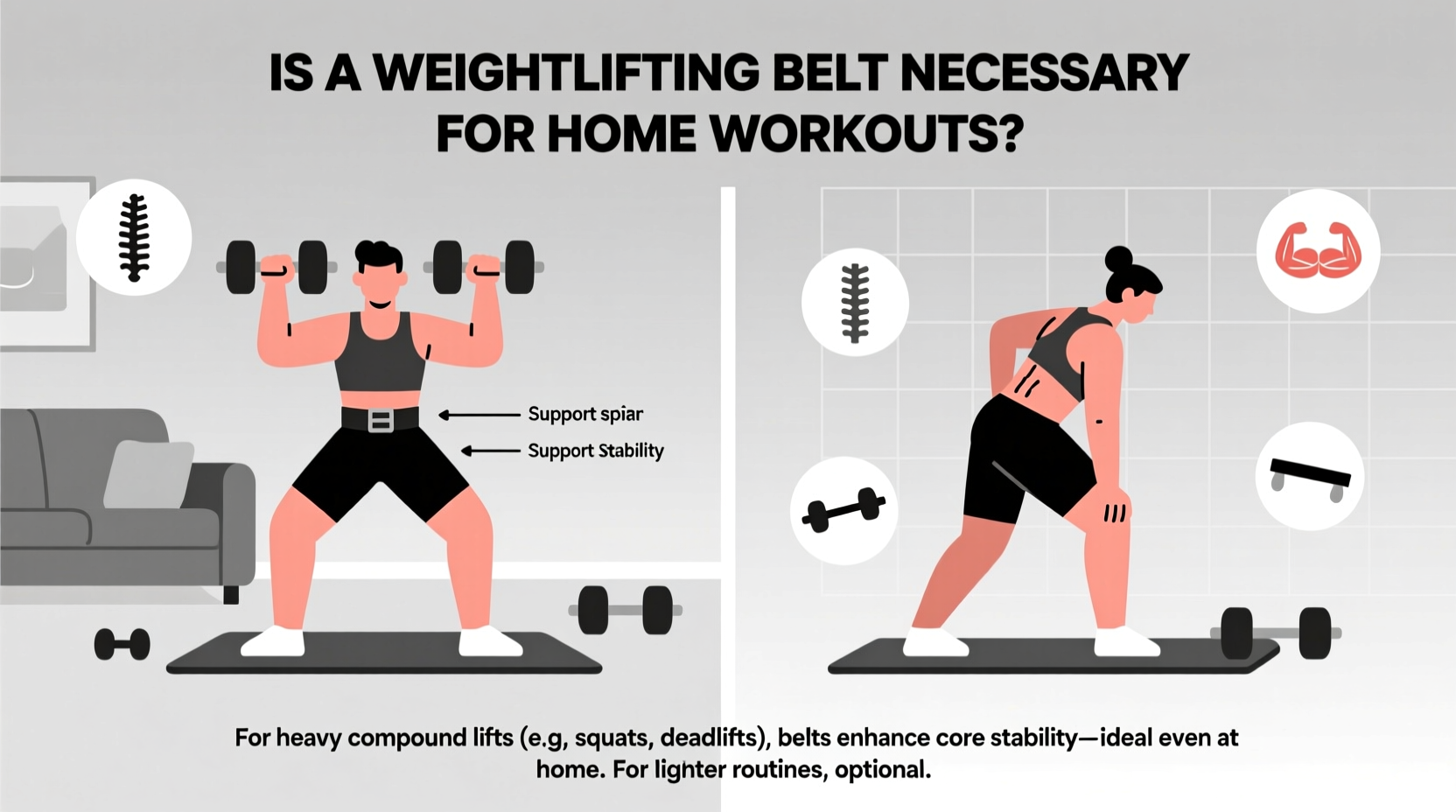
A weightlifting belt doesn’t physically support your spine like a back brace. Instead, its primary function is to enhance intra-abdominal pressure (IAP). When you brace your core during a heavy lift—by taking a deep breath and tightening your abdominal muscles—the belt provides external resistance against which your abs push. This creates a rigid cylinder around your spine, stabilizing it and reducing shear forces during movements like squats and deadlifts.
Research supports this mechanism. A 1990 study published in the Journal of Strength and Conditioning Research found that wearing a belt increased IAP by up to 30–40% during maximal lifts, leading to reduced compressive forces on the lumbar spine. However, the same study emphasized that the benefit is maximized only when the lifter knows how to properly brace their core.
“Belts amplify what your body already does—they don’t replace proper bracing technique.” — Dr. Stuart McGill, Spine Biomechanics Expert
This distinction is crucial. A belt won’t protect you from injury if you don’t know how to engage your core correctly. In fact, relying on a belt before mastering bracing may hinder long-term development of trunk stability.
Who Actually Benefits From a Weightlifting Belt?
Not all lifters need a belt. The decision should be based on training intensity, exercise selection, and individual biomechanics—not ego or aesthetics.
Powerlifters and competitive strength athletes typically use belts because they regularly lift near-maximal loads (above 85% of their one-rep max). For these individuals, a belt can improve performance by allowing greater force output and confidence under heavy weights.
Intermediate to advanced lifters training at high intensities—especially in compound lifts like low-bar back squats, deadlifts, and overhead presses—may also benefit. If you’ve been training consistently for 1–2 years and are progressing into heavier weight ranges, a belt could help maintain form and reduce fatigue over multiple sets.
Beginners and general fitness enthusiasts, however, rarely need a belt. Most home workout routines involve moderate loads, bodyweight exercises, or machines that don’t place extreme stress on the spine. Introducing a belt too early can lead to dependency and weaken natural core activation patterns.
Tip: Wait until you can squat or deadlift 1.5x your bodyweight with perfect form before considering a belt.When Should You Use a Belt at Home?
Home gyms vary widely—from basic setups with dumbbells to full racks and platforms. Whether a belt makes sense depends on what you're doing, not where you're doing it.
If your home workouts focus on hypertrophy, endurance, or functional training with lighter loads, a belt adds little value. But if you’re following a structured strength program like Starting Strength, StrongLifts 5x5, or Westside Barbell derivatives—and lifting progressively heavier—you might reach a point where spinal stability becomes a limiting factor.
In such cases, using a belt selectively—only on your heaviest sets of squats, deadlifts, or clean pulls—can be beneficial. The key word is *selectively*. Wearing a belt on every set, including warm-ups, prevents your core from learning to stabilize independently.
Real Example: Sarah’s Home Gym Progression
Sarah started her fitness journey with bodyweight circuits and light dumbbell work. After six months, she added a barbell and began following a linear progression program. Her squat climbed from 95 lbs to 185 lbs over nine months. At first, she felt strong and stable. But once she hit 205 lbs, she noticed her lower back rounding slightly at the bottom of the lift, despite good form.
She consulted a coach, who assessed her bracing technique and confirmed she was engaging her core properly. Given her load-to-bodyweight ratio and consistent training history, the coach recommended trying a 10mm leather belt for her top sets only. Within two weeks, Sarah reported feeling more locked-in and confident during heavy squats, with no loss of core engagement on lighter days.
This case illustrates a responsible, evidence-based approach: delaying belt use until needed, ensuring technical proficiency first, and applying it strategically.
Common Misconceptions About Weightlifting Belts
Misinformation about belts abounds online. Here are some myths that deserve clarification:
- Myth: Belts prevent back injuries. While they increase spinal stability, they don’t eliminate risk. Poor form, excessive loading, or lack of mobility can still cause injury—even with a belt.
- Myth: Belts weaken your core. This is partially true if used incorrectly. Wearing a belt constantly without engaging your abs can reduce neuromuscular activation. But when used appropriately—as an aid during maximal efforts—it complements core strength rather than replacing it.
- Myth: All belts are the same. Belts vary in width, thickness, material, and stiffness. Powerlifting belts are typically 10–13mm thick and uniform in width (4” back, 2” front), while Olympic lifting belts are curved and slightly flexible. Choosing the wrong type can affect comfort and effectiveness.
Do’s and Don’ts of Belt Use
| Do’s | Don’ts |
|---|---|
| Use only on heavy compound lifts (≥80% 1RM) | Wear it for every exercise, including curls or lunges |
| Learn proper diaphragmatic bracing first | Rely on the belt instead of bracing technique |
| Position the belt just above the hips, covering the lower abs | Place it too high under the ribcage or too low on the pelvis |
| Snug but not restrictive—should allow deep breathing | Tighten so much it restricts movement or causes discomfort |
| Take it off between sets to re-engage core muscles | Leave it on throughout your entire workout |
Step-by-Step Guide: How to Use a Weightlifting Belt Correctly
If you decide a belt is right for your training, follow this sequence to maximize benefit and minimize risk:
- Master bracing without a belt. Practice drawing air into your belly (not chest), then contracting your entire midsection as if preparing for a punch. Hold this tension while exhaling slowly. Perform this during planks, squats, and deadlifts.
- Choose the right belt. For home strength training, a 10mm leather powerlifting belt with double-prong buckle offers durability and support. Avoid cheap neoprene or Velcro belts—they provide minimal resistance.
- Position the belt properly. Place it around your waist, centered over the obliques and just above the iliac crest (top of hip bones). It should cover the area where your abs naturally tighten during a Valsalva maneuver.
- Secure snugly—but breathe. Fasten the buckle so the belt holds firm but doesn’t limit diaphragmatic expansion. You should still be able to take a full breath.
- Brace into the belt before lifting. Take a deep breath, expand your abdomen 360 degrees, and push outward into the belt. Maintain this tension throughout the rep.
- Remove between sets. Allow your core to reset and re-engage naturally. This maintains motor control and prevents reliance.
Alternatives to Belts: Building Natural Core Stability
Before investing in a belt, consider strengthening your body’s innate stabilizing systems. A robust core reduces the need for external aids and improves overall athleticism.
Include these exercises in your routine 2–3 times per week:
- Dead bugs – Teach anti-extension control.
- Plank variations – Build endurance in the anterior core.
- Farmers carries – Develop lateral stability and grip endurance.
- Ab wheel rollouts – Challenge full-range core engagement.
- Overhead pressing (with dumbbells or barbell) – Forces constant core bracing under load.
These movements train your body to create stability from within—something no belt can replicate. Over time, this leads to safer, more efficient lifting, regardless of equipment.
FAQ: Common Questions About Weightlifting Belts
Can a weightlifting belt help with lower back pain?
Not directly. While a belt may reduce spinal loading temporarily, it won’t fix underlying issues like poor posture, muscle imbalances, or technique flaws. If you experience chronic back pain, consult a physical therapist before adding a belt. In some cases, over-reliance on a belt can mask compensations and delay recovery.
Should women use weightlifting belts differently?
No. The biomechanics of bracing and intra-abdominal pressure are the same regardless of gender. However, some women prefer slightly narrower or contoured belts for comfort due to pelvic structure. Functionally, usage guidelines remain identical.
Is it bad to wear a belt every time I lift?
Yes, if done consistently. Chronic belt use on submaximal loads may reduce proprioception and core activation over time. Reserve the belt for heavy sets (85%+ of 1RM) and prioritize unaided stability work on lighter days.
Checklist: Is a Weightlifting Belt Right for You?
Answer the following questions honestly before purchasing or using a belt:
- ✅ Have you been training with proper form for at least 1 year?
- ✅ Can you perform squats and deadlifts with 1.5x your bodyweight safely?
- ✅ Do you understand how to brace your core using the Valsalva maneuver?
- ✅ Are you lifting heavy enough that spinal fatigue becomes noticeable?
- ✅ Will you use the belt selectively, not as a crutch?
If you answered “no” to any of the first three, hold off on getting a belt. Focus on technique, progressive overload, and core development first.
Conclusion: Tools Serve Purpose—Not Ego
A weightlifting belt is neither essential nor forbidden. It’s a tool—one designed for specific contexts and trained users. For most home exercisers focused on general fitness, health, or moderate strength gains, a belt offers negligible benefit and potential drawbacks if misused.
But for those pushing their limits with serious strength training, a belt can be a valuable asset when applied wisely. The goal isn’t to look like a pro; it’s to train safely, efficiently, and sustainably over the long term.
Build your foundation first. Master bracing. Earn the right to use supportive gear. Then, if needed, add a belt as a final piece of the puzzle—not the starting point.
🚀 Ready to assess your readiness? Try a month without a belt (or skip buying one). Focus on core bracing on every rep. Re-evaluate after hitting new strength milestones—you might find you don’t need one at all.








