As personal electric transportation becomes increasingly popular among teenagers, parents and guardians face a critical decision: which device offers the best balance of fun, independence, and safety? Standing electric scooters and electric skateboards are two of the most common choices, each with distinct handling characteristics, learning curves, and risk profiles. While both can provide efficient short-distance mobility, their safety implications for teen users differ significantly based on design, stability, braking performance, and real-world riding behavior.
Understanding these differences is essential for making informed decisions. This article examines the structural and operational distinctions between standing scooters and electric skateboards, evaluates injury data, analyzes user control and response times, and provides practical guidance for parents and teens navigating this growing trend.
Design and Stability: How Structure Influences Safety
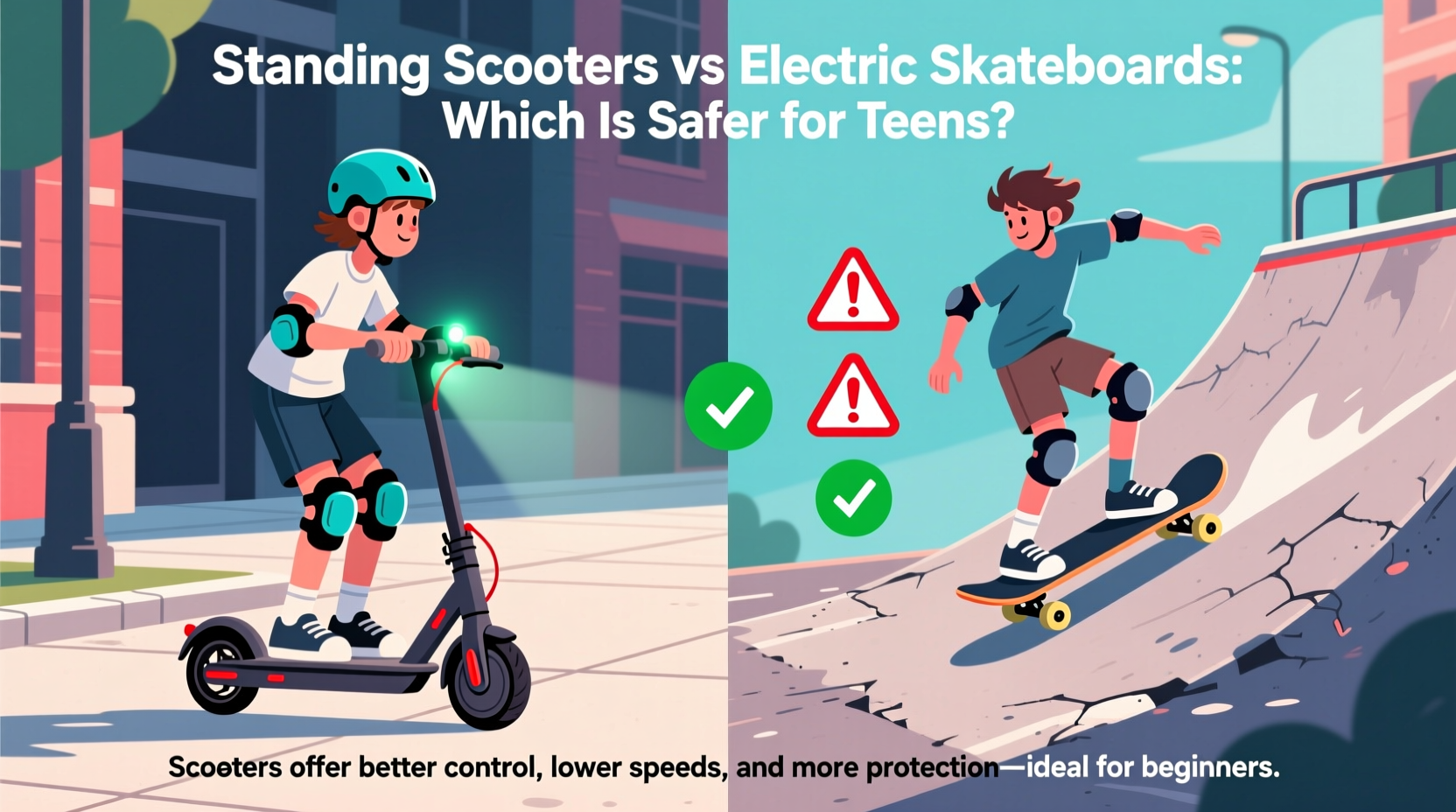
The fundamental difference between standing scooters and electric skateboards lies in their physical design and how they distribute weight and balance. Electric scooters typically feature a long deck, handlebars for steering and stability, a front-mounted motor, and dual braking systems (often electronic and mechanical). The upright riding posture allows riders to maintain a wide field of vision and use their arms to absorb shocks or correct imbalances.
In contrast, electric skateboards have a compact, flat deck with no handlebars. Riders control speed via a wireless remote and steer by shifting their body weight—similar to traditional skateboarding. This low-to-the-ground design increases agility but reduces upper-body support, making it harder to recover from sudden obstacles or loss of traction.
For teens still developing coordination and risk assessment skills, the added stability of handlebars can be a decisive safety advantage. Handlebars allow for better reaction time when avoiding potholes, curbs, or pedestrians. They also serve as a secondary point of contact during emergency maneuvers, reducing the likelihood of being thrown forward in a sudden stop.
Tip: Always choose a device with responsive brakes and visible lighting—both are crucial for safe operation in urban environments.Injury Risk Comparison: What Data Tells Us
While comprehensive national statistics specifically comparing scooter and skateboard injuries among teens are limited, several hospital-based studies offer insight. A 2022 study published in The Journal of Pediatrics analyzed emergency room visits related to e-mobility devices in adolescents aged 13–19. The findings indicated that electric skateboard riders were 1.7 times more likely to sustain head injuries and 2.3 times more likely to suffer wrist or ankle fractures compared to scooter riders.
The higher incidence of upper extremity injuries among skateboard users is often attributed to the instinctive “outstretched hand” reflex during falls—a motion made more dangerous by the lack of protective gear and high speeds achievable on modern boards (some exceeding 25 mph). Scooter riders, while not immune to falls, tend to remain upright longer due to the stabilizing effect of handlebars, allowing them to brake gradually rather than tumble.
Another contributing factor is foot placement. On scooters, both feet remain side-by-side on a stable platform. On skateboards, one foot is usually positioned near the rear trucks, creating a lever effect that amplifies instability during sharp turns or uneven surfaces.
“Teens are particularly vulnerable to overconfidence when using high-speed recreational devices. The absence of built-in stability features on electric skateboards increases the margin for error.” — Dr. Lena Torres, Pediatric Trauma Specialist, Boston Children’s Hospital
Safety Features and Control Mechanisms
Control interface plays a major role in preventing accidents. Standing scooters use hand-operated throttles and brakes, allowing riders to modulate speed precisely without disrupting their stance. Most models include regenerative braking, disc brakes, or foot-drag pads, giving multiple options for deceleration.
Electric skateboards rely entirely on a handheld remote for acceleration and braking. This introduces a delay between command input and board response, especially in low-signal conditions or with cheaper models. Additionally, if the remote is dropped or signal is lost, some boards default to coasting or sudden cutoffs—neither of which is ideal at high speed.
Consider this scenario: a teen approaches a crosswalk where a car suddenly pulls out. On a scooter, they can squeeze the brake lever instantly while maintaining balance through the handlebars. On a skateboard, they must locate the brake trigger on the remote, apply pressure accurately, and hope the connection holds—all while leaning back to avoid falling forward.
Modern scooters also increasingly include features like ABS-like anti-lock braking, LED headlights, taillights, turn signals, and reflective strips. These enhance visibility and reduce collision risks during dawn, dusk, or night rides. Most electric skateboards lack integrated lighting, placing greater responsibility on the rider to add aftermarket solutions.
Comparison Table: Key Safety Attributes
| Feature | Standing Scooter | Electric Skateboard |
|---|---|---|
| Steering Mechanism | Handlebar turning (direct control) | Weight shifting (indirect, delayed feedback) |
| Braking System | Hand brake + electronic/regenerative brake | Remote-controlled electronic brake only |
| Stability | High (handlebars aid balance) | Moderate to low (no upper-body support) |
| Top Speed (Average) | 15–20 mph | 18–28 mph |
| Integrated Lighting | Common (front/rear lights standard) | Rare (usually requires add-ons) |
| Learning Curve | Moderate (intuitive for most) | Steep (requires coordination and practice) |
| Injury Rate (Relative) | Lower (especially head and limb fractures) | Higher (based on ER data) |
Real-World Riding Behavior and Teen Decision-Making
Even the safest device can become hazardous when used recklessly. Teens often prioritize speed and style over caution, especially when riding with peers. This behavioral tendency interacts differently with each type of vehicle.
A mini case study from Portland, Oregon illustrates this dynamic. In 2023, a group of four 15-year-olds purchased electric skateboards after seeing social media videos of freestyle tricks. Within six weeks, two had crashed at speeds above 20 mph—one sustaining a concussion, another a fractured radius. None wore helmets regularly. When interviewed, they admitted underestimating stopping distances and overestimating their ability to handle wet pavement.
In contrast, a parallel group of teens using scooters in the same neighborhood reported fewer incidents. One experienced a flat tire but was able to walk the scooter home safely thanks to its kick-push capability. All scooter users wore helmets, citing school safety programs that included scooter education.
This divergence underscores a key point: the design of scooters inherently discourages extreme stunts. Their bulkier form and slower acceleration make them less appealing for wheelies or sharp slides—maneuvers that increase risk on skateboards. Moreover, scooters are often perceived as transportation tools, while skateboards carry a cultural association with rebellion and skill display, influencing how they’re used.
Tip: Set clear rules about speed limits, helmet use, and prohibited zones (e.g., busy streets or parking lots) regardless of device choice.Step-by-Step Guide to Choosing the Safest Option for Your Teen
Selecting between a standing scooter and an electric skateboard should involve more than price or aesthetics. Follow this structured approach to ensure safety remains the priority:
- Assess your teen’s experience level. Have they ridden a traditional scooter or skateboard before? Beginners benefit from the intuitive controls of scooters.
- Evaluate intended use. Is the primary purpose commuting to school or recreation? Scooters are better suited for routine travel on sidewalks and bike lanes.
- Check local laws. Some municipalities ban electric skateboards from sidewalks or require specific age minimums. Scooters often face fewer restrictions.
- Review safety features. Prioritize models with dual braking, bright lights, non-slip decks, and reliable suspension.
- Mandate protective gear. Helmets are non-negotiable. Consider adding wrist guards, knee pads, and elbow pads—especially for skateboards.
- Supervise initial rides. Observe your teen’s control and confidence in a closed environment before allowing street use.
- Establish usage rules. Define acceptable hours, routes, passenger policies (never allowed), and consequences for misuse.
Essential Safety Checklist for Parents and Teens
- ✅ Always wear a certified bicycle or multi-sport helmet
- ✅ Use reflective clothing or accessories for low-light conditions
- ✅ Charge devices away from flammable materials (lithium battery fire risk)
- ✅ Inspect tires, brakes, and bolts weekly
- ✅ Avoid riding in rain or on wet surfaces (reduced traction)
- ✅ Never ride with headphones or while distracted by phone
- ✅ Learn basic maintenance (tire inflation, brake testing)
- ✅ Practice emergency stops in a safe area
Frequently Asked Questions
Can teens legally ride electric skateboards or scooters on sidewalks?
Laws vary widely by city and state. Many urban areas permit scooters on sidewalks but restrict or ban electric skateboards due to speed and control concerns. Always check municipal codes and enforce compliance to avoid fines or accidents.
Which device has a higher risk of battery fires?
Both use lithium-ion batteries, which can pose fire risks if damaged, overcharged, or exposed to heat. However, scooters generally have better ventilation and protective casings. To minimize risk, use manufacturer-approved chargers and never leave devices charging unattended or on beds/sofas.
Do schools allow students to bring these devices on campus?
Policies differ. Some schools ban all motorized devices, while others allow scooters if stored securely and used only in designated zones. Check with your school administration before purchasing.
Conclusion: Prioritizing Safety Without Sacrificing Independence
When evaluating whether standing scooters are safer than electric skateboards for teens, the evidence strongly favors scooters. Their superior stability, direct braking, integrated safety features, and lower injury rates make them a more responsible choice for young riders still developing judgment and motor skills. While electric skateboards offer excitement and a sense of mastery, they demand a higher level of discipline and protective preparation that many teens may not consistently uphold.
Ultimately, no device eliminates risk entirely. The safest outcome comes not just from choosing the right equipment, but from combining it with education, supervision, and consistent safety habits. Parents who invest time in training, gear, and rule-setting empower their teens to enjoy personal mobility responsibly.
💬 Have experience with scooters or skateboards? Share your story or advice in the comments to help other families make safer choices.








