For trail runners, a reliable smartwatch isn’t just a luxury—it’s mission-critical gear. Whether navigating remote singletrack, monitoring heart rate at altitude, or pushing through multi-day ultras, the right device can mean the difference between confidence and confusion. Two top contenders dominate the premium outdoor smartwatch space: the Apple Watch Ultra and the Garmin Fenix 8. While both are rugged, feature-rich, and built for endurance athletes, their philosophies diverge sharply. Choosing between them isn't about specs alone—it's about aligning technology with your running lifestyle.
Durability and Build: Built for the Backcountry
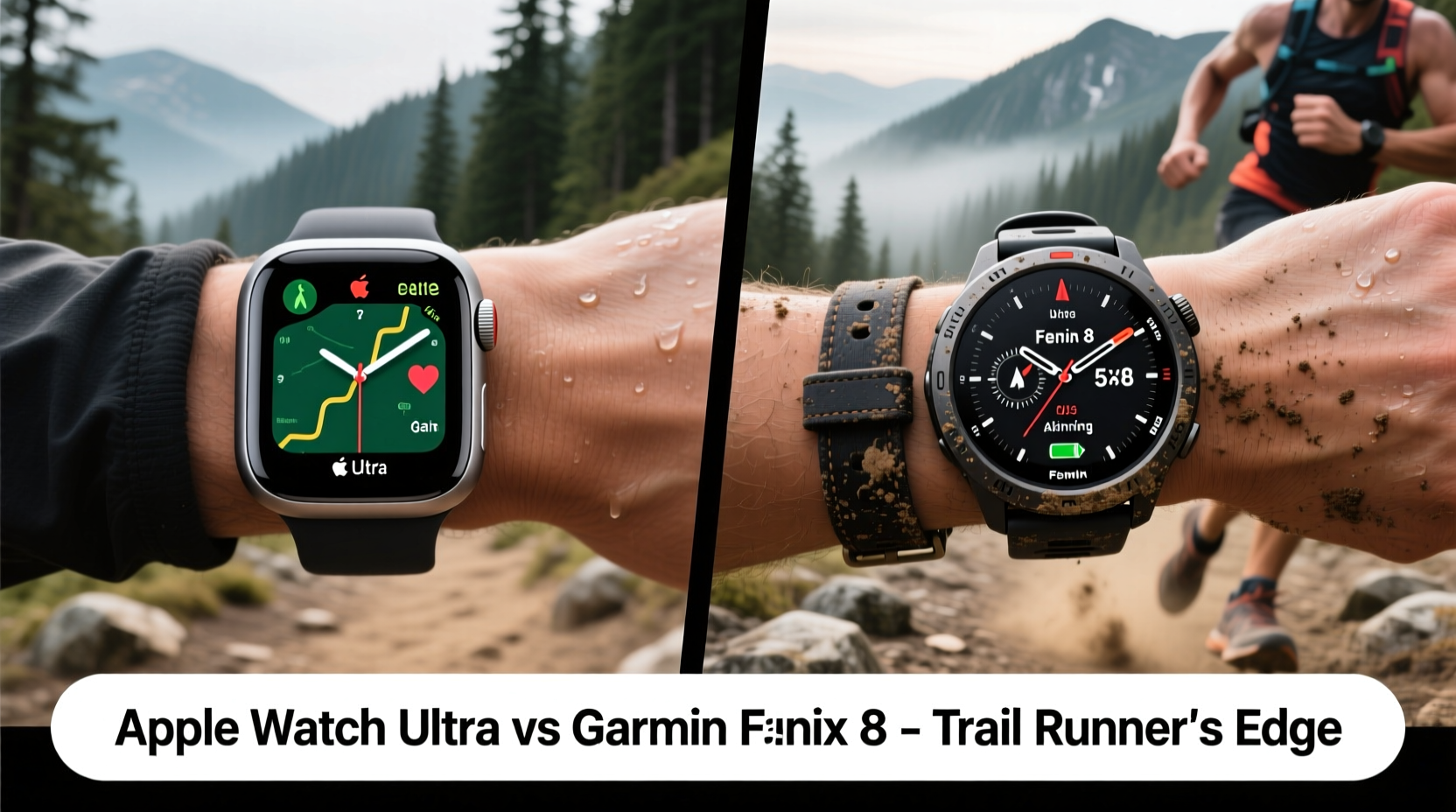
Trail running demands resilience. Rocks, rain, mud, and sudden temperature swings test any piece of equipment. Both the Apple Watch Ultra and Garmin Fenix 8 are engineered to military-grade standards (MIL-STD-810H), but they achieve toughness in different ways.
The Apple Watch Ultra features a titanium case, sapphire front crystal, and a 49mm diameter—large, bold, and unmistakably modern. Its flat sides make it easy to grip, and the Action button provides quick access to key functions like starting a workout or triggering an emergency beacon. Water resistance reaches 100 meters, making it suitable for swimming and unexpected river crossings.
Garmin takes a more traditional approach. The Fenix 8 comes in multiple sizes (51mm and 47mm) with either titanium or fiber-reinforced polymer cases. It also uses sapphire glass and offers 10 ATM water resistance. What sets it apart is its heritage in aviation and mountaineering—the Fenix line has long been trusted by explorers in extreme environments.
Tip: If you frequently drop your watch on rocky terrain, consider a raised bezel protector—especially for the Apple Watch Ultra, whose screen sits slightly flush.Battery Life: Endurance That Matches Your Run
No trail runner wants their watch dying mid-race. Battery performance is where the Garmin Fenix 8 pulls decisively ahead.
The Apple Watch Ultra delivers up to 36 hours in normal mode and around 60 hours in Low Power Mode with reduced functionality. For weekend trail races or fastpacking trips under two days, this may suffice—but only if you're disciplined with settings.
In contrast, the Fenix 8 offers 32 hours in full GPS mode, extending to over 100 hours in UltraTrac mode (adaptive sampling), and up to 34 days in smartwatch mode. With solar charging available on select models, that number climbs even higher in sunny conditions. For multi-day stage races or unsupported alpine traverses, this longevity is transformative.
“Battery anxiety shouldn’t be part of ultrarunning. With the Fenix, I start every race knowing my data will last as long as I do.” — Sarah Lin, 100-mile trail runner and coach
Navigation and GPS Performance
Precise navigation is non-negotiable when trails disappear or weather turns. Both watches support multiple satellite systems (GPS, GLONASS, Galileo), ensuring strong signal acquisition even under dense tree cover.
The Apple Watch Ultra leverages Apple’s dual-frequency GPS, offering improved accuracy—especially in urban canyons or narrow valleys. When paired with an iPhone, it can preload maps via the Compass app, allowing basic turn-by-turn guidance. However, standalone offline routing is limited without third-party apps like Gaia GPS or OnX Backcountry (which require workarounds).
The Fenix 8 excels here. It supports full-color TOPO maps, breadcrumb tracking, route reversion, and point-to-point navigation—all natively. You can upload GPX files directly, create round-trip routes from your current location, and receive alerts for elevation changes or waypoints. For self-supported runners who rely on autonomy, these tools are invaluable.
| Feature | Apple Watch Ultra | Garmin Fenix 8 |
|---|---|---|
| GPS Accuracy | Excellent (dual-frequency) | Excellent (multi-band + multi-system) |
| Offline Maps | Limited (requires iPhone sync) | Full-color, preloaded TOPO maps |
| Route Planning | Basic (via third-party apps) | Advanced (round-trip, climb planner, etc.) |
| Compass & Altimeter | Yes | Yes, with barometric calibration |
| Satellite Messaging | Emergency SOS via cellular (iPhone required) | Optional via inReach integration (Fenix 8 Pro Solar) |
Training Insights and Recovery Metrics
Trail running stresses the body differently than road running. Elevation gain, technical terrain, and variable pacing demand nuanced recovery analysis. Here, Garmin’s decades of sports science expertise shine.
The Fenix 8 includes advanced metrics such as Training Status, Training Load Focus, Recovery Time, and Acute:Chronic Workload Ratio. These help runners avoid overtraining and optimize periodization. It also tracks Pulse Ox, respiration rate, and sleep score with clinical-grade consistency. For those using power meters (like Stryd), the Fenix integrates seamlessly.
Apple Watch Ultra provides robust health tracking—ECG, blood oxygen, sleep stages, HRV, and comprehensive workout summaries. But its fitness insights are less prescriptive. While Fitness+ offers guided training, it lacks the depth of adaptive coaching found in Garmin’s ecosystem. Apple’s new \"Train with Heart Rate Zones\" feature is useful, but doesn’t match Garmin’s holistic view of strain and readiness.
Tip: Enable “All-Day Stress Tracking” on the Fenix 8 to monitor nervous system load during long expeditions—useful for detecting early signs of fatigue.Smart Features and Ecosystem Integration
If you live within the Apple ecosystem, the Watch Ultra integrates flawlessly. Notifications, music streaming (via LTE), contactless payments, and Find My compatibility offer convenience unmatched by Garmin. Receiving text alerts or skipping songs mid-run without pulling out your phone enhances daily usability.
The Fenix 8 supports notifications and music storage (download playlists to onboard memory), but lacks cellular connectivity or native app ecosystems. It won’t reply to messages or track Uber rides. However, for purists focused solely on performance, this minimalism reduces distraction.
For runners who want one device for both city commutes and backcountry missions, the Apple Watch Ultra bridges the gap. But if your priority is peak athletic performance over smart features, the Fenix 8 remains purpose-built.
Mini Case Study: A 50-Mile Mountain Race
Consider Alex, preparing for the High Sierra 50, a high-altitude trail race with 8,000 feet of climbing and unpredictable weather. He needs reliable GPS, long battery life, and real-time pace feedback based on elevation.
Alex trains with both devices. During a 30-mile shakeout run, the Apple Watch Ultra drains to 20% with GPS and music enabled—cutting it close for race day. Meanwhile, the Fenix 8 reports 70% remaining after the same effort. On race morning, Alex chooses the Fenix 8. Midway through, a storm rolls in. Thanks to the barometric altimeter trending downward, he receives a weather alert and adjusts his layering before hypothermia risk increases. At mile 42, his Training Status shows “Productive,” so he pushes the final climb confidently. Post-race, his Recovery Time estimate is 48 hours—accurate, as muscle soreness peaks the next day.
This scenario highlights how specialized tools provide tangible advantages when stakes are high.
Step-by-Step: Choosing the Right Watch for Your Needs
- Assess your typical run duration: If most runs exceed 6 hours or involve overnight segments, prioritize battery life—lean toward Fenix 8.
- Evaluate navigation needs: Do you follow complex routes off-grid? If yes, Fenix’s mapping suite is superior.
- Check smartphone dependency: If you rarely carry your phone while running, Apple Watch Ultra loses key advantages (LTE aside).
- Review training goals: Are you coached or data-driven? Garmin’s analytics integrate better with platforms like TrainingPeaks.
- Test daily usability: Try wearing each watch for a week. Notice comfort, notification handling, and charging frequency.
- Factor in budget: Both cost $700–$900 depending on model. Consider long-term value—Garmin typically supports devices longer with software updates.
Frequently Asked Questions
Can the Apple Watch Ultra survive a tough trail race?
Absolutely. It’s built with durability in mind—titanium case, sapphire glass, and water resistance make it resilient. However, shorter battery life and fewer trail-specific features may limit its effectiveness in ultra-distance events.
Does the Garmin Fenix 8 have cellular connectivity?
Not standard. Only the Fenix 8 Pro Solar model offers optional inReach satellite messaging (two-way texting via Iridium network). It does not have traditional LTE calling or texting like the Apple Watch.
Which watch has better heart rate accuracy on trails?
Both use optical sensors with similar accuracy during steady-state efforts. However, Garmin’s wrist-based HR tends to perform better during rapid elevation changes and interval efforts due to refined algorithms tuned for outdoor sports.
Checklist: Before You Buy
- ☐ Determine primary use: daily smartwatch vs dedicated training tool
- ☐ Confirm battery requirements for longest runs
- ☐ Test GPS acquisition speed in wooded areas
- ☐ Verify compatibility with preferred apps (Strava, Komoot, TrainingPeaks)
- ☐ Check band interchangeability and long-term comfort
- ☐ Evaluate after-sales support and warranty options
- ☐ Consider future firmware updates and product lifecycle
Expert Insight: The Philosophy Behind the Design
“The Apple Watch is designed to connect you to the world. The Fenix is designed to disconnect you from distractions and connect you to your environment.” — Dr. Marcus Reed, Sports Technology Researcher, University of Colorado Boulder
This distinction captures the core tension. Apple optimizes for seamless integration with digital life. Garmin prioritizes autonomy, precision, and endurance. Neither is objectively better—they serve different values.
Final Verdict: Who Should Choose Which?
The Apple Watch Ultra is ideal for tech-savvy runners who:
- Already own an iPhone and value ecosystem synergy
- Run mostly sub-ultra distances (under 12 hours)
- Want rich smart features alongside fitness tracking
- Prefer sleek design and vibrant touchscreen interface
The Garmin Fenix 8 suits serious trail and ultra runners who:
- Need extended battery life for multi-day adventures
- Require advanced navigation and route planning
- Use data to guide training decisions and prevent injury
- Value rugged independence from smartphones
There’s no universal winner. But for pure trail running performance—especially beyond marathon distance—the Garmin Fenix 8 offers deeper functionality, greater reliability, and smarter endurance-focused design.
Conclusion
Selecting between the Apple Watch Ultra and Garmin Fenix 8 comes down to intent. Are you enhancing your active lifestyle with cutting-edge tech? Or are you pursuing human-powered exploration where every metric matters? The Apple Watch dazzles with polish and connectivity. The Fenix empowers with precision and endurance. For trail runners measuring miles by elevation gain and solitude, the answer leans clear. Choose the tool that disappears into your rhythm—one that doesn’t just track the run, but becomes part of it.
💬 Which watch powers your trail runs? Share your experience, tips, or questions below—help fellow runners make informed choices in the wild.








