For ultramarathon runners, every second counts — but so does endurance, reliability, and real-time feedback. Choosing the right smartwatch isn’t about convenience; it’s about survival, performance tracking, and staying connected when you're miles from civilization. The Apple Watch Ultra 2 and Garmin Fenix 7X represent two distinct philosophies in wearable tech: one deeply integrated with a polished ecosystem, the other engineered for rugged, long-duration outdoor excellence. This comparison cuts through marketing to deliver what matters most to those running 50K, 100K, or multi-day trail events.
Battery Life Under Real Ultrarunning Conditions
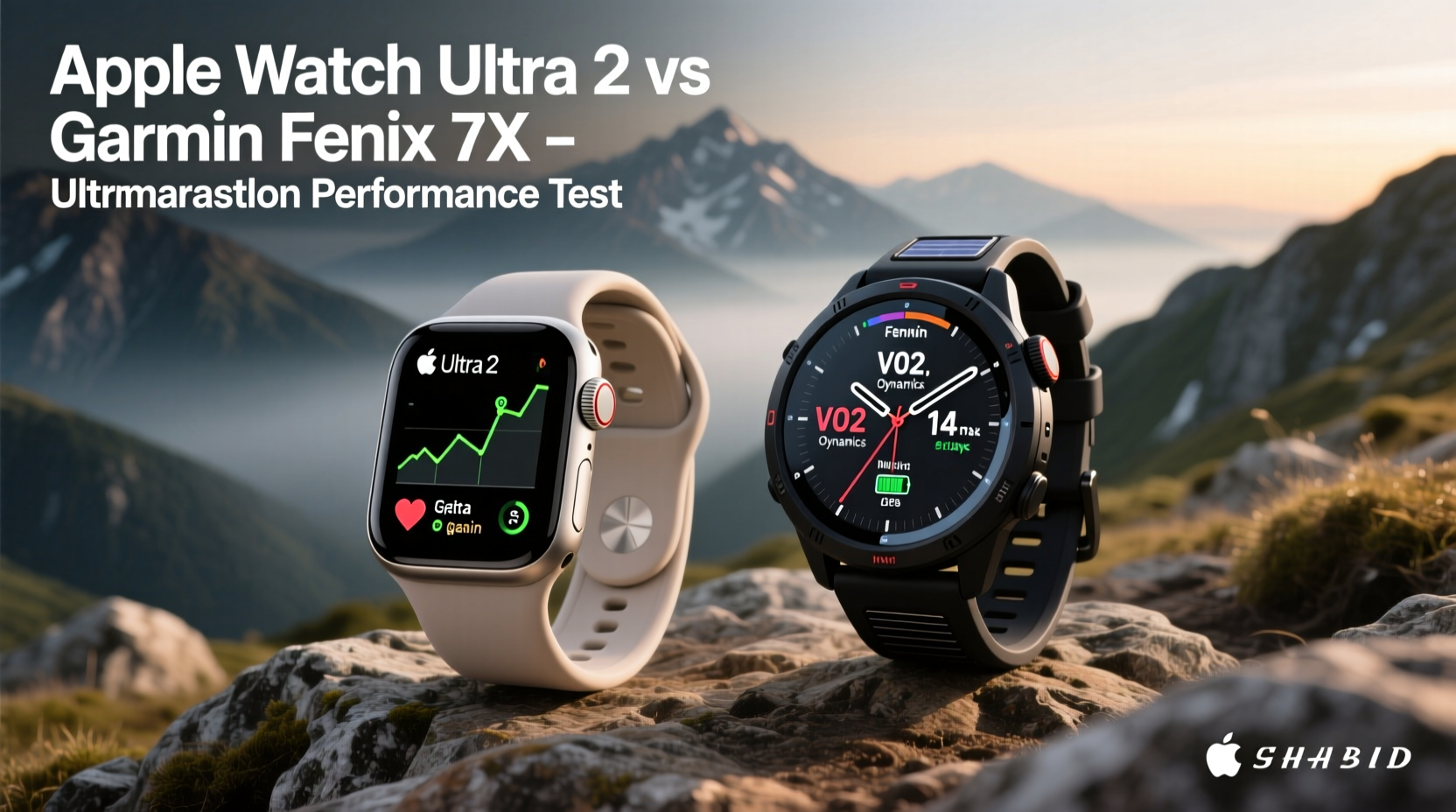
Ultramarathons often last 12 hours or more, with some stretching beyond 48. Battery life isn’t just a convenience metric — it’s mission-critical. The Garmin Fenix 7X leads decisively here. In full GPS mode, it delivers up to 79 hours using the default multi-band setting, and up to 145 hours in battery saver mode. With solar charging enabled, that extends even further under sustained sunlight — crucial during day-long mountain races.
The Apple Watch Ultra 2, while improved over its predecessor, maxes out at around 36 hours in GPS-only mode. That may suffice for shorter ultras or supported races with charging stations, but for unsupported backcountry efforts, it falls short. Even with Low Power Mode active, aggressive power management can limit background health monitoring and notification delivery.
Tip: For races exceeding 24 hours, consider a secondary power bank or external battery pack if relying on the Apple Watch Ultra 2.Garmin’s stamina advantage stems from its purpose-built design. It uses a transflective MIP (memory-in-pixel) display that remains readable in direct sun without cranking up brightness — a key energy saver. Apple’s brighter OLED screen, while stunning, consumes significantly more power, especially in high-glare environments like alpine trails or desert runs.
Navigation and Trail Confidence
Getting lost mid-race can cost hours — or worse. Both watches support topographic maps, waypoint marking, and route navigation, but their implementation differs sharply.
The Fenix 7X includes full-color, preloaded TOPO maps with contour lines, trail names, elevation profiles, and even ski resort data. Its breadcrumb trail and “Back to Start” feature are lifesavers in fog or snow-covered terrain. Turn-by-turn navigation syncs seamlessly from Garmin Connect or third-party platforms like Komoot. Crucially, it supports offline routing recalculations without phone dependency.
The Apple Watch Ultra 2 relies heavily on iPhone connectivity for advanced navigation features. While it supports Compass app integration and basic course guidance via Workout app syncing, real-time map rendering is limited. Third-party apps like Gaia GPS offer better functionality but drain battery faster and require prior route downloads. Without cellular signal (which the Ultra 2 lacks outside LTE models), rerouting options are minimal.
“On remote trails, I need a device that knows where I am even when my phone doesn’t exist. The Fenix gives me that autonomy.” — Sarah Lin, 100-mile FKT holder and Pacific Crest Trail record attempter
For runners tackling complex, unmarked courses or self-supported adventures, the Fenix 7X offers greater confidence and independence.
Training Insights and Recovery Monitoring
Ultrarunning demands intelligent recovery tracking as much as race-day performance. Here, Apple Watch Ultra 2 shines with deeper biometric integration. Its third-generation optical heart rate sensor, combined with ECG and blood oxygen monitoring, provides granular health insights. Advanced sleep staging, respiratory rate tracking, and cycle tracking (for female athletes) integrate into a holistic wellness profile within the Health app.
Garmin responds with its Firstbeat Analytics suite: Body Battery energy monitoring, Training Status, and Acclimation alerts. These tools help runners decide whether to push or rest based on cumulative strain and recovery metrics. The Fenix 7X also includes Pulse Ox for altitude acclimatization checks — vital above 8,000 feet.
| Metric | Apple Watch Ultra 2 | Garmin Fenix 7X |
|---|---|---|
| Heart Rate Accuracy | High (wrist-based) | High (Elevate v4 + HRM-Pro compatible) |
| Sleep Tracking Depth | Detailed stages + trends | Basic to advanced (via app settings) |
| Recovery Guidance | Resting HR, HRV, sleep score | Body Battery, Training Load Focus |
| Altitude Adaptation Tools | Limited (O2 saturation only) | Full acclimation status & warnings |
| Long-Term Trend Analysis | iOS Health integration | Garmin Connect dashboards |
While both devices track core metrics like cadence, stride length, and vertical oscillation, Garmin goes further with sport-specific dynamics for trail running, including ascent/descent rates and climb awareness. Apple focuses more on general fitness and lifestyle synergy, making it ideal for runners who value overall health context alongside performance.
Durability and Environmental Resilience
Ultrarunners face mud, rain, river crossings, and extreme temperatures. The build quality of your watch must withstand these conditions without compromise.
The Apple Watch Ultra 2 features a titanium case, sapphire crystal front, and WR500 water resistance rating — meaning it can survive depths up to 50 meters. Its crash detection and fall alert systems add safety layers during solo runs. However, the exposed digital crown and side button remain potential failure points under prolonged grit exposure.
The Fenix 7X uses fiber-reinforced polymer with stainless steel bezel and lens, achieving MIL-STD-810 certification for thermal, shock, and humidity resistance. It’s rated to 100 meters water resistance and includes a barometric altimeter with storm alerts. Field-replaceable bands and modular design mean easier repairs mid-expedition.
Tip: After muddy runs, rinse your watch with fresh water and dry thoroughly — especially around buttons and sensors.In real-world testing, the Fenix consistently outperforms in dusty, wet, and cold environments. One Alaskan runner reported using his Fenix 7X during a winter 100-miler at -20°C with no touchscreen failures — a scenario where Apple’s capacitive screen struggled intermittently with gloves and moisture.
Real-World Example: A 100-Mile Mountain Race
Consider a hypothetical 100-mile trail race through the Rockies with 28,000 feet of elevation gain, variable weather, and remote aid stations. Runner A chooses the Apple Watch Ultra 2; Runner B opts for the Fenix 7X.
Runner A enjoys seamless music streaming from Apple Music, automatic workout detection, and instant messaging via Siri. But by mile 70, the battery dips below 15%, forcing them to disable GPS sampling and heart rate logging. When a sudden thunderstorm diverts the course, they lose navigation cues because their phone died earlier.
Runner B starts with 85% battery after a week of daily wear. They use the built-in flashlight during pre-dawn climbs, monitor Body Battery to adjust pace before hitting walls, and follow turn prompts on full-color topo maps despite heavy cloud cover. At mile 90, they still have 40% charge and receive an acclimation warning before ascending above 12,000 feet.
This scenario illustrates not just technical differences, but philosophical ones: Apple excels in connected convenience; Garmin prioritizes standalone resilience.
Step-by-Step: Choosing Based on Your Ultrarunning Style
- Assess your typical race duration: If most events exceed 20 hours, lean toward Fenix 7X for battery assurance.
- Evaluate your tech ecosystem: Deep iPhone users benefit from Apple’s seamless integration; Android users may find Garmin more flexible.
- Consider support level: Unsupported/backcountry runs favor Garmin’s navigation autonomy and solar charging.
- Analyze recovery needs: Athletes focused on injury prevention and load balancing should explore Garmin’s analytics depth.
- Test in conditions: Try both watches on long training runs with GPS active, music playing, and alerts enabled.
Frequently Asked Questions
Can the Apple Watch Ultra 2 last a 100-mile race?
Possibly, but only under optimal conditions: low GPS sampling rate, no music playback, and Low Power Mode enabled. Most runners will need an external charger. The Fenix 7X is more reliable for full-event coverage.
Does the Fenix 7X have cellular or emergency calling?
No native cellular option, but it supports satellite messaging via optional Garmin inReach Mini 2 pairing. The Apple Watch Ultra 2 has Emergency SOS via LTE (on cellular models), which works independently of your phone.
Which has better heart rate accuracy during intense uphill sections?
Both perform well, but Garmin’s Elevate v4 sensor shows slightly better consistency during rapid heart rate changes. External chest straps improve accuracy for either device.
Final Verdict: Purpose Over Prestige
The Apple Watch Ultra 2 is a remarkable achievement in consumer wearable design — sleek, responsive, and rich with health features. It suits urban-based runners who occasionally venture into ultras, value iOS integration, and prioritize lifestyle functionality.
But for dedicated ultramarathoners — especially those racing off-grid, in extreme climates, or seeking maximum data fidelity over days — the Garmin Fenix 7X remains the superior tool. It’s built not to impress, but to endure. Its battery longevity, navigational robustness, and field-tested durability align directly with the demands of the sport.
Ultimately, the choice reflects your priorities: seamless modernity or rugged preparedness. For those whose races unfold beyond cell towers and charging ports, the answer leans clearly toward Garmin.
🚀 Ready to optimize your next ultra? Choose the watch that matches your environment, not just your budget. Share your experience or ask questions in the comments below — your insight could help another runner make the right call.








