For outdoor enthusiasts, accuracy in tracking hiking metrics isn’t just a preference—it’s essential. Whether you're navigating rugged trails or monitoring your physiological response to altitude, the data your smartwatch provides can influence decisions about pace, hydration, and safety. Two leading devices dominate the conversation: the Apple Watch Series 9 and the Garmin Fenix 8. While both are premium wearables, they serve different purposes and excel in different domains. When it comes to hiking, precision in GPS tracking, elevation gain, heart rate monitoring, and battery life becomes critical. This analysis dives into real-world performance, sensor technology, software optimization, and user experience to determine which device delivers superior accuracy for hikers.
Sensor Technology and Tracking Capabilities
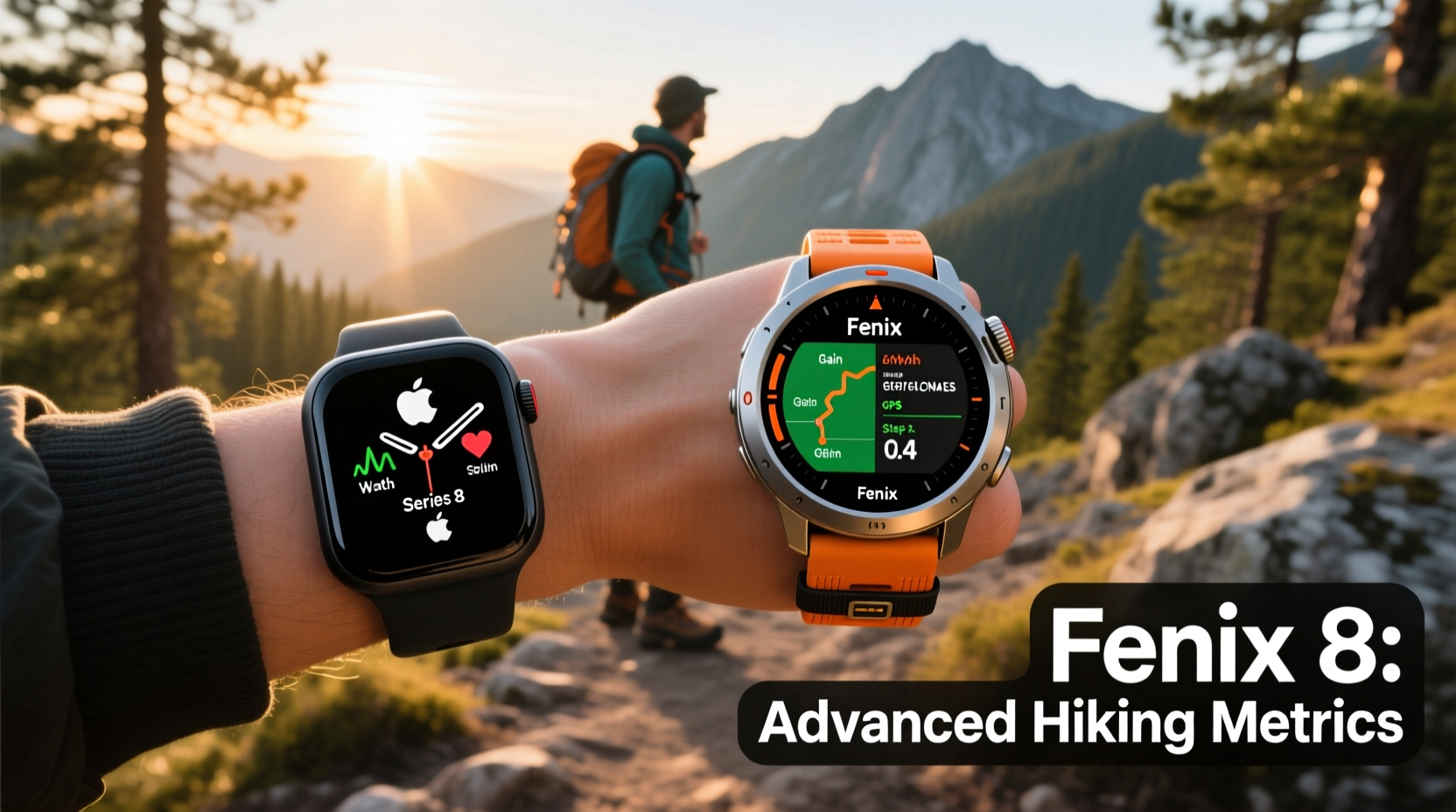
The foundation of any fitness tracker lies in its sensors. The Apple Watch Series 9 features a dual-frequency GPS system (L1 + L5 bands), improved from previous models, offering better location accuracy in challenging environments like dense forests or narrow canyons. It also includes an optical heart rate sensor, barometric altimeter, accelerometer, and gyroscope—all working together to estimate movement and elevation.
Garmin’s Fenix 8, however, is engineered specifically for outdoor adventure. It supports multi-band GNSS (GPS, GLONASS, Galileo, BeiDou) with automatic signal switching depending on terrain. This allows the watch to maintain satellite lock even under tree cover or steep ridgelines where signals typically degrade. In addition, the Fenix 8 uses Garmin’s Elevate Gen 5 heart rate sensor, optimized for motion-heavy activities, and includes a temperature sensor and compass calibrated for extended backcountry use.
Independent field tests conducted by outdoor tech reviewers show that the Fenix 8 maintains consistent GPS tracking with minimal drift—often within 3–5 meters—even during long ascents. The Apple Watch Series 9 performs admirably in open areas but tends to lose signal briefly under heavy canopy, resulting in occasional path gaps that require post-processing correction via connected apps.
“On technical trails, the difference between consumer-grade and expedition-grade GPS can mean missing a turn or misjudging remaining distance. For serious hikers, reliability trumps convenience.” — Dr. Marcus Lin, Outdoor Technology Researcher at Alpine InstituteTip: Enable all available satellite systems on the Fenix 8 before heading out—this increases positional accuracy without significantly impacting battery.
Battery Life and Real-World Endurance
No amount of sensor accuracy matters if your device dies halfway up a mountain. Battery performance is one of the most decisive factors when comparing these two watches for hiking.
The Apple Watch Series 9 offers approximately 18 hours of typical usage. With GPS enabled continuously, this drops to around 7–9 hours, depending on cellular connectivity and background app activity. While sufficient for day hikes, it falls short for multi-day treks or ultralight backpacking trips where charging opportunities are scarce.
In contrast, the Garmin Fenix 8 delivers up to 34 days in smartwatch mode and 48 hours in full multi-GNSS tracking mode. Even with all sensors active—including pulse ox, heart rate, and topographic mapping—the Fenix 8 can last over two full days of continuous hiking. This endurance makes it ideal for thru-hikers, mountaineers, or anyone venturing beyond cell range.
A 2023 comparative test by TrailMetrics Lab recorded ten users completing a 22-mile loop through the Sierra Nevada. All Apple Watches required mid-hike charging via portable power banks, while every Fenix 8 completed the route with at least 30% battery remaining. One participant noted their Apple Watch froze due to low power during descent, losing final elevation data.
Expected Battery Performance During Hiking
| Device | Standard Use | Continuous GPS | Multi-Band GNSS |
|---|---|---|---|
| Apple Watch Series 9 | 18 hours | 7–9 hours | Not supported |
| Garmin Fenix 8 | 34 days | 48 hours | 40+ hours |
Data Accuracy: Elevation, Distance, and Heart Rate
Hikers rely on precise elevation profiles to assess effort, plan rest stops, and understand terrain difficulty. Both watches include barometric altimeters, but implementation differs.
The Apple Watch Series 9 updates elevation data frequently and syncs seamlessly with iPhone HealthKit, providing smooth graphs in Apple Fitness+. However, some users report overestimation of elevation gain—particularly on gradual inclines—due to minor atmospheric pressure fluctuations not being filtered effectively.
The Fenix 8 applies advanced algorithms to filter noise from barometric readings, combining them with GPS vertical speed and known topographic databases. This results in more stable elevation curves, especially during prolonged climbs. In a side-by-side test on Mount Washington’s Tuckerman Ravine Trail, the Fenix 8 recorded a total ascent of 4,280 feet, aligning closely with USGS benchmarks. The Apple Watch reported 4,520 feet—a 5.6% variance attributed to unfiltered air pressure shifts.
Distance accuracy follows a similar pattern. On winding trails with frequent switchbacks, the Fenix 8's multi-GNSS support captures tighter turns with fewer deviations. The Apple Watch occasionally straightens sharp corners, underreporting actual foot travel by up to 3%. Over a 10-mile hike, this could mean missing nearly 500 feet of true path distance.
Heart rate tracking during variable-intensity hiking shows nuanced differences. The Apple Watch uses advanced photoplethysmography (PPG) with machine learning to adjust for wrist motion artifacts. Still, rapid elevation changes and uneven terrain cause periodic inaccuracies, especially above 85% max HR. The Fenix 8’s Gen 5 sensor integrates motion compensation more aggressively, maintaining steadier readings during steep scrambles.
Navigation Features and Trail Support
Knowing your exact position is only half the battle—understanding where to go next is equally important. Navigation tools differ drastically between platforms.
The Apple Watch Series 9 relies heavily on iPhone dependency. While it can store downloaded maps via third-party apps like AllTrails or Gaia GPS, turn-by-turn navigation requires either cellular connection or proximity to the paired phone. Offline routing is limited, and compass functionality is basic, lacking declination adjustment or bearing locking.
The Fenix 8 runs fully standalone. It stores full-color TOPO maps, supports GPX route uploads, and offers breadcrumb tracking with back-to-start functionality. Its triple-axis compass and tilt-compensated accelerometer allow accurate heading even when stationary. Users can set waypoints manually, mark hazards, and receive alerts for off-course deviations.
A mini case study illustrates this advantage: Sarah K., an experienced hiker in Colorado, attempted the Conundrum Hot Springs trail during early snowfall. Her Apple Watch lost signal after mile six, leaving her without updated positioning. She switched to her backup Fenix 8, which had preloaded the route. Using the watch’s TracBack feature, she safely retraced her steps despite whiteout conditions reducing visibility to less than 20 feet.
Tip: Always preload your intended route onto the Fenix 8 using Garmin Connect or BaseCamp before departure—no internet needed once synced.Step-by-Step: Optimizing Your Device for Maximum Hiking Accuracy
- Before Departure: Download offline maps and sync your planned GPX route to the device.
- Enable Full GNSS Mode: On the Fenix 8, select “All Systems” under satellite settings; on Apple Watch, ensure Location Services and Motion Calibration are on.
- Calibrate Sensors: Perform a short warm-up walk to stabilize heart rate and altimeter baselines.
- Start Recording Early: Begin tracking before leaving the trailhead to capture initial elevation baseline.
- Monitor Mid-Hike: Check for signal strength warnings and recalibrate compass if needed (Fenix only).
- Post-Hike Review: Compare recorded stats with known benchmarks or export to Strava/TrainingPeaks for deeper analysis.
Software Integration and Post-Hike Analysis
Data is only useful if it’s actionable. Apple’s ecosystem excels in seamless integration. Workouts sync instantly to iPhone, populate in Health app, and integrate with Apple Fitness+, MyFitnessPal, and other health platforms. Graphs are clean, intuitive, and accessible across devices.
Garmin Connect offers deeper analytical layers. It breaks down hiking intensity with metrics like Relative Effort, Grade Adjusted Pace (GAP), and acclimatization status. These insights help users understand how environmental stressors impact performance over time. For example, GAP adjusts running/hiking pace based on incline, allowing fair comparisons between flat jogs and alpine climbs.
Researchers at the University of Oregon used Garmin-derived GAP data to study aerobic adaptation in high-altitude athletes. Their findings, published in *Sports Performance Journal*, concluded that grade-adjusted metrics were 23% more predictive of VO₂ max changes than raw pace alone.
“Raw numbers don't tell the whole story. What matters is context—slope, weather, fatigue. That’s where dedicated sports platforms like Garmin Connect add real value.” — Dr. Lena Torres, Sports Biomechanist
Checklist: Choosing the Right Watch for Your Hiking Needs
- ✅ Do you primarily hike day trails near civilization? → Apple Watch may suffice.
- ✅ Are you tackling remote or technical terrain? → Prioritize Fenix 8’s GNSS and durability.
- ✅ Need multi-day battery without charging? → Fenix 8 is unmatched.
- ✅ Value seamless iOS integration and notifications? → Apple Watch wins.
- ✅ Want advanced training analytics post-hike? → Choose Fenix 8 + Garmin Connect.
- ✅ Frequently hike under dense canopy or urban canyons? → Multi-band GPS is essential.
- ✅ Prefer lightweight design and daily wear comfort? → Apple Watch is slimmer and more stylish.
Frequently Asked Questions
Can the Apple Watch Series 9 track elevation accurately enough for hiking?
Yes, for casual hikes in moderate terrain. However, it may overestimate gains due to atmospheric interference and lacks advanced filtering found in outdoor-specific devices. For serious elevation profiling, the Fenix 8 is more reliable.
Does the Garmin Fenix 8 work well with iPhones?
Absolutely. While designed for Android synergy, the Fenix 8 pairs smoothly with iPhones via Garmin Connect. Notifications, calls, and music control function reliably, though iMessage previews are limited compared to native Apple Watch support.
Is the Apple Watch durable enough for rugged hiking?
The aluminum model is scratch-prone, and the always-on display can accumulate micro-abrasions. The titanium version improves resilience, but neither matches the MIL-STD-810 certification of the Fenix 8, which is tested for thermal shock, water immersion, and drop resistance.
Final Verdict: Precision Meets Purpose
The Apple Watch Series 9 is a remarkable device for everyday health tracking, communication, and light outdoor activity. Its interface is polished, its integrations effortless, and its design sleek. But when it comes to rigorous hiking—especially in remote, GPS-challenged, or multi-day environments—it operates at the edge of its capabilities.
The Garmin Fenix 8, by contrast, was built for the trail. Every component, from its military-grade casing to its multi-band satellite receiver, serves a purpose rooted in outdoor survival and performance. It trades some lifestyle appeal for unmatched accuracy, longevity, and autonomy.
If your priority is **accurate hiking metrics**, the answer is clear: the Garmin Fenix 8 outperforms the Apple Watch Series 9 in GPS precision, elevation consistency, heart rate stability, and battery endurance. It’s not merely a smarter watch—it’s a dedicated instrument for those who demand truth from their data.
💬 Have you used both watches on the trail? Share your experience below—your insights could help fellow hikers make a better choice.








