For outdoor enthusiasts who hike regularly, choosing the right wearable can make a meaningful difference in tracking performance, safety, and long-term fitness progress. The Apple Watch Series 9 and the Garmin Fenix 7 are two of the most advanced smartwatches on the market—but they serve different priorities. While both offer comprehensive health and activity tracking, their approach to hiking-specific metrics varies significantly. Understanding these differences is essential for hikers who rely on accurate data, extended battery life, and rugged durability when venturing off the grid.
Hiking Metrics That Matter Most
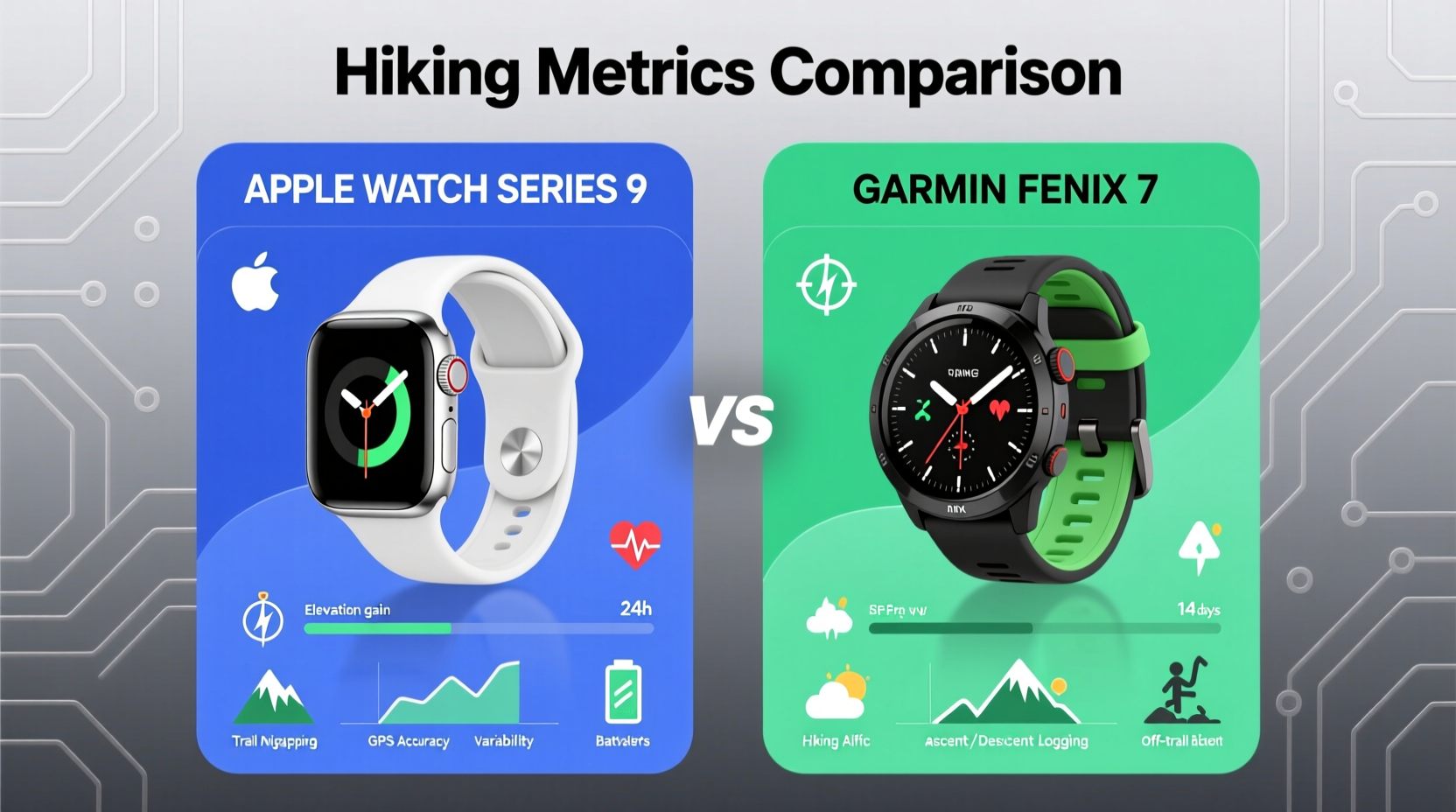
Before comparing devices, it’s important to define what constitutes effective hiking tracking. Unlike gym workouts or urban runs, hiking involves variable terrain, elevation changes, weather exposure, and often limited connectivity. Key metrics include:
- Precise GPS tracking – Accurate route mapping with minimal drift.
- Elevation gain/loss – Reliable barometric altimeter readings.
- Heart rate monitoring – Especially under exertion and changing altitudes.
- Battery longevity – Critical for multi-day hikes without charging access.
- Trail navigation features – Turn-by-turn directions, breadcrumb trails, offline maps.
- Environmental resilience – Water resistance, shock protection, temperature tolerance.
A device that excels in these areas supports not just fitness tracking but also safety and confidence on the trail.
Apple Watch Series 9: Strengths and Limitations for Hikers
The Apple Watch Series 9 continues to refine its role as a premium lifestyle and fitness companion. With seamless integration into the iPhone ecosystem, robust health sensors, and sleek design, it appeals to users who value connectivity and daily wellness insights. However, its utility for serious hiking has notable constraints.
On the plus side, the Series 9 includes an always-on Retina display, dual-frequency GPS (GPS + GLONASS), and a built-in altimeter. These enable reasonably accurate tracking of distance, elevation changes, and heart rate during hikes. When paired with the Apple Fitness+ app or third-party apps like AllTrails or Strava, it can record full routes and provide post-hike summaries.
Yet several limitations become apparent beyond day hikes:
- Limited battery life: Typically lasts 18–36 hours, depending on GPS usage. Even in Low Power Mode, extended hikes require external charging solutions.
- No offline topographic maps: While you can view your location via GPS, there's no native support for downloadable trail maps or backcountry navigation aids.
- Fragile build compared to dedicated outdoor watches: Though water-resistant up to 50 meters, it lacks MIL-STD-810 certification for extreme temperatures and shocks.
- Dependence on iPhone for setup and map syncing: Without prior preparation, real-time navigation is less reliable once out of cellular range.
Garmin Fenix 7: Engineered for the Trail
The Garmin Fenix 7 is purpose-built for outdoor adventurers. Available in multiple sizes (S, Standard, Plus), this rugged timepiece combines military-grade durability with advanced sensor technology tailored for hiking, mountaineering, and expedition use.
Its standout features include:
- Multi-band GNSS support (GPS, GLONASS, Galileo) with customizable power modes for improved accuracy and battery efficiency.
- Barometric altimeter, compass, and gyroscope for precise elevation tracking and orientation—even when GPS signal drops.
- Preloaded TopoActive maps with contour lines, trail classifications, and points of interest across regions worldwide.
- Breadcrumb navigation and route reversion to guide you back along your exact path if you get disoriented.
- Up to 34 days in smartwatch mode, 57 hours in full GPS mode—and even longer in expedition modes with solar charging (on Solar models).
- MIL-STD-810 certification ensures resilience against thermal extremes, shock, and water immersion.
Additionally, the Fenix 7 offers advanced performance analytics such as Grade Adjusted Pace (GAP), which accounts for incline when calculating effort, and ClimbPro, a feature that automatically displays upcoming ascents and descents in real time during a hike. These tools help hikers pace themselves efficiently over mountainous terrain.
“Devices like the Fenix 7 don’t just track hikes—they actively enhance decision-making through predictive metrics and environmental awareness.” — Dr. Lena Patel, Outdoor Sports Technologist at Boulder Institute of Performance Science
Detailed Comparison: Apple Watch Series 9 vs Garmin Fenix 7
| Metric | Apple Watch Series 9 | Garmin Fenix 7 |
|---|---|---|
| GPS Accuracy | Dual-frequency GPS; good in open sky, moderate drift under canopy | Multi-band GNSS + multi-band antenna; superior under tree cover and canyons |
| Altimeter & Compass | Yes (barometric) | Yes (barometric), 3-axis compass, gyroscope for pitch/roll correction |
| Offline Maps | No native support; depends on third-party apps | Yes – preloaded TOPO Active maps with routing capabilities |
| Battery Life (GPS Use) | ~18 hours max (Low Power Mode extends slightly) | Up to 57 hours (Standard); up to 81 hours (Solar model) |
| Navigation Features | Basic turn-by-turn via third-party apps; requires phone sync | ClimbPro, Breadcrumb Trail, TracBack, point-to-point routing |
| Durability | Water-resistant (50m), aluminum/stainless steel case | MIL-STD-810 rated, sapphire lens option, fiber-reinforced polymer |
| Specialized Hiking Tools | Elevation gain, heart rate, calories | Grade Adjusted Pace, ascent/descent alerts, sunrise/sunset times, storm alerts |
| Smartphone Integration | Excellent (iOS only); calls, messages, apps | Limited notifications; focused on fitness, not communication |
Real-World Scenario: A Weekend Backpacking Trip
Consider Sarah, an intermediate hiker planning a two-day backpacking trip in the Sierra Nevada. She’ll cover 22 miles with over 4,000 feet of cumulative elevation gain, traversing forested trails, exposed ridgelines, and high-altitude passes.
If she uses her Apple Watch Series 9, she can log her hike accurately enough for basic stats. But by the end of Day 1, the battery drops below 20%, forcing her to shut down non-essential functions. Her offline map from AllTrails works intermittently, and when fog rolls in near a junction, she struggles to confirm her position without cell service.
In contrast, had she used the Fenix 7, the watch would have displayed ClimbPro alerts before each major ascent, helping her manage energy. The Breadcrumb Trail reassured her when visibility dropped. With over 48 hours of GPS endurance and full topo maps loaded, she remained confident throughout—even after losing the trail briefly near a creek crossing.
This example illustrates how specialized tools translate into real-world reliability and peace of mind.
Actionable Tips for Choosing the Right Device
Tip: For casual day hikes near cities, the Apple Watch Series 9 is sufficient. For remote, multi-day, or technically challenging routes, choose the Fenix 7.Checklist: Selecting Your Ideal Hiking Watch
- ✅ Assess typical hike duration – does your watch last the full trip?
- ✅ Verify availability of offline topographic maps.
- ✅ Test GPS accuracy in wooded or canyon environments before relying on it.
- ✅ Check if navigation features include backtracking or route guidance.
- ✅ Confirm durability ratings (water, shock, temperature).
- ✅ Evaluate ease of charging in the field (portability of power banks, solar options).
- ✅ Determine whether smartphone dependency compromises your safety plan.
Step-by-Step: Optimizing Your Watch for a Long Hike
Regardless of which device you own, proper setup enhances performance:
- Plan your route in advance using an app like Gaia GPS (Fenix) or AllTrails (Apple Watch). Export the GPX file and load it onto your watch.
- Enable GPS-only mode or battery saver settings to extend runtime. On the Fenix 7, select “UltraTrac” mode if maximum battery is needed.
- Calibrate altimeter and compass before departure. On the Fenix, perform a compass calibration; on Apple Watch, ensure Location Services are fully enabled.
- Start recording before leaving the trailhead to capture initial GPS lock.
- Pause recording during long breaks to conserve battery and avoid skewing pace data.
- Review post-hike analysis to compare actual vs. predicted elevation gain and identify discrepancies.
Frequently Asked Questions
Can the Apple Watch Series 9 survive a tough hike?
Physically, yes—it’s water-resistant and durable for everyday wear. However, its glass screen is more prone to scratches or cracks from impacts than the Fenix 7’s sapphire lens. Additionally, lack of offline maps and short battery life limit its practicality on demanding trails.
Does the Garmin Fenix 7 work with iPhones?
Yes. While optimized for Android, the Fenix 7 syncs well with iOS via the Garmin Connect app. Notifications, music control, and safety features like incident detection function reliably on iPhones.
Is the extra cost of the Fenix 7 justified for occasional hikers?
If you primarily do short, well-marked day hikes with frequent phone access, the Apple Watch may suffice. But if you ever plan to venture into remote areas, carry a backpack, or face unpredictable conditions, the Fenix 7’s investment pays off in safety, accuracy, and autonomy.
Final Verdict: Who Should Choose Which?
The Apple Watch Series 9 shines as a holistic health and communication device. It delivers excellent heart rate monitoring, sleep tracking, and seamless integration with iPhone services. For urban dwellers who occasionally hike local trails, it’s a convenient all-in-one solution.
However, when it comes to tracking hiking metrics with precision, consistency, and independence, the Garmin Fenix 7 is unmatched. Its combination of advanced sensors, rugged construction, intelligent navigation tools, and industry-leading battery life makes it the preferred choice for serious hikers, thru-hikers, and outdoor professionals.
Ultimately, the decision hinges on intent. If your hikes are extensions of your active lifestyle within reachable distance of home, the Apple Watch fits naturally. But if you seek deeper engagement with nature—where self-reliance and accurate data are paramount—the Fenix 7 isn’t just better; it’s essential.
🚀 Ready to upgrade your hiking experience? Evaluate your next adventure’s demands and choose a watch that matches your ambition. Share your favorite hiking tech tips in the comments below and help others find their perfect trail companion.








